
How to Verify the Maple Leaf Bacon Recall List in OR/WA
How to confirm the recalled Maple Leaf bacon products and the Oregon/Washington retail consignee list against FSIS primary sources, and why an AI-generated version is unverified until checked.
- Jurisdiction
- US federal
- Court
- No court proceeding
- AI tool named
- General-purpose AI chatbot
- Ruling date
- Jul 24, 2026
- Source document
- View primary court order ↗
- Last verified
- Aug 4, 2026
Lex Machina Review is an independent risk-tracking and reference resource. Nothing on this site is legal advice, and using it does not create an attorney-client relationship. Every record is reviewed against primary sources but may not reflect the most current status of a matter — always verify directly against the cited court order, rule text, or a licensed attorney before relying on it.
Companion explanation — secondary to the source document above
- Verification status: FSIS Recall 011-2026, announced July 24, 2026, was listed as Active when last checked for this article on August 4, 2026. [1]
- Primary source set: the FSIS recall release, the FSIS label PDF, and RC-011-2026-Retail-List.pdf. [1][2][3]
- Reader warning: any AI-generated “maple leaf foods bacon recall Oregon Washington list” is unverified until the product entries and any store-level entries have been reconciled against those FSIS files directly.
What FSIS says was recalled
The recall covers approximately 12,036 pounds of not-ready-to-eat smoked bacon products imported by Maple Leaf Foods Inc. without the benefit of FSIS import reinspection. FSIS says the bacon was produced on June 9, 10, 12, 13, and 15, 2026, and distributed to Grocery Outlet distributors and retailers in Idaho, Oregon, and Washington. [1]
| Product | Package size | Sell-by dates in FSIS release | Identifier to verify |
|---|---|---|---|
| Royale Natural Applewood Smoked ALL NATURAL Uncured Bacon | 12 oz. | SEP 01 2026 and SEP 07 2026 | EST. 1 on package; health certificate 2026-S732971612 on master case boxes [1][2] |
| TOP VALU Uncured Hardwood Smoked Bacon | 12 oz. | SEP 01, 02, 04, 05, and 07 2026 | EST. 1 on package; health certificate 2026-S732971612 on master case boxes [1][2] |
The Class I label deserves careful wording. FSIS defines a Class I recall as a health hazard situation in which there is a reasonable probability that use of the product will cause serious, adverse health consequences or death. That classification is not the same thing as a laboratory finding that the bacon was contaminated. Here, the FSIS release identifies the trigger as missing import reinspection discovered during routine FSIS inspection, and states that there had been no confirmed reports of adverse reactions when the recall was announced. [1][4]
That distinction matters in legal writing. A notice to a retailer, a litigation hold, or a client memo can say that FSIS classified the recall as Class I and that the product was imported without the benefit of reinspection. It should not convert that into “FSIS found contaminated bacon” unless the record actually says so.
The Oregon/Washington “list” is not one document
A searcher asking for the Oregon and Washington list is usually asking for two things at once: the recalled product list and the affected retail consignee list. FSIS keeps those answers in different places. The release gives the official recall record and the product universe. The label PDF is the package-identity exhibit. The retail consignee PDF is the store-level document to check for locations. [1][2][3]
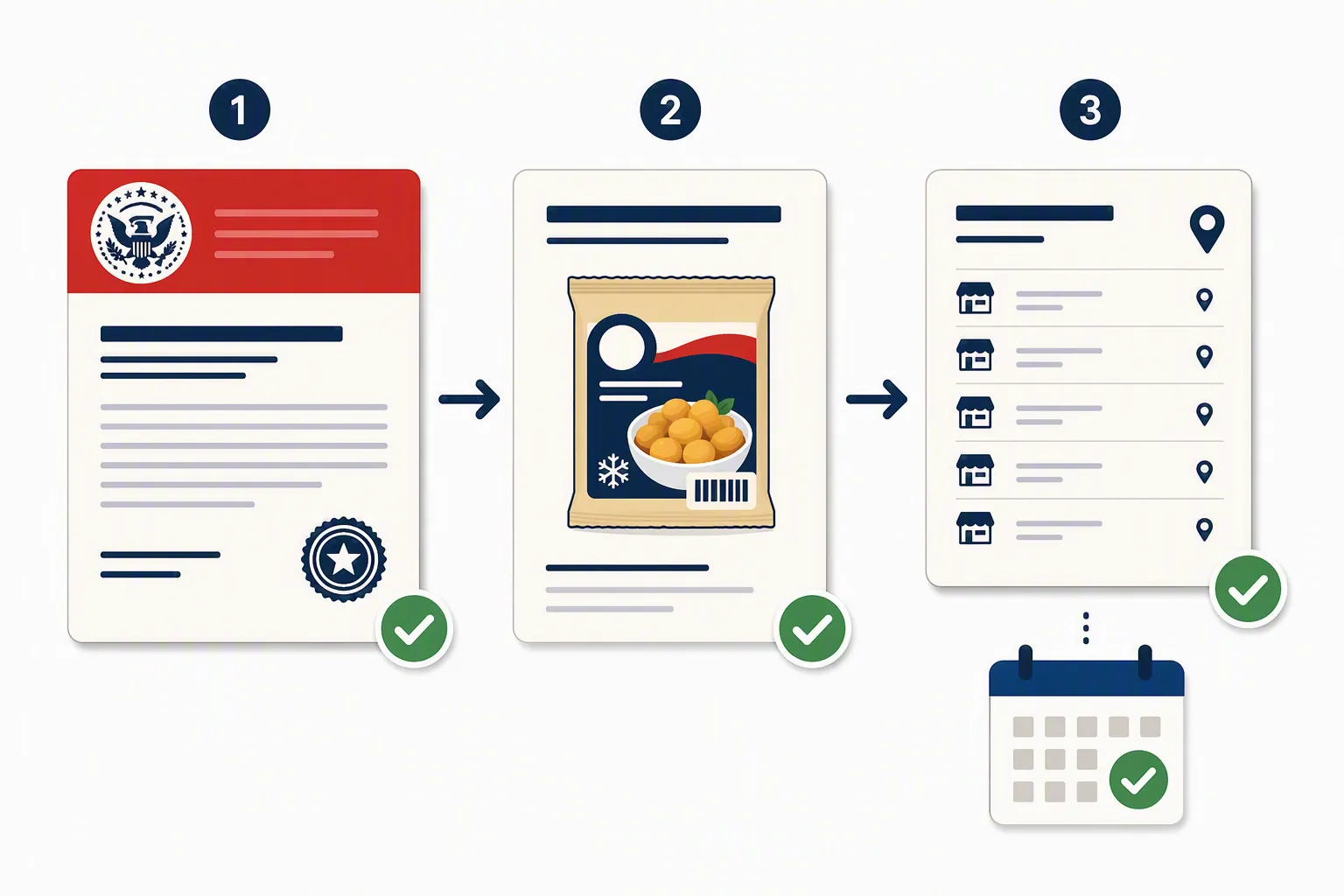
In checking the source set for this article, the FSIS PDFs were not reliably machine-parsed by the crawler. That is not a harmless technical footnote. If a lawyer, retailer, or publisher wants to circulate store names and addresses, the retail consignee PDF must be downloaded and inspected directly. Store-level Oregon or Washington entries should not be copied from a summary, a chatbot answer, a cached snippet, or secondary source notes.
A lawyer’s verification workflow
Start with the FSIS recall release, not with a news story and not with a generated answer. The release is the official record for the recall number, announcement date, recall class, product weight, production dates, distribution states, product descriptions, sell-by dates, establishment number, case-level health certificate, reason for recall, and illness-report status. [1]
Then use the label PDF to confirm package identity. Product names are not enough. Retail private-label names can be similar, and an internal email that says “Maple Leaf bacon” may be too broad for a preservation or withdrawal instruction. The package-facing details—brand line, product name, sell-by date, establishment mark, and any case identifier—are what keep the recall scope from drifting. [2]
Only after that should the store list be opened. The retail consignee list is a separate FSIS artifact, not a paragraph inside the recall release. FSIS explains that retail consignee information may be posted when available and can change as the agency receives additional distribution information. For counsel, that means the list needs its own retrieval date and its own saved copy. [3][4]
| Workpaper field | What to record |
|---|---|
| Recall record | FSIS Recall 011-2026; release URL; date accessed; status shown on access date [1] |
| Product verification | Exact product name, package size, sell-by date, EST. 1 mark, and label PDF version saved or printed [2] |
| Retail verification | RC-011-2026-Retail-List.pdf; date and time retrieved; Oregon and Washington entries copied only from the PDF [3] |
| Limit of conclusion | Whether the memo answers products only, stores only, or both; whether Idaho entries were excluded by instruction rather than omitted by mistake |
| Update trigger | Recheck FSIS if the recall status changes, if a new consignee list is posted, or before the work product is circulated externally |
That last line is where many quick summaries fail. A current retail consignee list is a dated fact. It is not a permanent fact. If a partner asks, “Can we say these are the affected Oregon and Washington stores?” the answer should be tied to the exact PDF checked, the date checked, and the scope of the check.
If you must circulate Oregon or Washington entries
- Download RC-011-2026-Retail-List.pdf directly from FSIS, rather than opening a copy embedded in another site or summarized by an AI tool. [3]
- Filter or extract only the Oregon and Washington rows you need, but keep the full PDF in the file so the exclusion of other states is auditable.
- Compare each store entry against the product identifiers from the FSIS release and label PDF; do not assume that a Grocery Outlet location appearing in commentary is necessarily on the current FSIS consignee list. [1][2][3]
- Label the circulated document as “verified against FSIS sources on [date/time]” rather than “the Maple Leaf recall list,” which sounds final when the source file may change.
Company statements and regulator language are different evidence
Maple Leaf’s reported characterization—that the issue involved paperwork review at the border and that the product would not cause illness—belongs in a different evidentiary box from the FSIS recall language. Snopes reported the company’s characterization; FSIS, for its part, described the product as imported without the benefit of import reinspection and classified the recall as Class I. [5][1]
Both may be relevant to a practical assessment, but they do not prove the same thing. A client-facing answer should attribute each statement to the source that actually made it. That is not pedantry. It is how later readers can tell whether they are looking at the agency’s operative record, the company’s explanation, or press context.
Why an AI-generated list is not enough for counsel
There is nothing wrong with using AI to find the FSIS release faster, draft a verification checklist, or flag that the retail consignee list exists. The problem starts when the AI output becomes the record. A chatbot can flatten the release, the label PDF, the consignee PDF, and secondary coverage into one confident-looking list, losing the very distinctions a lawyer needs to preserve.
The available hallucination research does not measure food-recall list generation. It does, however, give counsel a serious prior warning about relying on legal AI systems without checking their sources. Stanford RegLab and HAI reported that general-purpose chatbots hallucinated in 58% to 82% of tested legal queries, while legal research systems still produced hallucinations at double-digit rates: more than 17% for Lexis+ AI and Ask Practical Law AI, and more than 34% for Westlaw AI-Assisted Research in the reported benchmarking. [6][7]
The Stanford work also distinguishes between answers that are simply incorrect and answers that are misgrounded—appearing to rest on authority that does not actually support the proposition. That distinction maps uncomfortably well onto recall-list work. A generated answer might name a real city, a real retailer, and a real FSIS recall, while still failing to prove that a particular store appears in the current consignee PDF. [7]
For a broader treatment of those benchmark numbers, see the site’s legal AI accuracy benchmarks guide. The lesson for this recall is narrower: benchmark improvement is not the same thing as verified output.
Professional-responsibility materials point in the same direction. The ABA’s Formal Opinion 512 announcement frames generative AI use around competence, confidentiality, communication, supervision, and fees. The National Center for State Courts’ practitioner guidance uses the blunt standard lawyers now have to live with: never trust, always verify. [8][9]
That duty is not limited to briefs filed in court. It applies before advising a retailer that a location is or is not on a recall list, before sending a preservation instruction keyed to specific products, and before circulating a client-facing statement that purports to define the affected Oregon and Washington stores. The same verification failure pattern appears in court-filing sanction coverage and hallucination case databases, though any specific sanction amount should be checked against the underlying order before being repeated as a hard fact. [10][11]
Related Risk Digest examples on this site address the same failure mode in different clothing: fabricated AI citations in the ICE airport detention sanctions matter, the difference between an agency record and an AI interface in the Foster City fire AI liability analysis, and adoption pressure around unproven tools in OpenAI Astra legal applications. This recall-list problem is smaller than a sanctions order, but the verification discipline is the same.
How to use secondary coverage without laundering it into proof
Local and national coverage can be useful for orientation. Oregon coverage identified affected communities in the state, and Island County Public Health identified Clinton and Oak Harbor in Washington. Those reports may help a lawyer know where to look first, but they are not the FSIS retail consignee list. [12][13]
The same caution applies to AI-assisted news production. OregonLive’s recall coverage carried an Express Desk AI editorial disclosure, a useful reminder that even consumer-facing recall articles may involve AI-supported workflows. That does not make the article wrong; it does make it a secondary source. [14]
If a store name or address is going into a legal memo, retailer instruction, hold notice, or client alert, it should come from the FSIS retail consignee PDF. If a news article is used at all, use it as corroboration or context and say so.
The work product counsel should keep
A defensible answer to the Maple Leaf bacon recall list question is not a pasted list. It is a dated verification record: FSIS Recall 011-2026 checked on August 4, 2026; product identity checked against the FSIS release and label PDF; Oregon and Washington store entries, if used, checked against RC-011-2026-Retail-List.pdf; and the limits of the conclusion stated plainly.
As of that verification time, the reliable “list” is the current FSIS record set, especially the label PDF and the retail consignee PDF inspected directly. An AI-generated Oregon/Washington version is only a lead sheet until someone reconciles it against those files and records when that reconciliation occurred.
References
- Maple Leaf Foods Inc. Recalls Not-Ready-To-Eat NRTE Bacon Product Imported Without Benefit of Import Reinspection, FSIS, July 24, 2026.
- Recall-011-2026-Labels.pdf, FSIS, July 2026.
- RC-011-2026-Retail-List.pdf, FSIS, July 2026.
- Understanding FSIS Food Recalls, FSIS.
- Maple Leaf Foods Bacon Recall, Snopes.
- AI on Trial: Legal Models Hallucinate in 1 out of 6 (or More) Benchmarking Queries, Stanford HAI.
- Legal RAG Hallucinations, Stanford RegLab / Stanford HAI.
- ABA issues first ethics guidance on AI tools, American Bar Association, July 2024.
- Legal Practitioners' Guide to AI Hallucinations, National Center for State Courts.
- AI Court Filing Sanctions, Klemchuk.
- AI Hallucination Cases Database, Damien Charlotin.
- Oregon bacon recall, Statesman Journal, July 27, 2026.
- Island County Civic Alert AID 238, Island County, Washington.
- Did you buy bacon from Grocery Outlet? Check your refrigerator for this recall, OregonLive, July 2026.
Related records
Tool profile
How Meta's AI Spending Reshapes Law Firm ProfitabilityGoverning regulation
Browse the obligations tracker →Preventive workflow
Browse verification workflows →
Report a correction or tip
Spotted an outdated figure, a misstated fact, or a ruling this case record should reflect? Public comments are disabled for this content given the professional cost of a misreported case outcome, penalty amount, or rule text — use the structured correction channel instead.
Report a correction or tip for this record →