
Claude vs ChatGPT for legal work — which is safer?
Neither Claude nor ChatGPT is safe for unverified legal work on benchmark or sanction evidence. The accuracy gap between them is real but secondary; the verification workflow determines whether either model is defensible.
- Tool
- Anthropic Claude vs OpenAI ChatGPT
- Benchmark source
- Stanford RegLab/JELS; Stanford HAI; Vals AI LegalBench; Harvey BigLaw Bench; LawNext/VLAIR
- Hallucination rate
- 17-33% (legal RAG tools); 1 in 6+ (legal models)
- Test methodology
- Synthesis of independent academic benchmarks, provider and third-party legal-task tests, and sanctions-case review across citation accuracy, legal reasoning, authoritativeness, and filing failures
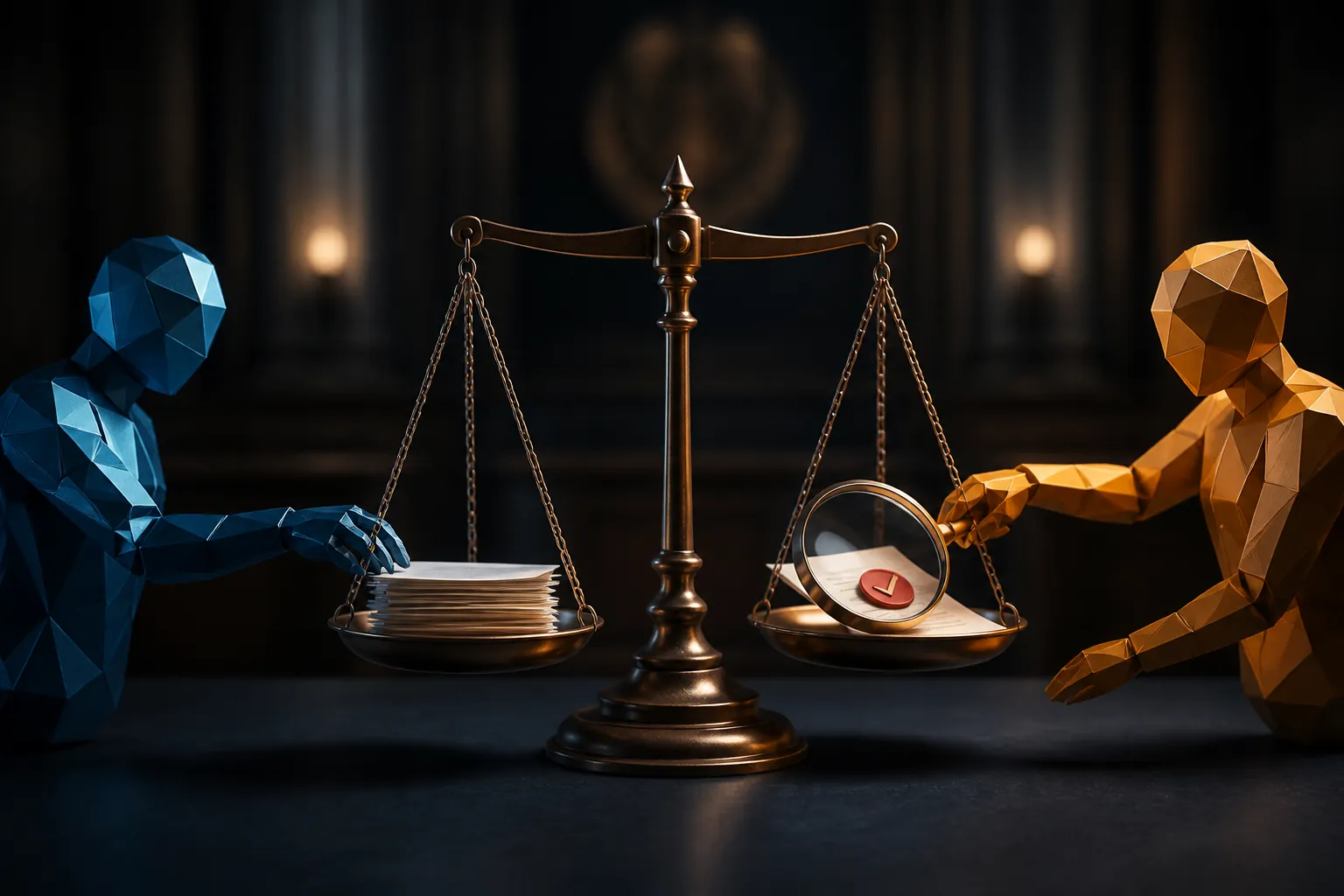
If your firm is deciding which general-purpose AI tool is safer for legal work, the practical answer is narrow: as of mid-2026, Claude has the stronger cited accuracy signals on several legal-reasoning and citation benchmarks, while ChatGPT remains competitive on some legal-research tasks. Neither is safe for unverified legal work. The risk that matters is not whether the demo answer sounds lawyerly; it is whether a fabricated case, misstated holding, or invented quotation can survive into advice, a memo, or a filing.
| Evidence source | Model/version or tool class | Legal task tested | Result | Independence level | Verification warning |
|---|---|---|---|---|---|
| Stanford RegLab / JELS study | Legal RAG tools and general-purpose chatbots | Legal research reliability | RAG-based legal research tools from major providers hallucinated on 17–33% of queries; general-purpose chatbots were reported as far higher risk. [1] | Peer-reviewed / independent academic evidence | Specialized legal tools reduce some risk, but they do not eliminate source-checking. |
| Stanford HAI coverage | Large language models used for legal questions | Legal hallucination benchmarking | Stanford HAI characterized legal mistakes as pervasive and separately described legal models hallucinating in 1 out of 6 or more benchmarking queries. [2][3] | Independent academic reporting | The baseline is not zero-risk for any model category. |
| Harvey BigLaw Bench | Claude Opus 4.8 vs GPT-5.4 | Legal reasoning inside Harvey’s benchmark environment | Claude Opus 4.8 scored 91.1% versus GPT-5.4 at 84.2%. [4] | Vendor-generated benchmark | Useful signal, but not the same evidentiary weight as independent testing. |
| Vals AI LegalBench | Claude Fable 5 vs GPT-5.6 Sol | Legal benchmark tasks | Claude Fable 5 scored 88.56% versus GPT-5.6 Sol at 86.97%. [5] | Benchmark-provider evidence | A current-version comparison, but still task-specific and not a filing-safety guarantee. |
| Vals AI VLAIR, reported by LawNext | ChatGPT running GPT-4 era model | Legal research accuracy and authoritativeness | ChatGPT matched legal-specific AIs on accuracy at 80% versus an 80% grouped average, but trailed on authoritativeness at 70% versus 76%; the study excluded Thomson Reuters, LexisNexis, and vLex. [6] | Third-party benchmark as reported by legal-tech press | Version-specific. It does not answer how GPT-5.x performs in the same setup. |
| District of Oregon sanctions coverage | AI-generated legal work; model attribution not treated as a reliable model-rate datapoint here | Real filing failure | Two lawyers were penalized $110,000 after filings included 15 nonexistent cases and 8 fabricated quotations. [7] | Public sanctions reporting | Sanctions prove the failure mode. They usually do not prove a model-by-model incident rate. |
What the benchmark evidence actually supports
The benchmark record supports a cautious preference, not a safe harbor. Claude’s case is stronger on the mid-2026 evidence listed above because it leads ChatGPT in the Harvey legal-reasoning comparison and in Vals AI’s LegalBench comparison. That is worth taking seriously. A roughly seven-point gap in a legal-reasoning benchmark can matter when a firm is choosing a default assistant for drafts, summaries, issue spotting, or first-pass research triage.
But benchmark strength and professional defensibility are not the same thing. Harvey’s result is a vendor-generated benchmark inside a product environment. It may be useful, and it may reflect real model capability, but it should not be weighted like an independent court order, peer-reviewed study, or fully reproducible external evaluation. It is a procurement signal, not a malpractice shield.
Vals AI’s LegalBench result is more directly useful for a Claude-versus-ChatGPT comparison because it puts named current models beside each other on legal tasks. The gap there is smaller: Claude Fable 5 at 88.56% and GPT-5.6 Sol at 86.97%. That still favors Claude, but it does not justify treating ChatGPT as categorically unsuitable or Claude as independently safe. It says that, on that benchmark, one current Claude model did better than one current OpenAI model.
The older VLAIR result points in the other direction a buyer should care about: ChatGPT can be competitive on legal-research accuracy, but accuracy is not the whole task. In the LawNext report, ChatGPT matched legal-specific AIs on accuracy while trailing on authoritativeness, and the tested ChatGPT system was GPT-4-era rather than GPT-5.x. That makes the result useful for understanding task shape, not for ranking today’s frontier models.
The independent Stanford evidence is the floor under the comparison. It tells firms not to confuse legal tailoring, retrieval-augmented generation, or a polished interface with a no-hallucination environment. If RAG-based legal research products still hallucinate on a meaningful share of legal queries, then a general-purpose model with no locked citation workflow deserves even stricter controls, not looser ones.
Why a sanctions record is not a Claude-versus-ChatGPT scorecard
Sanctions evidence is essential for legal-risk analysis because it shows what happens after the benchmark table ends. The Oregon order, as reported by ABA Journal, involved two lawyers, 15 nonexistent cases, 8 fabricated quotations, and a $110,000 penalty. That is the part of AI risk that a leaderboard cannot absorb: someone had to sign, file, explain, correct, and pay.
It would be sloppy, though, to turn every AI-citation sanction into evidence against whichever chatbot a reader already dislikes. Many orders and case reports describe AI-generated authorities without creating a reliable dataset of model identity, model version, prompt, retrieval setup, user behavior, and supervision failure. Even when a specific tool is named in one case, that is a case fact, not an incident-rate denominator.
That distinction matters for this comparison. A sanctions order proves that fabricated citations and quotations can reach court when lawyers do not verify AI output. It usually does not prove that Claude, ChatGPT, or any other model is statistically safer in the wild. The defensible question is therefore not, “Which model has never been involved in a bad filing?” The defensible question is, “Which model performs better on relevant tests, and what workflow prevents its remaining errors from reaching a client or court?”
For case-by-case tracking, the model-comparison question should be separated from the sanction-pattern question. The site’s Risk Digest entries on Payne v. State, prosecutor AI hallucination cases, and SSA litigation sanctions are useful for understanding the recurring failure pattern: false authorities, inadequate checking, and late remedial work after a filing has already created professional exposure.
The legal task changes the answer
A firm does not need one global answer for “legal work.” It needs to sort tasks by the consequence of a wrong answer. Claude’s long-context and citation-accuracy signals make it the better candidate for some document-heavy and research-adjacent workflows. ChatGPT may remain entirely adequate for lower-risk drafting, brainstorming, client-friendly explanations, and internal issue lists where no authority is being represented as verified.
| Task | Relative model-risk read | Required control |
|---|---|---|
| Summarizing a large document set for internal orientation | Claude’s long-context reputation and benchmark signals make it attractive, especially where the source packet is supplied by the user. | Check summaries against the source documents before relying on them for advice. |
| Generating research leads or possible authorities | Claude has the stronger cited mid-2026 benchmark case, but ChatGPT can still produce useful leads. | Treat every authority as unverified until located in a primary or trusted legal database. |
| Drafting a memo section that cites cases | Neither model should be allowed to create the final citation layer unaudited. | Human verification of existence, holding, procedural posture, jurisdiction, and quoted language. |
| Preparing filing-ready legal argument | The model should not be the final source of legal truth. | Supervising lawyer review, citation audit, quote check, and documented signoff before filing. |
| Confidential client analysis | The safer model is the one deployed under acceptable confidentiality, retention, and access terms. | No confidential input into a public or unmanaged system without a policy-approved basis. |
That last row often receives too little attention in model comparisons. A model with a better benchmark score can still be the wrong deployment if the firm cannot control data retention, access, logging, or client-confidential input. ABA Formal Opinion 512, issued in July 2024, frames lawyers’ use of generative AI around duties including competence, confidentiality, supervision, and verification. [8]
For a deeper comparison between general-purpose systems and dedicated legal platforms, see the separate analysis of ChatGPT versus specialized legal AI tools. The important point here is simpler: specialization and retrieval are risk controls, not immunity.
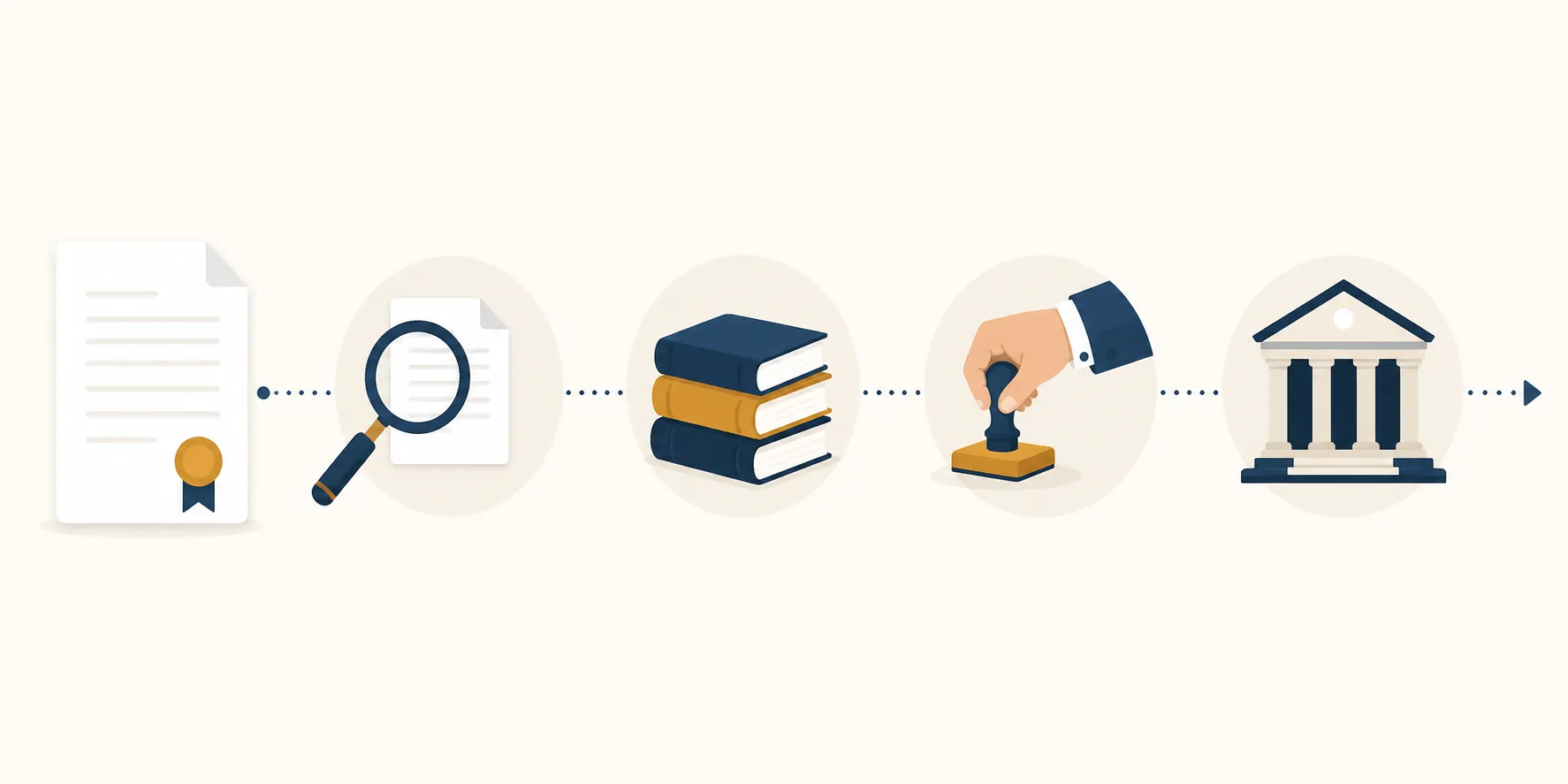
A defensible workflow for either model
The verification workflow is not administrative decoration. It is the thing that turns an AI-assisted draft from an uncontrolled artifact into a reviewable legal work product. If a firm cannot describe who checks the sources, who approves the final text, and what happens when a citation cannot be verified, it has not solved the safety problem by choosing Claude over ChatGPT.
| Control point | What must happen | Who owns the risk |
|---|---|---|
| Task classification | Classify the use before prompting: internal drafting, research lead generation, confidential analysis, client advice, or filing support. | Matter lawyer or supervising attorney |
| Model and version logging | Record the tool, model version if visible, date, and broad task purpose for legal work that may affect advice or filings. | Responsible user and KM/risk team |
| Confidentiality gate | Confirm that client-confidential or privileged material may be entered under the firm’s approved terms and client expectations. | Supervising attorney and firm policy owner |
| Citation extraction | Pull every cited case, statute, rule, quotation, parenthetical, and factual assertion that depends on an external source into a review list. | Drafting lawyer or assigned reviewer |
| Source existence check | Locate each authority in a primary source or trusted legal research database. If it cannot be found, remove it. | Reviewer |
| Proposition check | Confirm that the cited authority supports the proposition for which it is used, in the relevant jurisdiction and procedural posture. | Lawyer responsible for the analysis |
| Quotation check | Compare every quoted sentence, ellipsis, bracketed insertion, and pincite against the source text. | Reviewer, with attorney signoff |
| Adverse-treatment check | Confirm current validity and treatment before relying on the authority. | Lawyer responsible for the filing or advice |
| Final filing gate | No AI-generated authority, quotation, or legal proposition reaches a court filing unless the review list is complete and signed off. | Signing lawyer |
A light version of that workflow can be enough for internal brainstorming. It is not enough for a brief, opinion letter, dispositive motion, agency submission, or client advice that depends on legal authority. The closer the work gets to a client or court, the more the firm needs a documented trail showing that the model was an assistant, not the final legal source.
Firms that need a policy template rather than another benchmark table should start with a written verification SOP. The site’s AI ethics and sanctions policy template and defensible AI workflow for law firms map that control structure to legal-ethics duties and filing risk.
How to read vendor and benchmark claims without overbuying them
Procurement teams still need a decision, so “all benchmarks are flawed” is not a useful answer. The better approach is to rank evidence by what it can bear. Independent studies establish the risk baseline. Public benchmarks help compare model families and versions. Vendor benchmarks can identify promising performance inside a product environment. Sanction orders show the consequences of review failure. None of those sources answers all questions alone.
- Give more weight to independent or peer-reviewed evidence than to vendor announcements.
- Treat every model-version claim as time-sensitive. A Claude Opus 4.8 result is not a permanent Claude result; a GPT-4-era ChatGPT result is not a GPT-5.x result.
- Separate citation accuracy from general writing quality. A clear paragraph with a false case is still a professional-responsibility problem.
- Separate source existence from source fit. A real case can still be wrong for the proposition.
- Ask whether the benchmark resembles the firm’s work: litigation research, contract review, regulatory analysis, privilege review, factual summarization, or client communications.
This is also where firms should be skeptical of neat “Claude writes better” or “ChatGPT is more practical” claims. Those observations may be true for a user’s style preference, but style preference is not a safety metric. For legal work, the serious questions are narrower: Does the system invent authorities? Does it misquote? Does it overstate holdings? Does it preserve confidentiality under the chosen deployment? Can the firm prove that a human checked what mattered?
For teams building their own evaluation process, a component-level benchmark is more useful than a single average score. A firm can test source existence, quotation accuracy, jurisdictional fit, adverse-treatment recognition, document-grounded summarization, and refusal behavior separately. The methodology discussion in benchmark validation gaps is useful here because legal AI should be evaluated for failure tolerance, not just average performance.
So which is safer?
On the cited mid-2026 benchmark evidence, Claude is the lower-risk general-purpose choice for legal work, especially where citation accuracy, legal reasoning, and long-context document handling matter. That conclusion should be stated plainly because procurement teams cannot operate on permanent ambiguity.
The same conclusion should also be bounded. ChatGPT remains competitive in some legal-research settings, older ChatGPT results do not answer current GPT-5.x performance, and vendor benchmarks should not be treated as independent proof. More importantly, a lower-risk model can still generate a sanction-grade error if the firm lets plausible legal text bypass source verification.
If the question is “Which general-purpose model would I choose first on the available evidence?” the answer is Claude. If the question is “What makes AI-assisted legal work safe enough to defend?” the answer is verified citations, checked quotations, source-supported propositions, confidentiality controls, supervisory review, and a workflow record before anything reaches a client or a court.
References
- Hallucination-Free? Assessing the Reliability of Leading AI Legal Research Tools — Yale Institution for Social and Policy Studies
- Hallucinating Law: Legal Mistakes with Large Language Models are Pervasive — Stanford HAI
- AI on Trial: Legal Models Hallucinate in 1 out of 6 (or More) Benchmarking Queries — Stanford HAI
- Opus 4.8 Now Live in Harvey — Harvey — May 28, 2026
- LegalBench — Vals AI
- Vals AI’s Latest Benchmark Finds Legal and General AI Now Outperform Lawyers in Legal Research Accuracy — LawNext — October 2025
- Oregon federal judge hands down $110,000 penalty for AI errors — ABA Journal
- ABA issues first ethics guidance on a lawyer’s use of AI tools — American Bar Association — July 2024
Chronological incident history
- GEMA v. OpenAI lawsuit update: Munich ruling is on appeal
- Where does the NYT v. OpenAI lawsuit stand now?
- Wisconsin absentee ballot replacement rules just changed
- What the '1933 double' Reveals About ChatGPT Benchmarks
- FBI agent Patrick Yaroch charged with stealing Bitcoin
- What charges does the FBI agent face for crypto theft?
- FBI agent cryptocurrency theft case, explained
Report a correction or tip
Spotted an outdated figure, a misstated fact, or a ruling this tool profile should reflect? Public comments are disabled for this content given the professional cost of a misreported case outcome, penalty amount, or rule text — use the structured correction channel instead.
Report a correction or tip for this record →