
AI Hedge Fund Collapse Spurs Legal AI Reliability Questions
The $20B Situational Awareness LP failure was not caused by a wrong AI thesis but by structural fragility—concentrated leverage and no circuit-breaker. This evaluation explains why legal AI buyers must apply the same lesson: benchmark for failure tolerance, not just average accuracy.
- Tool
- generic legal LLM
- Benchmark source
- SAOT validation benchmark-gaps analysis
- Hallucination rate
- Not measured / undisclosed
- Test methodology
- failure-mode testing with novel jurisdictional and thin-authority cases
- Test date
- Jul 31, 2026
This Tool Evaluations analysis is not legal, investment, or trading advice. It starts with a correction because the phrase “situational awareness ai hedge fund 600 million loss” is already doing too much work: no authoritative source in the available record confirms a precise $600 million loss for Situational Awareness LP. CNBC reported on July 30, 2026, that the size of the fund’s losses and the amount it was seeking to raise could not immediately be determined, while other reporting described a fund in the $20 billion-plus range and a forced sale process rather than a verified $600 million loss figure.[1]
That distinction matters. A site evaluating hallucination risk should not launder an unverified number just because the number is circulating in search behavior. The safer reading is narrower and more useful: Situational Awareness appears to have suffered a severe, fast-moving unwind after a concentrated AI-infrastructure trade came under pressure. The lesson is not that “AI picked wrong.” The lesson is that a high-conviction thesis was deployed through a fragile control design.
The reported 4x leverage figure also needs attribution. SpotGamma cites CNBC’s David Faber for that number, but it is not presented here as a fund-document-verified leverage schedule.[2] The fund’s assets under management are likewise reported differently across outlets, so this article uses the attributed $20 billion-plus framing rather than treating any one peak-AUM number as settled.
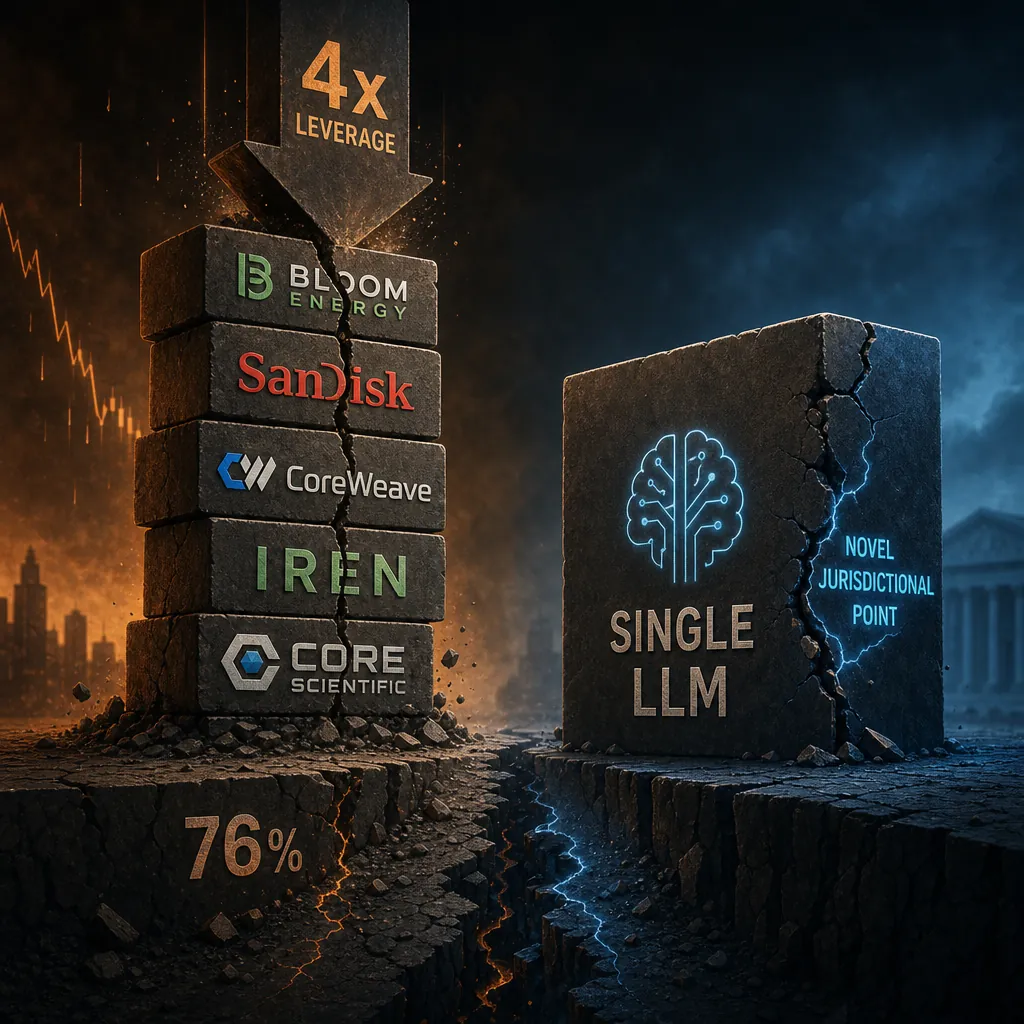
The Failure Was in the Stack, Not Just the Thesis
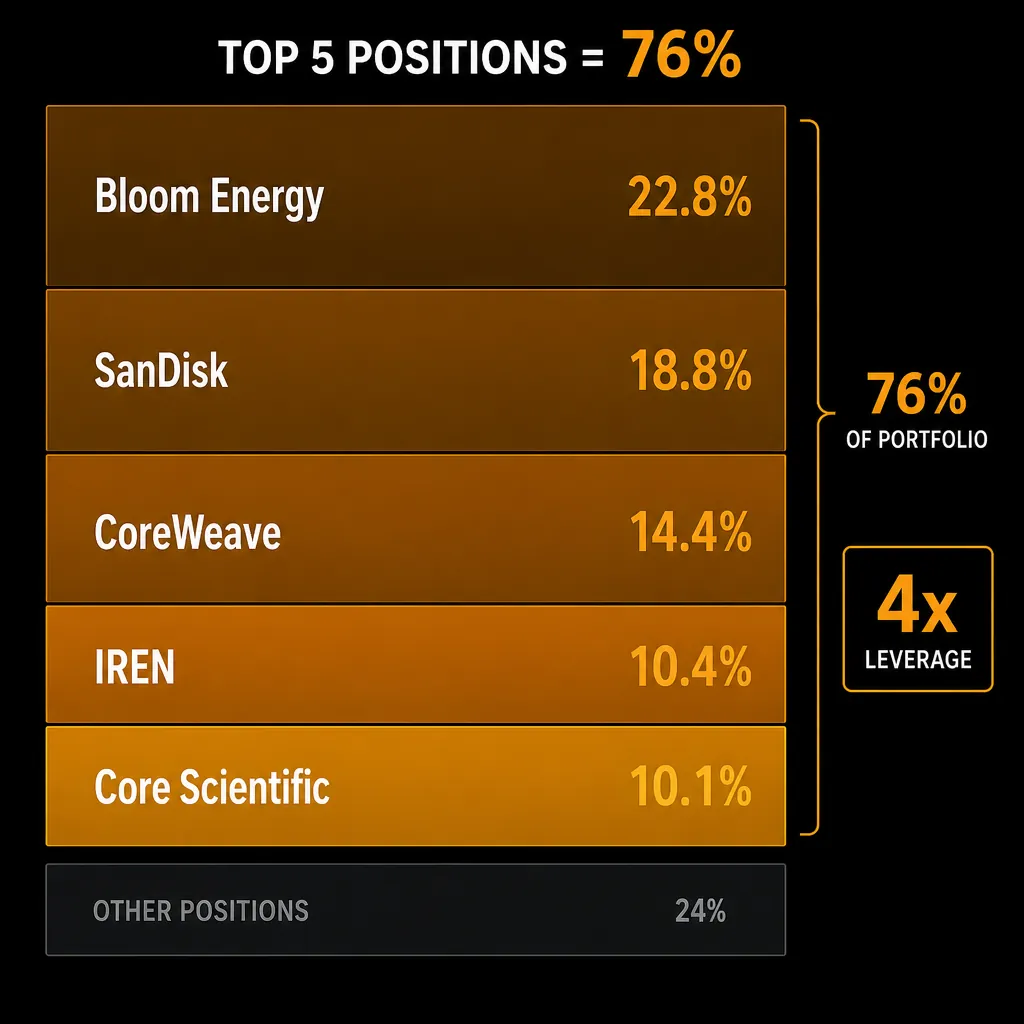
The most useful material is not founder lore, not personality, and not a broad referendum on the AI trade. It is the portfolio anatomy. SpotGamma reported that the fund’s top five disclosed positions made up 76% of the book: Bloom Energy at 22.8%, SanDisk at 18.8%, CoreWeave at 14.4%, IREN at 10.4%, and Core Scientific at 10.1%.[2]
| Reported position | Share of disclosed book |
|---|---|
| Bloom Energy | 22.8% |
| SanDisk | 18.8% |
| CoreWeave | 14.4% |
| IREN | 10.4% |
| Core Scientific | 10.1% |
| Top five total | 76.0% |
Those names are not identical businesses, but they sat inside one correlated conviction cluster: AI infrastructure, compute demand, data-center buildout, power, chips, and the financing conditions that had been rewarding that story. A five-name 76% book is already a dependency map. Add reported 4x leverage, and the control problem changes character. SpotGamma’s calculation was blunt: at 4x leverage, a 30% decline in the underlying book would hit equity by roughly 120% before any hedge offset.[2]
This is where the “AI caused it” explanation becomes too imprecise. A thesis can be directionally intelligent and still be operationally unsafe. The fund may have understood the long-term AI-infrastructure demand story better than many skeptics. But a correct long-term thesis does not pay margin calls, satisfy redemption pressure, or create liquidity when the same trade is being repriced across related names.
The reported hedges make the structure more uncomfortable, not less. SpotGamma identified $2.04 billion notional in SMH puts and $1.57 billion notional in NVDA puts, but described them as correlated hedges that failed alongside the longs rather than offsetting the book.[2] Calling a position a hedge does not make it independent. If the hedge is exposed to the same regime shift as the exposure it is supposed to protect, it may only look protective on a normal day.
Why the 36-Hour Sale Matters More Than the Spectacle
The crisis timeline is the part procurement teams should sit with. CNBC reported on July 30 that Situational Awareness was facing steep AI-related losses and seeking emergency capital, while The New York Times reported the same day that Citadel agreed to buy the portfolio at a substantial discount after an overnight bidding process.[1][3]
In plain operational terms, that is the difference between a control that works before the crisis and a negotiation that begins after the crisis has already narrowed every option. Once a leveraged, concentrated book is in distress, the organization is no longer deciding whether its thesis is right. It is deciding who will take the assets, at what discount, before counterparties and liquidity constraints make the decision for it.
Business Insider added the detail that, six days before the forced liquidation, the fund’s July 24 investor letter described the sell-off as a “buying opportunity” and opened a subscription window for August 1.[4] That does not prove bad faith. It does show how quickly an institution can move from confident framing to forced process when its control system depends on conviction surviving market stress.
The same Business Insider analysis put the point cleanly: “The market doesn't care how smart you are. If you add enough leverage and enough conviction, the market eventually stops judging your ideas. It starts judging your ability to survive.”[4] The line works because it is procedural, not theatrical. It identifies the handoff from analysis quality to survival mechanics.
The Legal-AI Parallel Is Control Design
For legal AI buyers, the useful analogy is not “a trading model hallucinated.” The better translation starts with the portfolio structure.
| Portfolio failure structure | Legal-AI equivalent |
|---|---|
| 76% in five correlated AI-infrastructure names | One legal LLM used for research, drafting, summarization, and citation checking |
| 4x leverage | Filing deadlines, partner confidence, client pressure, and repeated reuse without fresh review |
| SMH and NVDA puts treated as protection | One model or AI workflow used to verify another model’s output |
| No effective circuit-breaker before forced sale conditions | No mandatory stop when the tool reaches a novel jurisdictional issue, thin authority, or conflicting output |
A single legal LLM may perform well on ordinary tasks. It may summarize routine contracts cleanly, draft first-pass discovery requests, and retrieve familiar black-letter propositions with enough fluency to make a busy team comfortable. That is the attractive part, and it should be granted. Repeatable work is brittle in many legal organizations, and a tool that reduces copy-paste errors or accelerates first-draft work can be valuable.
The procurement question is what happens when that same tool becomes the long book, the hedge, and the risk report. If it researches the law, drafts the argument, checks the citations, and explains why the answer is probably fine, the buyer has built a correlated stack. The output may be polished, the reasoning may be plausible, and the failure may still be concentrated in exactly the part no one independently checked.

Novel jurisdictional points are the legal equivalent of a sudden regime shift. Average accuracy on routine prompts tells the buyer less than it appears to. The dangerous task is the one with sparse authority, local procedural variation, a new statute, a split among courts, or a fact pattern that resembles a known doctrine just closely enough to invite a confident wrong answer.
That is also where “use another AI to check it” can become the SMH-put problem. If both systems draw from similar training patterns, retrieval sources, prompt assumptions, or vendor pipelines, their agreement is not the same thing as independence. Two tools can share the same blind spot and still produce a reassuring comparison report.
Leverage in a law department does not look like margin debt. It looks like a filing deadline that leaves no time for manual source tracing, a partner who has already relied on the draft in a client call, a general counsel who wants consistency across matters, and an associate who is now checking citations at 11 p.m. because the tool’s confidence was treated as a control. The risk is not that the model is useless. The risk is that the organization uses normal-task performance to justify extraordinary-task dependence.
Benchmarks Have to Test the Breakpoint
The external reliability signals around trading AI should be used carefully. Bloomberg reported in May 2026 that most AI trading bots lost money in head-to-head contests and that systems produced inconsistent outputs from identical instructions.[5] Fortraders states that 95% of AI trading bots fail within 90 days.[6] The CFTC warns that “AI technology cannot predict the future or sudden market changes.”[7]
Those sources do not prove that every AI tool will fail, and they should not be stretched into that claim. They do support a more restrained procurement lesson: model performance in a controlled or familiar setting is not the same as deployment reliability under pressure, novelty, or regime change.
Legal-AI benchmarking should therefore include ordinary tasks, but it cannot stop there. A buyer needs to know whether the system recognizes when it is outside its reliable zone, whether it preserves source traceability, whether it changes its answer when the same instruction is repeated with small variations, and whether it escalates instead of smoothing over uncertainty.
- Test novel jurisdictional questions where the answer depends on local procedure, not broad federal doctrine.
- Test thin-authority issues where the correct response may be “there is not enough support,” not a confident synthesis.
- Test citation integrity by requiring pinpoint verification against primary sources, not only retrieval of case names.
- Test repeated prompts and near-duplicate instructions to see whether the system gives materially inconsistent answers.
- Test escalation behavior: the tool should identify uncertainty, request human review, or stop the workflow when the risk class changes.
This is why average accuracy is a weak procurement comfort if it is not paired with failure-mode testing. A model that is very good at common questions may still be unsafe for the marginal question that ends up in a filed brief. The relevant score is not only how often the tool is right. It is how the tool behaves when being wrong would matter.
Automation Overconfidence Is Not New
Situational Awareness belongs in a longer line of automation-control failures. In 2012, Knight Capital lost $440 million in 45 minutes after a software deployment problem sent erroneous orders into the market.[8] The mechanism was different, but the institutional lesson rhymes: automation risk becomes expensive when speed, scale, and insufficient stopping conditions meet a live environment.
Legal teams do not need a market feed to reproduce the same governance error. A workflow can scale a bad output across matters, templates, client alerts, diligence reports, or pleadings. Once reuse begins, the original verification gap becomes embedded. The person who catches it later is rarely the person who approved the procurement slide.
The Underwood hallucination record is a useful next check because it shows the practical consequence of relying on an AI-generated legal account that needed verification before it became operationally consequential. See the Underwood hallucination case record for the litigation-side version of the same control failure.
What a Legal Buyer Should Require Before Trusting the Tool
The procurement file should separate three questions that vendors and internal champions often blend together: whether the model is capable, whether the workflow is supervised, and whether the organization has a circuit-breaker when conditions change.
- Capability: What tasks does the tool perform reliably on ordinary matters, and what source evidence supports that claim?
- Independence: What verification step is genuinely outside the same model, same retrieval assumptions, and same prompt path?
- Escalation: Which outputs must stop for lawyer review before they reach a client, court, regulator, or board audience?
- Traceability: Can the reviewer move from answer to authority to pinpoint source without relying on the model’s own assurance?
- Stress behavior: What happens when the question is novel, time is short, the user repeats the instruction, or the retrieved authorities conflict?
A good legal-AI evaluation should make ordinary performance visible, but it should spend disproportionate attention on the edge of the envelope. That is where the buyer learns whether the tool is a useful assistant or a concentrated exposure disguised as efficiency.
The same point appears in benchmarking design outside finance. The SAOT validation benchmark-gaps analysis is relevant because it focuses on component-level validation rather than broad comfort scores. For AI-agent governance and stopping conditions, the Onyx Security evaluation is the closer procurement parallel.
The practical standard is simple enough to write into a review memo: do not buy or deploy legal AI on average accuracy alone. Require failure-tolerance evidence, independent verification, and circuit-breaker behavior before the tool is used on novel jurisdictional points, edge cases, or work that will be filed, relied on, or reused.
References
- Leopold Aschenbrenner’s hedge fund is facing steep AI losses, CNBC, July 30, 2026.
- Situational Awareness Unwind: Margin Call AI, SpotGamma.
- Artificial Intelligence Situational Awareness Citadel, The New York Times, July 30, 2026.
- Leopold Aschenbrenner’s Situational Awareness Wall Street lesson AI stocks, Business Insider, July 30, 2026.
- AI Bots Auditioning for Wall Street Trading Are Mostly Losing, Bloomberg, May 2026.
- Trading Bots Lose Money, Fortraders.
- AI Trading Bots, Commodity Futures Trading Commission.
- Knight Capital Group Trading Glitch, Wikipedia, 2012.
Chronological incident history
No sanction cases have named this tool in the tracked record set to date. This does not imply the tool is safe — see Risk Digest for ongoing monitoring.
← Compare peer toolsReport a correction or tip
Spotted an outdated figure, a misstated fact, or a ruling this tool profile should reflect? Public comments are disabled for this content given the professional cost of a misreported case outcome, penalty amount, or rule text — use the structured correction channel instead.
Report a correction or tip for this record →