
Is Gemini or ChatGPT the Safer Choice for Legal Work?
A version-dated risk scorecard comparing Gemini and ChatGPT for legal work task by task: neither model is safe to trust for citations, and where gaps exist—citation fabrication, citation verification, disclosure of hallucination data—current benchmarked versions mostly favor ChatGPT. Because those margins are version- and task-dependent, the verification workflow, not the model choice, is the binding constraint.
- Tool
- Gemini, ChatGPT
- Benchmark source
- LePhantomCite; Vals AI Legal Research Bench 2026
- Hallucination rate
- LePhantomCite hallucinated-citation detection: GPT-5 55.0% F1 vs Gemini 2.5 Flash 27.0% F1
- Test methodology
- Task-specific legal benchmarks: strict all-pass grading on agentic U.S. legal research; hallucinated-citation detection against CourtListener; jurisdiction-specific legal queries.
Q3 2026 answer: safer is not the same as safe
For legal work in Q3 2026, the defensible answer is narrow: neither Gemini nor ChatGPT should be trusted for legal citations without human source-checking. On the public, versioned legal benchmarks available now, ChatGPT has the edge on several measurable legal-risk signals—especially citation verification and legal research all-pass performance—but the gap is task-specific, model-specific, and too dependent on configuration to support a permanent “winner” label.
This is a risk comparison for legal research, drafting support, and citation-facing review. It is not legal advice, and it does not evaluate confidentiality, privilege, contract terms, data-retention settings, or firm-specific deployment controls. Those issues can decide whether a tool may be used at all. Here, the narrower question is: when a lawyer asks Gemini or ChatGPT for legal help, which model is less likely to create or miss citation problems that later have to survive adversarial review?

The answer below relies on task-specific legal benchmarks where available, not broad model impressions. The most useful current sources are Vals AI’s Legal Research Bench 2026 for agentic legal-research performance and LePhantomCite for hallucinated-citation detection in legal briefs. Vals reports GPT-5.6 Sol at 48.08% under strict all-pass grading, with Claude Opus 5 leading at 55.29%, while Gemini 3.5 Flash and Gemini 3.1 Pro Preview sit roughly 20–30 points lower across practice areas; across 27 models, the pooled all-pass score is only 28.4%.[1] LePhantomCite gives the clearest direct Gemini-vs-ChatGPT citation-risk split: agentic GPT-5 reaches 55.0% F1 and 84.4% recall in detecting hallucinated citations, compared with 27.0% F1 and 66.9% recall for agentic Gemini 2.5 Flash.[2]
Task-by-task scorecard
| Legal task | Current benchmark signal | Risk read for Gemini vs ChatGPT |
|---|---|---|
| Agentic U.S. legal research | Vals AI Legal Research Bench 2026: GPT-5.6 Sol scores 48.08% strict all-pass; Claude Opus 5 leads at 55.29%; Gemini 3.5 Flash and Gemini 3.1 Pro Preview are roughly 20–30 points lower across practice areas; pooled all-pass across 27 models is 28.4%.[1] | ChatGPT has the stronger benchmarked showing here, but even the stronger result is not high enough to remove review by a lawyer or trained legal researcher. |
| Detecting fabricated citations in briefs | LePhantomCite: agentic GPT-5 reaches 55.0% F1 and 84.4% recall; agentic Gemini 2.5 Flash reaches 27.0% F1 and 66.9% recall.[2] | This is the sharpest head-to-head legal gap. ChatGPT is materially better in this tested setting, but still misses enough that it cannot be treated as a citation firewall. |
| Avoiding false alarms on legitimate citations | LePhantomCite: when legitimate citations were absent from CourtListener, Gemini 2.5 Flash falsely flagged 65.9%; GPT-5 falsely flagged 25.0%.[2] | Gemini’s false-positive burden matters operationally: someone has to re-check the citations the model wrongly marks as fake. |
| Place-sensitive legal questions | Place Matters, using late-2024 GPT-4o, Gemini 1.5 Pro, and Claude 3.5, reports hallucination rates of 45% for Los Angeles, 55% for London, and 61% for Sydney; per-model rates were GPT-4o 52%, Gemini 1.5 Pro 53%, and Claude 3.5 56%.[3] | Jurisdiction and query setting can matter as much as brand. A one-city or one-jurisdiction prompt test is a poor basis for procurement. |
| General legal hallucination baseline | Stanford HAI reported 58–82% legal-query hallucination rates for general chatbots; Stanford RegLab later reported 17–33% for leading retrieval-augmented legal research tools.[4][5] | Purpose-built legal tools reduce but do not eliminate the problem. General chatbots need stricter controls, not looser ones. |
| Knowing when the model does not know | AA-Omniscience reports Gemini 3 Pro hallucinating 88% of the time when it does not know, at 55.9% accuracy; Gemini 3.1 Pro calibration tuning reduced that to 50% with about a 1% accuracy loss; GPT-5.5 posts 86% hallucinate-when-unknown at 57% accuracy.[6] | Calibration is volatile by version. A procurement memo should name the exact tested model, not just “Gemini” or “ChatGPT.” |
| General factuality with grounding | Google DeepMind’s FACTS results, as reported in public coverage, show Gemini 3 Pro ahead of GPT-5 on general factuality metrics, including search-grounded results; the same coverage notes the absence of first-party Gemini hallucination-rate disclosures from Google.[7] | Useful context, not legal proof. A general grounded factuality win does not establish safer citation generation or court-facing legal research. |
That table is intentionally unsympathetic to feature lists. Multimodal inputs, interface polish, writing tone, long-context handling, and speed can matter in daily use. They do not answer whether a citation is real, controlling, current, or accurately characterized. For that, the relevant question is not “Which assistant feels smarter?” It is “Which assistant creates less legal cleanup work before filing?”
Citation risk is where the comparison becomes least forgiving
Legal citation failure is not one failure mode. A model can invent a case, give a real case with the wrong proposition, cite a real reporter page that does not support the sentence, miss a fake citation inserted by someone else, or mark a legitimate but hard-to-find citation as fabricated. Those errors impose different costs. Fabrication creates filing risk. Missed detection leaves bad authority in the document. False positives waste reviewer time and may cause a good authority to be removed.
LePhantomCite is useful because it does not merely ask whether a model can write legal prose. It tests detection of hallucinated citations in briefs. In that setting, agentic GPT-5’s 84.4% recall means it found a much larger share of fake citations than agentic Gemini 2.5 Flash at 66.9%; the F1 split, 55.0% versus 27.0%, captures the combined precision-recall weakness more starkly.[2] For a litigation team, recall matters because the missed fake citation is the one that can remain in the brief.
The false-positive result is just as important. Gemini 2.5 Flash falsely flagged 65.9% of legitimate citations that were absent from CourtListener, compared with 25.0% for GPT-5.[2] That is not a cosmetic problem. A reviewer now has to spend time proving that many “bad” citations are real. In a court-facing workflow, the model that cries wolf too often can still increase risk, because exhausted reviewers start discounting warnings.
The safer operational use is therefore not “ask the model if the citation exists.” It is: extract every cited authority, verify existence in an authoritative database, verify the quoted or paraphrased proposition against the source text, check subsequent history and jurisdictional status, and only then let the draft move toward filing. A chatbot can help organize that queue. It should not be the final citation authority.
For teams building a written procedure, this site’s AI citation-verification workflow is the more important companion document than any model leaderboard. The consequence records in the Risk Digest archive are a useful antidote to treating fabricated citations as a mere quality-control nuisance.
Legal research performance: ChatGPT leads in the benchmark, but the ceiling is still low
Vals AI’s Legal Research Bench is broader than citation detection. It evaluates agentic U.S. legal research under strict all-pass grading, which is a harsher but more legally realistic standard than awarding partial credit for a fluent answer with one serious authority problem. In that benchmark, GPT-5.6 Sol’s 48.08% is meaningfully ahead of the reported Gemini 3.5 Flash and Gemini 3.1 Pro Preview range, while the overall pooled all-pass score across 27 models is only 28.4%.[1]
The procurement implication is not “ChatGPT can do legal research alone.” It is that, on this benchmark, ChatGPT currently gives the legal team a better starting point. A 48.08% all-pass score still means the user must assume a substantial chance that at least one necessary element failed under benchmark conditions.[1] For an associate preparing a research memo, that affects staffing: the model’s answer may shorten the first pass, but it does not remove the need for source-by-source review before the memo becomes advice.
Vals evidence should also be read with its limits. The benchmark is structured and much more useful than one-off prompting anecdotes, but Vals discloses participant and customer relationships, and some major legal-research vendors did not participate in VLAIR-related comparisons.[1] That does not make the results disposable. It does mean a buyer should treat them as strong benchmark evidence, not as a complete market map.
For readers comparing more than Gemini and ChatGPT, the sibling multi-model legal reliability comparison is a better place to weigh whether a tiered workflow should route different legal tasks to different systems.
Place can swamp brand-level confidence
The cleanest way to overstate a Gemini-vs-ChatGPT result is to test one jurisdiction, one prompt style, and one model version, then generalize. Place Matters is a useful corrective. Using late-2024 models—GPT-4o, Gemini 1.5 Pro, and Claude 3.5—it found legal-query hallucination rates of 45% in Los Angeles, 55% in London, and 61% in Sydney. The per-model spread was much narrower: GPT-4o at 52%, Gemini 1.5 Pro at 53%, and Claude 3.5 at 56%.[3]

That result does not contradict the newer GPT-5 and Gemini 2.5/3.x evidence. It narrows what can be claimed from it. A model that looks safer in a U.S. benchmark may still need separate validation for another jurisdiction, another source base, or another legal domain. A legal-ops team standardizing a tool for U.S. employment research, U.K. financial-services advice, and Australian litigation support should not rely on a single pooled score.
The practical test set should therefore include the jurisdictions and practice areas the organization actually uses. If the work is state-heavy, include state authorities. If the work turns on local rules, include local rules. If the work often requires administrative guidance rather than cases, test that separately. Brand-level rankings are weakest precisely where legal research is most local.
General factuality benchmarks help, but they are not legal citation evidence
General factuality results can explain why a lawyer may experience Gemini as impressive in some grounded tasks. Public coverage of Google DeepMind’s FACTS results reported Gemini 3 Pro at 68.8 overall and 83.8 in search-grounded performance, ahead of GPT-5 at 61.8 overall and 77.7 search-grounded.[7] That is relevant context for ordinary factual answering. It is not evidence that Gemini is safer for legal citations, detecting fabricated authorities, or distinguishing controlling from merely related law.
Calibration evidence cuts in a different direction and shows why version naming matters. AA-Omniscience reports Gemini 3 Pro hallucinating 88% of the time when it does not know, with 55.9% accuracy; Gemini 3.1 Pro calibration tuning reduced that hallucinate-when-unknown rate to 50% with about a 1% accuracy loss. GPT-5.5, meanwhile, posted an 86% hallucinate-when-unknown rate at 57% accuracy.[6] Those figures do not settle a legal-research dispute, but they show that the same product family can change materially between versions and tuning choices.
This is why broad claims such as “Gemini wins factuality” or “ChatGPT is safer” need a task label attached. Search-grounded general factuality, legal citation detection, all-pass legal research, and calibrated refusal are different tasks. A model can lead one and lag another.
Transparency is a procurement issue, not a substitute benchmark
Google’s lack of first-party Gemini hallucination-rate disclosure is a real procurement concern. Public reporting has specifically noted that Google does not publish first-party hallucination rates for Gemini in the way a buyer would want for direct risk comparison.[7] That does not prove Gemini is worse in every legal setting. It does mean a legal department has less vendor-supplied risk evidence to inspect before adoption.
The distinction matters. A transparency gap is not an error rate. It is an evidence gap. The right response is to demand versioned evaluation results, run internal tests on representative matters, and require usage controls that assume the model can be wrong. Treating nondisclosure as proof of inferiority would be sloppy; treating it as irrelevant would be worse.
The workflow is the binding safety control
The best baseline studies still leave no room for unsupervised chatbot citation use. Stanford HAI reported legal-query hallucination rates of 58–82% for general chatbots.[4] Stanford RegLab found that leading retrieval-augmented legal research tools performed better, but still hallucinated at rates of 17–33%.[5] If even tools designed for legal research still require verification, a general-purpose chatbot answer should be treated as a draft lead, not as authority.
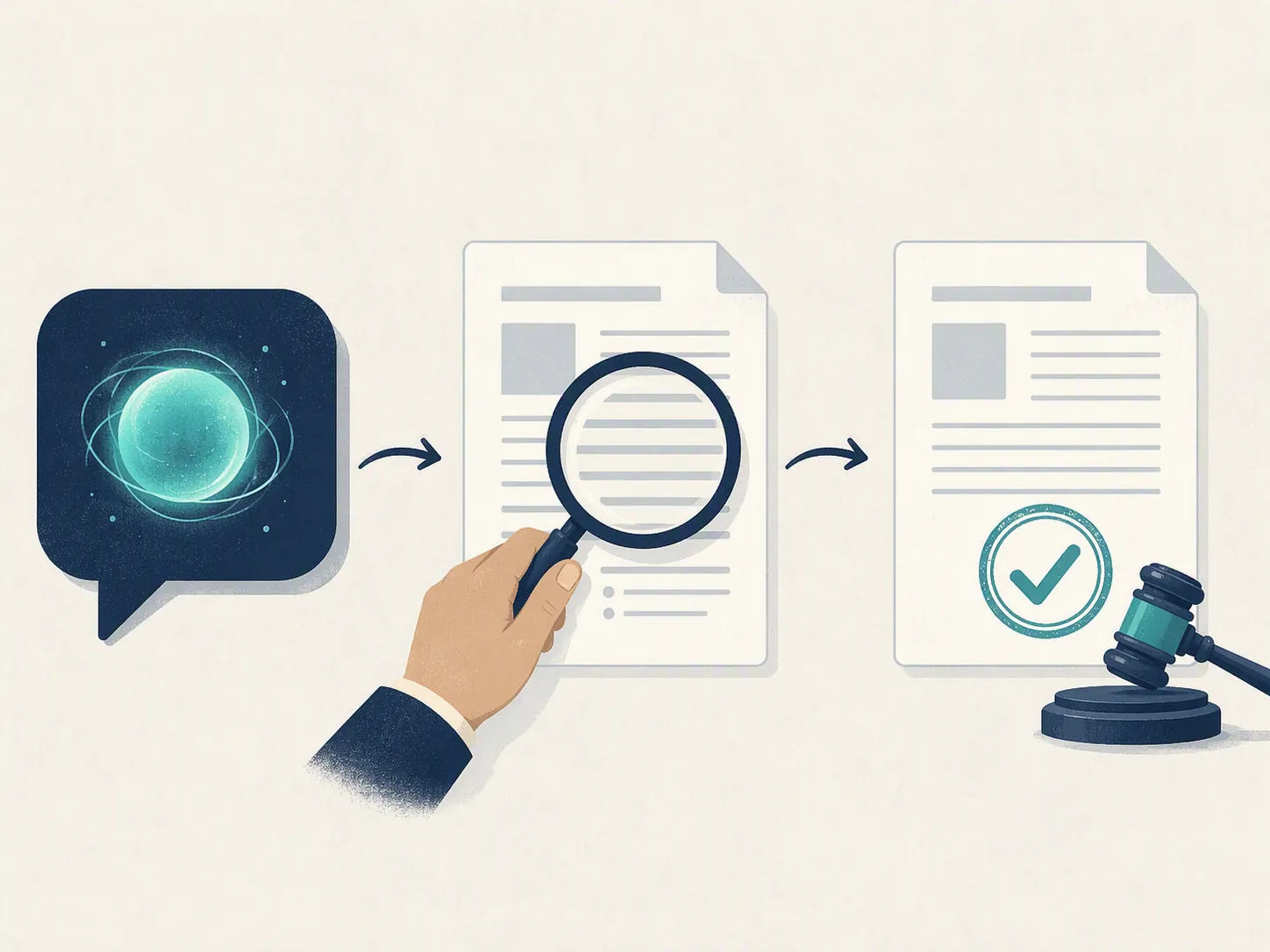
A defensible Gemini or ChatGPT workflow for legal work should make the human verification step explicit. At minimum, the process should require the reviewer to separate model output into propositions, authorities, quotations, procedural claims, and jurisdictional assumptions. Each citation then has to be checked in a trusted legal database or official source. Each proposition has to be matched to the cited page, paragraph, rule, or statutory subsection. Any quoted language must be compared against the source text, not against the chatbot’s memory of it.
For court-facing work, the model should not be allowed to create a final table of authorities, certify that all cases exist, or resolve negative-treatment questions without separate database review. It may help format a verification log or flag citations for review, but the log should record the source checked, the person who checked it, the date, and the result. That audit trail matters when the question later becomes not “Was the model usually accurate?” but “Who verified this filing?”
Configuration also belongs in the risk file. Web search, retrieval grounding, document access, jurisdictional source coverage, and enterprise settings can change outcomes. A model comparison that does not say whether search was on, which database was available, what model version answered, and when the test ran is not a legal-risk comparison. It is a product impression.
What to write in the risk memo
If the organization must choose one general-purpose assistant for legal work today, the evidence supports a cautious preference for ChatGPT on the measured legal-risk signals. GPT-5 and GPT-5.6 Sol perform better than the tested Gemini versions on the legal benchmarks that most directly touch citation verification and all-pass legal research.[1][2] That preference should be dated, versioned, and limited to the tested tasks.
The memo should not say that ChatGPT is safe for legal citations. It should say that, on current benchmarked legal-risk evidence, ChatGPT has the edge over Gemini on several measurable citation-risk signals, while neither model may be relied on for court-facing authority without a documented source-checking workflow. That is the comparison a reviewer can defend.
References
- Legal Research Bench 2026 — Vals AI — 2026
- LePhantomCite — arXiv
- Place Matters — arXiv
- AI Trial: Legal Models Hallucinate in 1 out of 6 (or More) Benchmarking Queries — Stanford HAI
- Hallucination-Free? Assessing the Reliability of Leading AI Legal Research Tools — Stanford RegLab
- AA-Omniscience — Artificial Analysis
- Google Gemini 3.5 Flash honesty accuracy hallucination lack of transparency — Mashable
Chronological incident history
- Wisconsin absentee ballot replacement rules just changed
- What the '1933 double' Reveals About ChatGPT Benchmarks
- FBI agent Patrick Yaroch charged with stealing Bitcoin
- What charges does the FBI agent face for crypto theft?
- FBI agent cryptocurrency theft case, explained
Report a correction or tip
Spotted an outdated figure, a misstated fact, or a ruling this tool profile should reflect? Public comments are disabled for this content given the professional cost of a misreported case outcome, penalty amount, or rule text — use the structured correction channel instead.
Report a correction or tip for this record →