
Qualcomm's On-Device AI Chips Reshape Legal Confidentiality Risk
This evaluation examines whether Qualcomm's 2025–2026 chip roadmap — from the Snapdragon X Elite on-device NPU to the AI200 data-center accelerator — materially reduces confidentiality risk for legal AI tools. It provides procurement teams with a two-tier inference architecture framework to distinguish on-device and cloud-chip risk profiles when drafting RFPs.
- Tool
- SpotDraft VerifAI
- Benchmark source
- SpotDraft and National Law Review
- Hallucination rate
- not provided
- Test methodology
- Two-tier architecture comparison and RFP evidence framework
- Test date
- Jul 30, 2026
As of July 30, 2026, the procurement question is not whether Qualcomm has become an “AI company.” The useful question is narrower: does the chip architecture change where privileged or confidential client content travels during a legal AI workflow?
This is a risk and procurement evaluation, not legal advice. It relies on the public deployment and product information cited below, and it treats vendor claims as claims to be verified in diligence rather than as controls already proven in a buyer’s environment.
The short answer is yes, but only in one lane. Qualcomm’s Snapdragon X Elite endpoint NPU can support a different confidentiality tier when inference is performed locally and the document content does not leave the device. Qualcomm’s AI200 and AI250 data-center accelerators belong in a separate tier: they may change cloud inference economics and capacity, but they do not remove the need for data-processing terms, retention controls, logging disclosures, and metadata governance.

The procurement split: endpoint NPU versus data-center accelerator
“Qualcomm AI chips” is too blunt a category for legal procurement. An endpoint NPU and a rack-scale inference card create different evidence trails, different contracts, and different failure modes. The first question in an RFP should therefore be deployment-specific: where does the client document sit at the moment the model reads it?
| Architecture tier | What changes for legal confidentiality | RFP evidence to request |
|---|---|---|
| Snapdragon X Elite endpoint/on-device inference | The Snapdragon X Elite Hexagon NPU is described as a 45+ TOPS on-device AI engine; in the SpotDraft deployment, contract review, clause extraction, risk scoring, and redlining are claimed to run offline with zero data leaving the device for inference workloads.[1][2] | Offline demonstration; local model manifest; packet-capture or equivalent network test during inference; telemetry inventory; logs showing whether document content, prompts, embeddings, or snippets are transmitted. |
| AI200/AI250 data-center inference | The AI200 is described as a rack-scale inference accelerator with 768 GB LPDDR per card and liquid-cooled rack design, with AI200/AI250 availability discussed across the 2026–2027 window.[3] | DPA; retention and deletion terms; training-use exclusion; subprocessor list; location and access controls; logging disclosures; confidential-computing representations where applicable; metadata-retention schedule. |
The table is intentionally asymmetric. For the endpoint tier, the buyer is testing whether content transmission was removed from the inference path. For the data-center tier, the buyer is negotiating what happens after transmission, because transmission remains part of the architecture.
That distinction should appear before feature comparisons. If a vendor says a review tool is “powered by Qualcomm AI,” the follow-up is not “which benchmark?” It is: “Is the relevant inference performed on the user endpoint, or on a hosted system accelerated by Qualcomm hardware?”
Why the SpotDraft deployment matters, and where it stops
The SpotDraft example carries most of the legal-tech weight here because it is not just a silicon roadmap. SpotDraft’s VerifAI engine is described as running contract review, clause extraction, risk scoring, and redlining on Snapdragon X Elite devices, with inference occurring offline and no data leaving the device for those inference workloads.[2]
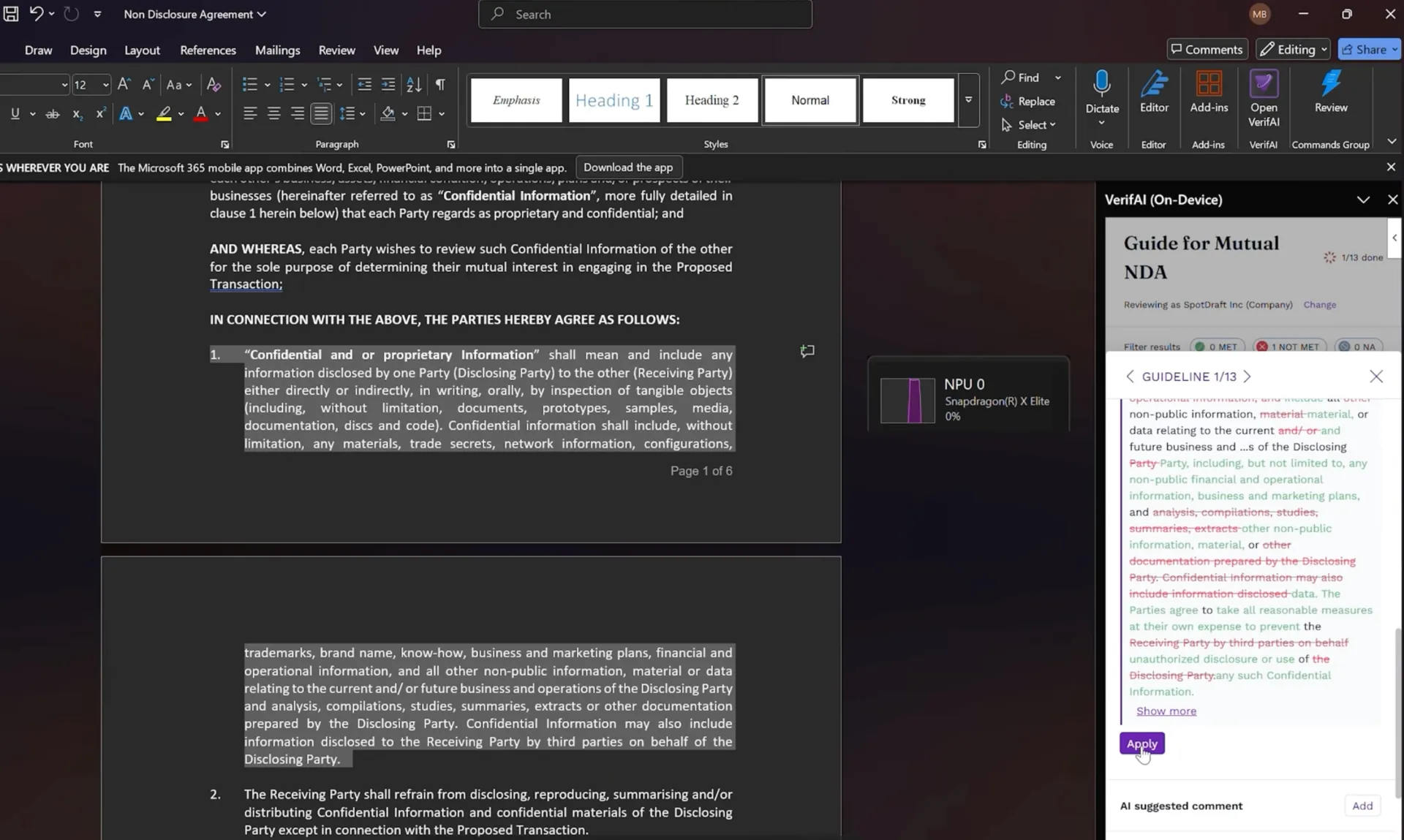
The scale figures also matter. SpotDraft is described as serving roughly 50,000 monthly active users, processing more than 1 million contracts per year, and reporting 100% year-over-year customer growth; Qualcomm Ventures’ strategic investment was reported at $8 million in January 2026.[2]
Those figures do not prove that every legal AI workflow should move to an endpoint NPU. They prove something narrower and more useful: at least one contract-focused legal AI vendor claims production-scale use of on-device inference for common contract tasks, not merely a lab demo or a privacy-themed product slide.
That narrower proof is enough to change an RFP. A buyer can now ask vendors to classify contract workflows by inference location and to explain, task by task, whether the document content, prompt text, extracted clauses, risk scores, embeddings, or generated redlines leave the endpoint. The buyer does not have to accept “private AI” as a substitute for a data-flow diagram.
It is also not a universal proof point. The public example cited here is a single-vendor deployment. Other legal AI vendors may rely on Apple Silicon, Intel NPUs, AMD Ryzen AI, conventional CPU execution, or cloud inference. Even within Qualcomm’s own roadmap, Snapdragon endpoint inference and AI200 rack-scale inference are different risk surfaces. Treating all of that as one hardware category would make the procurement record worse, not better.
How on-device inference changes the ABA 512 analysis
ABA Formal Opinion 512, issued in July 2024, frames lawyers’ use of generative AI through existing duties, including the obligation under Model Rule 1.6(c) to make reasonable efforts to prevent unauthorized disclosure or access to client information.[4] The opinion predates these specific Qualcomm NPU announcements, so it should not be cited as direct guidance on Snapdragon hardware. The useful move is analogical: if a workflow eliminates cloud transmission of content during inference, one important disclosure vector has been removed from the reasonable-efforts analysis.
That is not a cosmetic difference. In a hosted AI workflow, the firm must evaluate whether document content, prompts, uploads, outputs, logs, embeddings, and vendor support access are handled under terms that satisfy the firm’s confidentiality posture. In a verified on-device workflow, the main document content used for inference may never enter the vendor’s cloud in the first place. If the vendor never receives the content, the buyer is no longer relying solely on a contractual promise that the vendor will not retain it.
The word “verified” is doing real work. A legal team should not classify a tool as lower-risk because a marketing page says “offline.” It should require evidence that the relevant model files are local, that inference continues with network access disabled, that prompts and document snippets are not sent through telemetry, and that crash reporting or analytics do not recreate the content-transfer problem through a side channel.
This is where privacy improvement and review burden diverge. Local inference can reduce confidentiality exposure while increasing the buyer’s need to validate model behavior, updates, and output quality on managed endpoints. The separate on-device AI verification burden workflow is the right companion control: the fact that content stayed local does not prove the redline is correct, the clause extraction is complete, or the risk score is defensible.
The cloud contrast is still the right baseline
The confidentiality contrast is not theoretical. Heppner v. United States, decided in the Southern District of New York in February 2026, is reported as holding that consumer AI chats lacked a reasonable expectation of confidentiality where the platform terms permitted training use.[5] The point is not that every legal AI cloud tool has the same terms. Many do not. The point is that cloud-based AI starts with a platform relationship the lawyer must examine and control.
For a legal buyer, that means the cloud workflow still needs settings review, training exclusions, retention limits, access controls, and logging terms. A settings-level control review like the ChatGPT security settings workflow for lawyers is not replaced by a chip announcement. It is replaced only when the specific workflow no longer sends the protected content to that cloud service.
That is why procurement language should separate “no content transmission during inference” from softer language such as “data is protected,” “enterprise-grade privacy,” or “not used for training.” Those softer phrases may still matter, but they answer a different question. They describe how a vendor promises to handle data it receives. On-device inference, if proven, changes whether the vendor receives the content at all for that task.
The metadata caveat prevents the privacy halo
On-device inference does not make the workflow invisible. The metadata caveat is direct: file names, timestamps, and query-frequency patterns may remain on-device and may still be discoverable.[6] A local model can reduce content transmission without eliminating the records that show what was reviewed, when it was reviewed, by whom, and in what volume.
That matters in litigation, investigations, employment matters, and regulated environments where the fact of review can itself become sensitive. A filename may reveal a counterparty, a deal name, a witness, or a regulatory topic. A burst of queries around a custodian or document set may show work patterns even when the underlying contract text never left the laptop.
The RFP should therefore ask for a metadata map. It should cover local application logs, operating-system logs, document-management integrations, Microsoft Word add-in records, endpoint-management tools, crash reports, update checks, analytics events, and administrative dashboards. A vendor that can prove local content inference but cannot explain metadata retention has solved only part of the confidentiality problem.
What AI200 and AI250 signal, without overstating them
Qualcomm’s data-center roadmap is relevant because it confirms the second tier. The AI200 is described as a rack-scale inference product with 768 GB LPDDR per card and liquid cooling, with AI200/AI250 timing discussed across 2026 and 2027.[3] That is a cloud or hosted-inference procurement issue, not an endpoint air-gap issue.
The market signals should be kept in their lane. Qualcomm’s reported $15 billion AI chip sales target is useful context for why legal vendors and infrastructure providers may build around this stack, but it does not reduce privilege or confidentiality exposure by itself.[3] Likewise, Qualcomm’s Q2 FY2026 revenue was reported at $10.6 billion, and the company’s CEO was reported as signaling that a “major hyperscaler” AI200 deal was approaching; that customer claim had not been publicly confirmed as of the cited reporting.[7]
For legal procurement, the practical consequence is simple: do not let a vendor borrow the privacy posture of Snapdragon endpoint inference when the actual deployment is hosted on AI200-class infrastructure. A hosted Qualcomm-accelerated model still needs the cloud controls that any hosted legal AI system needs.
This is the same hardware-layer discipline that should apply across AI infrastructure diligence. Prior hardware-risk reviews, including memory shortage risk for legal AI accuracy, AMD Instinct law firm ethics, and Arm supply-gap reliability risk, all point to the same procurement habit: hardware matters only after it is tied to the legal workflow it constrains or exposes.
RFP language should classify the workflow, not the vendor slogan
A useful RFP section can be short. It should force the vendor to put each proposed AI function into an architecture tier and then attach evidence to the tier.
- For on-device inference: identify each workflow that runs locally; state whether network access is required; disclose whether document content, prompts, embeddings, snippets, outputs, or telemetry leave the endpoint; provide an offline demonstration; and describe endpoint logs and metadata retention.
- For cloud or hosted inference: identify the hosting environment and accelerator tier; provide the DPA; state training-use exclusions; disclose retention periods; list subprocessors; describe administrative and support access; provide logging and audit information; and state whether confidential-computing controls are available for the deployment.
- For hybrid workflows: separate local and hosted steps. A contract may be redlined locally but synced, stored, benchmarked, or reviewed through a cloud dashboard later. Each transition needs its own data-flow answer.
The buyer should also require a task-level matrix. Contract intake, clause extraction, risk scoring, playbook comparison, redline generation, approval routing, document storage, analytics reporting, and model improvement may not share the same architecture. If only the redline suggestion is local while analytics and learning occur in a hosted system, the confidentiality classification should reflect that split.
| Vendor answer | Procurement treatment |
|---|---|
| “The tool uses Qualcomm AI on the device.” | Ask for proof that the relevant inference continues offline and that content, prompts, embeddings, and snippets are not transmitted. |
| “The tool is accelerated by Qualcomm AI infrastructure.” | Treat as hosted inference unless the vendor proves otherwise; require DPA, retention limits, logging disclosures, access controls, and metadata terms. |
| “Customer data is not used for training.” | Keep the clause, but do not treat it as equivalent to no transmission. It controls one use of received data; it does not prove the data was never received. |
| “Zero data leaves the device.” | Define “data.” Require separate answers for document content, prompts, extracted clauses, generated outputs, metadata, telemetry, crash reports, and update checks. |
The resulting policy can recognize on-device Snapdragon-class inference as a separate confidentiality tier when the evidence supports it. That tier can justify different approval routing for certain contract-review tasks because content-transmission risk during inference has been reduced. It should not be written as a blanket approval for all AI use on a laptop.
For Qualcomm data-center acceleration, the procurement posture stays closer to ordinary cloud AI diligence. The chip may be new; the confidentiality controls are familiar: DPAs, retention limits, training restrictions, support-access controls, logging disclosures, confidential-computing representations where applicable, and metadata governance.
References
- Snapdragon X Elite Hexagon NPU and Qualcomm AI Stack materials — Qualcomm
- SpotDraft x Qualcomm partnership page; Qualcomm Ventures strategic investment press release — SpotDraft and National Law Review, January 2026
- Qualcomm AI200 and AI250 data-center inference accelerator coverage — CNBC, Forbes, NAND Research, October 2025
- ABA Formal Opinion 512 — American Bar Association / NCBE, July 2024
- Heppner v. United States — S.D.N.Y., February 2026
- The Metadata Trap — Law.com, March 2026
- Qualcomm Q2 FY2026 earnings coverage — Semicon Alpha, April 2026
Chronological incident history
No sanction cases have named this tool in the tracked record set to date. This does not imply the tool is safe — see Risk Digest for ongoing monitoring.
← Compare peer toolsReport a correction or tip
Spotted an outdated figure, a misstated fact, or a ruling this tool profile should reflect? Public comments are disabled for this content given the professional cost of a misreported case outcome, penalty amount, or rule text — use the structured correction channel instead.
Report a correction or tip for this record →