
Is Westlaw Advantage or Classic Safer for Legal Research?
Deciding between Westlaw Advantage and Classic turns on the reliability of the AI layer Advantage adds, not on feature parity. This comparison grounds the choice in benchmarked hallucination rates and documented failure modes, shows what Advantage's guardrails do and do not catch, and frames the migration as a verification-cost trade-off for litigators and legal-tech buyers.
- Tool
- Westlaw Advantage
- Benchmark source
- Stanford/Yale study, arXiv 2024
- Hallucination rate
- ~33% (Westlaw AI-Assisted Research predecessor, not Advantage Deep Research)
- Test methodology
- 202 preregistered legal queries scored for correctness and groundedness; Cohen's kappa 0.77, 85.4% inter-rater agreement
- Test date
- Jan 1, 2024
At renewal, the useful answer is narrower than most Westlaw Advantage vs Westlaw Classic comparisons make it sound. If “Classic” means the current non-generative Westlaw tier, Classic does not ask an AI system to synthesize a legal answer for you. Advantage does. That is the real safety difference.
Advantage may still be the better tool in a real litigation department. Deep Research, quote verification, KeyCite-linked sources, and document-analysis guardrails can reduce the time spent assembling and checking an answer. But those controls do not convert an AI answer into a verified legal conclusion. The strongest public reliability evidence available for Thomson Reuters’ earlier Westlaw AI-Assisted Research layer found hallucinations in roughly one in three benchmarked responses and accuracy of 42%; Lexis+ AI, in the same study, hallucinated at about 17%.[1] That is not an Advantage Deep Research hallucination rate. It is the reason Advantage should be evaluated as a verification-cost trade-off rather than treated as safer because it is newer.

First, “Westlaw Classic” has to be pinned down
“Westlaw Classic” is an unstable term. It can refer to the original Westlaw interface, which was retired on August 31, 2015, or to the later entry tier that has existed since 2018.[2] Those are not the same comparison. A lawyer comparing a dead interface to the current AI-branded platform is not making a procurement decision; a lawyer comparing today’s non-generative tier with Advantage is.
Here, Classic means the lower Westlaw tier without the generative research layer. Westlaw Advantage is the newer Westlaw version launched with CoCounsel Legal and agentic AI capabilities on August 13, 2025.[3] The question is therefore not whether Advantage has more features. It does. The question is whether those features reduce risk enough to justify introducing generated legal answers into the research workflow.
The benchmark that should slow the comparison down
The Stanford/Yale study is unusually useful because it did not ask whether legal AI tools feel polished. It preregistered 202 legal queries, evaluated answers for correctness and groundedness, and reported Cohen’s kappa of 0.77 with 85.4% inter-rater agreement.[1] That design matters because a research platform can sound cautious, cite real-looking sources, and still fail the filing lawyer’s basic test: is the proposition right, and is it supported by the cited authority?
On that benchmark, Westlaw’s AI-Assisted Research produced hallucinated responses roughly 33% of the time and accurate responses 42% of the time, the weakest accuracy result among the paid tools tested. Lexis+ AI hallucinated at about 17% in the same study. Ask Practical Law AI had a different problem: it was incomplete in more than 60% of responses.[1] Those numbers should not be flattened into a generic “AI can hallucinate” warning. They measure specific systems under a specific benchmark, and the Westlaw system measured was the pre-Advantage AI-Assisted Research layer.
That scope limit is not a technicality. No public preregistered benchmark cited here measures Westlaw Advantage Deep Research. So the right sentence is not “Advantage hallucinated one-third of the time.” The right sentence is: the closest independent public benchmark of Westlaw’s earlier generative research layer found serious reliability problems, and Advantage has not yet displaced that evidence with comparable public benchmark results.
The study also tested the industry claim that retrieval-augmented generation would “dramatically reduce hallucinations to nearly zero” and found the claim overstated.[1] That conclusion is more important than the branding. RAG can improve source access. It does not, by itself, prove that a generated legal answer is correct.
The failures were lawyer-shaped, not merely technical
The benchmark’s examples are the part a litigation team should actually read. Westlaw AI-Assisted Research fabricated a bankruptcy rule provision, stated holdings backwards in Robers v. United States and Doo v. Packwood, and discussed overruled authority without citing the fact that it had been overruled.[1] None of those errors is cured by noticing that the interface looks professional. Each one would send a junior lawyer into exactly the wrong kind of cleanup: checking whether a quoted rule exists, whether the cited case says the opposite, or whether the authority survives.
Those are also familiar failure categories outside Westlaw: invented authority, fabricated quotations, and real citations used for unsupported propositions. The site’s Knox Kercher legal AI hallucination probe tracks the same operational problem from the sanction-risk side. The dangerous answer is often not the one with no citation. It is the answer with enough citation furniture to survive a quick skim.
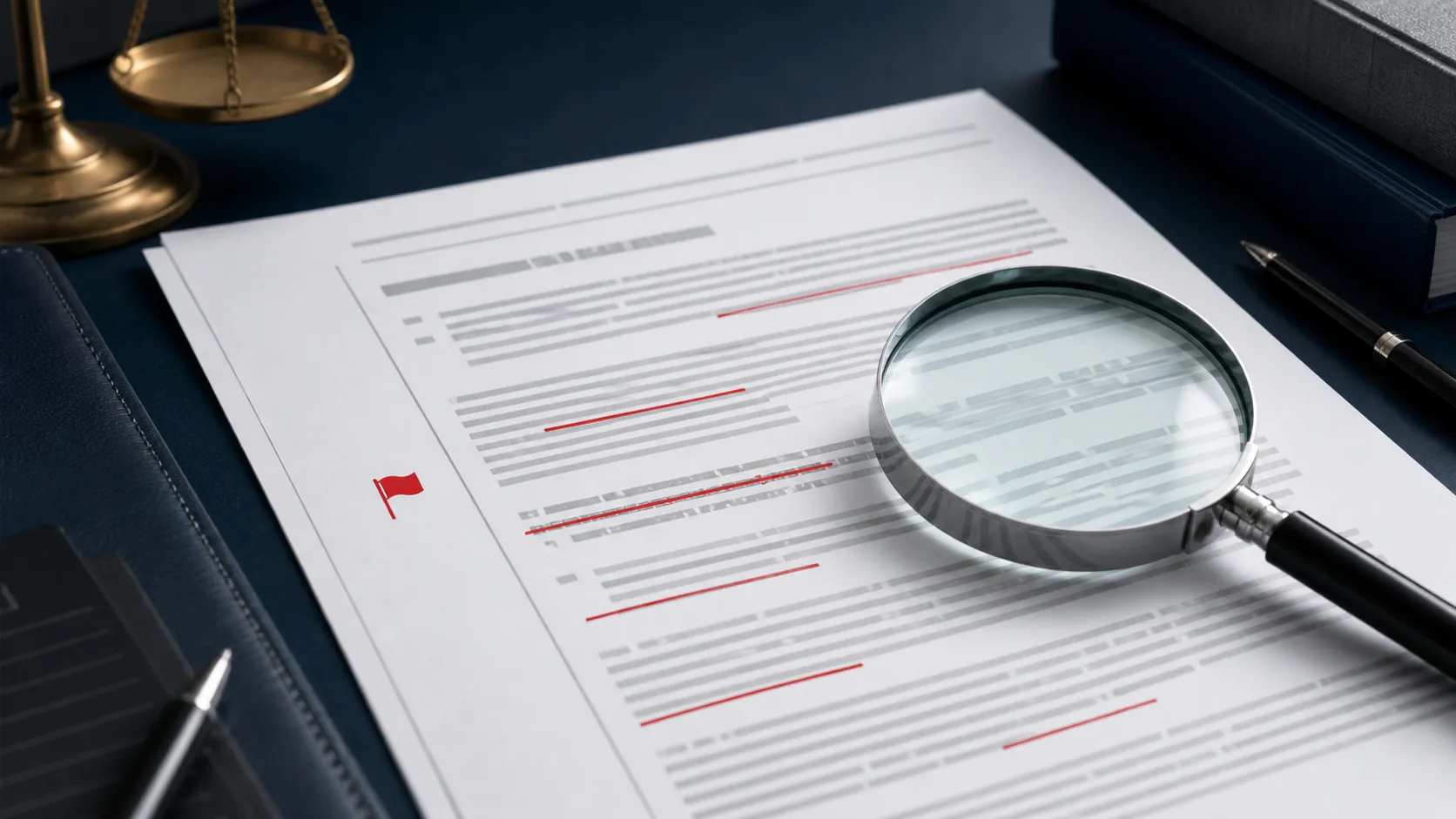
What Advantage’s guardrails actually change
Advantage is not just a renamed search screen. Thomson Reuters positioned the August 2025 launch as the new and final version of Westlaw, with CoCounsel Legal, agentic AI, and Deep Research capabilities.[3] LawNext’s launch coverage reports that Litigation Document Analyzer replaces Quick Check and adds a hallucination checker plus quote verification.[3] Penn State’s later overview describes Deep Research as running approximately 3-, 7-, or 10-minute agentic research tasks across up to three jurisdictions, and says Litigation Document Analyzer retains uploads for no more than 24 hours and reports for 48 hours.[4]
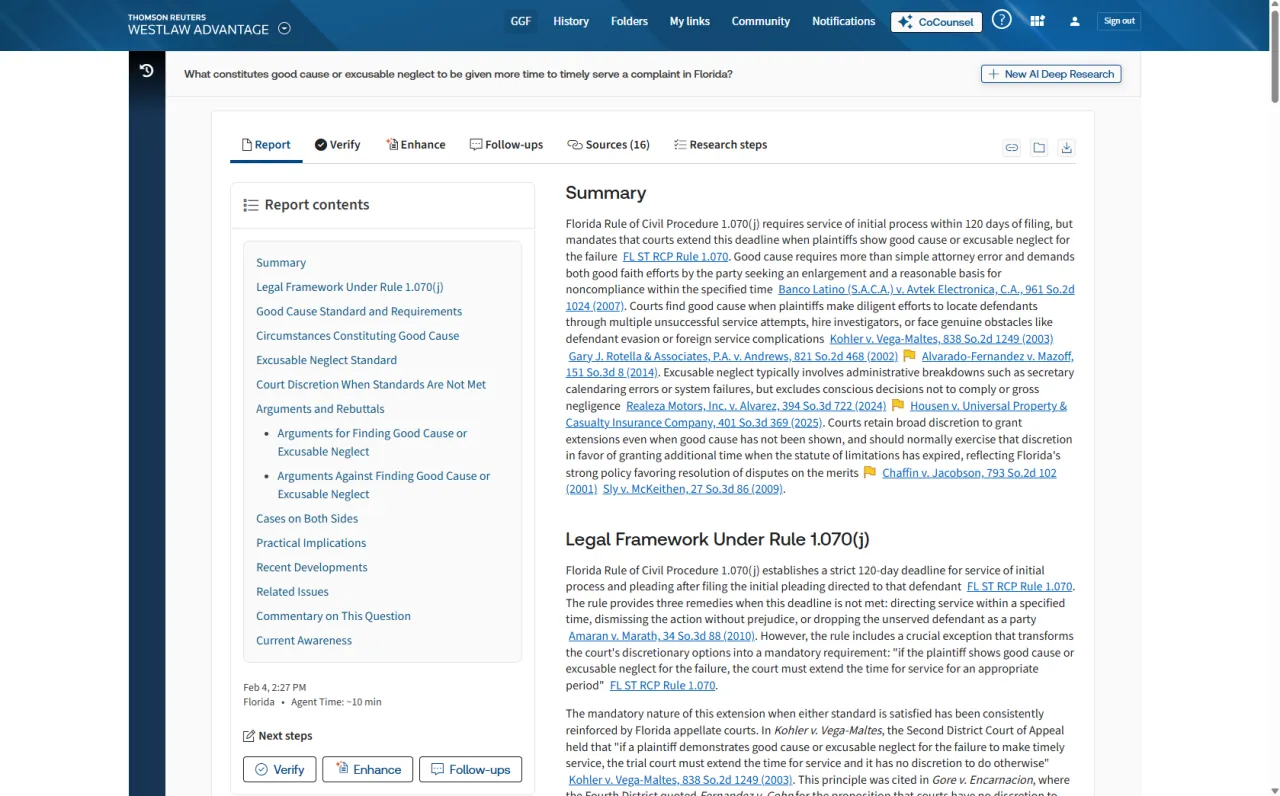
Those are real controls, and some of them are exactly the controls a legal department should want. A quote-verification feature can reduce the drudgery of matching quoted language to source text. KeyCite-linked sources make it easier to move from an AI summary to citator review. A hallucination checker may catch some unsupported statements before they travel into a draft. Deep Research reports can give a supervising lawyer a structured map of the agent’s path rather than a bare chat answer.
But feature descriptions do not report false-negative rates. They do not tell us how often the hallucination checker misses a backwards holding, how it treats a proposition that is partially supported, or whether it reliably flags a real case cited for the wrong rule. They also do not tell us whether Deep Research improves accuracy enough to offset the new review burden it creates. That distinction is where procurement comparisons usually get too cheerful: a guardrail is evidence of design attention, not evidence that the risk has been measured down to an acceptable level.
That is also the split in CoCounsel itself. Closed-document tasks and open-ended agentic legal research create different verification problems. A lawyer reviewing a document analyzer can compare output against a known record. A lawyer reviewing a generated research answer must also test the universe of omitted law, adverse authority, jurisdictional fit, and subsequent treatment. The site’s CoCounsel legal research reliability evaluation is the right companion piece for that distinction.
| Decision point | Westlaw Classic | Westlaw Advantage | Verification consequence |
|---|---|---|---|
| Generated legal answer | Not the core research mode in the current entry-tier comparison | Central to Deep Research and CoCounsel-enabled workflows | Advantage adds an answer that must be decomposed into propositions and checked |
| Source trail | Researcher builds the trail through search, headnotes, KeyCite, and documents | AI report can surface sources and link them into the workflow | May reduce source-gathering time, but the lawyer still verifies whether the cited source supports the statement |
| Quote checking | Manual comparison against source text | Quote verification is reported as part of Litigation Document Analyzer[3] | Useful control for quotation accuracy; not a full merits check |
| Hallucination control | No generative answer means no AI-generated research hallucination at that layer | Hallucination checker is reported as part of Litigation Document Analyzer[3] | A checker may lower risk, but public materials here do not measure its miss rate |
| Agentic research duration | Research time depends on lawyer workflow | Deep Research runs are described as approximately 3, 7, or 10 minutes across up to three jurisdictions[4] | Time saved on first pass must be compared with time spent auditing the final answer |
The cost question is really a review-labor question
Pricing matters in a renewal meeting, but the available materials do not support a clean price comparison, and only Advantage has a published rate in the sources cited here. More importantly, a cheaper or more expensive subscription does not answer the safety question. The relevant unit is the cost of a verified answer.
In Classic, the lawyer pays that cost up front: construct the search, read the cases, check KeyCite, and decide whether the proposition survives. In Advantage, the platform may front-load a plausible answer, collect authorities faster, and check some quotes. The lawyer then pays a different cost: break the answer into propositions, confirm each cited authority, look for omitted controlling law, and verify that adverse treatment has not been buried under a smooth summary.
That is not a reason to reject Advantage. It is a reason to pilot it against the work lawyers actually do. A motion team doing repetitive, jurisdiction-bound research may find that Deep Research gives them a faster first map. A small in-house team may value document analysis and quote verification if it reduces the number of manual checks before outside counsel review. A group that already has disciplined research checklists may get more value than a group that treats AI output as a memo substitute.
The pilot should measure verified outputs, not generated outputs. For each sample question, reviewers should record whether the answer identified the controlling source, whether every cited proposition was supported, whether contrary authority was surfaced, whether quotes matched the source, and how much lawyer time was spent after the AI report appeared. The site’s statute-first verification workflow and broader AI legal database verification workflows offer a better frame than a feature checklist.
A disciplined renewal answer
For legal research safety, Classic has one advantage that sounds unsophisticated but matters: it does not introduce a generative research layer into the core task. That does not make Classic more complete, faster, or better for every team. It means the hallucination risk being discussed here is not created at that layer.
Advantage has the more ambitious toolset. Its reported guardrails are the right kind of guardrails: source links, quote verification, hallucination checking, and structured Deep Research reports. They can reduce review labor if lawyers use them as controls rather than permission slips. They are not, on the public record available here, proof that Advantage Deep Research has solved the reliability problem measured in Westlaw’s earlier AI-Assisted Research layer.
The renewal decision should therefore be made with a narrow burden of proof. Adopt Advantage where a controlled pilot shows that its speed and guardrails reduce total lawyer time per verified answer without increasing unsupported propositions. Keep or limit Classic where the team cannot staff that verification layer or where the work does not benefit enough from AI-assisted synthesis. Until Advantage Deep Research has its own public preregistered benchmark, migration is best treated as a controlled verification-cost trade-off, not as a safety upgrade.
References
- Hallucination-Free? Assessing the Reliability of Leading AI Legal Research Tools — arXiv, 2024.
- From Westlaw to Westlaw Advantage: How the Names Tell the Story of Westlaw's Evolution — UNC Law Library, November 2025.
- Thomson Reuters Launches CoCounsel Legal with Agentic AI and Deep Research Capabilities, Along with A New and Final Version of Westlaw — LawNext, August 2025.
- From Westlaw Precision to Westlaw Advantage — Penn State Law, January 2026.
Chronological incident history
No sanction cases have named this tool in the tracked record set to date. This does not imply the tool is safe — see Risk Digest for ongoing monitoring.
← Compare peer toolsReport a correction or tip
Spotted an outdated figure, a misstated fact, or a ruling this tool profile should reflect? Public comments are disabled for this content given the professional cost of a misreported case outcome, penalty amount, or rule text — use the structured correction channel instead.
Report a correction or tip for this record →