
How to verify a client's Amazon tariff refund eligibility
An entry-by-entry verification workflow for counsel determining whether an Amazon seller or consumer holds a legally eligible IEEPA tariff refund claim. It walks through the three facts that decide eligibility—refundable tariff authority, importer of record, and liquidation status—and routes each verified claim to the correct CAPE or protest filing lane.
- Applicable role
- attorney
- Workflow stage
- pre-filing
- Primary source
- CBP IEEPA Duty Refunds guidance
Legal information only, not legal advice. Legal-background review: Rachel M. Levin, J.D. Last verified: Aug. 2, 2026, 14:00 UTC. Do not advise a client that it is eligible for an Amazon tariff refund until the file proves three entry-level facts: the refundable duty was an IEEPA duty, the client is the importer of record CBP recognizes for that entry, and the liquidation status still leaves an open filing lane. CBP’s IEEPA refund process is built around ACE/CAPE entry records and payment routing, while the refund scope described in public small-business guidance is IEEPA-specific rather than a refund of every tariff a seller or buyer may have absorbed. [1][2]

That answer is narrower than most intake calls want it to be. A seller may say Amazon collected tariff costs. A consumer may say a price increase was passed through. A platform disclosure may say Amazon received a large refund. None of those facts identifies the CBP payee for a particular entry. For the short-form eligibility answer, use the companion verdict record. This record is for the harder desk problem: proving, entry by entry, whether counsel can tell this client to file, route the matter through a broker or carrier, pursue platform pass-through, or stop.
Start the file with a hold, not an eligibility opinion
The intake response should be short and disciplined: “We cannot determine Amazon tariff refund legal eligibility from invoices, marketplace screenshots, or the fact that a tariff cost was economically borne. We need the entry packet.” That is not evasive. It prevents a bad claim from being built around the wrong actor.
Amazon’s reported Q2 2026 refund receipt is useful background, but it is not proof that any particular seller or consumer has a direct CBP claim. CNBC reported Amazon’s receipt of about $600 million in tariff refunds and Amazon’s statement that it would automatically refund customers in a “limited set of circumstances” where the tariff amount could be traced to a specific purchase; Fortune also reported the same broad controversy and the consumer-facing dispute over whether refunds should be passed back. [3][4]
The platform point that matters for verification is narrower: Amazon has stated that it is not the importer of record for the large majority of items sold in its store and that it does not pay tariffs for Fulfillment by Amazon sellers. [3][4] If that statement fits the client’s lane, counsel should be looking for the seller’s own importer-of-record documents or the broker/carrier lane, not treating Amazon’s receipt as the client’s filing credential. For the broader narrative around the reported refund amount, use the $600 million claim record.
The entry packet counsel should require
Do not begin with a damages spreadsheet. Begin with records that let the file answer three questions without guessing.
- CBP Form 7501 or equivalent entry summary, including tariff lines, duty amounts, entry number, entry date, importer number, and filer information.
- Broker packet, ACE Portal screenshots, CAPE status, notices of liquidation, bills for duties, and any post-summary correction or protest history.
- Commercial invoice, purchase order, landed-cost calculation, and marketplace or FBA documentation only as support. These do not substitute for the entry summary.
- Importer-of-record evidence: CBP importer number, CBP Form 5106 status if relevant, broker power of attorney, carrier import terms, and ACH readiness for the party that may receive payment.
- For UPS, Global SEND, or similar routed imports, the shipment documentation and carrier refund page for who files and who receives or passes through any refund.
Open a verification log before reviewing merits. Each row should carry the entry number, importer of record, tariff authority, duty amount under that authority, entry date, liquidation date or unliquidated status, available filing lane, source document reviewed, reviewer initials, and last-verified timestamp. If a later CAPE phase, appeal, or CBP instruction changes the route, the log should show what changed and when. CBP’s page expressly frames IEEPA refunds around CAPE/ACE mechanics, ACH payment setup, and procedural status, so the log should mirror those fields rather than the client’s commercial grievance. [1]
Separate the refundable authority line by line
The phrase “tariff refund” is too blunt for this file. The first legal sort is not Amazon, seller, consumer, or country of origin. It is the authority under which the duty was assessed on the entry line.
| What the record says | What counsel does next |
|---|---|
| IEEPA duty assessed during the Feb. 4, 2025 through Feb. 24, 2026 refund window | Continue to importer-of-record and liquidation review. |
| Section 301, Section 232, Section 201, AD/CVD, or MFN duty only | Do not route as an IEEPA refund claim; log the exclusion and consider any separate remedy only if supported by another authority. |
| Mixed entry with IEEPA plus surviving tariff layers | Calculate only the IEEPA component as potentially refundable and preserve the non-IEEPA layers as excluded. |
| Commercial documents mention tariffs but the entry summary is missing | Hold eligibility opinion; request Form 7501 or broker/ACE confirmation before giving a filing recommendation. |
Public guidance following the Learning Resources litigation describes the refund opportunity as limited to IEEPA duties and not a refund of Section 301, Section 232, Section 201, AD/CVD, or ordinary MFN duties. [2] That distinction is where many optimistic files fail. A client may have paid a large landed-cost increase, but if the entry line shows a surviving tariff authority rather than an IEEPA assessment inside the relevant window, the IEEPA refund process is the wrong tool.
For mixed entries, do not mark the whole entry eligible or ineligible. Mark the line. If a Form 7501 shows several duty layers, create a line-level calculation that isolates the IEEPA amount and leaves the other duties untouched. Readiness checklists and practitioner explainers have emphasized the same operational problem: refund preparation depends on separating IEEPA duties from Section 301 and other tariff layers before any filing route is chosen. [5][6]
The verification log should not say “China tariff,” “Trump tariff,” or “Amazon tariff.” It should say, for example, “IEEPA line identified on entry summary; amount isolated; non-IEEPA duties excluded; source: Form 7501 reviewed Aug. 2, 2026.” If the file concerns Canada-related imports or other layered regimes, use the same authority separation discipline; the site’s IEEPA-versus-surviving-tariff discussion is useful background, but the entry summary still controls the client memo.
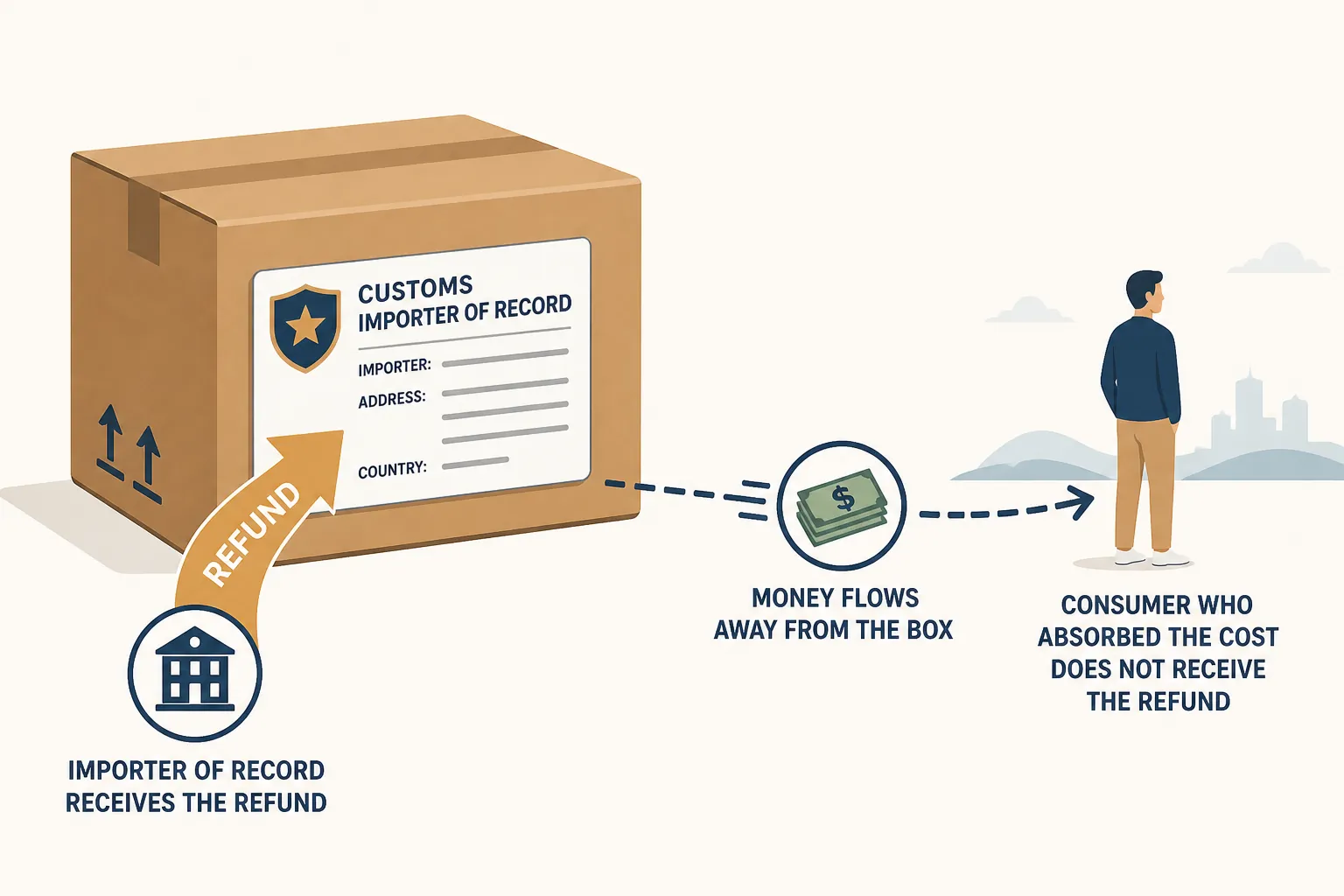
Confirm who CBP will recognize as the payee
After the duty authority is isolated, the importer-of-record field decides whether the client is in the CBP refund lane at all. Economic burden is not enough. The party that paid higher prices, reimbursed a supplier, or saw Amazon fees rise may have a commercial or litigation theory, but CBP’s refund process is built around the importer of record and the filing channel reflected in ACE/CAPE. [1]
On each entry, compare the client’s legal name, importer number, broker power of attorney, and entry summary. Do not rely on the seller account name. Do not rely on the ship-to address. Do not rely on a reimbursement line in a marketplace settlement report. The record must show who appeared as importer of record for the entry carrying the IEEPA duty.
| Importer-of-record finding | Refund eligibility consequence | What to record |
|---|---|---|
| Client is importer of record | Continue to liquidation-status routing; client may be the CBP refund claimant if the duty and timing checks also pass. | Entry number, importer number, broker filer, source document, ACH readiness, last-verified timestamp. |
| Amazon is importer of record | Client seller or buyer should not be advised to file a direct CBP claim for that entry; analyze Amazon’s traceable auto-refund statement, contract terms, or pass-through remedies instead. | Amazon IOR evidence, client relationship to transaction, amount allegedly passed through, platform/refund route noted. |
| UPS, broker, or carrier lane appears to control filing | Route through the carrier or broker procedure before promising direct filing; confirm who files and how any refund is remitted. | Carrier terms, shipment number, entry number if available, carrier refund page reviewed, contact opened. |
| IOR cannot be confirmed | Hold the eligibility opinion. | Missing records list and client/broker request date. |
The UPS/Global SEND branch deserves particular care because the client may have an Amazon seller account and still not be the importer CBP recognizes for the relevant entry. UPS maintains its own tariff-refund page for international shipments, and that page should be checked against the shipment record before counsel assumes the seller can file directly. [7] If the carrier or broker will file on behalf of the importer lane, the client memo should say that plainly and should not describe the client as a direct CBP claimant unless the entry record supports it.
CBP also warns that IEEPA duty refund filing carries no CBP fees and that importers should be alert to third-party solicitations. [1] That warning belongs in the client communication if a seller has brought in a refund vendor, especially where the vendor’s intake form asks for a percentage of a recovery before anyone has checked the IOR field.
Route the claim by liquidation status
A file can pass the authority and IOR checks and still be procedurally closed. Liquidation status is not a back-office detail. It decides whether the file belongs in CAPE Phase 1, a protest, or a no-filing memo.
| Entry status | Procedural lane | Who should act | Verification note |
|---|---|---|---|
| Unliquidated entry | CAPE Declaration in the ACE Portal under CBP’s Phase 1 process | Importer of record or properly authorized filer/broker | Confirm ACE access, importer account, entry number, IEEPA duty amount, and ACH payment setup. |
| Liquidated entry within 80 days of liquidation | CAPE Declaration in the ACE Portal under CBP’s Phase 1 process | Importer of record or properly authorized filer/broker | Record liquidation date and calculate the 80-day window from the notice. |
| Liquidated entry outside the 80-day CAPE window but within 180 days of liquidation | CBP protest | Importer of record or authorized representative | Record protest deadline, protest basis, entry lines, and excluded non-IEEPA duties. |
| Liquidated entry beyond the 180-day protest window | No direct CBP refund filing lane identified from current guidance | Counsel prepares closed-lane memo unless another preserved remedy exists | Record the liquidation date, missed deadline, and any non-CBP pass-through or litigation issue. |
CBP’s current IEEPA refund page states that Phase 1 allows CAPE Declarations for unliquidated entries and entries within 80 days of liquidation, while entries liquidated more than 80 days earlier must proceed by protest if they are still within the 180-day protest period. [1] The same page states that refunds are ACH-only and that payment is expected within 60 to 90 days after processing, so ACH readiness is not a clerical afterthought. [1]
For unliquidated or recently liquidated entries, the practical question is usually ACE/CAPE access: who has the importer account, who has the broker relationship, and whether the CAPE Declaration can be made with the correct entry and duty data. For older liquidated entries still inside the protest period, the file shifts from declaration mechanics to protest drafting and deadline control. For entries beyond the protest period, counsel should stop using the word “eligible” unless another preserved procedural basis exists.
Do not average deadlines across a shipment group. If ten entries appear in the same client spreadsheet, they may have ten liquidation dates and more than one filing lane. The memo should route each entry separately, even if the client wants one yes-or-no answer.
Consumer and pass-through branches are real, but they are not CBP filing lanes
Consumers have a legitimate frustration: if a tariff was built into the price they paid, a later refund to an importer can feel like a windfall. The legal verification question is different. CBP does not refund a retail buyer because the buyer absorbed the economic burden. The direct CBP question remains who was importer of record for the entry.
Amazon’s stated auto-refund position matters only for a traceable subset: where Amazon can identify that a tariff amount was paid and connected to a customer purchase, it has described a limited auto-refund commitment. [3][4] That is a platform refund route, not proof that the consumer can file a CAPE Declaration or protest with CBP.
Consumer-side materials and class-action pages frame the dispute as a pass-through and retention problem rather than a direct CBP entitlement problem. ConsumerShield describes consumer eligibility around pass-through theories, and Hagens Berman’s Amazon import-tariff case page presents the consumer claim as litigation over refunds retained after tariff charges allegedly reached buyers. [8][9] ClassAction.org and Spectrum News have reported similar allegations and related lawsuits, including claims that Amazon did not seek or pass through certain tariff refunds. [10][11]
Those allegations may matter for consumer claims, platform communications, arbitration strategy, or class-action monitoring. They should not be copied into an importer refund memo as if they establish CBP eligibility. For the litigation posture, use the Amazon tariff lawsuit explainer and the broader consumer tariff class-action tracker. The verification log should mark these matters as “no direct CBP filing unless IOR evidence changes.”
What the final client memo should be able to say
A defensible memo does not need a long history of the tariff litigation. It needs enough record support that a partner, broker contact, or in-house lawyer can see why the file went down one lane and not another.
- For each entry reviewed, identify the tariff authority and state whether the potentially refundable amount is limited to IEEPA duties assessed during the Feb. 4, 2025 through Feb. 24, 2026 window.
- Name the importer of record shown in the entry records and state whether the client, Amazon, a broker, UPS, or another party controls the refund route.
- State the liquidation status, liquidation date if applicable, and procedural lane: CAPE Declaration, protest, carrier/broker process, platform pass-through, litigation monitoring, or closed.
- Confirm ACH readiness where the client is the importer of record and the CBP lane is open.
- Attach or cite the exact source record for each conclusion, with reviewer initials and last-verified timestamp.
That posture leaves little room for the usual ambiguity. If the entry shows IEEPA duties, the client is the importer of record, and the liquidation date leaves CAPE or protest open, the file can move. If the entry shows only excluded tariff layers, names another importer, or sits beyond the procedural window, the client may still have a commercial complaint, but not the direct CBP refund claim it called about.
References
- IEEPA Duty Refunds — U.S. Customs and Border Protection.
- Tariff Refunds FAQ: What Small Businesses Need to Know After Supreme Court’s Ruling — U.S. Chamber of Commerce.
- Amazon Trump tariff refunds — CNBC, July 30, 2026.
- Amazon 600 million tariff refunds wallet lawsuit Bezos Trump — Fortune, July 31, 2026.
- IEEPA tariff refund readiness checklist — Baker Tilly.
- IEEPA vs Section 301 tariffs — Ayar Law.
- Tariff Refunds — UPS.
- IEEPA tariff refund eligibility — ConsumerShield.
- Amazon Import Tariff Consumer Class Action — Hagens Berman.
- Amazon not seeking tariff refunds to curry favor with Trump, class action lawsuit alleges — ClassAction.org.
- Lawsuits: Amazon pass tariff refunds back to customers IEEPA duties — Spectrum News, June 22, 2026.
Grounded in
This procedure is grounded in CBP IEEPA Duty Refunds guidance, independent of any single documented case. See the Regulation tracker for the governing text.
Cases this step would have prevented
No cases have been explicitly linked to this checklist yet. See Risk Digest for documented incidents generally.
← Back to WorkflowsReport a correction or tip
Spotted an outdated figure, a misstated fact, or a ruling this workflow checklist should reflect? Public comments are disabled for this content given the professional cost of a misreported case outcome, penalty amount, or rule text — use the structured correction channel instead.
Report a correction or tip for this record →