
AI Ethics in Legal Practice 2026: The Rules, the Sanctions, and the One-Page Policy Your Firm Needs
This action-oriented reference for in-house counsel, compliance officers, and risk managers synthesizes the escalating sanctions trajectory ($5K to $110K), the four-duty framework from ABA Formal Opinion 512 and Florida Bar Opinion 24-1, and a ready-to-adapt traffic-light policy template to close the governance gap.
Introduction: The Enforcement Reality Has Arrived
In June 2023, a federal judge in the Southern District of New York sanctioned two attorneys $5,000 for submitting a brief that cited six nonexistent cases generated by ChatGPT. The case, Mata v. Avianca, was widely treated as a cautionary tale — an embarrassing but isolated incident. By December 2025, a district court in Oregon imposed sanctions exceeding $110,000 in Couvrette v. Wisnovsky, signaling that judicial tolerance for AI-generated errors had evaporated.
The sanctions trajectory tells a clear story. In Mata (S.D.N.Y., 2023), the court imposed a $5,000 penalty and required the attorneys to notify their client and the opposing party. In Lacey v. State Farm (C.D. Cal., May 2025), the sanction rose to $31,000. By Couvrette (D. Or., Dec. 2025), the court ordered more than $110,000 in sanctions, fees, and related monetary consequences. The message is unambiguous: courts expect attorneys to verify AI-generated work product, and the cost of failing to do so is rising rapidly.
This article is designed for in-house counsel, compliance officers, law firm ethics partners, and risk managers who need a concise but authoritative reference on current AI ethics obligations and how to operationalize them. It synthesizes the key cases, the four-duty framework from ABA Formal Opinion 512 and Florida Bar Opinion 24-1, and a ready-to-adapt traffic-light policy template. For readers who want a deeper case-by-case analysis of citation hallucination sanctions, see our companion piece, AI Citation Hallucination Sanctions in Federal Courts.
The Five Ethics Questions Every Firm Faces in 2026
Before examining the specific rules and sanctions, it is worth identifying the practical dilemmas that drive the need for a formal AI policy. Every firm that has adopted or is considering AI tools must answer five questions:
- Can we use AI for client work? The answer is yes — but with conditions. Both ABA Formal Opinion 512 and Florida Bar Opinion 24-1 affirm that lawyers may use AI, provided they do so competently and ethically.
- How do we protect confidentiality? Feeding client confidences into a public AI tool like the free version of ChatGPT may waive attorney-client privilege. Enterprise platforms with contractual confidentiality and zero-data-retention policies are the safer choice.
- Who supervises AI outputs? Model Rule 5.3 extends a lawyer's supervisory obligations to non-lawyer assistants — and both ABA 512 and Florida 24-1 confirm that this duty applies to AI tools as well.
- How do we bill for AI-assisted work? Rule 1.5 prohibits billing clients for hours that AI saved. Firms must develop a clear policy on how AI time savings are reflected in invoices.
- What do we tell clients? Florida Opinion 24-1 requires disclosure when AI chatbots are used in client communications. More broadly, informed client consent may be required before feeding confidential information into self-learning AI tools.
These questions are not hypothetical. The 8am 2026 Legal Industry Report, surveying more than 1,300 legal professionals, found that 69% now use general-purpose AI tools for work — more than double the 31% reported in 2025. Yet 54% of firms provide no training on responsible AI use, and 43% have no formal AI policy and no plans to create one. Only 9% reported having a written and actively enforced policy.
Florida Bar Opinion 24-1: The Four-Duty Framework
In January 2024, the Florida Bar became one of the first state bars to issue formal ethics guidance on generative AI. Florida Bar Opinion 24-1 establishes four core duties that every lawyer using AI must satisfy. While the opinion is specific to Florida, its framework has been cited approvingly in other jurisdictions and aligns closely with the later ABA Formal Opinion 512.
1. Confidentiality (Rule 4-1.6)
Lawyers must research their AI provider's data retention and sharing policies before inputting any client information. Public AI tools that use input data for model training pose a direct threat to attorney-client privilege. Enterprise platforms with contractual confidentiality provisions and zero-data-retention policies are better positioned to satisfy this duty.
2. Supervision (Rule 4-5.3)
The duty to supervise non-lawyer assistants extends to AI tools. This means a lawyer must understand the AI tool's capabilities and limitations well enough to evaluate its output. Blind reliance on AI-generated content — whether research, drafting, or analysis — violates this duty.
3. Fees (Rule 4-1.5)
A lawyer cannot bill a client for hours that AI saved. If a task that previously took four hours now takes one hour with AI assistance, the client should be billed for one hour — not four. This requires firms to track time honestly and adjust billing practices to reflect AI-driven efficiencies.
4. Advertising (Rule 4-7.1)
If a firm uses an AI chatbot to communicate with prospective clients, that fact must be disclosed. The opinion requires transparency about when a client or potential client is interacting with an AI system rather than a human attorney.
ABA Formal Opinion 512: The National Framework
On July 29, 2024, the American Bar Association issued Formal Opinion 512, providing national-level guidance on the ethical use of generative AI. The opinion does not create new rules — it interprets existing Model Rules in the context of AI. Its key requirements align with and extend the Florida framework.
- Reasonable understanding: Lawyers must have a reasonable understanding of the capabilities and limitations of any AI tool they use. This does not require a computer science degree, but it does require enough knowledge to evaluate the tool's output critically.
- Informed client consent: Before feeding confidential client information into a self-learning AI tool — one that uses input data to improve its model — lawyers must obtain the client's informed consent. This is a direct application of the confidentiality duty under Model Rule 1.6.
- Supervision of AI outputs: Model Rule 5.3 applies to AI-generated work product. A lawyer must review and verify all AI-generated content before using it in client matters. This includes checking citations, legal reasoning, and factual assertions against primary sources.
ABA 512 is significant because it provides a nationally recognized standard that courts and bar associations are likely to reference in disciplinary proceedings. For a deeper dive on the duty of technological competence under Model Rule 1.1, see our glossary entry: ABA Model Rule 1.1 and AI: The Duty of Technology Competence for Attorneys.
The Sanctions Line: From $5,000 to $110,000
The most effective way to understand the current enforcement climate is to trace the sanctions trajectory across three key cases. Each represents a step change in judicial intolerance for AI-generated errors.
| Case | Court | Date | Sanction | Key Fact |
|---|---|---|---|---|
| Mata v. Avianca | S.D.N.Y. | June 2023 | $5,000 | Attorneys submitted brief with six fabricated cases generated by ChatGPT. |
| Lacey v. State Farm | C.D. Cal. | May 2025 | $31,000 | AI-generated citations went unchecked; court imposed escalating sanctions. |
| Couvrette v. Wisnovsky | D. Or. | Dec. 2025 | $110,000+ | Sanctions, fees, and related monetary consequences for AI citation errors. |
The pattern is clear: courts are moving from modest penalties designed to educate, to substantial sanctions intended to deter. The Couvrette sanction of more than $110,000 signals that AI-generated errors are no longer treated as a novel problem — they are treated as a failure of professional responsibility.
The Emerging Privilege Split: Heppner vs. Warner
Beyond sanctions, a critical new risk emerged in February 2026: a federal split on whether AI-assisted work product is protected by attorney-client privilege. In Heppner v. XYZ Corp. (S.D.N.Y., Feb. 2026), the court held that work product generated using a public AI tool was not privileged because the tool's terms of service allowed the provider to access and use input data. In Warner v. ABC Inc. (E.D. Mich., Feb. 2026), a different court reached the opposite conclusion, finding that the enterprise AI platform used by the law firm had contractual confidentiality provisions that preserved privilege.
This split creates significant uncertainty for firms using AI tools. The safest course is to use enterprise AI platforms with contractual confidentiality guarantees and zero-data-retention policies — and to document those protections as part of any privilege analysis.
The Prompt → Verify → Audit Framework
To operationalize the duties outlined in ABA 512 and Florida 24-1, firms need a repeatable verification protocol. The Prompt → Verify → Audit framework provides a structured approach that can be integrated into any workflow.
- Prompt with clear instructions and context. Provide the AI tool with specific, unambiguous instructions. Include relevant jurisdiction, procedural context, and desired output format. A well-crafted prompt reduces — but does not eliminate — the risk of errors.
- Verify every citation, fact, and reasoning against primary sources. This is the non-negotiable step. Every case citation, statutory reference, and factual assertion generated by AI must be checked against a verified legal database. The ABA's 10-step checklist provides a detailed framework for this review.
- Audit the process with documented sign-off. Maintain a record of the AI tool used, the prompt provided, the verification steps taken, and the attorney who reviewed and approved the final output. This documentation is critical for demonstrating compliance in the event of a dispute or disciplinary inquiry.
The ABA's 10-step checklist for reviewing AI-generated legal content includes: using firm-approved tools, confirming security and confidentiality (Zero Data Retention, SOC 2 Type II), checking factual accuracy, cross-checking sources against verified legal databases, analyzing reasoning quality (IRAC/CRAC), confirming correct jurisdiction, looking for bias or mischaracterization, verifying formatting and procedural rules, ensuring ethical compliance with ABA Model Rules and state rules, and requiring final human sign-off.
Traffic-Light Policy Template: Red, Yellow, Green
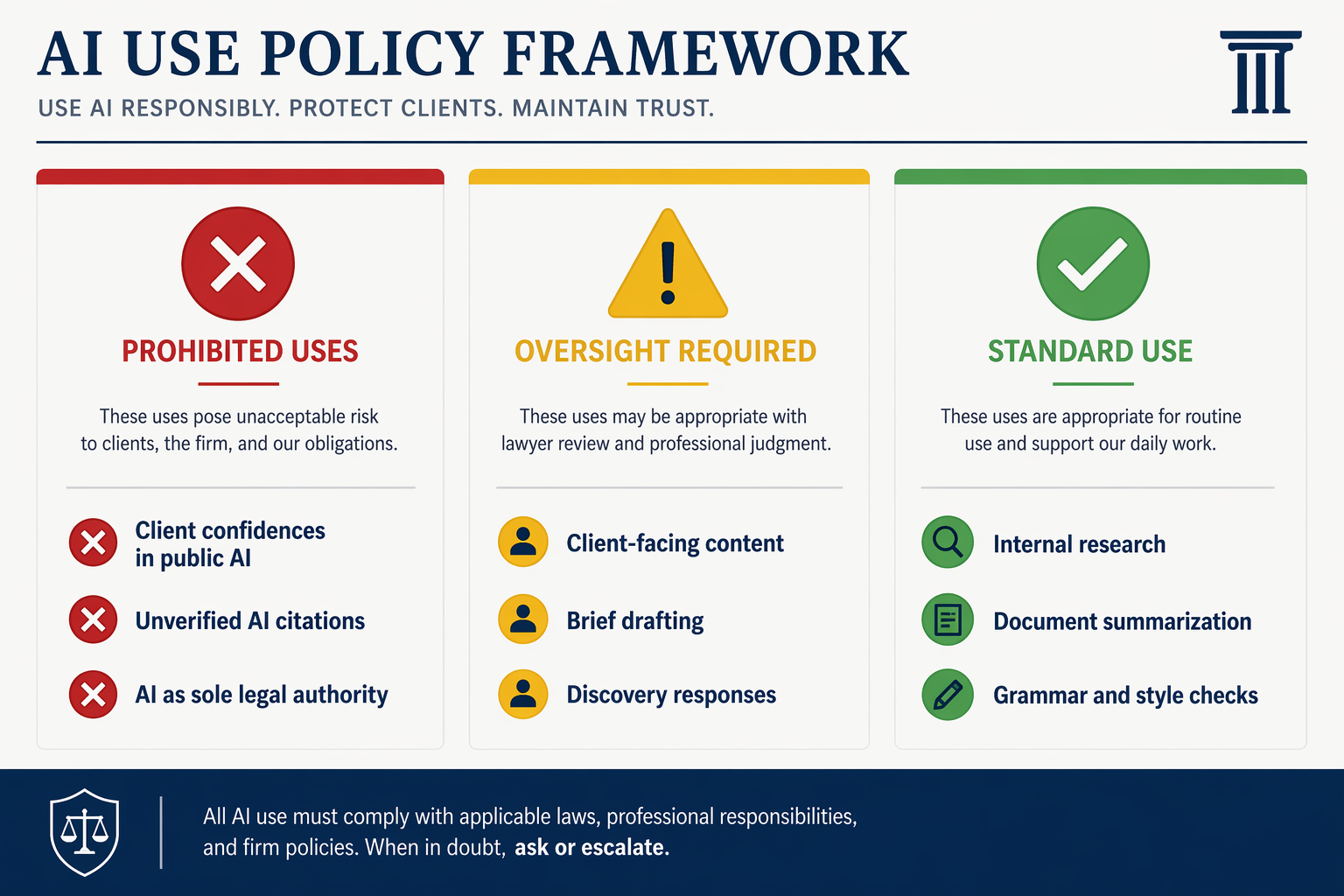
A one-page traffic-light policy is the most practical way to communicate AI usage rules across a firm. It categorizes AI use into three zones — prohibited, oversight required, and standard use — making it easy for every attorney and staff member to understand what is and is not allowed.
| Zone | Definition | Examples | Requirements |
|---|---|---|---|
| Red — Prohibited | Uses that pose an unacceptable risk to client confidentiality, privilege, or professional responsibility. | Inputting client confidences into public AI tools; submitting AI-generated citations without verification; using AI as the sole authority for legal analysis. | Zero tolerance. Violations trigger immediate review and potential disciplinary action. |
| Yellow — Oversight Required | Uses that carry moderate risk and require attorney supervision and verification. | Drafting client-facing communications; generating initial drafts of briefs or motions; preparing discovery responses. | Mandatory human review and verification against primary sources. Documented sign-off required. |
| Green — Standard Use | Uses that carry low risk and can be performed with standard professional judgment. | Internal legal research (with citation verification); document summarization; grammar and style checks; brainstorming and outlining. | Standard professional responsibility obligations apply. No additional restrictions beyond firm-wide AI policy. |
Vendor Due Diligence Checklist
Before adopting any AI tool, firms should conduct a structured due diligence review. The following seven-question checklist covers the key areas identified by ABA 512, Florida 24-1, and the NC Bar Association's guidance.
- Does the vendor offer a contractual guarantee of data confidentiality? Look for provisions that explicitly state client data will not be used for model training.
- Does the tool have a Zero Data Retention policy? Input data should be deleted after the session ends, not stored for future use.
- Is the tool SOC 2 Type II certified? This certification provides independent verification of the vendor's security controls.
- Does the tool provide citation verification? Some legal AI tools include built-in citation checking against verified legal databases.
- What jurisdictions does the tool support? Ensure the tool's training data and knowledge base cover the jurisdictions where your firm practices.
- Does the vendor provide transparency about the model's limitations? Look for documented accuracy benchmarks and known failure modes.
- Can the tool be configured to comply with your firm's data retention and deletion policies? Enterprise-grade tools typically offer administrative controls for this purpose.
90-Day Implementation Checklist
Moving from no policy to an enforced traffic-light policy is achievable within 90 days. The following timeline provides a structured path, drawing on implementation advice from the ABA, the NC Bar Association, and the Clio policy template.
| Phase | Timeline | Key Actions |
|---|---|---|
| Audit current AI use | Weeks 1–2 | Survey all attorneys and staff to identify which AI tools are currently in use. Document use cases, data types input, and any existing informal policies. |
| Draft policy | Weeks 3–4 | Draft a traffic-light policy based on the template above. Include the vendor due diligence checklist and the Prompt→Verify→Audit framework. |
| Partner/ethics committee review | Weeks 5–6 | Present the draft policy to firm leadership and the ethics committee. Revise based on feedback. Ensure alignment with applicable state bar guidance. |
| Firm-wide training | Weeks 7–8 | Conduct mandatory training sessions covering the policy, the Prompt→Verify→Audit framework, and the consequences of non-compliance. Document attendance. |
| Rollout and documentation | Weeks 9–10 | Publish the final policy. Distribute a one-page summary. Implement documentation requirements for AI-assisted work product. |
| First review cycle | Weeks 11–12 | Conduct the first policy review. Gather feedback from attorneys and staff. Identify any gaps or ambiguities. Schedule the next review (recommended: every six months). |
For a broader analysis of the governance gap between individual AI adoption and institutional readiness, see our companion article: Legal AI in 2026: The Governance Gap Between Individual Adoption and Institutional Readiness. And for a detailed rule-by-rule analysis of professional responsibility rules triggered by AI hallucinations, see AI Hallucinations and Attorney Ethics: Which Professional Responsibility Rules Are Triggered and How Sanctions Have Escalated.
Grounded in
This procedure is grounded in the cited rule or opinion, independent of any single documented case. See the Regulation tracker for the governing text.
Cases this step would have prevented
No cases have been explicitly linked to this checklist yet. See Risk Digest for documented incidents generally.
← Back to WorkflowsReport a correction or tip
Spotted an outdated figure, a misstated fact, or a ruling this workflow checklist should reflect? Public comments are disabled for this content given the professional cost of a misreported case outcome, penalty amount, or rule text — use the structured correction channel instead.
Report a correction or tip for this record →