
Building AI Compliance Governance Infrastructure: A Practical Guide for Legal and Compliance Teams
This guide provides compliance officers, legal operations managers, and risk officers with a structured, operational approach to building the AI governance infrastructure regulators now demand — including AI inventories, risk classification systems, model lifecycle controls, and continuous monitoring programs.
What Regulators Now Expect: From Principles to Enforceable Rules
The compliance conversation has shifted. Through 2024 and most of 2025, regulatory guidance on AI was largely aspirational — frameworks, white papers, and voluntary principles. That era ended. As Joe Knight, senior managing director at FTI Consulting, put it, "AI governance in 2026 is moving from high-level principles to enforceable rules." The practical consequence for legal and compliance teams is that a policy document sitting in a shared drive no longer constitutes a defensible compliance posture.
Regulators across jurisdictions are converging on a specific set of operational expectations. These are not abstract recommendations. They are the documented, auditable artifacts that enforcement bodies will request when investigating an AI-related incident or conducting a routine examination. The core requirements, as synthesized from multiple law firm and advisory sources, include:
- Documented AI inventories: A complete catalog of every AI system in use across the organization, including those embedded in third-party SaaS products and those deployed by individual business units without central IT approval (shadow AI).
- Risk classifications: Each AI system must be assigned to a risk tier — high, medium, or low — based on factors such as the consequence of an erroneous output, the sensitivity of data processed, and the regulatory exposure of the use case.
- Third-party due diligence: AI tools procured from vendors, including AI features embedded in existing SaaS platforms, must undergo the same scrutiny as internally developed systems.
- Model lifecycle controls: From procurement through retirement, each model must have documented validation gates, version control, and a decommissioning process.
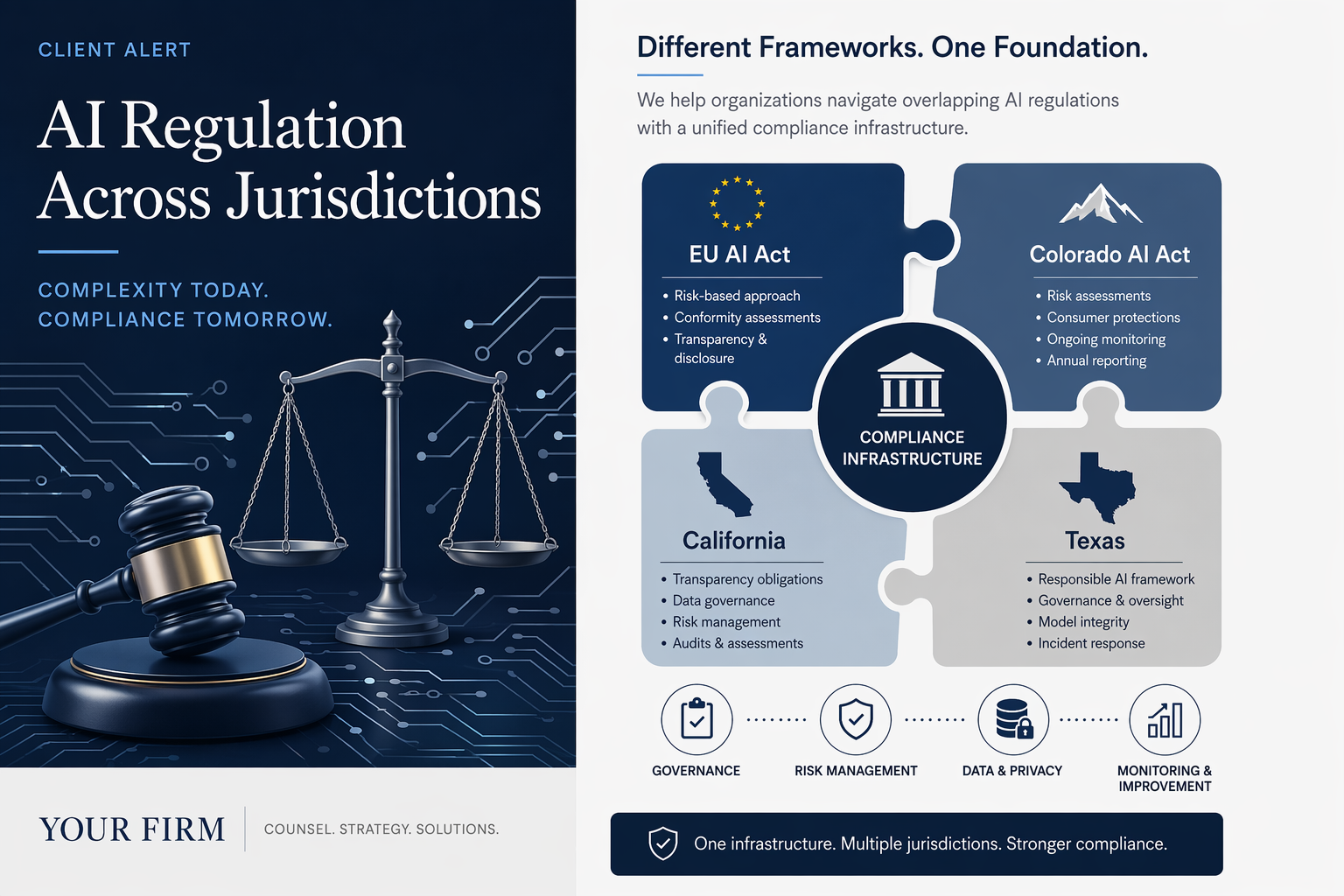
The EU AI Act's enforcement date for high-risk AI systems — August 2, 2026 — is the most prominent deadline on the calendar, with non-compliance fines reaching up to €35 million or 7% of global annual turnover. But it is far from the only one. The Colorado AI Act, originally enacted as SB 205, was repealed and replaced by SB 189 in May 2026, shifting from a duty-of-care model to a disclosure-based framework effective January 1, 2027, enforced exclusively by the Colorado Attorney General. State attorneys general across the country are also bringing enforcement actions under generally applicable consumer protection statutes, even where no specific AI law exists.
For a deeper analysis of the enforcement trends driving this shift — including FTC actions, SEC scrutiny, and insurance market responses — see our companion article, AI Compliance in 2026: The Enforcement Shift. The remainder of this guide focuses on what to do about it.
The Compliance Function Under Strain: Why Policy-on-Paper No Longer Works
The demand for operational AI governance arrives at a moment when compliance teams are already stretched thin. According to Diligent data cited by Governance Intelligence, 61% of compliance teams report experiencing "regulatory complexity and resource fatigue." This is not a marginal challenge — it is the prevailing condition of the function. Adding a new AI compliance program on top of existing obligations without structural support is a recipe for performative compliance.
The data on organizational readiness is sobering. AIMultiple reports that only 4% of organizations have a cross-functional team dedicated to AI compliance. While 47% have some form of AI risk management framework, 70% lack ongoing monitoring and controls. In other words, nearly half of organizations have recognized the need for a framework, but the vast majority have not operationalized it beyond the initial documentation stage.
The implication is clear: adding another policy document to the compliance library will not meet regulatory expectations. Regulators are, as Cimplifi notes, "less interested in aspirational ethics statements and more focused on demonstrable controls." The infrastructure described in the following sections is designed to be built incrementally — starting with the highest-risk AI systems — and to scale as resources allow. The goal is not perfection on day one, but a functioning, auditable system that can demonstrate continuous improvement.
Building Block 1: Cross-Functional AI Governance Committees
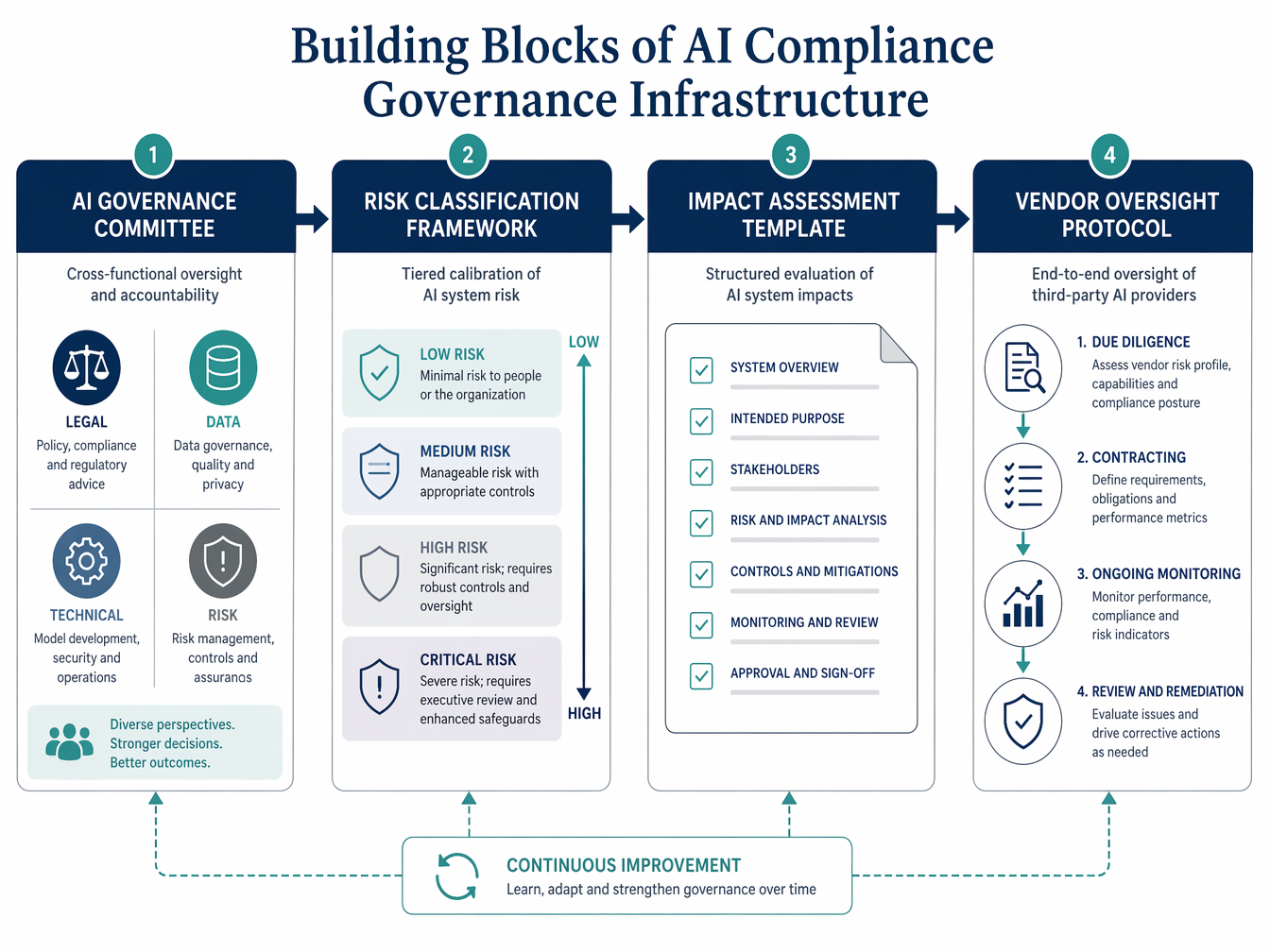
The first and most consequential decision an organization makes about AI governance is who sits at the table. AI compliance is not a legal problem, a technology problem, or a business problem — it is all three simultaneously. A governance committee that excludes any of these perspectives will produce blind spots that regulators will exploit.
Morgan Lewis advises that organizations "consider establishing cross-functional AI governance committees that include legal, compliance, technology, and business stakeholders." Gunderson Dettmer similarly recommends forming an AI governance group as a cross-functional team. The RAILS AI Risk Management Framework, designed specifically for corporate legal teams, places governance as the fourth of its eight steps, after risk understanding, categorization, and prioritization.
| Stakeholder Group | Primary Role on Committee | Key Contribution |
|---|---|---|
| Legal / Compliance | Chair or co-chair; regulatory interpretation | Maps obligations to controls; owns regulatory filings and audit defense |
| Data Governance / Privacy | Data classification and lineage | Determines which data can be used for which AI purposes; manages consent and retention |
| Technology / Engineering | Model inventory and technical risk assessment | Maintains the AI system registry; conducts technical validation and bias testing |
| Business / Product | Use case justification and prioritization | Defines business value; owns the decision to deploy or retire a model |
| Risk / Audit | Independent challenge and KRI monitoring | Provides second-line oversight; escalates control failures to board-level risk committees |
The committee's charter should define:
- Decision rights — which AI systems require committee approval before deployment, and which can be approved at the business-unit level under delegated authority
- Meeting cadence — monthly for operational oversight, quarterly for strategic review, and ad hoc for incident response
- Escalation path — how unresolved disagreements between legal, technology, and business stakeholders are resolved, including a defined appeal to the board or a designated executive
- Documentation requirements — minutes, decisions, and rationales must be recorded and retained as part of the audit trail
Building Block 2: AI Inventory and Risk Classification Systems
You cannot govern what you cannot see. The single most important operational artifact an organization can produce is a complete, living inventory of every AI system in use. This includes not only the obvious candidates — generative AI tools like ChatGPT Enterprise or Harvey — but also AI features embedded in existing SaaS products: contract analytics in a CLM platform, resume screening in an HR system, fraud detection in a payments processor, and predictive coding in an eDiscovery tool.
The inventory should capture, at minimum:
- System name, vendor, and version
- Deployment model (cloud-hosted, on-premises, hybrid)
- Primary use case and business owner
- Data inputs and outputs, including data sensitivity classification
- Risk tier assignment (high, medium, low)
- Last risk assessment date and next review date
- Status (production, pilot, retired)
Once the inventory is established, each system must be classified by risk tier. The RAILS framework's second step — "Categorize and Calibrate" — provides a useful methodology. High-risk systems are those where an erroneous AI output could cause significant harm: denial of credit or employment, incorrect legal advice, misdiagnosis in a healthcare context, or decisions affecting individual rights. Medium-risk systems have moderate consequences, such as internal process automation where errors cause inefficiency but not legal harm. Low-risk systems include internal chatbots, document summarization tools, and other辅助 functions with limited decision authority.
| Risk Tier | Examples | Governance Requirements |
|---|---|---|
| High | AI-driven hiring decisions, credit underwriting, legal research tools used for client advice, healthcare diagnostic support | Full impact assessment; bias audit; human-in-the-loop mandate; quarterly committee review; incident response plan |
| Medium | Contract clause extraction, internal knowledge base Q&A, eDiscovery predictive coding, compliance monitoring alerts | Abbreviated impact assessment; annual bias check; documented human oversight; semi-annual review |
| Low | Internal meeting transcription, document formatting, email drafting assistance, calendar scheduling AI | Self-certification by business owner; annual inventory verification; no formal impact assessment required |
Building Block 3: Impact Assessments and Model Lifecycle Controls
An AI impact assessment is the operational document that translates risk classification into specific controls. It is the artifact that regulators will request first in an investigation. The RAILS framework's eight-step process provides a structured approach, and Gunderson Dettmer's guidance on "embedding compliance-by-design" reinforces the need to integrate these assessments into the procurement and development lifecycle rather than treating them as after-the-fact paperwork.
A comprehensive AI impact assessment template should include the following components:
- Purpose and scope: What specific decision or task is the AI system performing? What is the business justification? What is the scope of its authority — is it advisory, determinative, or fully automated?
- Data sources and lineage: What data does the model train on? What data does it process in production? Is any of that data sensitive, regulated (HIPAA, GDPR, GLBA), or subject to contractual restrictions? Documentation of training data sources is becoming "table stakes," per Cimplifi.
- Bias and fairness testing: Where AI systems influence consequential decisions — hiring, credit, healthcare, pricing — Morgan Lewis advises that organizations "conduct bias and fairness audits and maintain records of those assessments." The assessment should specify the testing methodology, the metrics used, and the results.
- Human oversight design: At what points in the workflow does a human review the AI's output? Is the human empowered to override the AI? Is the oversight mechanism documented and auditable?
- Incident response plan: What happens when the AI produces an erroneous output that causes harm? Who is notified? How is the error documented? How is the model retrained or retired?
Model lifecycle controls extend beyond the initial assessment. Each model should pass through defined validation gates:
| Lifecycle Stage | Required Gate | Documentation Artifact |
|---|---|---|
| Procurement / Build | Governance committee approval based on impact assessment | Approved impact assessment with risk tier assignment |
| Pre-deployment testing | Validation against defined accuracy and fairness thresholds | Test results report with pass/fail determination |
| Production deployment | Sign-off from legal, technology, and business owners | Deployment authorization record |
| Ongoing monitoring | Periodic KRI review and re-assessment | Monitoring dashboard and exception reports |
| Retirement | Data purge confirmation and model decommissioning | Retirement certificate with data disposition record |
Building Block 4: Vendor Oversight and Third-Party AI Governance
Most organizations will procure far more AI capability than they build. The challenge is that AI features are increasingly embedded in existing SaaS products — a contract lifecycle management platform adds an AI clause extraction module, an HR system adds AI-powered resume ranking, a customer support platform adds an AI chatbot. These features often appear without fanfare, buried in release notes, and are activated by default.
FTI Consulting's expectation for "third-party due diligence" means that vendor AI features must be subjected to the same risk classification and impact assessment process as internally developed systems. This requires updating procurement workflows and vendor contracts.
- Contract clauses: Vendor agreements should include specific representations about the AI model's training data, accuracy benchmarks, bias testing results, data retention practices, and incident notification obligations. The contract should grant the customer the right to audit the vendor's AI governance practices.
- Due diligence questionnaires: Develop a standardized AI due diligence questionnaire that procurement teams must complete before any AI-enabled tool is approved. Questions should cover model type (e.g., RAG-augmented LLM, fine-tuned model, rules-based system), deployment architecture, data handling, and certification against frameworks like ISO 42001 or NIST AI RMF.
- Ongoing monitoring: Vendor AI governance is not a one-time check. Establish a cadence for reviewing vendor AI updates — new model versions, changes to training data, security incidents — and require vendors to notify customers of material changes.
Technology Enablers: AI Governance Platforms and Monitoring Tools
The compliance function cannot scale the infrastructure described above through spreadsheets and email alone. Technology enablers — AI governance platforms, responsible AI toolkits, bias detection software, and MLOps/LLMOps frameworks — are what transform a manual, error-prone process into a sustainable program.
The market for AI governance technology has matured significantly in 2025–2026, driven by the same regulatory pressures described earlier. The categories of tools that compliance teams should evaluate include:
| Tool Category | Primary Function | When to Evaluate |
|---|---|---|
| AI governance platforms | Centralized inventory management, risk classification workflow, policy enforcement, and audit trail generation | When the organization has more than 10 AI systems in production or faces multi-jurisdictional obligations |
| Responsible AI toolkits | Bias detection, fairness metrics, explainability analysis, and model documentation generation | When deploying high-risk AI systems that influence consequential decisions (hiring, credit, healthcare) |
| Bias detection software | Statistical testing of model outputs across demographic groups; disparate impact analysis | As part of the impact assessment process for any high-risk system; required by Morgan Lewis guidance |
| MLOps / LLMOps frameworks | Model version control, deployment validation, monitoring, and rollback capabilities | When the organization develops or fine-tunes its own models; less critical for purely procured SaaS AI |
For a structured comparison of specific products in these categories, including pricing tiers, deployment models, and integration capabilities, refer to our AI Compliance Tool Buyer's Guide for Legal Departments. The guide includes evaluation criteria specifically designed for legal and compliance buyers, including data privacy posture, jurisdiction coverage, and audit trail completeness.
Continuous Improvement: KRIs, KPIs, and Incident Response Cadence
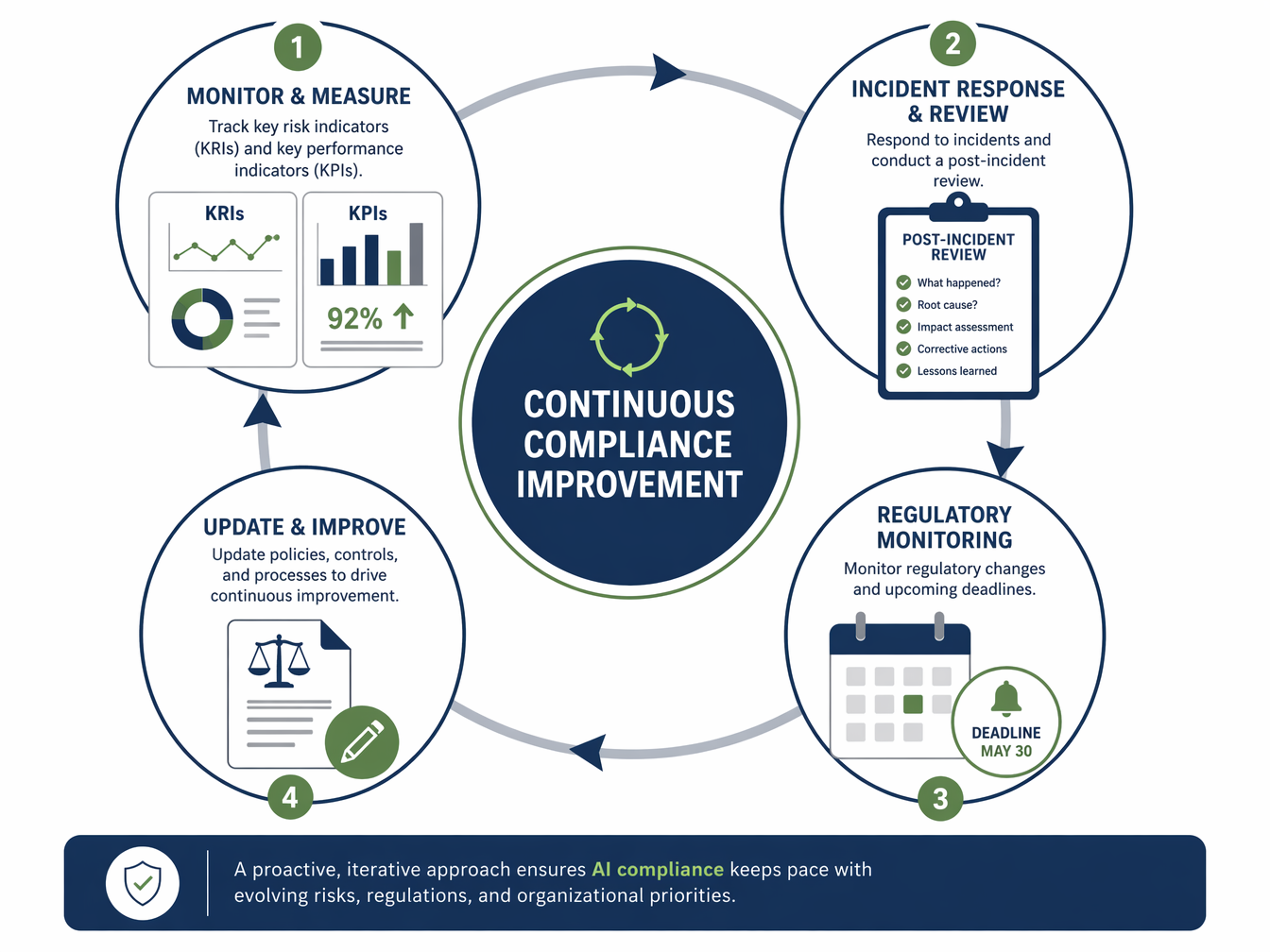
The final building block is the one that transforms a static compliance program into a dynamic one. FTI Consulting's Knight emphasizes that governance will be measured "by clear KRIs or KPIs, not just policies on paper." The RAILS framework's eighth step — "Continuous Improvement" — reinforces that AI governance is not a project with an end date but an ongoing operational discipline.
Key Risk Indicators (KRIs) and Key Performance Indicators (KPIs) for AI compliance should be defined at the outset and reviewed at each governance committee meeting. Examples include:
- KRI: Number of high-risk AI systems without a current impact assessment (target: zero)
- KRI: Number of AI-related incidents reported in the period (track trend, not absolute value — increasing reports may indicate better detection, not worse performance)
- KPI: Percentage of AI systems in the inventory with a completed risk classification (target: 100% within 90 days of discovery)
- KPI: Average time to remediate a high-risk AI finding (target: 30 days)
- KPI: Percentage of third-party AI vendors with current due diligence on file (target: 100%)
Incident response is the stress test of any governance program. When an AI system produces a harmful output — a hallucinated legal citation, a biased hiring decision, a privacy breach — the organization's response will be scrutinized by regulators, plaintiffs' attorneys, and the media. A well-designed incident response process includes:
- Immediate containment: Disable the model or workflow that produced the error. Notify affected parties if required by law or contract.
- Root cause analysis: Was the error caused by a training data issue, a model drift, a prompt injection, or a human oversight failure? Document the findings.
- Remediation: Retrain the model, update the prompt, add a human review step, or retire the system. Document the change.
- Post-incident review: Present the incident to the governance committee. Determine whether the risk classification for the system needs to be upgraded. Update the impact assessment template if the incident reveals a gap in the original analysis.
Finally, the regulatory monitoring cadence must be maintained. The AI regulatory landscape is evolving at a pace that no single compliance officer can track manually. Subscribing to law firm alerts, monitoring state legislative trackers, and maintaining a relationship with the organization's outside counsel are essential practices. For a jurisdiction-by-jurisdiction reference, see our AI Compliance Framework in 2026: A Jurisdiction-by-Jurisdiction Guide, which maps obligations across the EU AI Act, US state laws, and voluntary standards.
Building AI compliance governance infrastructure is not a one-time project. It is an ongoing operational commitment that must evolve as regulations change, technology advances, and organizational AI adoption matures. The organizations that treat it as such — investing in the committees, inventories, assessments, vendor oversight, technology, and monitoring processes described in this guide — will be the ones that can demonstrate to regulators, auditors, and stakeholders that their AI compliance is not just a policy on paper.
Grounded in
This procedure is grounded in the cited rule or opinion, independent of any single documented case. See the Regulation tracker for the governing text.
Cases this step would have prevented
No cases have been explicitly linked to this checklist yet. See Risk Digest for documented incidents generally.
← Back to WorkflowsReport a correction or tip
Spotted an outdated figure, a misstated fact, or a ruling this workflow checklist should reflect? Public comments are disabled for this content given the professional cost of a misreported case outcome, penalty amount, or rule text — use the structured correction channel instead.
Report a correction or tip for this record →