
The Growing Use of General-Purpose AI for Contract Review
The appeal is obvious. An attorney opens a browser tab, types a question about a non-disclosure agreement into ChatGPT, and receives an analysis in seconds. There is no procurement process, no IT approval, no per-seat license fee. For solo practitioners and small firms operating on thin margins, that frictionless access is powerful. According to the Clio Legal Trends Report for 2025, 79% of legal professionals now use AI tools in some capacity. The same survey found that 52% of corporate legal departments have adopted AI, more than doubling from 23% in a single year, per the ACC/Everlaw 2025 report.
But the convenience of general-purpose AI creates a professional responsibility blind spot. When a lawyer uploads a client contract to a consumer-grade chatbot, they are not just asking for a quick read — they are making a series of implicit decisions about competence, confidentiality, and the standard of care they owe their client. The question is not whether these tools can review a contract. It is whether relying on them for that task meets the obligations imposed by the ABA Model Rules.
What the 2026 Benchmarks Actually Show: A Significant Accuracy Gap
Two vendor-published benchmarks from 2026 provide the most concrete data available on the performance gap between general-purpose and purpose-built AI for contract review. While both are self-published and should be treated as directional rather than independently verified, they represent the most detailed task-specific comparisons currently in the public domain.
LegalOn's 2026 Contract Review Benchmark compared its platform against 11 general-purpose models across 3,282 contracts and 21 precision-critical contract guidelines. LegalOn ranked first across all provision types. The platform completed a full contract review in 2.3 seconds — 17 times faster than Claude Opus 4.6, the strongest general-purpose model tested. In a separate evaluation, an LLM judge preferred LegalOn's output over models like Claude Opus 4.6 and GPT-5.1 by a factor of up to 1.8x.
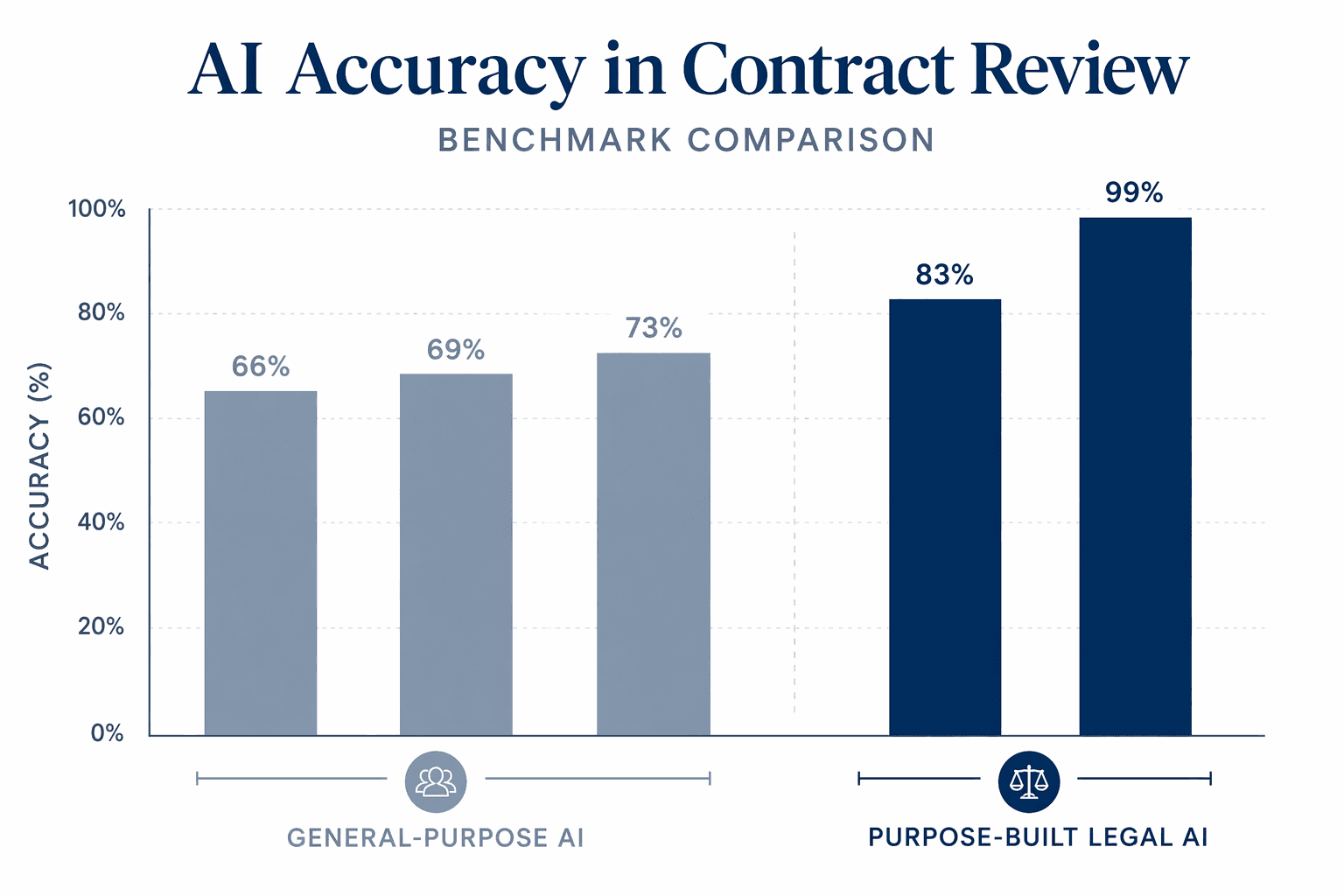
GC AI's In-House Legal Bench (May 2026) tested models on 100 contract-analysis tasks scored by attorneys with more than 80 combined years of practice. The results show a clear hierarchy:
| Model | Category | Accuracy Score |
|---|---|---|
| GC AI | Purpose-Built Legal AI | 82.7% |
| ChatGPT (GPT-5.5) | General-Purpose AI | 72.8% |
| Claude (Opus 4.7) | General-Purpose AI | 66.3% |
| Gemini (3.1 Pro) | General-Purpose AI | 42.9% |
The pattern across both benchmarks is consistent. General-purpose AI models reliably identify that a clause exists. They fail systematically on tasks that require precision: evaluating numeric thresholds, verifying multi-part requirements, tracking cross-references across a document, and — critically — identifying the absence of a clause. These are not edge cases. They are the core competencies required for competent contract review.
Professional Responsibility Under ABA Model Rule 1.1: Competence and AI Tool Selection
ABA Model Rule 1.1 requires that a lawyer provide competent representation, which includes the legal knowledge, skill, thoroughness, and preparation reasonably necessary for the matter. ABA Formal Opinion 512 (2024) explicitly extends this duty to a lawyer's use of technology, including generative AI. The opinion states that a lawyer must understand the capabilities and limitations of the technology they employ.
The 2026 benchmark data creates a concrete argument under this framework. If a lawyer knows — or should know — that general-purpose AI models fail systematically on numeric thresholds, multi-part requirements, and absence checks, and that purpose-built alternatives exist with documented higher accuracy, then relying on the general-purpose tool for client contract review may fall below the standard of competence. The argument is not that general AI is useless. It is that using it for a task where its failure modes are both known and avoidable raises a question about whether the lawyer has exercised the thoroughness and preparation required by Rule 1.1.
This is not a hypothetical concern. The Stanford RegLab study, cited in LegalOn's benchmark report, found that generic AI models hallucinate legal information in case law at rates that would be unacceptable in any client-facing analysis. When a contract review tool fabricates a clause interpretation or invents a legal standard, the attorney who relied on that output without independent verification has a professional responsibility problem.
For a broader examination of how professional responsibility frameworks apply to AI contract review, see our guide Limits and Liabilities: A Professional Responsibility Framework for AI Contract Review in 2026.
Confidentiality Risks Under ABA Model Rule 1.6: Data Practices Compared
Accuracy is only half the equation. ABA Model Rule 1.6 requires a lawyer to make reasonable efforts to prevent the inadvertent disclosure of information relating to the representation of a client. When an attorney uploads a contract to a consumer-tier AI product, they are transmitting client confidential information to a third-party server. The question is what that third party does with it.
The data handling practices of general-purpose and purpose-built AI tools differ in ways that are directly relevant to Rule 1.6 compliance:
| Data Practice | General-Purpose AI (Consumer Tier) | Purpose-Built Legal AI |
|---|---|---|
| Training data use | Conversations used for model training by default | Customer contracts never used to train AI models |
| Data retention agreements | Standard terms of service; no zero-retention guarantee | Zero-retention agreements with model providers (e.g., OpenAI, Anthropic) |
| Security certifications | Varies; SOC 2 not standard on consumer tiers | SOC 2 Type II, SOC 3, GDPR, CCPA compliance |
| Encryption | Standard TLS in transit | AES-256 encryption at rest and in transit |
The critical distinction is training data use. Consumer-tier products like the free version of ChatGPT use conversations for model training by default. Uploading a client contract to such a tool means the terms, business strategies, and confidential information in that document could be incorporated into the model's training data — and potentially reproduced in responses to other users. Purpose-built legal AI platforms, by contrast, explicitly contract with model providers to ensure zero data retention and prohibit training on customer content.
For a detailed examination of security certifications and data governance frameworks, see AI Contract Review Security and Data Governance: A Due Diligence Guide for GCs and Compliance Officers.
Documented Failure Modes: Hallucinations, Inconsistent Output, and Lack of Citation
Beyond the aggregate accuracy scores, the specific failure modes of general-purpose AI in contract review are well-documented and directly relevant to professional responsibility.
- Hallucinated legal information: The Stanford RegLab study found that generic AI models fabricate case law and legal standards at rates that make them unreliable for any task requiring legal accuracy. In contract review, this can manifest as invented interpretations of standard clauses or false statements about legal requirements.
- Inconsistent output across runs: General-purpose models are non-deterministic by design. Running the same contract through the same model twice can produce different analyses. For a lawyer who needs to document their review process, this inconsistency creates a verification problem that purpose-built tools avoid through structured output pipelines.
- No character-level citation: When a general-purpose AI says a contract has a problem with Section 4.2, it cannot point to the specific language that triggered that assessment. The lawyer must re-read the entire contract to verify every claim. Purpose-built tools provide clause-level citation, allowing the attorney to jump directly to the relevant language and confirm the analysis.
- Failure on absence checks: General-purpose AI reliably finds clauses that exist. It struggles to identify clauses that are missing — a core requirement of contract review. If a contract lacks a non-solicitation provision or a data breach notification requirement, a general-purpose model may not flag the absence.
For a deeper analysis of hallucination risks in legal AI, see AI Legal Research Hallucinations: What Every Lawyer Needs to Know in 2026.
When General AI Can Supplement vs. When It Must Not
The argument here is not that general-purpose AI has no place in legal practice. It is that the attorney must understand the boundary between appropriate supplementation and inappropriate reliance. The burden is on the lawyer to know the tool's limitations and to choose the right tool for the task.
General-purpose AI can be appropriate for:
- Brainstorming initial contract language or alternative phrasing
- Summarizing non-confidential, publicly available documents
- Generating first-draft questions for opposing counsel or clients
- Explaining general legal concepts to the lawyer (not to the client)
Purpose-built tools are required — or at minimum, strongly indicated by professional responsibility considerations — for:
- Client contract review where accuracy on specific terms, thresholds, and absence checks is critical
- Analysis of confidential terms, business strategies, or personally identifiable information
- Due diligence reviews where missing a single provision could create liability
- Any task where the output will be relied upon without independent verification of every claim
Building an AI Usage Policy That Addresses the General vs. Purpose-Built Gap
The Clio 2025 survey found that 53% of legal professionals say their firm has no AI policy or are unaware of one. In a market where 79% of professionals are already using AI tools, that policy gap represents a significant governance risk. Firms that have not addressed the distinction between general-purpose and purpose-built AI are exposing themselves to professional responsibility claims without a defense.
An effective AI usage policy should address at least the following:
- Tool classification: Define categories of AI tools (general-purpose, purpose-built legal, CLM-embedded) and specify which are approved for which tasks.
- Accuracy verification: Require that any AI tool used for client contract review have documented accuracy benchmarks that the attorney has reviewed and understands.
- Confidentiality safeguards: Prohibit uploading client confidential information to any AI tool that does not provide contractual guarantees against training data use and data retention.
- Competence documentation: Require attorneys to document their evaluation of the tool's capabilities and limitations before using it for client work, consistent with ABA Formal Opinion 512.
- Review cadence: Establish a regular review cycle for AI tools, given that the market is evolving rapidly and today's benchmark may not reflect tomorrow's performance.
For firms seeking specific guidance on ABA Formal Opinion 512 compliance and a template AI usage policy, see The Professional Responsibility Guide to AI Contract Analysis: What ABA Formal Opinion 512 Means for Your Tool Selection and AI Ethics in Legal Practice 2026: The Rules, the Sanctions, and the One-Page Policy Your Firm Needs.
Comments
Join the discussion with an anonymous comment.