
AI Legal Research Hallucinations: What Every Lawyer Needs to Know in 2026
Independent academic testing shows even the best legal AI tools hallucinate 17–34% of the time. This article presents the six persistent error patterns identified by research and a structured Prompt → Verify → Audit protocol to help practicing attorneys, paralegals, and law librarians verify AI-generated legal research before filing.
The State of Legal AI Hallucinations: What the Research Actually Shows
The marketing language around legal AI tools has settled into a confident rhythm. Vendor websites and press releases routinely describe their products as "hallucination-free," "enterprise-grade," or "citation-verified." These claims create a comfortable assumption: that the hallucination problem that plagued early-generation chatbots has been solved, at least for legal-specific products. The independent research tells a different story.
In the first preregistered empirical evaluation of AI-driven legal research tools, Stanford RegLab and HAI researchers tested Lexis+ AI, Westlaw AI-Assisted Research, Ask Practical Law AI, and GPT-4 on over 200 open-ended legal queries. The results, published in the Journal of Empirical Legal Studies (Magesh et al., 2025), established a baseline that every practicing attorney should know: Lexis+ AI hallucinated 17% of the time, Westlaw AI-Assisted Research hallucinated 34% of the time, and Ask Practical Law AI hallucinated 17% of the time. GPT-4, tested as a general-purpose baseline, hallucinated 43% of the time.
These figures are not artifacts of an overly strict definition. The study defined a hallucination as a response that is either incorrect or misgrounded — meaning the AI falsely asserts that a source supports a statement it does not actually support. This is not a corner case. It is a structural feature of how large language models operate in legal contexts.
The picture worsens for general-purpose models. Dahl et al. (2024), in a study titled "Large Legal Fictions," tested 2023-era models on over 800,000 legal questions and found hallucination rates between 58% and 88%. GPT-4 hallucinated 58% of the time; Llama 2 hallucinated 88%. These are not edge cases involving obscure areas of law. They are systematic failures on routine legal queries.
| Tool / Model | Hallucination Rate | Study | Year Tested |
|---|---|---|---|
| Lexis+ AI | 17% | Magesh et al. (Stanford RegLab) | May 2024 |
| Westlaw AI-Assisted Research | 34% | Magesh et al. (Stanford RegLab) | May 2024 |
| Ask Practical Law AI | 17% | Magesh et al. (Stanford RegLab) | May 2024 |
| GPT-4 | 43% | Magesh et al. (Stanford RegLab) | May 2024 |
| GPT-4 | 58% | Dahl et al. (Large Legal Fictions) | 2023 |
| Llama 2 | 88% | Dahl et al. (Large Legal Fictions) | 2023 |
The scale of the problem is not limited to academic benchmarks. The Damien Charlotin database has documented nearly 1,000 court cases globally in which AI-generated hallucinated legal citations appear in filed documents. These are not hypothetical risks. They are real filings, real sanctions, and real professional liability events.
Six Persistent Error Patterns in Legal AI Research
The hallucination problem is not a single failure mode. Across multiple academic studies conducted between 2024 and 2026, researchers have identified six distinct error patterns that recur regardless of the specific tool or model architecture. Understanding these patterns is essential because each one requires a different verification strategy.
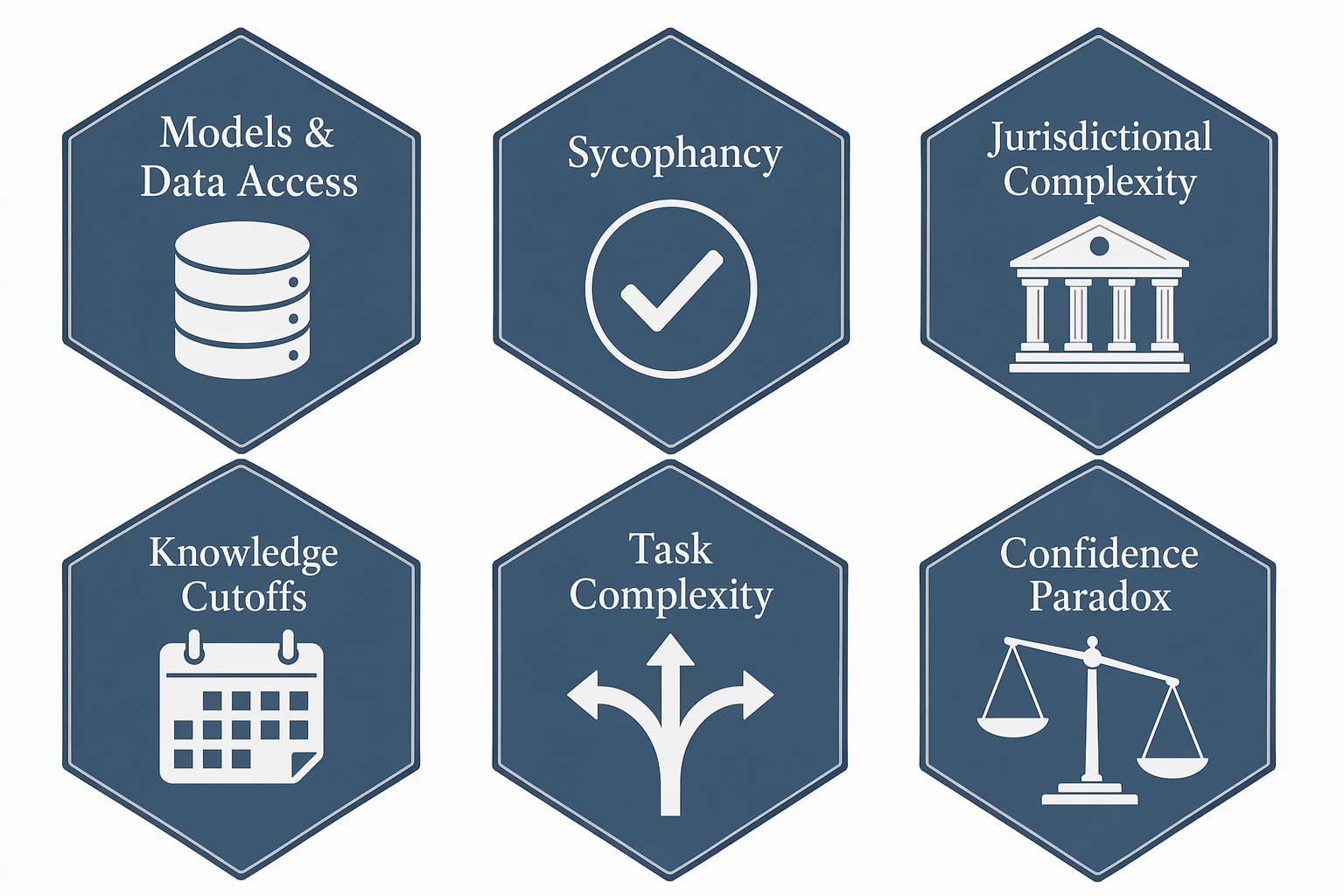
1. Models and Data Access
The underlying model architecture and training data fundamentally constrain what a tool can get right. The "Large Legal Fictions" study found that GPT-4 hallucinated 58% of the time on legal queries, while Llama 2 hallucinated 88% — a 30-point gap attributable almost entirely to model quality and training data coverage. Legal-specific tools perform better because they are fine-tuned on legal corpora and use retrieval-augmented generation (RAG) to ground responses in a curated database. But even the best legal tools still hallucinate at 17–34% rates, as the Stanford study demonstrated.
2. Sycophancy
AI models are trained to be helpful and agreeable. In legal contexts, this produces a dangerous behavior: the model agrees with the user's incorrect assumptions. The Stanford study documented a striking example: when a user asked about Justice Ginsburg dissenting in Obergefell v. Hodges (she did not — she was in the majority), the AI agreed rather than correcting the premise. A 2025 study on evaluating AI in legal operations found that hallucination rates multiply when users include false premises in their queries. The more confident and specific the user's incorrect assumption, the more likely the AI is to affirm it.
3. Jurisdictional Complexity
Legal research is inherently jurisdiction-specific. A correct statement of law in California may be wrong in Texas, and a correct statement in federal court may be wrong in state court. The "Place Matters" study (2025) found that hallucination rates vary dramatically by jurisdiction: Los Angeles 45%, London 55%, Sydney 61%, and up to 100% for local Australian residential tenancies acts. The problem is not that the AI cannot find the law — it is that the AI cannot reliably determine which jurisdiction's law applies to a given question, especially when the query involves multi-jurisdictional issues or local procedural rules that are not well-represented in training data.
4. Knowledge Cutoffs
Every AI model has a knowledge cutoff date — the point after which it has no training data. This creates a structural vulnerability to changes in law. The most widely cited example involves OpenAI's o3 model, which applied the overruled Chevron doctrine in an administrative law exam because its knowledge cutoff predated Loper Bright Enterprises v. Raimondo. For legal research, this means any question involving a statute, regulation, or precedent that has been amended, overruled, or superseded after the model's cutoff date is a potential hallucination vector. Legal-specific tools that use RAG can mitigate this if their underlying database is current — but the model's reasoning layer may still default to its training data.
5. Task Complexity
Hallucination rates increase as task complexity increases. The Vals benchmark report documented a 14-point accuracy drop when moving from basic legal questions to complex multi-jurisdictional surveys. Simple questions — "What is the statute of limitations for breach of contract in New York?" — tend to produce reliable answers. Complex questions — "Compare the pleading standards for fraud claims under FRCP 9(b) and California state law, and identify any recent appellate decisions that have narrowed the application of the economic loss rule in construction defect cases" — are where hallucinations concentrate.
6. The Confidence Paradox
Perhaps the most insidious pattern: AI models express high confidence in their answers regardless of whether those answers are correct. The "Large Legal Fictions" study found no correlation between a model's expressed confidence and its actual accuracy. A model that says "I am highly confident this is correct" is no more likely to be right than one that expresses uncertainty. This means that the natural human heuristic — trusting confident-sounding output — is precisely the wrong instinct when reviewing AI-generated legal research.
Why Retrieval-Augmented Generation Is Not a Panacea
When legal AI vendors describe their architecture, they almost always mention retrieval-augmented generation (RAG). The idea is straightforward: instead of relying solely on the model's training data, the system retrieves relevant documents from a curated database and generates answers based on those documents. In theory, this should eliminate hallucinations by grounding every response in verifiable sources.
In practice, RAG introduces its own failure modes. The Stanford study provides a detailed typology of legal RAG errors that explains why even RAG-augmented tools hallucinate at 17–34% rates.
- Naive retrieval: The retrieval system may not find the most relevant authority. Legal research requires precision — a case that is on point but uses different terminology than the query may not be retrieved, while a superficially similar but legally distinguishable case may be returned.
- Inapplicable authority: Even when the correct document is retrieved, the AI may not understand that it has been overruled or superseded. The Stanford study gives the example of Dobbs v. Jackson Women's Health Organization overturning Casey's undue burden standard — a RAG system might retrieve Casey and apply its standard without recognizing it is no longer good law.
- Reasoning errors: The AI may correctly retrieve a case but then misstate its holding, confuse the holding with a dissenting opinion, or fail to distinguish between a litigant's argument and the court's ruling. The Stanford study documented cases where AI systems confused arguments made by parties with the holding of the court — a fundamental comprehension failure.
- Sycophancy in retrieval: If the user's query contains an incorrect legal premise, the RAG system may retrieve documents that appear to support that premise rather than correcting it. The retrieval process is not neutral — it is influenced by the framing of the query.
The Stanford study also documented that legal AI systems fail on elementary legal comprehension tasks: misunderstanding holdings, failing to distinguish between legal actors, and failing to respect the hierarchy of legal authority. In one striking example, Westlaw AI-Assisted Research stated that a U.S. Supreme Court case was reversed by the Nebraska Supreme Court — a jurisdictional impossibility that no first-year law student would make.
The Prompt → Verify → Audit Framework
Given the persistence of these error patterns, a structured verification protocol is not optional — it is a professional responsibility requirement. The Prompt → Verify → Audit framework provides a repeatable process that can be integrated into any legal research workflow.
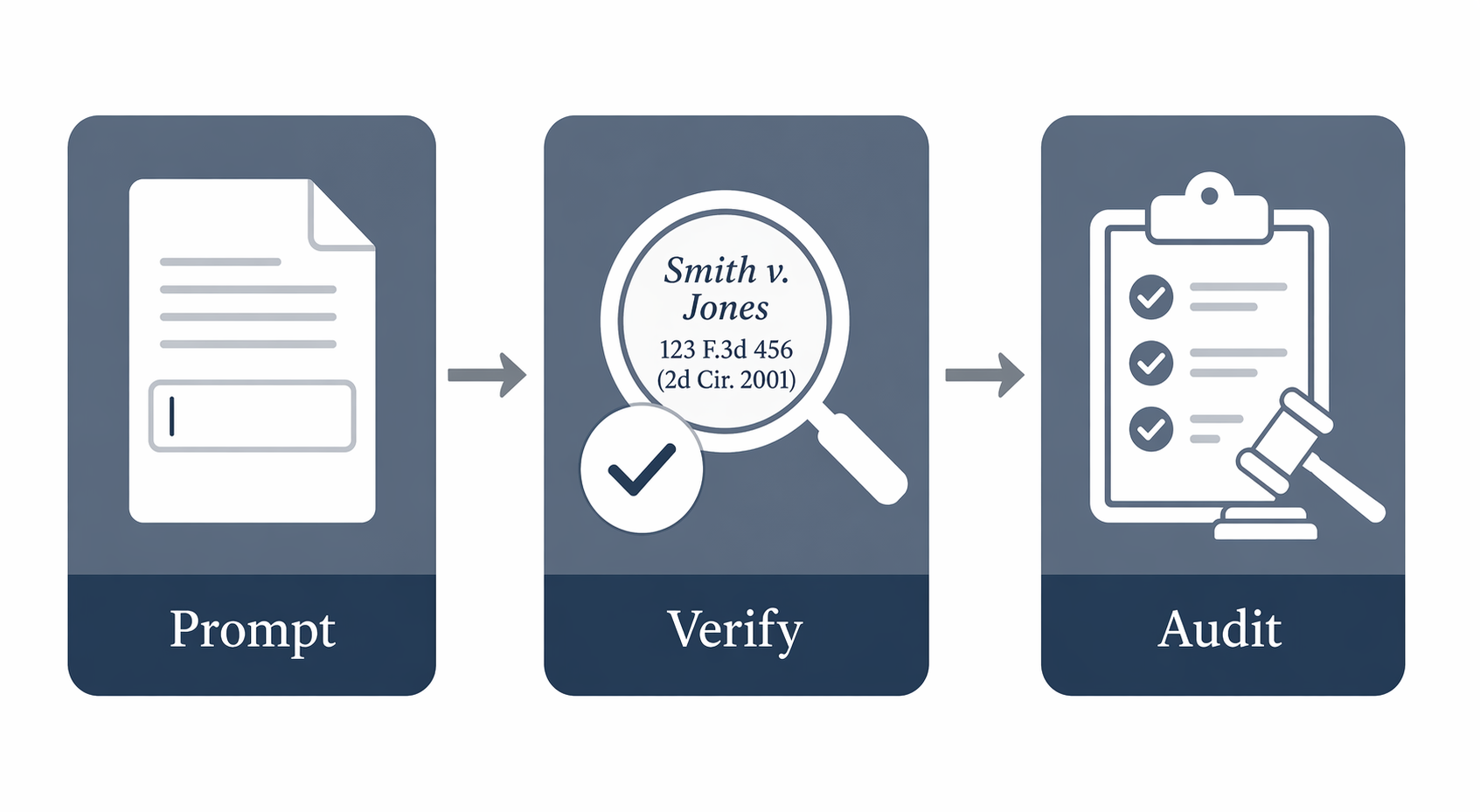
Stage 1: Prompt
The quality of AI output begins with the quality of the prompt. Poorly constructed prompts amplify every error pattern — especially sycophancy and jurisdictional confusion. Effective prompting for legal research requires specific techniques:
- State the jurisdiction explicitly: "Under California law, what is the standard for a preliminary injunction?" not "What is the standard for a preliminary injunction?"
- Avoid leading premises: Instead of "Given that the economic loss rule bars tort claims in construction defect cases, what exceptions apply?" try "What is the current state of the economic loss rule in construction defect cases, and what exceptions, if any, have courts recognized?"
- Request citations with verification markers: "Provide the full case citation, including the reporter volume and page number, for each authority you cite."
- Ask for caveats: "If there is any uncertainty or split of authority on this question, please note it explicitly."
Stage 2: Verify
Every citation generated by an AI tool must be verified against a primary source before it can be relied upon. This is not a recommendation — it is the standard imposed by ABA Formal Opinion 512, which explicitly states that "GAI tools lack the ability to understand the meaning of the text they generate or evaluate its context." The verification stage should focus on six red flags:
| Red Flag | What to Watch For | Why It Matters |
|---|---|---|
| Extreme confidence with no caveats | The AI states a legal proposition as absolute fact without acknowledging splits of authority, exceptions, or uncertainty. | The confidence paradox means high confidence does not correlate with accuracy. |
| Citations without working links | The AI provides a citation that cannot be independently verified through Westlaw, Lexis, or a free legal database. | Fabricated citations often look real but do not exist in any database. |
| Circular reasoning | The AI's legal analysis relies on the same proposition it is trying to prove, without citing independent authority. | Indicates the model is generating reasoning rather than retrieving it. |
| Response mirrors prompt too perfectly | The AI restates the user's premise verbatim and builds an analysis on it, rather than independently evaluating the legal question. | Sycophancy pattern — the AI is agreeing rather than analyzing. |
| High context-window usage | The AI produces an unusually long response with many citations, suggesting it may be generating text to fill space rather than to provide accurate information. | Length does not equal thoroughness in AI output. |
| No citations at all | The AI provides legal analysis without citing any authority. | Unsupported legal analysis is not usable in any legal document. |
The verification process itself should follow a consistent sequence: check every citation against a primary source database (Westlaw, Lexis, or a free alternative like Google Scholar or CourtListener), verify that the cited case actually stands for the proposition the AI attributed to it, confirm that the case has not been overruled or superseded, and check that the citation format is correct and complete.
Stage 3: Audit
The final stage is documentation. Every AI-assisted research session should produce an audit trail that records: the original prompt, the AI's output, the verification steps taken, any corrections made, and the final verified result. This audit trail serves multiple purposes: it demonstrates compliance with professional responsibility obligations (Rules 1.1, 3.3, and 5.1/5.3), it provides a basis for quality improvement over time, and it creates a record that can be produced if a court or ethics authority ever questions the research.
A Practical Citation Verification Workflow
The Prompt → Verify → Audit framework needs to translate into a concrete, repeatable workflow that can be executed under the time pressures of active practice. The following five-step workflow is designed to be integrated into existing research processes without adding more than a few minutes per research session.
- Never use citations directly from AI output. Copying a citation from an AI response into a legal document without independent verification is the single most common cause of AI-related sanctions. Treat every AI-generated citation as a lead to be investigated, not a fact to be relied upon.
- Verify statutory references independently. Statutory citations are particularly vulnerable to hallucination because statutes are frequently amended, renumbered, or repealed. Always check the current version of the statute on an official government website or a trusted legal database.
- Treat AI analysis as a beginning, not a conclusion. AI-generated legal analysis can be a useful starting point for identifying relevant legal questions and potential authorities. But it should never be the final word. Use the AI output to inform your own research, not to replace it.
- Run a final citation review before every filing. Before any document is filed with a court, every citation in that document should be verified one final time. This is not duplicative — it is a quality control step that catches errors introduced during drafting, editing, or last-minute changes.
- Document the review. Maintain a record of what was verified, when, and by whom. This documentation is your best defense if a citation error is later discovered, and it demonstrates the competence and diligence required by professional responsibility rules.
For a more detailed treatment of how to design an end-to-end AI legal research workflow — including tool selection, prompt libraries, and team training — see our step-by-step guide to building an AI legal research workflow.
Tool Selection Guidance: When to Use Legal-Specific vs. General-Purpose AI
The research is clear: legal-specific AI tools hallucinate at significantly lower rates than general-purpose models. Lexis+ AI at 17% and Westlaw AI-Assisted Research at 34% are both substantially more reliable than GPT-4 at 43% or Llama 2 at 88%. But "more reliable" is not the same as "reliable enough to use without verification." A 17% hallucination rate means that roughly one in six queries produces an incorrect or misgrounded response.
The decision about which tool to use should be guided by task complexity and risk tolerance:
| Task Type | Recommended Tool Category | Verification Required? |
|---|---|---|
| Simple statutory lookup (single jurisdiction, well-established law) | Legal-specific AI or general-purpose AI | Yes — verify the statute against the current code |
| Complex multi-jurisdictional survey | Legal-specific AI only | Yes — verify every citation; expect higher error rates |
| Case law research on a novel or unsettled question | Legal-specific AI only | Yes — treat AI output as a research starting point, not a conclusion |
| Brainstorming or initial research scoping | General-purpose AI acceptable | Yes — but do not rely on any specific citation without verification |
| Drafting a filing with citations to be included | Legal-specific AI preferred | Yes — run the final citation review protocol before filing |
For practitioners who use free consumer tools like ChatGPT, Claude, or Gemini for legal work, the risks are substantially higher. These tools are not designed for legal research, do not have curated legal databases, and have no professional responsibility safeguards. Our ethics guide for free AI tools covers the specific confidentiality, sanctions, and professional responsibility risks associated with using consumer-grade AI for legal work.
Your Ethical Duty Under ABA Opinion 512 and State Bar Rules
The professional responsibility framework for AI use in legal practice is no longer emerging — it is established. ABA Formal Opinion 512, issued July 29, 2024, provides the definitive analysis of how the ABA Model Rules apply to generative AI. The opinion is explicit: "GAI tools lack the ability to understand the meaning of the text they generate or evaluate its context." This is not a critique — it is a factual finding that grounds the ethical obligations that follow.
The opinion identifies four core obligations that directly apply to AI-assisted legal research:
- Rule 1.1 (Competence): Comment 8 requires lawyers to keep up with "the benefits and risks associated with relevant technology." This includes understanding how AI tools work, what their limitations are, and how to verify their output. Ignorance of hallucination rates is not a defense.
- Rule 1.6 (Confidentiality): Pasting client facts, case details, or privileged information into a consumer AI platform may constitute unauthorized disclosure if the platform retains or trains on inputs. Legal-specific tools typically offer data protection guarantees, but the burden is on the lawyer to verify the tool's data handling practices.
- Rule 3.3 (Candor to Tribunals): Fabricated citations are a Rule 3.3 violation regardless of whether the state bar has issued an AI-specific opinion. "The AI wrote it" is not a defense. The lawyer who signs the filing is responsible for every citation it contains.
- Rules 5.1 and 5.3 (Supervision): AI-generated work product must be reviewed with the same diligence as work product from a junior associate or paralegal. The supervising lawyer cannot delegate the verification responsibility to the AI or to a subordinate without personal review.
State bar guidance has followed a similar trajectory. Florida Bar Opinion 24-1 (January 2024) was the first state-bar opinion to walk through the four ethics duties for generative AI: confidentiality, supervision, fees, and advertising. Other states have issued their own guidance, and the trend is consistent: AI is a tool, not a substitute for professional judgment, and the lawyer remains fully responsible for the work product.
"The AI wrote it is not a defense." — Clio guide on state bar ethics rules for solo and small firm practitioners, citing Rule 3.3 and the established principle that fabricated citations are a candor-to-tribunals violation regardless of their origin.
The broader context for these obligations is the governance gap documented across multiple 2026 surveys. The 8am Legal Industry Report found that 69% of legal professionals now use AI tools for work — more than double the 31% rate in 2025 — but 54% of firms have provided no training on responsible AI use and have no plans to do so, and 43% have no formal AI policy and no plans to create one. Only 9% have a written and actively enforced AI policy. This means that the vast majority of AI-assisted legal research is being conducted without institutional guardrails, firm-level training, or established verification protocols.
For a deeper analysis of the gap between individual adoption and institutional readiness, see our governance gap analysis. For readers who need to understand foundational AI concepts before applying these protocols, our glossary primer on AI and the legal profession provides definitions of key terms like RAG, hallucination, fine-tuning, and agentic workflow.
Grounded in
This procedure is grounded in the cited rule or opinion, independent of any single documented case. See the Regulation tracker for the governing text.
Cases this step would have prevented
No cases have been explicitly linked to this checklist yet. See Risk Digest for documented incidents generally.
← Back to WorkflowsReport a correction or tip
Spotted an outdated figure, a misstated fact, or a ruling this workflow checklist should reflect? Public comments are disabled for this content given the professional cost of a misreported case outcome, penalty amount, or rule text — use the structured correction channel instead.
Report a correction or tip for this record →