
DOE Emergency Order Regulation, Explained
- Authority
- U.S. Department of Energy
- Rule type
- regulation
- Jurisdiction scope
- US federal
- Source text
- Read primary rule text ↗
Verify the cited FPA authority, order addressees, mandatory actions, expiration or renewal terms, and Part 205 rehearing path before relying on a DOE emergency order.
| Verification point | Answer |
|---|---|
| Category and scope | Regulation-ethics explainer; not legal advice. Last verified: August 3, 2026 UTC. |
| Immediate answer | A Department of Energy emergency order is not an all-purpose emergency decree. It must rest on a cited Federal Power Act authority, usually §202(c), and the obligations come from the order text. |
| Core authorities | Federal Power Act §202(c), now administered by DOE, supplies the main emergency electric-power order authority; a separate §215A track governs grid-security emergency orders. [1][2] |
| Main time limits to check first | For §202(c), the key cap is the renewable 90-day limit when the order conflicts with environmental law or permits. For §215A, the order expires in 15 days unless renewed by written presidential directive. [1][2] |
| Why 2026 coverage is confusing | DOE’s 2026 pages list a numbered §202(c) order series through 202-26-37 as of July 26, 2026, including a class involving backup generation at data centers. [3][4] |
The useful question is narrow: what does the order require, who must comply, and when does the authority run out? That is also why the pending D.C. Circuit challenge matters. It is not a request for a court to philosophize about “emergency” in the abstract; it is a test of whether DOE stayed inside the statutory trigger, duration limits, and review path it invoked.
Two emergency tracks that should not be collapsed
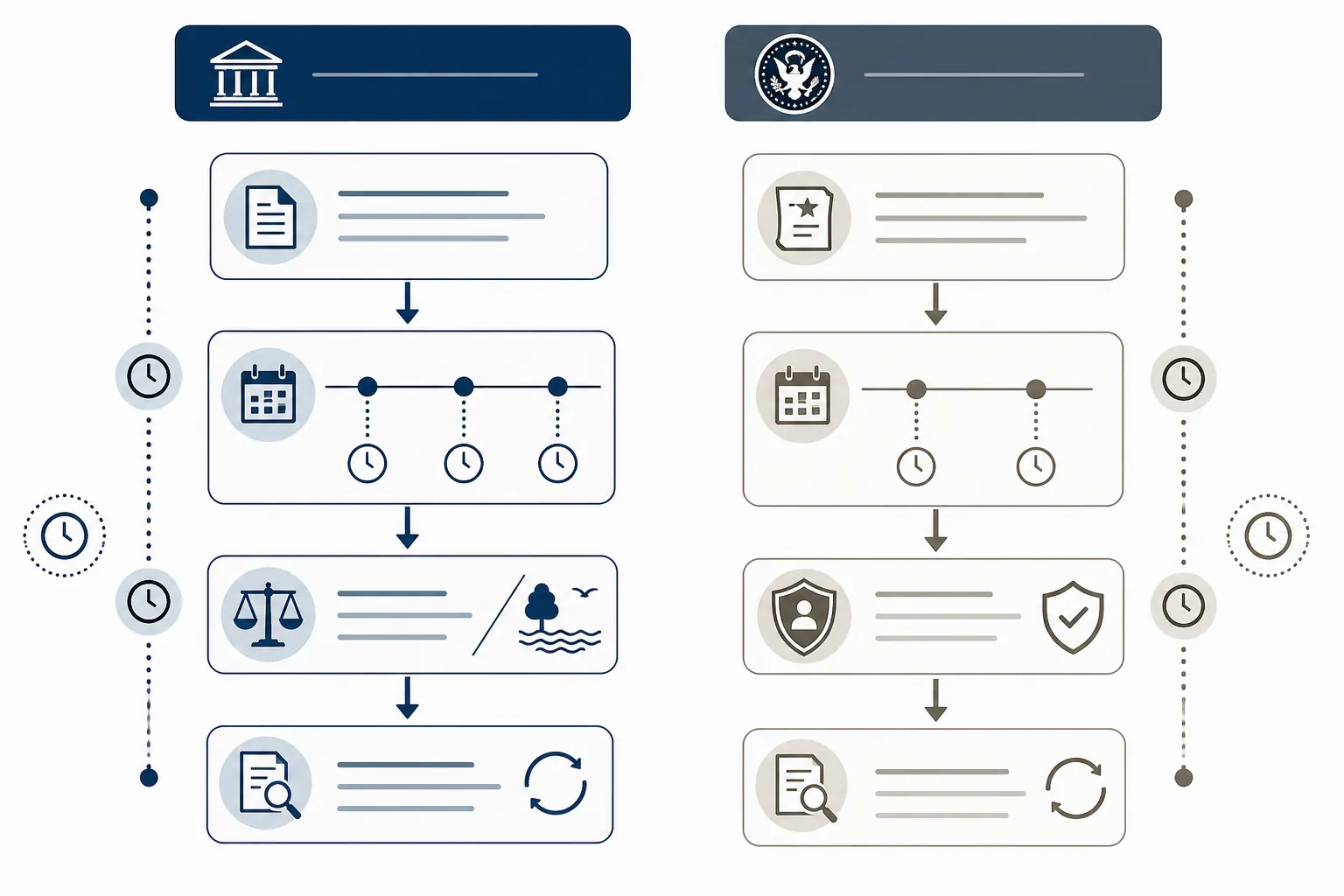
The recurring mistake in coverage is to treat “DOE emergency order” as one legal container. There are at least two containers relevant here. Section 202(c) is the better-known electric-power emergency authority. Section 215A is a separate grid-security-emergency regime with a different trigger, a shorter life, and a presidential-renewal mechanism.
| Feature | FPA §202(c) | FPA §215A |
|---|---|---|
| Basic function | Emergency electric-power orders, including temporary connections, generation, delivery, interchange, or transmission where the statutory emergency trigger is met. [1] | Grid-security emergency orders for the bulk-power system and related covered infrastructure under the §215A framework. [2] |
| Trigger to verify | War or an emergency tied to a sudden increase in demand, shortage of electric energy, shortage of generating or transmission facilities, shortage of fuel or water for generation, or other causes recognized under the statute. [1] | A grid-security emergency track governed by §215A and DOE’s implementing procedures. [2] |
| Duration issue most likely to matter | If the order would conflict with environmental law or permits, the 2015 amendment imposes a renewable 90-day cap. [1] | Orders expire after 15 days unless renewed by written presidential directive. [2] |
| Compliance posture | Read the order’s addressees, required actions, reporting duties, dates, and any environmental-conflict language. | Read the order plus the §215A procedures, including renewal, compliance reporting, rehearing, and liability protection. [2] |
| Review path | Part 205 and the order’s own terms matter before judicial review; rehearing requirements should not be skipped. [5] | The final rule expressly addresses clarification or reconsideration, compliance reporting, and rehearing before judicial review. [2] |
The distinction is not academic. A lawyer asked whether a generator, grid operator, or data-center operator must comply should not start from the press release. Start with the caption and authority line of the order. If it says §202(c), the 90-day environmental-conflict cap may become central. If it says §215A, the 15-day expiration rule and written presidential directive become immediate questions.
What a §202(c) order can actually do
Section 202(c) traces to the Federal Power Act’s emergency electric-power framework, later administered by DOE after the Department of Energy Organization Act. In practical terms, it lets DOE order temporary electric-power measures when the statutory emergency condition exists. The classic verbs are operational rather than atmospheric: connect, generate, deliver, interchange, transmit. The legal obligation is created by the order’s command, not by the administration’s description of the grid situation.
The statutory trigger matters because it is narrower than the ordinary political use of emergency language. CRS describes §202(c) as applying during war or when DOE determines that an emergency exists because of a sudden increase in demand, a shortage of electric energy, a shortage of facilities for generation or transmission, a shortage of fuel or water for generation, or other causes under the provision. [1]
That does not answer every hard case. “Other causes” is doing work, and a court may have to decide how much work it can do. But it at least tells the reader where the fight is: the agency must connect its order to the statutory emergency finding, and the challenger will try to show that the facts are policy preference, market-management preference, or long-term adequacy planning dressed as emergency response.
The 90-day environmental-law conflict cap
The 2015 amendment is one of the easiest provisions to miss and one of the hardest to talk around. CRS describes it as limiting §202(c) orders that may result in a conflict with environmental law or environmental permits to periods of not more than 90 days, while allowing renewal for additional periods of not more than 90 days. [1]
That structure does not make every §202(c) order a 90-day order. It matters when the order conflicts with environmental requirements. The verification task is therefore specific: identify whether the order acknowledges an environmental-law or permit conflict, identify the expiration date, then identify the stated basis for renewal if DOE extends it. A renewal is not the same legal fact as the original emergency finding; it is another agency act with its own date, text, and record.
Clarification, reconsideration, reporting, rehearing
Part 205 is where the emergency order becomes less headline-shaped and more procedural. DOE’s grid-security-emergency final rule identifies mechanisms for clarification or reconsideration, compliance reporting, and rehearing before judicial review. [2] State Power Project’s litigation explainer also flags the rehearing requirement as a practical step in challenges to DOE §202(c) orders. [5]
For counsel, the sequence is usually more important than the rhetoric. If an order imposes a reporting duty, someone has to know who signs it, when it is due, what operational data it requires, and whether the filing creates admissions for later litigation. If a party wants to challenge the order, it should verify whether rehearing is required before judicial review and calculate that deadline from the operative order, not from a news story about the order.
- First, identify the authority line: §202(c), §215A, or another provision.
- Second, identify the addressees: generator, balancing authority, regional transmission organization, utility, data-center operator, or another covered party.
- Third, separate mandatory verbs from background findings. “Must,” “shall,” and dated reporting clauses do more work than recitals.
- Fourth, check expiration and renewal language before assuming the order is still in force.
- Fifth, check whether the order creates or acknowledges a conflict with environmental law or permits.
Section 215A: shorter, sharper, and separately constrained
Section 215A deserves separate treatment because it is often folded into a generic “grid emergency” discussion. DOE’s 2018 final rule for grid-security emergency orders implements a distinct process. The most visible limit is temporal: a §215A emergency order expires after 15 days unless renewed by written presidential directive. [2]
That 15-day rule changes the reader’s checklist. Under §202(c), the environmental-conflict question may drive the 90-day analysis. Under §215A, the first duration question is whether the initial 15-day period has expired and, if so, whether there is a written presidential directive supporting renewal. If the directive is absent, stale, or not tied to the order being enforced, the compliance analysis changes quickly.
The §215A track also carries a liability shield for parties complying with grid-security emergency orders. The final rule states that covered persons are not liable for actions or omissions taken to comply with such an order, subject to the statutory and regulatory terms. [2] That protection should be read with the order in hand: the shield is tied to compliance, not to a party’s independent emergency improvisation.
The same procedural discipline applies here. Clarification or reconsideration, compliance reporting, and rehearing-before-review are not ornamental administrative-law features; they are the hinge between emergency operations and later court review.
The historical record is smaller than the current headlines make it feel
CRS identified 20 §202(c) events from 2000 through June 2025. Eleven were weather-related. The shortest example in that record involved four hours per day on two days during a September 2023 Texas heat wave; the longest ran from June 16, 2017, to March 8, 2019. [1]
Those figures are useful calibration. They show that §202(c) has been used for more than one kind of event, but they also keep the scale honest. A statute can have a long pedigree and still have a relatively modest modern usage record. The question raised by the 2025–26 order pattern is not whether DOE has ever used emergency authority before. It plainly has. The question is whether the newer orders fit the same statutory machine.
The 2026 order series as a stress test
DOE’s own emergency-authority pages show why the legal framework now needs closer reading. As of July 26, 2026, DOE’s 2026 §202(c) order page listed orders numbered from 202-26-01 through 202-26-37. The listed materials include a new class authorizing grid operators to direct backup generation at data centers. [3][4]
The data-center point is important, but it should not take over the whole analysis. It is one application of the order power, not a substitute for reading the authority. If a grid operator directs a data-center operator to run backup generation, the compliance chain has at least three layers: the DOE order, the grid operator’s instruction, and the facility’s own permits, contracts, and interconnection obligations. Readers working on that narrower chain should use the site’s separate PJM/data-center backup-generation compliance analysis.
DOE has also used large numbers to explain the policy problem. Its materials refer to 35 GW of backup generation and $44 billion in annual outage costs. Those are DOE claims, not independent judicial findings and not neutral market facts established by this article. [3]
Executive Order 14156, declaring a national energy emergency, is relevant backdrop to the administration’s posture. It should not be treated as a substitute for the order-specific statutory authority. [6] If a claim turns on continuation of that executive order after January 20, 2026, reverify the Federal Register continuation notice directly before relying on it; this article does not use an uncrawled continuation notice as an independent authority source.
The same caution applies to record-level documents behind authentication walls or inaccessible PDFs. If a secondary source quotes an amended order, treat that quotation as a lead. For compliance, enforcement, or litigation, verify the operative PDF or Federal Register source directly, including amendments, appendices, expiration dates, and service lists.
Where the pending D.C. Circuit case fits
Michigan v. DOE, No. 25-1159 in the D.C. Circuit, is the current place where these limits are being tested. State Power Project identifies the case as argued on May 15, 2026, with a decision expected later in 2026. [5] The site’s separate D.C. Circuit challenge to DOE emergency grid limits tracks that litigation rather than repeating it here.
For this explainer, the case matters because it concentrates the verification issues: what emergency did DOE identify, which facilities or operators did the order bind, what environmental-conflict language did DOE use, how did DOE renew or amend the order, and what administrative steps preceded court review? Those are order-text questions before they are politics questions.
There are adjacent risk records for readers following consequences rather than authority. A state-side emergency-pricing analogue appears in the Texas power-grid emergency-order litigation record. Data-center load and grid-operator risk are treated in the PJM data-center disconnect record and the PJM data-center power-cost analysis.
How to verify a DOE emergency order under deadline
A defensible verification note does not need to solve the national energy debate. It needs to identify the legal instrument and avoid overclaiming. The minimum record is the cited authority, the order text, the addressees, the mandatory actions, the expiration date, any renewal document, any environmental-law conflict language, and the Part 205 path for clarification, reconsideration, rehearing, and review.
| Question | What to look for in the primary record |
|---|---|
| What authority is DOE invoking? | The order’s authority line: §202(c), §215A, or another provision. |
| Who must comply? | Named companies, grid operators, balancing authorities, facility owners, data-center operators, or classes of covered entities. |
| What must they do? | Mandatory operational verbs, reporting clauses, dispatch obligations, fuel or emissions conditions, and deadlines. |
| How long can it last? | The stated expiration date; for environmental-conflicting §202(c) orders, the renewable 90-day limit; for §215A, the 15-day rule and any written presidential renewal directive. |
| What happens before court? | Clarification, reconsideration, compliance reporting, rehearing, and judicial-review prerequisites under the applicable Part 205 route. |
| What should not be treated as the obligation? | Press-release descriptions, policy speeches, generalized grid-reliability claims, or uncited secondary summaries. |
That is the practical limit of the phrase “DOE emergency order.” It tells you to open the Federal Power Act, Part 205, and the order. It does not tell you, by itself, who has to run a plant, who may direct backup generation, whether an environmental permit is displaced, or whether the order survives review.
References
- CRS Report R48568, Congressional Research Service.
- Grid Security Emergency Orders: Procedures for Issuance, Federal Register, January 10, 2018.
- DOE's Use of Federal Power Act Emergency Authority, U.S. Department of Energy.
- 2026 DOE 202(c) Orders, U.S. Department of Energy.
- Challenges to DOE 202(c) Orders, State Power Project.
- Declaring a National Energy Emergency, The White House.
Operationalizing workflow
No workflow has been explicitly linked to this obligation yet. See Workflows generally.
Illustrative cases
No illustrative case is currently tracked for this obligation. See Risk Digest for documented incidents generally.
← Back to RegulationReport a correction or tip
Spotted an outdated figure, a misstated fact, or a ruling this regulation entry should reflect? Public comments are disabled for this content given the professional cost of a misreported case outcome, penalty amount, or rule text — use the structured correction channel instead.
Report a correction or tip for this record →