
Did the Ceasefire Legally Reopen the Strait of Hormuz?
- Authority
- United Nations (UNCLOS)
- Rule type
- treaty
- Jurisdiction scope
- International
- Source text
- Read primary rule text ↗
Do not hamper or suspend transit/innocent passage; wartime restrictions must preserve neutral shipping corridors.
The narrow answer counsel can use
The ceasefire did not, by itself, legally reopen the Strait of Hormuz. It suspended hostilities without terminating the international armed conflict, and that distinction matters. A ceasefire may change the immediate likelihood of being fired on; it does not create, revoke, or redefine passage rights through an international strait unless the instrument itself validly does so under some separate legal authority. The better starting point is therefore modest: the truce changed the operating environment, not the underlying law of navigation. The Lieber Institute’s treatment of ceasefires in international armed conflict, drawing on Hague Regulations Article 36 and the DoD Law of War Manual, makes the same basic point: a ceasefire suspends military operations but does not terminate the legal state of war or armed conflict. The ICRC glossary uses the same functional distinction. [1][2]
This is a regulation-and-ethics analysis for risk review, not legal advice for any voyage, cargo, insurer, flag state, or charterparty dispute. The reported truce chronology should also be treated as a verification point, not a settled filing exhibit. The public chronology describes a 7–8 April 2026 two-week truce, a 21 April indefinite extension, and a 17 June Islamabad Memorandum, but the ceasefire article itself carried a June 2026 update flag; before relying on those dates in a board memo or coverage position, counsel should re-check primary releases where available. [3]
The phrase “reopened” answers the wrong legal question
A commercial team can use “reopened” as shorthand for lower attack probability, renewed port instructions, or an insurer’s willingness to quote. It is much less safe as a legal conclusion. For Hormuz, the hard question was not whether a truce announcement used reopening language. It was whether, during each phase of the truce, Iran’s restrictions unlawfully burdened neutral passage rights that existed independently of the ceasefire.
Three bodies of law sit on top of each other here and should not be merged. Ceasefire law explains what happened to active hostilities. Law of the sea explains what merchant and naval vessels may claim when passing through a strait used for international navigation. Law of naval warfare explains what a belligerent may still do during an international armed conflict, including exclusion of enemy vessels and measures such as mining, subject to limits protecting neutral shipping. The ceasefire only works at the first layer.
| Layer | What it answers | What it does not answer |
|---|---|---|
| Ceasefire law | Whether active hostilities are suspended between the belligerents. | Whether neutral ships have lost or gained passage rights. |
| Law of the sea | Whether transit passage or non-suspendable innocent passage applies in the Strait. | Whether a particular wartime measure is justified as a naval-warfare measure. |
| Law of naval warfare | Whether wartime restrictions, enemy-vessel exclusion, or mining measures respect neutral-vessel protections. | Whether a truce phrase alone settles the Hormuz passage-regime dispute. |
Ceasefire law: a pause in hostilities, not a passage instrument
The April two-week truce, the April indefinite extension, and the June Islamabad Memorandum matter operationally because they mark the periods in which owners, charterers, underwriters, and naval-risk advisers would reassess threat levels. They do not, just because they are ceasefire instruments, decide whether a Liberian-flagged tanker, a Singaporean container ship, a U.S. warship, or an Iranian-flagged vessel is entitled to pass on the same terms as before. [3]
That is the point too often lost when a strait is described as closed during fighting and reopened after a truce. The ceasefire may narrow the factual basis for firing on a vessel. It may reduce the number of warnings, diversions, convoy requirements, or underwriting exclusions. But the ceasefire does not itself supply the legal basis for a toll, a “coordination” requirement, a boarding demand, or a refusal to let a neutral merchant vessel pass. Those measures still need their own justification.
The passage-rights dispute survived every truce phase
Under UNCLOS Part III, transit passage through straits used for international navigation includes the exercise of freedom of navigation and overflight solely for continuous and expeditious transit. Article 44 says that states bordering such straits shall not hamper transit passage and that there shall be no suspension of transit passage. [4]
That text is not the end of the Hormuz problem because neither Iran nor the United States is a party to UNCLOS. The United States has long treated transit passage through such straits as customary international law. Iran has disputed that position and has claimed that only innocent passage applies, while also asserting a persistent-objector position against the customary-law status of transit passage. That disagreement is not cosmetic; it changes what a state thinks it may demand before a vessel enters, what kinds of military movement it may object to, and how strongly a neutral operator can resist a coastal-state instruction. [5][6][7]
The distinction does not make Iran’s position automatically correct, and it does not make the U.S. position automatically settled against Iran. It means a defensible memo should label the competing claims. One line can state the U.S. and much of the shipping-market baseline: transit passage applies as customary law, and it cannot be suspended by Iran merely because of the armed conflict or ceasefire. Another line can state Iran’s narrower position: transit passage under UNCLOS does not bind it as treaty law, and the relevant right is non-suspendable innocent passage. The memo then has to ask whether the particular restriction fails under either framing.
That last move is where the useful work sits. If a restriction would be unlawful even on Iran’s own innocent-passage theory, the operator does not need to win the entire customary-transit-passage debate to identify the exposure. If the restriction is unlawful only under the U.S. transit-passage theory, the memo should say so and explain that the point remains contested. For a fuller treatment of Iran’s persistent-objector argument, see the site’s persistent-objector analysis.
Naval-warfare limits do not disappear in a strait
The armed-conflict layer cuts both ways. A belligerent state is not required to pretend that enemy vessels pose the same risk as neutral merchant traffic. Commentators applying the San Remo Manual and the Corfu Channel principles to Hormuz have treated a strait state’s wartime powers as narrower than a general power to shut the waterway: enemy vessels may be excluded in certain circumstances, and mines may be used only subject to duties such as preserving safe corridors for neutral shipping. [5][8]
That is why a blanket statement that “Iran closed Hormuz” or “the ceasefire reopened Hormuz” is too blunt for counsel. The legally relevant questions are more granular: Was the vessel neutral or enemy? Was it merchant or military? Was the measure a warning, delay, inspection, toll, routing instruction, denial of passage, seizure threat, or physical attack? Did the measure apply to all traffic, to enemy-linked vessels, to cargoes associated with sanctions exposure, or to vessels that refused a coordination demand? Did Iran preserve a safe and practical corridor for neutral shipping if it claimed a mining or naval-security justification?
Those questions remain live inside a ceasefire window. A truce may suspend attacks between the parties, but it does not convert a legally defective neutral-shipping restriction into a lawful one. Nor does it deprive a belligerent of every wartime argument where the measure is genuinely directed at enemy vessels and complies with neutral-shipping limits. The ceasefire reduces some facts and leaves the legal categories intact.
| Truce phase | Operational relevance | Legal question that remained |
|---|---|---|
| Reported 7–8 April two-week truce | Initial period for rerouting, war-risk quotation, and owner/charterer instructions. [3] | Did any Iranian condition unlawfully burden neutral transit or innocent passage? |
| Reported 21 April indefinite extension | Longer planning window, but not a peace settlement or passage-rights instrument. [3] | Were toll, coordination, inspection, or delay demands justified under a defensible law-of-sea or naval-warfare theory? |
| Reported 17 June Islamabad Memorandum | Later truce framework requiring primary-source verification before reliance. [3] | Did the memorandum alter practical risk without resolving the underlying passage-regime dispute? |
Why commercial reopening lagged behind legal entitlement
Traffic figures are useful here, but only for what they actually show. They do not prove whether Iran’s restrictions were lawful. They do show why “reopened” was commercially misleading. CRS reported roughly 130 ships per day passing through the Strait before the war. During the crisis, the public crisis chronology reported a wartime daily average of nine ships and only four dry-cargo ships transiting on the first day of the truce. [9][10]
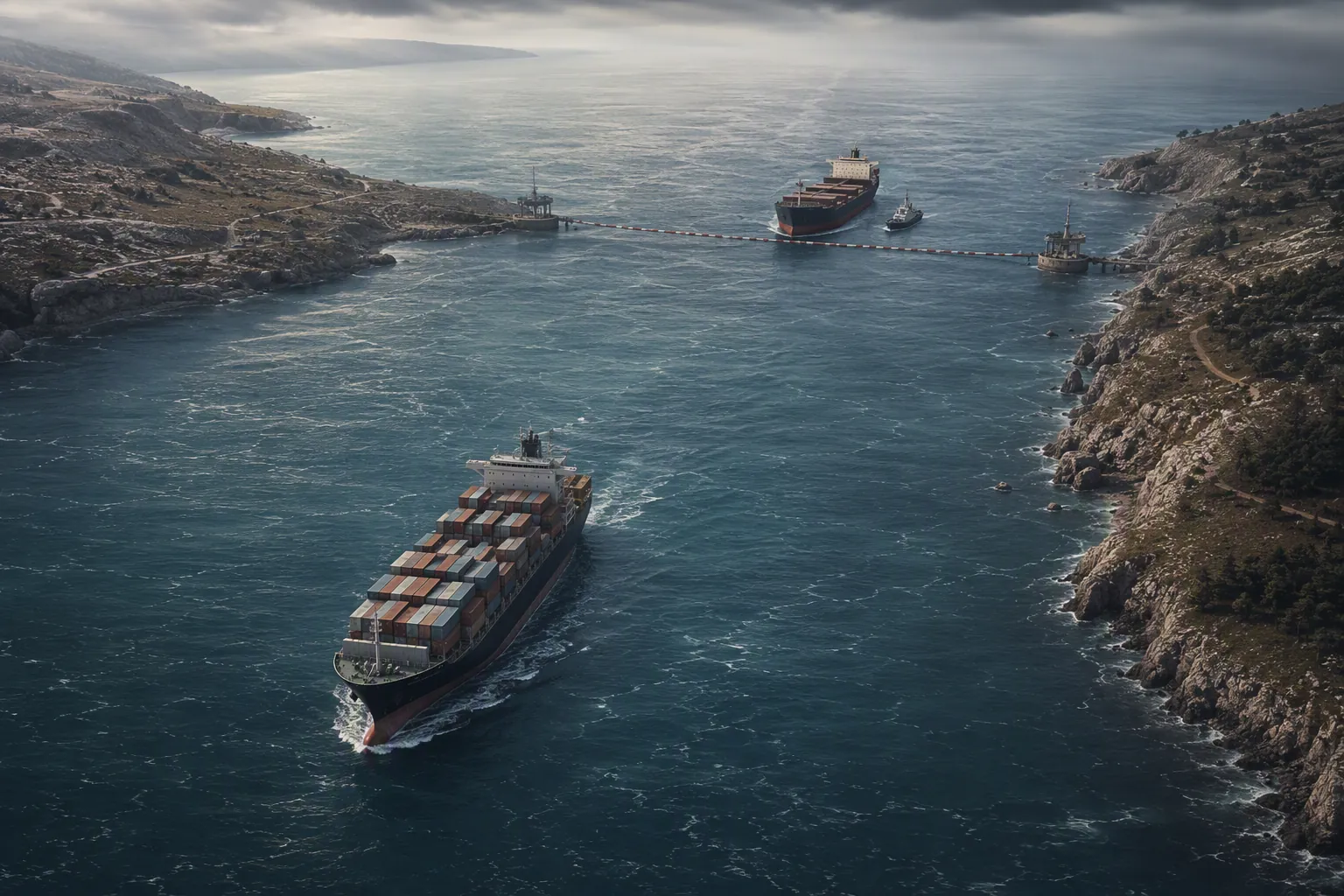
The gap between those figures is not a courtroom finding. It is a commercial signal. Owners may hold back because crews are exposed, insurers have not repriced, charterers have not accepted deviation risk, banks are reviewing sanctions language, or naval authorities have not clarified escort and reporting channels. A vessel can have a plausible legal right to pass and still wait because the voyage cannot be financed, insured, documented, or defended to a claims committee.
That distinction is particularly important for marine insurance. A ceasefire can affect war-risk premium, additional premium notices, held-covered decisions, deviation arguments, and charterparty performance disputes. It does not by itself answer whether a delay at a checkpoint was a lawful coastal-state control, an unlawful burden on passage, a sanctions-triggering payment demand, or a seizure risk that made performance commercially unreasonable. The Red Sea experience is a useful comparator for how quickly attack risk can cascade through insurance and contract performance; see the site’s Red Sea insurance and contract-cascade record.
The toll or “coordination” regime is where exposure became concrete
The most awkward post-truce problem was not the abstract status of the Strait. It was the reported toll or “coordination” regime and the associated U.S. seizure threat. Chatham House’s analysis treated the Iranian regime as a practical constraint on shipping, while CRS identified the U.S. threat to seize vessels that paid Iran-imposed charges. [6][9]
That is the kind of fact pattern that makes a clean legal label dangerous. If the payment is described as a toll for passage through an international strait, it raises law-of-the-sea objections. If it is described as a coordination charge, it raises questions about whether the requirement is genuinely navigational, whether it discriminates by flag, cargo, ownership, or destination, and whether refusal leads to delay, diversion, detention, or attack exposure. If the United States threatens seizure for vessels that comply, the operator faces a second legal system before the first one has been adjudicated.
The practical file then becomes less about a single right to transit and more about documents. Who instructed payment? Who classified it? Was the payment made by owner, charterer, agent, cargo interest, or a local service provider? Was the purpose written as port service, maritime safety coordination, security clearance, or passage fee? Did the insurer know? Did the bank screen it? Did the flag state object or acquiesce? For sanctions and payment-risk mapping, the site’s toll-regime sanctions exposure record is the better companion piece.
A ceasefire does not sanitize that chain. It may make the vessel less likely to be hit while the payment question is resolved. It does not decide whether the payment demand was lawful, whether paying it violates another state’s sanctions or seizure policy, or whether a charterer can force an owner to proceed through a payment regime that the owner’s bank or insurer will not accept.
What a defensible file note should separate
A useful Hormuz memo should not begin and end with the word “reopened.” It should separate the claim to pass from the wisdom of passing, and it should mark which propositions are settled enough to rely on and which remain advocacy positions.
- Ceasefire status: identify the relevant truce phase and state that the ceasefire suspended hostilities without terminating the international armed conflict.
- Passage theory: state whether the file relies on customary transit passage, Iran’s non-suspendable innocent-passage framing, or both in the alternative.
- Vessel status: identify flag, ownership, beneficial ownership, cargo, destination, military connection, and any facts that could make the vessel appear enemy-linked rather than neutral.
- Restriction type: distinguish warning, reporting, routing, inspection, payment, detention, denial of passage, mining risk, and attack risk.
- Commercial consequence: record insurer response, premium change, sanctions review, bank position, charterparty notices, and any deviation or delay instructions.
- Evidence status: mark reported traffic figures, public truce dates, and crisis chronologies as sources to verify before treating them as operative facts.
That structure also prevents the passage analysis from being pulled into the wrong record. If the question is whether a tanker attack was lawful, the relevant file is closer to the site’s Hormuz ship-attacks lawfulness record or tanker-attacks briefing. If the issue is whether Iran could reject a proposed corridor or impose alternate routing, the better cross-check is the Hormuz corridor-rejection analysis. If the file concerns seizure and detention limits, the site’s competing-regimes analysis keeps the law-of-sea and coercive-enforcement questions apart.
The point at which law and prudence diverge
There will be voyages where the legal argument for passage is stronger than the operational case for sailing. That is not a contradiction. A neutral vessel may have a respectable claim that it cannot be subjected to a blanket closure, toll, or suspension. The same vessel may still wait because the crew-risk assessment, war-risk premium, lender condition, sanctions screen, or charterparty indemnity is not in place.
There will also be voyages where the commercial appetite to sail is stronger than the legal comfort. A charterer may want the shortest route. A cargo interest may press for delivery. A state authority may say the strait has reopened. None of that answers whether a payment, coordination instruction, or Iranian restriction can be defended against the passage regime that the operator’s flag state, insurer, and financing bank are likely to apply.
The ceasefire reduced active-hostilities risk, but it did not decide the Hormuz passage regime. The unresolved assessment remained the same through the April truce, the indefinite extension, and the June memorandum: whether each Iranian restriction, in that phase and against that vessel, unlawfully burdened neutral transit or innocent passage. The truce may have changed the operating weather; it did not rewrite the navigational law.
References
- Ceasefire in International Armed Conflict: Implications for Jus Ad Bellum Self-Defense, Lieber Institute
- Ceasefire, ICRC Casebook
- 2026 Iran war ceasefire, Wikipedia
- UNCLOS Part III, United Nations
- The Legality of Iran's Closure of the Strait of Hormuz, EJIL: Talk!
- The Strait of Hormuz, shipping, and law, Chatham House
- Clarifying Freedom of Navigation in the Gulf, Washington Institute
- The Closure of the Strait of Hormuz by Iran, Opinio Juris
- CRS R48903, EveryCRSReport
- 2026 Strait of Hormuz crisis, Wikipedia
Operationalizing workflow
No workflow has been explicitly linked to this obligation yet. See Workflows generally.
Illustrative cases
No illustrative case is currently tracked for this obligation. See Risk Digest for documented incidents generally.
← Back to RegulationReport a correction or tip
Spotted an outdated figure, a misstated fact, or a ruling this regulation entry should reflect? Public comments are disabled for this content given the professional cost of a misreported case outcome, penalty amount, or rule text — use the structured correction channel instead.
Report a correction or tip for this record →