
Why Italy can’t suspend Spain from the Schengen Agreement
- Authority
- European Parliament and Council of the European Union
- Rule type
- regulation
- Jurisdiction scope
- EU
- Source text
- Read primary rule text ↗
No unilateral suspension of another Schengen state; temporary border controls must follow Schengen Borders Code procedures.
Last verified: 2026-08-02, 00:00 UTC. Category: regulation-ethics. This record is a legal-information note, not legal advice.
The headline version—“Italy suspended Spain from Schengen”—uses the wrong legal verb. A member state may temporarily reintroduce border control at its own internal borders under the Schengen Borders Code. It does not acquire a power to expel, suspend, or remove another member state from the Schengen area. The provision most likely to be mistaken for a “suspension” rule, Article 29, is a Council recommendation mechanism based on a Commission proposal; it is not a unilateral Italian instrument. [1]
The Commission’s public Schengen page is the official place to check notified temporary reintroductions and related Commission opinions. As of this record’s timestamp, the safer formulation is narrow: no Commission proposal or Council recommendation triggering the Article 29 pathway has been identified in the public official record checked for this article, and Italy’s reported measure should be treated as a temporary border-check measure rather than as a suspension of Spain. [2]
| Question | Verified legal position | Practical consequence |
|---|---|---|
| Can Italy suspend Spain from Schengen? | No unilateral power appears in the Schengen Borders Code. Temporary border control and Article 29 recommendations are different instruments. [1] | A traveler may face checks at a border covered by Italy’s measure; Spain is not thereby removed from Schengen. |
| What happened on July 31, 2026? | Italy was reported to have acted after the Ceuta crossings, but the legal form is a time-limited reintroduction of checks at Italy’s own borders, not a Spanish suspension. [2] | For traveler-facing effects, see the separate Italy record on targeted document checks and exemptions. |
| Why do Ceuta and Melilla matter? | Spain’s Schengen accession declaration preserved identity and document checks on sea and air connections from Ceuta and Melilla; Article 41 of the current Code preserves special arrangements for those cities. [1][3] | Irregular entry into an enclave does not by itself create a right to travel to mainland Spain or onward within Schengen. |
| Has Article 29 been triggered? | No published Commission proposal or Council recommendation has been identified in the official record checked as of 2026-08-02 UTC. [1][2] | The legal posture remains ordinary temporary border-control mechanics, not a collective Schengen-area suspension. |
“Suspend” is doing work the law does not give it
The Schengen Borders Code has verbs of its own: reintroduce border control, notify, consult, issue an opinion, propose, recommend. “Suspend Spain” is not one of them. That distinction is not cosmetic. It decides who has legal authority, what text controls the measure, how long it may last, and what a traveler or lawyer can actually rely on.
A temporary reintroduction of border control is a measure taken by a member state at its own internal borders, within the limits and procedures of the Code. It may affect crossings into that state. It does not amend another state’s membership status, annul the Schengen acquis for that state, or turn Spanish territory into non-Schengen territory. For the wider statutory framework—grounds, time limits, notification duties, and the current notified-controls table—see the companion record on Schengen suspension rules and conditions.
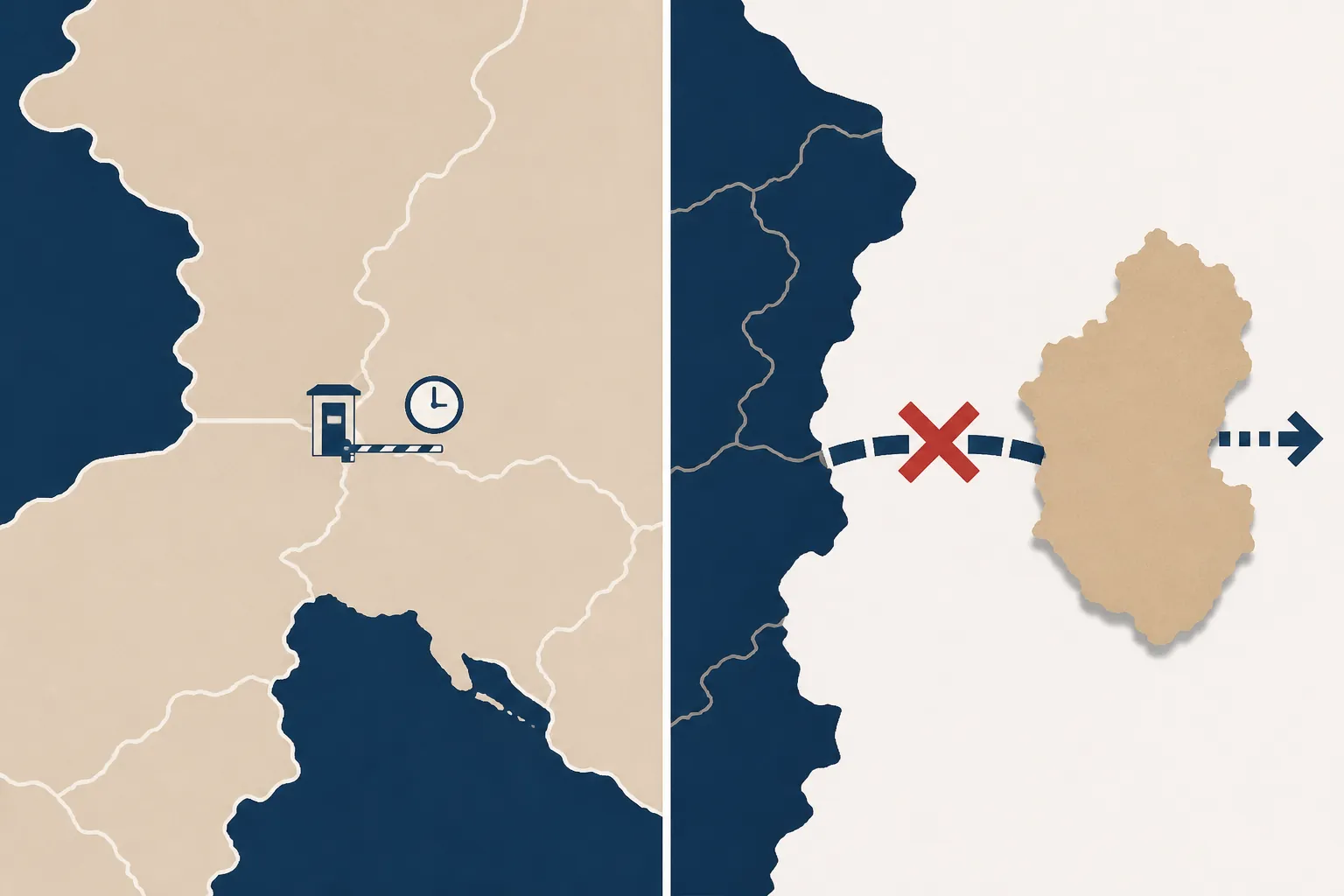
That is why the legal correction has to come before the political one. Italy may complain about Spain’s handling of Ceuta. It may take a border-control step that must fit the Code. It may not convert that complaint into a unilateral suspension of Spain from a multistate legal area.
What Articles 25–29 actually allow
Articles 25 through 29 of the Schengen Borders Code deal with temporary reintroduction of border control at internal borders. The architecture is restrictive: internal border control is not meant to be the normal condition of the area, so reintroduction is tied to specified threats, procedure, necessity, proportionality, and time limits. [1]
For a one-state measure, the legal question is not whether the state has made a strong political accusation. It is whether the state has reintroduced checks at its own internal borders under the relevant Code procedure and whether the notification and duration match the applicable route. The Commission’s Schengen page describes the notification system and publishes member-state notifications and Commission opinions. [2]
That public-record point matters here because the reported July 31 Italy measure had not appeared in the Commission’s public temporary-reintroduction table when this record was checked. Its one-month description makes it look like a temporary-control measure under the Code structure, but the exact notified legal basis should be rechecked against the published Commission record rather than inferred from headlines. [2]
Article 29 is not a unilateral expulsion clause
Article 29 is the provision that can make a headline sound more plausible than it is. It deals with exceptional circumstances where the overall functioning of the area without internal border control is put at risk because of serious deficiencies relating to external border control. Even then, the route is institutional and collective: the Council may recommend that one or more member states decide to reintroduce border control at all or specific parts of their internal borders, acting on the basis of a Commission proposal. [1]
The timing is also controlled. The Article 29 recommendation route is a last-resort mechanism, initially for a period of up to six months, renewable up to three times. Those words do not describe expulsion of a member state. They describe recommended temporary controls at internal borders, adopted through EU institutions, when the Code’s conditions are met. [1]
So Article 29 cannot be used to save the “Italy suspended Spain” formulation. If triggered, it would still not be Italy acting alone to remove Spain. It would be a Council recommendation process, based on a Commission proposal, authorizing temporary controls by specified member states. As of the timestamp on this record, no such published proposal or recommendation has been identified in the official record checked here. [1][2]
Ceuta and Melilla already have a screened-movement regime
The Ceuta and Melilla point is often treated as if it creates a new Schengen emergency by itself. The legal record is less dramatic and more important. Spain’s 1991 Schengen accession materials include a declaration on Ceuta and Melilla under which Spain committed to maintain identity and document checks on sea and air connections from those cities. Article 41 of the current Schengen Borders Code preserves the special arrangements applying to Ceuta and Melilla. [1][3]
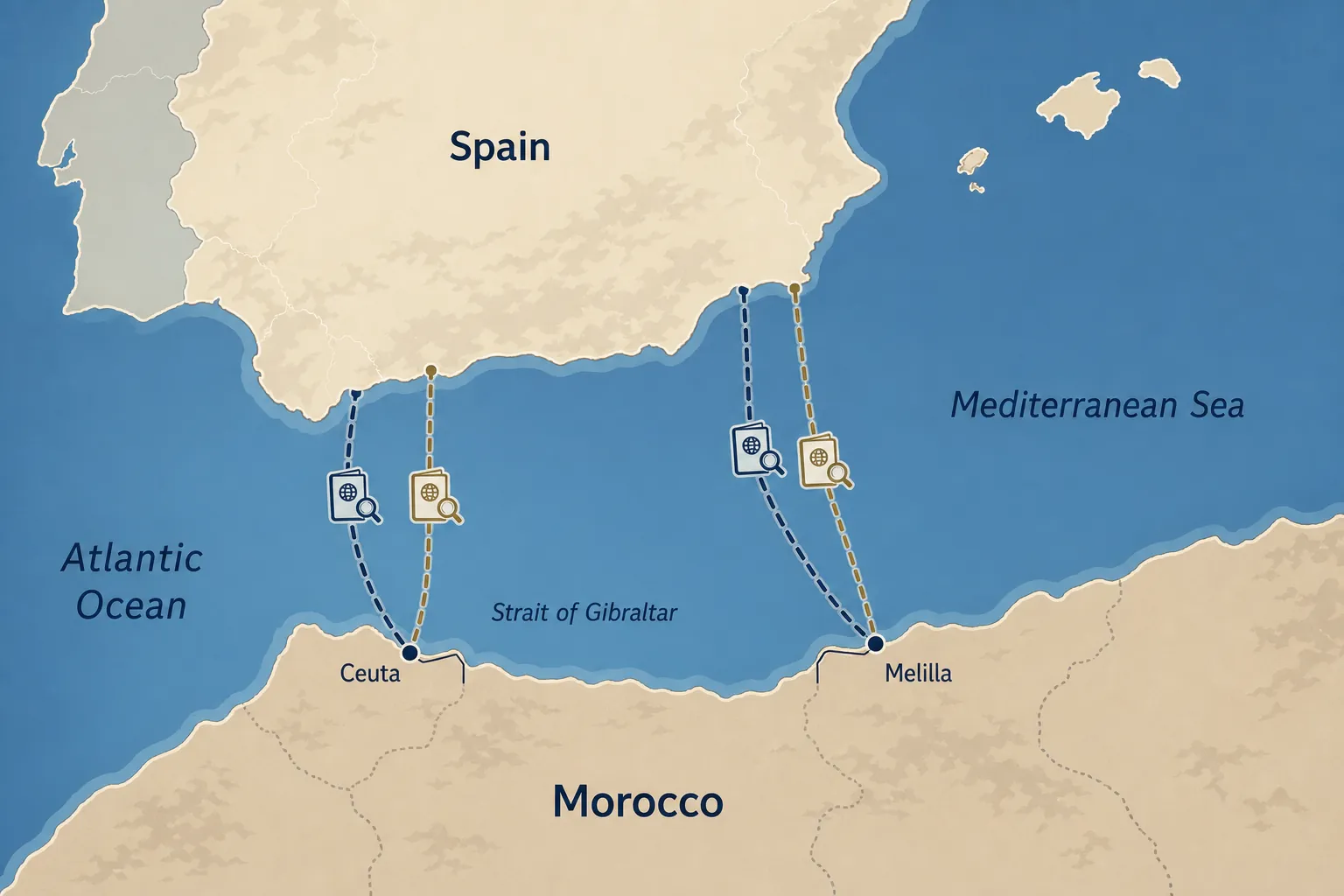
In practical terms, the enclaves do not work like an unchecked internal Schengen platform. A person leaving Ceuta or Melilla by sea or air toward mainland Spain, or toward another Schengen state, remains subject to police identification and document checks. The legal consequence is direct: irregular entry into Ceuta or Melilla does not itself supply a right to remain there, board a ferry or flight to mainland Spain, or move onward within Europe. [3]
That is the point EU officials stressed in response to the suspension talk. IMI Daily quoted law professor Marie-Laure Basilien-Gainche of Lyon 3 as saying, “There is no provision in the Schengen framework for this kind of action. One state cannot unilaterally expel another from the area.” The quote is useful because it states the legal conclusion plainly, but it is still a mediated quote in a secondary publication rather than an original transcript. [4]
The same reporting also attributed to Commissioner Magnus Brunner the point that nobody who entered Ceuta irregularly had moved to the mainland and that the special exit-check rules for Ceuta and Melilla remained in force. Euronews separately quoted a senior EU official putting the practical premise more bluntly: “it’s not like they’re landing in Spain and moving onto France.” [4][5]
Spain’s Foreign Affairs explainer gave a concrete account of the July 30 crossings: more than 48,000 of roughly 50,000 people who crossed returned to Morocco within 48 hours, and irregular entry conferred no right to remain, travel to the mainland, or move within Europe. Those numbers should be attributed to Spain’s ministry, not treated as a universal settlement of all crowd estimates in circulation. [6]
The Italy measure may matter to travelers without changing Spain’s status
The correction should not be overread in the other direction. Saying Italy cannot suspend Spain from Schengen does not mean Italy’s measure has no practical effect. A temporary reintroduction of checks can still delay a route, require document presentation, or change the screening position for the people covered by the measure.
That is a different consequence from “Spain suspended.” For the narrower travel record on Italy’s reported one-month measure, including which routes and travelers were described as covered, see Italy’s Schengen travel rules for Spain.
The surrounding Ceuta litigation and enforcement background may explain why the political claim became loud. It does not change the instrument. Readers tracking that background can start with the Risk Digest records on judgment 814/2026 and the enforcement vacuum, the Ceuta migrant surge and asylum rulings, and legal responsibility for child migrants in Ceuta.
Secondary commentary has described the Italy-Spain posture as novel compared with ordinary temporary reintroductions of internal border control. That may be a useful political and historical point, but it is not the source of legal power. The source of power remains the Code text and the published institutional acts. [7]
Current legal position
As of 2026-08-02 UTC, Spain has not been shown in the official record checked here as suspended from Schengen. Italy has no unilateral Schengen Borders Code power to expel or suspend Spain from the area. The available legal characterization of the July 31 action is a time-limited reintroduction of checks at Italy’s own borders, subject to the Code’s procedures and to verification against the Commission’s public record.
Article 29 has not appeared in the checked official record as triggered by a published Commission proposal or Council recommendation. Ceuta and Melilla remain subject to the special identity and document-check arrangements preserved through Spain’s Schengen accession materials and Article 41 of the Code. Movement out of those enclaves remains screened, which is precisely why irregular entry there is not the same legal event as unchecked onward movement through the Schengen area.
References
- Regulation (EU) 2016/399 of the European Parliament and of the Council (consolidated text), EUR-Lex, October 12, 2025.
- Temporary reintroduction of border control, European Commission.
- Agreement on the Accession of the Kingdom of Spain to the Convention implementing the Schengen Agreement of 14 June 1985, EUR-Lex.
- Italy Suspends Schengen Free Movement With Spain After Ceuta Crossings, IMI Daily.
- Could the EU kick Spain out of the Schengen area over the Ceuta crisis?, Euronews, August 1, 2026.
- Ceuta, Melilla and the integrity of the Schengen Area, Spanish Ministry of Foreign Affairs.
- Suspending Schengen, what the legislation says. The specific case of Ceuta and the precedents, Il Foglio, July 31, 2026.
Operationalizing workflow
No workflow has been explicitly linked to this obligation yet. See Workflows generally.
Illustrative cases
No illustrative case is currently tracked for this obligation. See Risk Digest for documented incidents generally.
← Back to RegulationReport a correction or tip
Spotted an outdated figure, a misstated fact, or a ruling this regulation entry should reflect? Public comments are disabled for this content given the professional cost of a misreported case outcome, penalty amount, or rule text — use the structured correction channel instead.
Report a correction or tip for this record →