
No Senate Vote Yet on Permanent Daylight Saving Time Bill
- Authority
- U.S. Congress
- Rule type
- statute
- Jurisdiction scope
- US federal
- Source text
- Read primary rule text ↗
No permanent DST in effect; clocks still fall back Nov. 1, 2026.
Regulation & Ethics status record. Not legal advice. Legislative status can change without this page changing first; use the cited official action pages and roll calls for publication-day verification.
Last verified: Aug. 1, 2026, UTC.
| Status item | Verified answer as of Aug. 1, 2026 |
|---|---|
| Bill status | H.R.139 has passed the House. It has not passed the Senate and has not become law. |
| Last House action | The House passed H.R.139 on July 14, 2026, by a 308-117 recorded vote. [1] |
| Current Senate posture | The Senate received H.R.139 on July 15, 2026, read it twice, and referred it to the Committee on Commerce, Science, and Transportation. [2] |
| Senate floor vote | No Senate floor vote is scheduled in the verified record used for this status check. Senate leadership had not committed to floor action. [2][3] |
| Procedural obstacle | The unanimous-consent route has been blocked by Sen. Tom Cotton, and Majority Leader John Thune has described the 60-vote question as unresolved. [3][4] |
| Clock-change consequence | Under current law, clocks still fall back on Nov. 1, 2026. [5] |
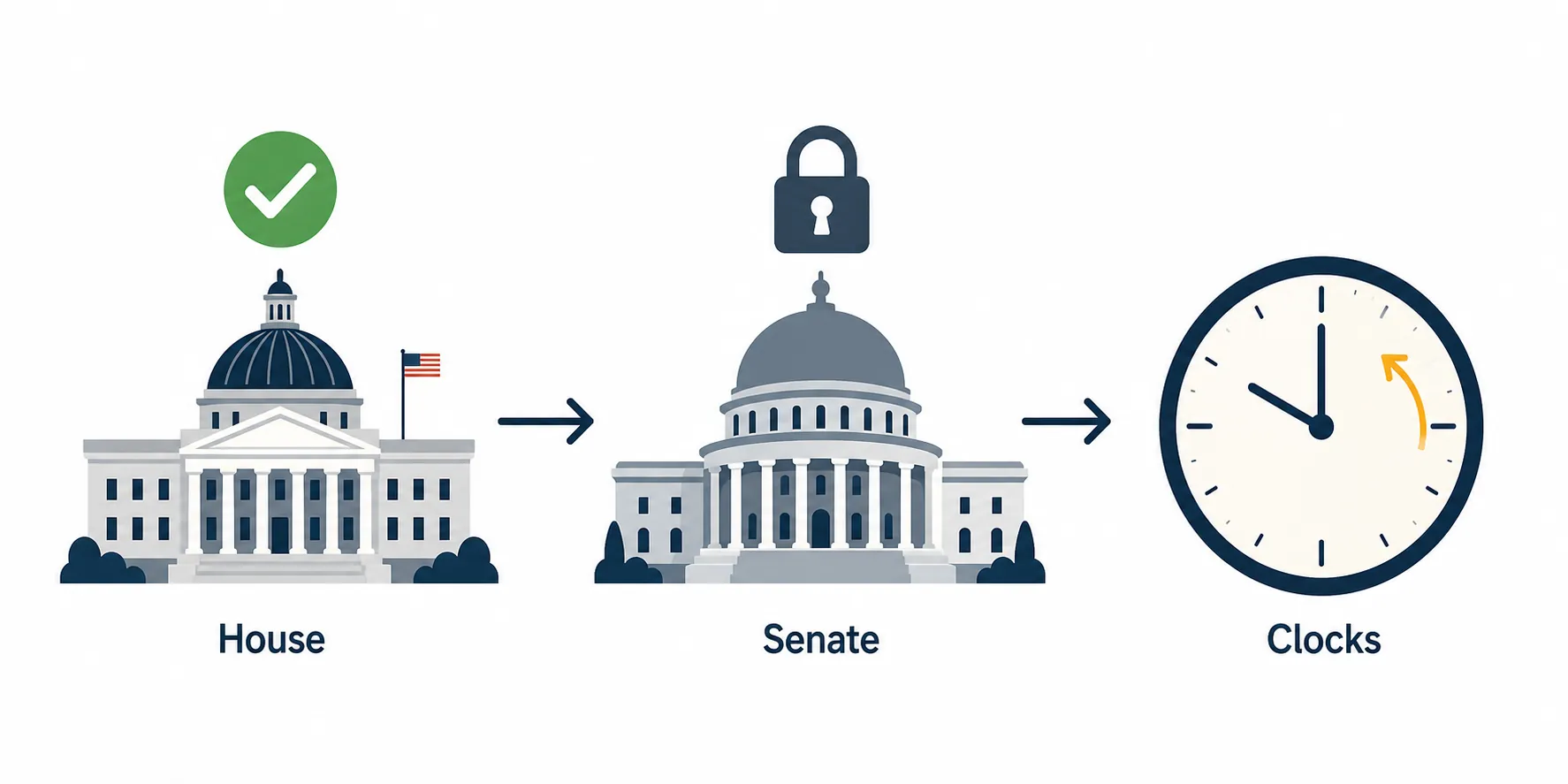
The short answer: no Senate vote yet. The House vote was real. The Senate vote has not happened. A bill that has passed one chamber is not a law, and it is not “passed Congress.”
What passed, and where it is now
The House-passed vehicle is H.R.139. The Clerk’s roll call records the July 14, 2026 vote as 308 yeas, 117 nays, and 8 not voting. That vote moved the bill out of the House; it did not send the bill to the president. [1]
Congress.gov then records the next step: on July 15, 2026, H.R.139 was received in the Senate, read twice, and referred to the Senate Committee on Commerce, Science, and Transportation. That is a Senate referral, not a Senate passage vote. [2]
This distinction is the part most headlines blur. “Permanent daylight saving time bill passes” may be accurate if the missing words are “the House.” It is inaccurate if it leaves readers with the impression that the Senate has also approved the bill or that the president has a bill to sign.
There is also a Senate companion bill, S.29, introduced on Jan. 7, 2025, by Sen. Rick Scott. That companion is relevant to the policy debate, but it is not a substitute for a Senate floor vote on H.R.139, and it should not be described as Senate-passed. [6]
| Measure | Chamber record that matters for status |
|---|---|
| H.R.139 | Passed the House on July 14, 2026; received and referred in the Senate on July 15, 2026. [1][2] |
| S.29 | Senate companion introduced Jan. 7, 2025; no verified Senate floor passage in the record used here. [6] |
| Current legal result | No enacted permanent daylight saving time law; Nov. 1, 2026 fall-back remains under current law. [5] |
One additional caution belongs here because it affects careful status writing. Public materials have referred to committee movement and related legislative packaging in more than one way, including discussion of the Motor Vehicle Modernization Act and the House-passed H.R.139 vehicle. Unless the engrossed text and official action pages are checked at publication, it is safer to state the chamber actions than to assert detailed operative mechanics such as opt-out windows, territory treatment, or Uniform Time Act self-exemption effects.
Why being one chamber away is still a real bottleneck
The Senate has two broad procedural paths available if supporters want to move quickly: unanimous consent or the regular floor route. Neither is presently clear.
The unanimous-consent route is not open while one senator objects. Reuters reported that Sen. Tom Cotton blocked an attempt to pass permanent daylight saving time by unanimous consent on Oct. 28, 2025. Reuters later reported, after the House vote, that Cotton had asked Thune not to bring the bill to a vote. [4][3]
The regular route depends on leadership scheduling and vote count. On July 15, 2026, Reuters reported that Senate Majority Leader John Thune said whether the bill could reach 60 votes “remains to be seen.” Thune also said, “I just don’t think we want a mandate, and that was tried once before and repealed,” and noted that he had voted against the measure in committee. [3]
That is why “one chamber from the president’s desk” does not mean “nearly enacted.” The House has done its part on H.R.139. The Senate still has to decide whether to bring the measure to the floor, how to move it, and whether enough senators will support the selected path.
The policy disagreement is not only whether to stop changing clocks. At an April 2025 Senate Commerce Committee hearing, Sen. Ted Cruz framed the issue this way: “There is widespread agreement on locking the clock, but where to lock it?” [7]
That sentence explains much of the stall without requiring a detour into sleep studies or sunrise tables. Some lawmakers favor permanent daylight saving time. Others prefer permanent standard time, or oppose a federal mandate. Those positions matter procedurally because unanimous consent requires no objection, and the regular path may require a supermajority threshold.
The compressed timeline that prevents the common mix-up
| Date | Status significance |
|---|---|
| 2022 | A prior permanent-DST push cleared the Senate by unanimous consent but did not become law; the 2026 House-passed bill is a different current vehicle. [3] |
| Apr. 2025 | Senate Commerce discussion showed the central division: whether to lock the clock on daylight time or standard time. [7] |
| Oct. 28, 2025 | Cotton blocked the unanimous-consent route. [4] |
| July 14, 2026 | The House passed H.R.139, 308-117. [1] |
| July 15, 2026 | The Senate received H.R.139 and referred it to Commerce; Thune publicly left the 60-vote question unresolved. [2][3] |
| Aug. 1, 2026 | No verified Senate floor vote yet; no enacted permanent daylight saving time law. |
The 2022 episode is useful only as a caution. It shows that the Senate has previously allowed a permanent-DST bill to move by unanimous consent, but it does not tell readers that the present Senate has passed H.R.139. It has not.
What happens next
The next required federal action is a Senate floor vote, unless the Senate first takes some other committee or procedural step reflected in the official action record. As of this status check, that vote is not scheduled.
A fall-session vote is possible in the ordinary sense that Senate leadership can schedule one later. It is not a pending calendar item in the verified record used here. Treating it as scheduled would be a status error.
If the Senate does schedule and pass H.R.139, the measure would still need to be presented to the president. Until that happens and the bill is signed into law, the current 2026 clock-change schedule remains in place. The next fall-back is Nov. 1, 2026. [5]
State trigger laws and preemption questions therefore remain downstream issues, not current federal enactment effects. For those narrower questions, use the separate records on the 19-state preemption puzzle, the state-by-state trigger-law map, and the Mississippi permanent-DST record.
For practical effects if Congress eventually acts, the separate sunrise-impact brief covers morning-light consequences, and the Senate opposition and procedural-hurdles analysis tracks the arguments against passage. They are separate from the narrower status answer here.
As of Aug. 1, 2026: no Senate vote yet, no enacted permanent daylight saving time, and no change to the 2026 clock schedule unless Congress acts.
References
- Roll Call 238, Office of the Clerk, U.S. House of Representatives, July 14, 2026.
- H.R.139 - 119th Congress (2025-2026), Congress.gov.
- US Senate undecided on bill to make daylight saving time permanent, Reuters, July 15, 2026.
- Long-stalled push to make US daylight saving time permanent hits dead end, Reuters, Oct. 28, 2025.
- Will daylight saving time end in 2026? Bill update on permanent daylight savings, USA TODAY Network / NorthJersey.com, July 29, 2026.
- S.29 - 119th Congress (2025-2026), Congress.gov.
- Daylight saving time 2025: Senate hearing debates locking the clock, CBS News, Apr. 10, 2025.
Operationalizing workflow
No workflow has been explicitly linked to this obligation yet. See Workflows generally.
Illustrative cases
No illustrative case is currently tracked for this obligation. See Risk Digest for documented incidents generally.
← Back to RegulationReport a correction or tip
Spotted an outdated figure, a misstated fact, or a ruling this regulation entry should reflect? Public comments are disabled for this content given the professional cost of a misreported case outcome, penalty amount, or rule text — use the structured correction channel instead.
Report a correction or tip for this record →