
What the Aschenbrenner unwind means for AI-stock margin risk
The Aschenbrenner forced unwind crystallized the Bank of England's July 2026 warning that record hedge fund equity prime-brokerage balances are concentrated in AI-linked names — at the same moment the SEC/CFTC Form PF proposal, if finalized, would remove the current-report trigger for margin defaults. This analysis separates confirmed facts from reported claims and maps the prospective margin-call dispute and disclosure obligations for funds and prime brokers, with no litigation or enforcement filed as of August 3, 2026.
- Jurisdiction
- US federal
- Court
- No court (no litigation filed)
- AI tool named
- No AI tool named
- Ruling date
- Aug 3, 2026
- Source document
- View primary court order ↗
- Last verified
- Aug 3, 2026
Lex Machina Review is an independent risk-tracking and reference resource. Nothing on this site is legal advice, and using it does not create an attorney-client relationship. Every record is reviewed against primary sources but may not reflect the most current status of a matter — always verify directly against the cited court order, rule text, or a licensed attorney before relying on it.
Companion explanation — secondary to the source document above
Last checked August 3, 2026: the Leopold Aschenbrenner hedge fund forced unwind in AI stocks is still a disclosure and margin-risk case study, not a resolved legal case. The useful question is not whether the trade was brilliant, reckless, or unlucky. It is whether the reporting and documentation system would surface this kind of concentrated leverage stress early enough, and with enough precision, for regulators, fund counsel, prime brokers, and investors to act on it.
- No litigation or enforcement action against the fund, Citadel, or prime brokers has been reported as of this check. The event-status baseline belongs in the companion Situational Awareness fund collapse record, which should be read before treating any market account as a legal finding.
- Reuters reported that Citadel bought most of Situational Awareness’s stock holdings after the AI-share rout, while also cautioning that it was not clear whether formal margin calls occurred. That distinction matters: a reported liquidity squeeze is not the same thing as a confirmed contractual margin call or default. [1]
- The SEC/CFTC Form PF changes remain proposed, not final. Any analysis of the reporting gap has to stay in the conditional tense unless and until the rulemaking is finalized. [2]
- The fund’s own investor communication, republished by Business Insider, gives unaudited performance estimates and contests shutdown or liquidation framing. Those are fund-stated claims, not adjudicated facts. [5]

The timing is the legal-risk fact
The unwind landed almost exactly where the Bank of England had just pointed. In its July 2026 Financial Stability Report, the Bank said hedge fund equity prime-brokerage balances were at record levels, had grown roughly 40% globally year over year, and were concentrated in semiconductor stocks. [3]
That does not make one fund’s losses systemic. It does make the episode procedurally important. The risk category was already on the regulator’s page before the market story arrived: leveraged hedge fund equity exposure, held through prime-brokerage relationships, crowded into semiconductor names that had become the market’s preferred AI proxy.
This is why loose verbs create legal confusion. “Forced unwind” may describe market pressure. “Liquidated” may imply a legal or operational endpoint. “Margin call” may refer to a specific contractual notice, with timing, valuation, cure, and default consequences. “Default” may trigger reporting, acceleration, termination, or collateral rights. Reuters’s caution that formal margin calls were not confirmed is not a footnote; it is the line between a market-mechanics account and a legal-obligation account. [1]
There is a narrow but important consequence for counsel and compliance teams: the first obligation is not to produce a satisfying story. It is to preserve the difference between what happened in the market, what counterparties communicated, what the agreements required, what the fund told investors, and what any reporting regime actually required at the time.
The Form PF gap would sit exactly where this stress appeared
The April 2026 Form PF proposal is the second document that matters. As described in the Federal Register notice, the SEC and CFTC proposed amendments to Form PF reporting requirements for all filers. The proposal has not been finalized, but its treatment of hedge fund margin stress is difficult to ignore beside the Aschenbrenner unwind. [2]
| Issue | Current or proposed treatment | Why it matters here |
|---|---|---|
| Margin default / inability to meet margin calls | The proposal would remove the current-report trigger for margin default or inability to meet margin calls. [2][4] | That is the category most directly implicated when market accounts describe pressure to sell positions, even if formal margin calls are not confirmed. |
| Reporting timing | Under the 2023 rules, current reporting for the relevant trigger was due within three days; the proposal would remove that trigger. [4] | A later reconstruction may still be possible from counterparty and fund records, but the early regulatory signal would be less direct. |
| Large hedge fund adviser threshold | The proposal would raise the large-hedge-fund-adviser threshold from $1.5 billion to $10 billion. Cleary’s analysis said that would drop nearly two-thirds of current large-fund filers from that category. [4] | The reporting perimeter would narrow at the same time concentrated AI-linked equity leverage has become more visible. |
| Regulatory detection | The Federal Register notice itself warned that removing the trigger could “significantly hinder detection of margin stress in qualifying hedge funds which could contribute to systemic risk.” [2] | That sentence is the rulemaking record anticipating the precise visibility problem this episode now illustrates. |

The point is not that Situational Awareness would necessarily have filed a Form PF current report, or that it failed to do so. The public record supplied here does not support that conclusion. The point is narrower: if the proposed rule were finalized, the reporting system would become less sensitive to a type of margin stress that regulators had already identified as relevant to systemic-risk monitoring.
That distinction is familiar from other obligation-clock problems. In cyber, securities, and enforcement contexts, the legal question often turns on when a duty matured, what was known at that point, and whether later public narratives smuggled in facts that were not available to the decision-makers at the time. The same discipline appears in records such as the site’s SEC Form 8-K Item 1.05 trigger analysis and SEC enforcement-risk framing for Coinbase. Here, the equivalent discipline is to ask whether a margin-stress signal would have reached regulators quickly, not whether a dramatic market account can be backfilled into a reportable legal event.
The fund letter adds another reason to keep the record clean. Business Insider republished a letter in which the fund stated unaudited estimates of approximately -67% month to date and +80% year to date, while also saying the fund “was not shut down, liquidated, or transformed into a private-only fund.” [5] Those statements may be important to investors and counterparties, but they do not resolve whether particular notices were sent, whether contractual thresholds were breached, or whether any regulatory reporting obligation was triggered.
The market story is not the margin-call record
Same-day explanations of the unwind can be useful for understanding how crowded AI exposure, falling collateral values, and concentrated semiconductor positions may have interacted. They are less useful for proving the legal sequence. A broker sale, a negotiated transfer, a collateral call, an informal risk-reduction demand, and a formal event of default can all produce similar market footprints.
For editors and compliance staff, the operational rule is simple: do not convert “reported margin pressure” into “confirmed margin call.” Do not convert “stock holdings sold” into “liquidation.” Do not convert “large loss” into “default.” Each term carries a different paper trail and a different legal consequence.
This is also why the event is better treated as an obligations tracker than as an AI-bubble morality play. Prior AI-market-risk work, including the site’s analysis of zero AI value narratives, belongs to the valuation and narrative layer. The Aschenbrenner episode belongs, for present purposes, to the leverage, reporting, and dispute-readiness layer.
If a dispute arrives, four issues would likely organize the fight
There is no reported margin-call litigation here as of August 3, 2026. The useful exercise is therefore prospective: if a margin dispute later emerges, what will the parties fight about? Quinn Emanuel’s margin-call dispute framework identifies four recurring issues for investors under English law: margin-call validity, collateral valuation, acceleration or termination, and collateral liquidation. It also emphasizes duties around good-faith and commercially reasonable valuation in the ISDA context. [6]
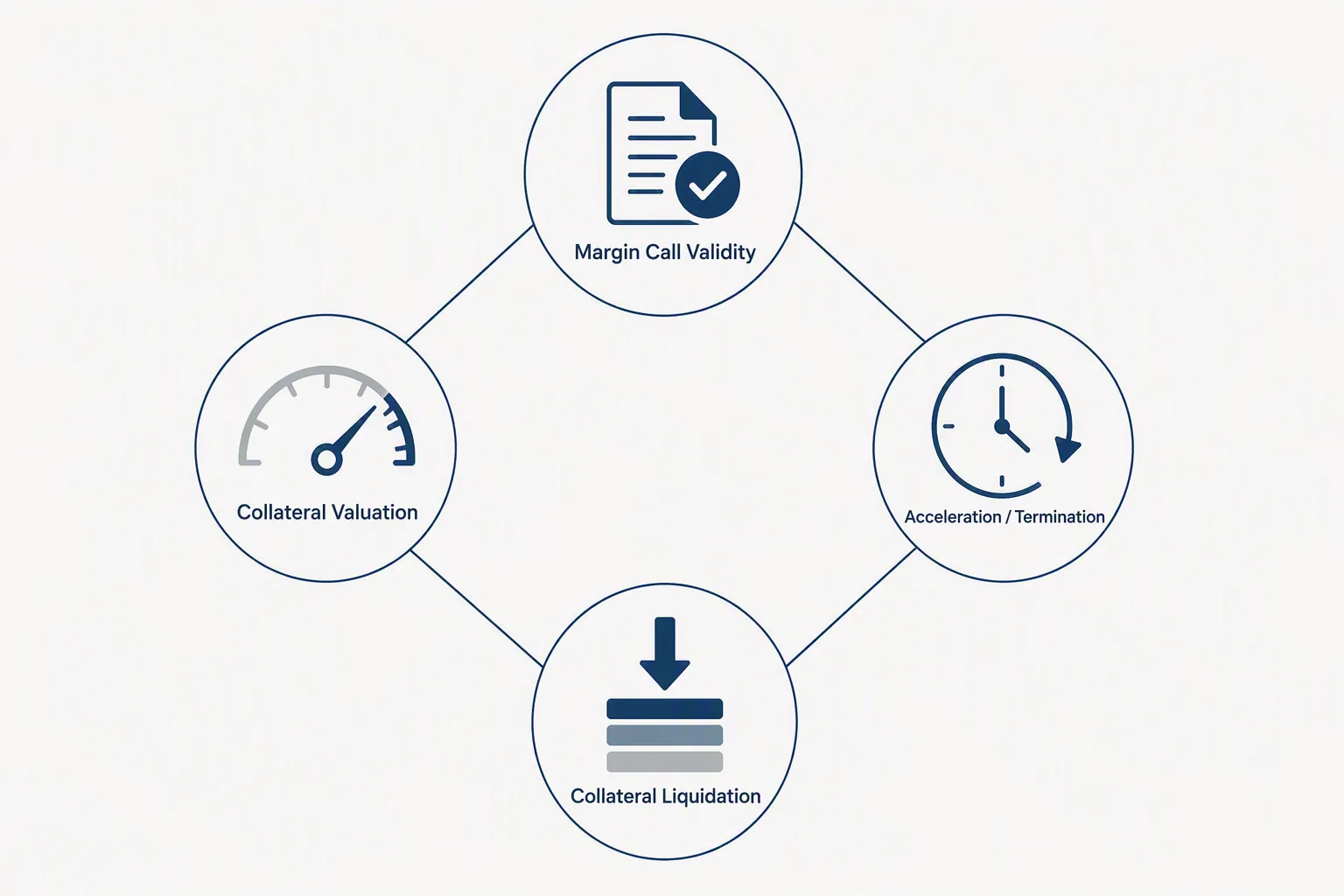
Margin-call validity
The first question is whether the call, if one was made, complied with the governing documents. That means notice method, timing, calculation agent authority, eligible collateral, thresholds, cure periods, and any cross-product or cross-default provisions. A market selloff alone does not answer any of those questions.
Collateral valuation
The second question is valuation. In concentrated AI-linked or semiconductor positions, the valuation record may matter as much as the price print. The parties would want timestamped marks, haircut methodology, liquidity assumptions, concentration adjustments, internal approvals, and any contemporaneous challenge by the fund. If a broker revised marks during a volatile window, the record should show why.
Acceleration or termination
The third question is whether any alleged failure matured into acceleration, termination, or another contractual remedy. The distinction is not semantic. A demand for more collateral, a reduction of exposure, a contractual event of default, and a termination event can sit on different steps of the same agreement.
Collateral liquidation
The fourth question is how any collateral sale was conducted. Timing, venue, method, price, conflicts, block-sale process, and commercially reasonable execution can become the record. In an AI-stock rout, the after-the-fact temptation is to judge the sale by where prices closed days later. A dispute usually asks a harder question: what was reasonable, permitted, and documented at the time?
Camelot Event Driven Fund v. Morgan Stanley & Co. LLC is the concrete precedent to keep near the file, not because it decides anything about Situational Awareness, but because it shows how Archegos-era margin-call litigation can turn on contractual rights, notices, valuation, and liquidation conduct. [7]
What should already be organized
The practical work is not prediction. It is file hygiene before memories harden into advocacy. Funds and prime brokers should assume that, if a reporting question or margin-call dispute later arrives, the most valuable material will be the material created before anyone knew which verb the press would settle on.
| Record set | Fund-side focus | Prime-broker / counterparty focus |
|---|---|---|
| Governing agreements | Prime-brokerage agreements, ISDA schedules, credit support documents, side letters, amendments, and authority matrices. | Executed versions, notice provisions, calculation-agent authority, cross-default language, termination rights, and internal responsibility mapping. |
| Notices and communications | All formal and informal collateral communications, investor communications, risk-committee updates, and internal escalation notes. | Margin notices, call logs, emails, chat messages, trade-desk instructions, risk-reduction requests, and preservation notices. |
| Valuation support | Position files, internal marks, liquidity assumptions, concentration analysis, and any contemporaneous objection to broker marks. | Mark sources, haircut methodology, model overrides, approval trails, concentration add-ons, and records showing good-faith valuation process. |
| Sale or transfer records | Instructions received, objections made, timing of consent or non-consent, and investor-facing descriptions of any sale. | Execution method, bids, block-sale process, pricing records, conflicts checks, allocation decisions, and rationale for timing. |
| Disclosure analysis | Form PF analysis under the rule then in force, investor-letter review, side-letter notice checks, and any board or committee minutes. | Regulatory-reporting analysis, client-notification analysis, record retention, and review of statements that could imply default, liquidation, or termination. |
The caution cuts both ways. A fund should not overstate broker conduct before it has the notices and agreement language in hand. A prime broker should not rely on market stress as a substitute for a clean contractual record. Counsel on either side should be able to show, without reconstructive storytelling, when a call was made, what it demanded, how it was calculated, how the recipient responded, and what happened next.
The Aschenbrenner unwind matters because it exposed a leverage-stress visibility problem at an awkward moment. The Bank of England had just identified record hedge fund equity prime-brokerage balances concentrated in semiconductors. The Form PF proposal would, if finalized, remove a reporting trigger tied to margin default or inability to meet margin calls. No legal outcome has arrived. The risk is that the next episode may be less visible at precisely the point when visibility matters most.
References
- Citadel buys most of Situational's stock holdings — Reuters, July 30, 2026
- Form PF; Reporting Requirements for All Filers — Federal Register, April 24, 2026
- Bank of England Financial Stability Report July 2026 — Bank of England, July 2026
- SEC and CFTC Jointly Propose Amendments to Reduce Form PF Reporting Burdens — Cleary Enforcement Watch, April 2026
- Leopold Aschenbrenner's letter to investors after hedge fund meltdown — Business Insider, July 2026
- Margin Call Disputes — Key Issues for Investors Under English Law — Quinn Emanuel
- Camelot Event Driven Fund v Morgan Stanley & Co. LLC — NY Courts, 2023
Related records
Tool profile
How Meta's AI Spending Reshapes Law Firm ProfitabilityGoverning regulation
Browse the obligations tracker →Preventive workflow
Browse verification workflows →
Report a correction or tip
Spotted an outdated figure, a misstated fact, or a ruling this case record should reflect? Public comments are disabled for this content given the professional cost of a misreported case outcome, penalty amount, or rule text — use the structured correction channel instead.
Report a correction or tip for this record →