
Who Is Liable in an Alabama Bad-Weather Truck Accident?
Alabama's pure contributory negligence rule means a 1% at-fault finding can bar recovery entirely, so in a bad-weather truck crash the decisive question is not whether weather caused the wreck but whether the driver and carrier adjusted to the conditions. This explainer maps the controlling duties — Ala. Code § 32-5A-170 and 49 CFR § 392.14 — and the truck records that prove liability.
- Jurisdiction
- Alabama, United States
- Court
- Alabama state courts
- AI tool named
- No AI tool implicated
- Source document
- View primary court order ↗
- Last verified
- Aug 5, 2026
Lex Machina Review is an independent risk-tracking and reference resource. Nothing on this site is legal advice, and using it does not create an attorney-client relationship. Every record is reviewed against primary sources but may not reflect the most current status of a matter — always verify directly against the cited court order, rule text, or a licensed attorney before relying on it.
Companion explanation — secondary to the source document above
Legal information only — not legal advice. Legal-background reviewer: Mara Ellis, J.D. Last verified: August 5, 2026. Primary-source starting point: 49 CFR § 392.14; Alabama’s condition-adjusted speed rule is commonly cited as Ala. Code § 32-5A-170.
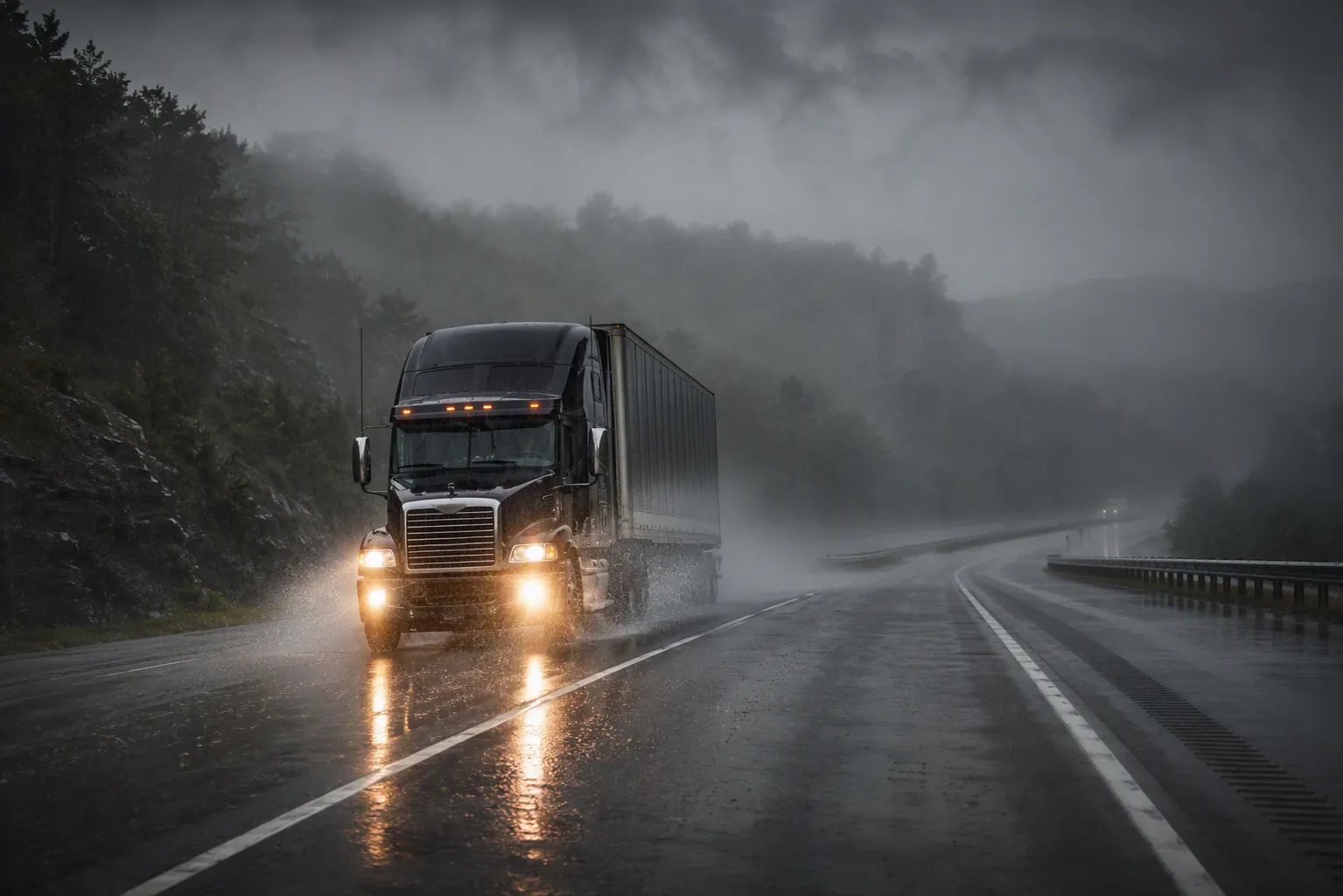
Bad weather is not liable for a truck crash in Alabama. A driver, trucking company, another motorist, or more than one of them may be liable if their choices did not match the danger that was visible or reasonably foreseeable at the time.
That answer has a harsh Alabama footnote: the injured person’s own conduct is not a side issue. Alabama is treated as a pure contributory-negligence state, meaning a claimant found even slightly at fault can be barred from recovery entirely; plaintiff-side materials commonly describe this as the “1% fault” problem because insurers look for any argument that the injured driver was also driving too fast, following too closely, failing to keep a lookout, or reacting unsafely for the conditions.[1][2]
So the real question in an Alabama bad-weather truck claim is not “Was it raining?” It is: who adjusted, who failed to adjust, and what records prove it before the data disappears.
The two duties that frame a bad-weather truck crash
Alabama’s speed rule and the federal commercial-driver rule do different work. One applies broadly to speed under existing conditions. The other tells commercial drivers what to do when hazardous weather affects visibility or traction.
| Duty | What it asks | Why it matters after a rain, fog, or wind crash |
|---|---|---|
| Alabama condition-adjusted speed duty | Was the driver traveling at a speed that was reasonable and prudent under the conditions? | The posted speed limit does not end the inquiry. A speed can be too fast for wet pavement, fog, traffic, curves, or limited sight distance even if it is under the posted limit. |
| FMCSA hazardous-conditions rule, 49 CFR § 392.14 | Did the commercial driver use extreme caution, reduce speed when conditions affected visibility or traction, and stop the trip if conditions became sufficiently dangerous? | For truck drivers, the weather response itself becomes evidence: slowing, spacing, braking, route decisions, and whether continuing was safe. |
The federal rule is unusually direct. Section 392.14 says “extreme caution” must be used in hazardous conditions, including those caused by snow, ice, sleet, fog, mist, rain, dust, or smoke, and that speed must be reduced when those conditions adversely affect visibility or traction. It also states that if conditions become sufficiently dangerous, operation of the commercial motor vehicle must be discontinued and not resumed until the vehicle can be safely operated.[3]
Alabama’s speed rule points in the same practical direction. Alabama legal explainers consistently describe Ala. Code § 32-5A-170 as requiring speed to be reasonable and prudent under the conditions, with attention to actual and potential hazards.[1] That matters because “I was under the speed limit” is not a complete answer when the roadway is wet, visibility is short, traffic is bunching up, or a loaded tractor-trailer needs more room to stop.
Those two duties keep the analysis from turning weather into a fog machine. A thunderstorm may explain why the pavement was slick. It does not answer whether the truck driver reduced speed early enough, left enough following distance, braked in a controlled way, or chose to keep moving after conditions became unsafe.
The same storm can produce different liability outcomes
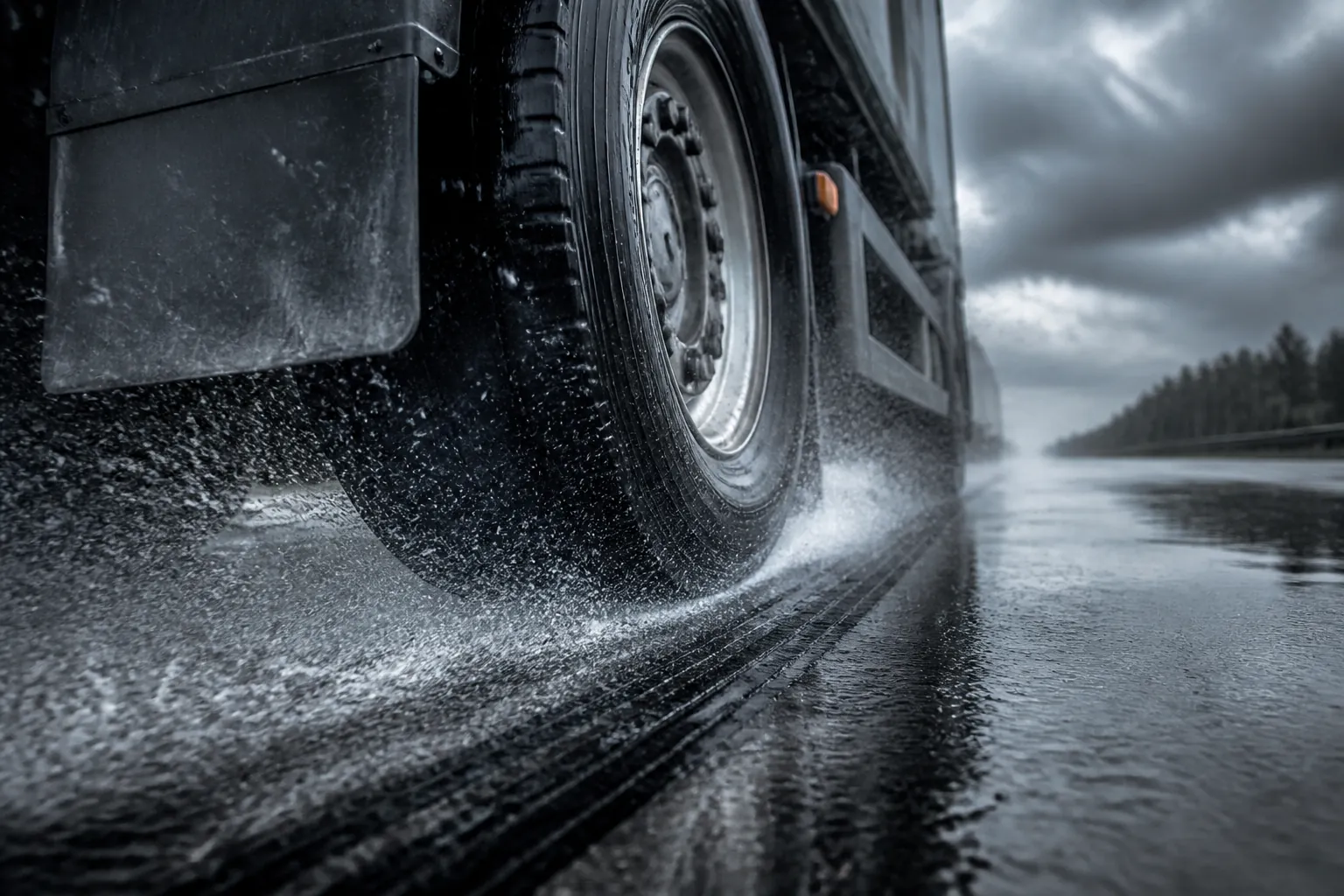
A bad-weather crash is rarely decided by naming the weather condition alone. Rain, fog, or wind becomes legally important through the choices it required.
Consider a hypothetical interstate crash in heavy rain. If a tractor-trailer is traveling close to the posted limit, closes rapidly on slower traffic, and jackknifes after hard braking, the liability questions are speed, lookout, following distance, braking, and whether the driver reduced speed when traction and visibility changed. If the same truck had already slowed substantially, increased distance, activated appropriate lighting, and was struck after another vehicle spun into its lane, the weather facts point in a very different direction.
Fog works the same way. The claim does not become strong merely because fog was present. It becomes stronger or weaker depending on whether the truck was moving at a speed that matched the available sight distance, whether the driver could stop within the distance visible ahead, and whether other drivers’ conduct gave the defense a contributory-negligence argument.
Wind raises a slightly different set of questions: vehicle control, lane position, cargo profile, route choice, and whether the driver or carrier knew the vehicle was especially vulnerable to gusts. Rain adds hydroplaning, tire condition, tread depth, and braking distance. None of those topics makes liability automatic. They identify what must be proven.
Why the injured driver’s conduct gets examined first in Alabama
In many states, a partially at-fault claimant may still recover a reduced amount. Alabama’s contributory-negligence rule is more unforgiving. If the defense can persuade an adjuster, judge, or jury that the injured driver contributed to the crash at all, recovery may be barred.[2]
That is why a bad-weather truck claim often turns immediately into questions that feel accusatory to the injured person: How fast were you going for the rain? Were your headlights on? Did you brake suddenly? Were you following too closely? Did you move into the truck’s blind spot? Did you have enough distance to react to slowing traffic?
Those questions are not distractions from the truck driver’s conduct. They are the route by which an Alabama claim can fail even when the truck driver also made serious mistakes. This is the practical reason to preserve records on both sides of the collision, not just the records that make the truck look bad.
For readers comparing contributory-negligence systems, the site’s companion discussion of pure contributory negligence in crash claims is useful because Virginia is another jurisdiction where slight fault can have outsized consequences.
When the trucking company may share responsibility
The driver-duty analysis comes first because the crash happens through someone’s driving. But commercial trucking cases widen quickly. A carrier may be part of the liability picture when company decisions made the weather risk foreseeable, harder to manage, or more dangerous than it needed to be.
Carrier-level questions commonly include whether the company trained drivers for rain, fog, wind, and reduced-traction conditions; whether it maintained tires, brakes, lights, and safety systems; whether dispatchers pushed a route despite known dangerous conditions; and whether company scheduling left the driver with bad choices once the weather deteriorated. Alabama bad-weather truck materials identify training and maintenance failures as recurring carrier-liability theories in these cases.[4]
The federal hours-of-service guidance on adverse driving conditions is useful here, but only if read carefully. FMCSA explains that the adverse-driving-conditions exception depends on conditions that were not known, or could not reasonably have been known, before the trip or dispatch began.[5] That foreseeability limit matters. A carrier cannot treat every storm delay as a surprise if the dangerous condition was available to dispatch before sending or keeping the truck on the road.
This does not mean dispatch into weather is automatically negligent. It means the timing and knowledge trail matter: weather alerts, route planning, driver messages, delivery pressure, hours remaining, equipment condition, and the point at which continuing stopped being reasonable.
The records that answer the liability questions
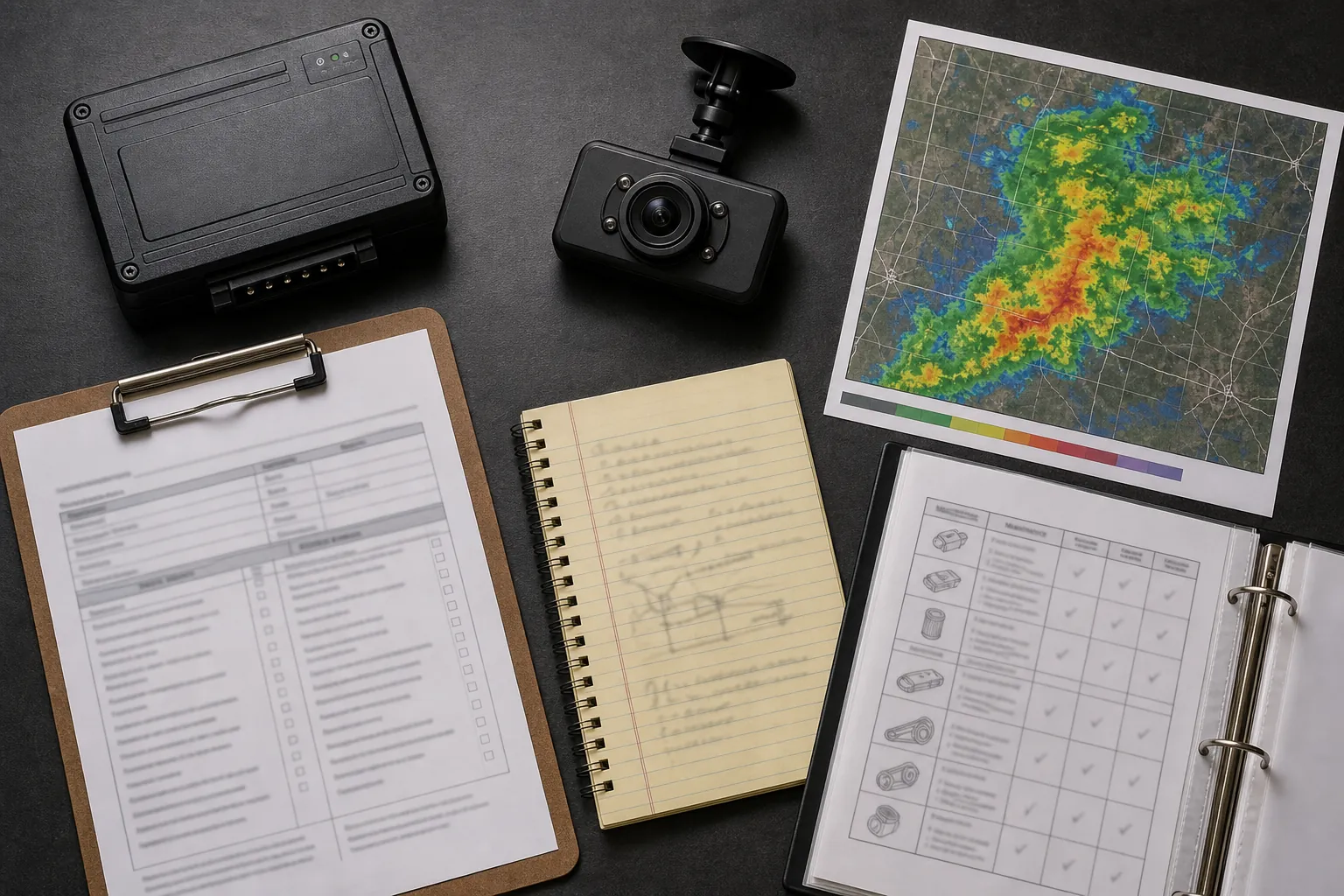
Bad-weather truck evidence is not just a pile of documents that “supports a claim.” Each record should answer one of the duty questions already on the table.
| Record | What it can help prove |
|---|---|
| Electronic logging device, engine-control, or event-data records | Speed, braking, throttle, hours, route timing, and whether the driver slowed when conditions changed |
| Dashcam or onboard video | Visibility, traffic flow, following distance, lane position, lighting, and sudden hazards |
| Weather and radar records | Rain intensity, fog, wind, storm timing, and whether the conditions were foreseeable before dispatch or before the crash location |
| Police report and scene documentation | Initial witness accounts, roadway condition notes, crash location, citations, vehicle positions, and diagrams |
| Maintenance logs | Tire, brake, light, wiper, and safety-system condition before the trip |
| Dispatch and driver communications | What the carrier and driver knew, when they knew it, and whether delivery pressure affected the decision to continue |
ELD and related truck data deserve early attention because some of it is time-sensitive. Truck-crash evidence-preservation discussions commonly stress ELD records, dashcam footage, and prompt preservation requests because the most useful data may not remain available indefinitely without action.[6]
The same preservation work should cover evidence that protects the injured driver from a contributory-negligence defense: vehicle damage photos, phone records if distraction is alleged, medical timing, witness statements, roadway photos, and any video showing the claimant’s speed, braking, lights, and lane position.
For a practical sequence, use the site’s evidence-preservation workflow after a crash. The value question is related but separate; the site’s car-accident settlement factors guide explains how liability proof, damages, insurance, and dispute risk interact.
Deadlines and the problem of waiting
Alabama personal-injury claims are generally described as having a two-year limitations period, and Alabama truck-accident weather materials flag that deadline while also emphasizing early evidence collection.[7] The limitations period is not the only clock that matters. Dashcam clips, onboard data, driver communications, and weather-specific observations can become harder to obtain or interpret long before a filing deadline arrives.
Delay also gives the contributory-negligence argument more room to harden. If the only preserved story is a police summary saying “wet roadway” and “driver lost control,” the missing details may be exactly the details needed to show who adjusted to the weather and who did not.
What crash statistics can and cannot prove
Weather statistics provide context, not liability proof. FHWA’s Road Weather Management program reports national five-year averages for 2019–2023, including about 744,911 weather-related crashes per year, and states that 77% of weather-related crashes occur on wet pavement and 77% occur during rainfall.[8] Those are national, all-weather-roadway figures. They do not prove that an Alabama truck driver was negligent in a particular storm.
Alabama figures have the same limitation. ALDOT reported 967 fatalities, approximately 140,000 crashes, and more than 36,600 injuries for Alabama traffic crashes in 2024.[9] Drive Safe Alabama reports that 11% of Alabama crashes occurred in rain and 0.3% in fog.[10] Those numbers describe all-vehicle crash context, not Alabama commercial-truck bad-weather liability.
Statistics can explain why rain, fog, and wet pavement are foreseeable roadway hazards. They cannot substitute for ELD data, video, maintenance records, dispatch messages, and witness accounts in a specific truck case.
Do not let “sudden emergency” swallow the evidence
Bad-weather crashes sometimes invite a sudden-emergency argument: the driver faced an unexpected condition and reacted as best as possible. That phrase should not be treated as a magic defense, and it should not be dismissed with a slogan either.
The useful boundary is foreseeability. A patch of dense fog, a flooded lane, stopped traffic beyond a blind curve, or a gust that pushes a trailer may be described as sudden. But the record still has to show what was known before that moment: speed, visibility, radar, traffic, driver warnings, dispatcher knowledge, and whether the truck was already being operated with the “extreme caution” federal law requires.
In Alabama bad-weather truck cases, the winning question is not whether the weather was bad. It is whether every driver and carrier decision matched the danger that was visible or foreseeable at the time. Even strong evidence against a truck driver can be defeated if the injured driver is assigned any fault, so the practical work is to preserve the records that prove adjustment to conditions on both sides.
References
- Who’s at Fault When Bad Weather Causes an Accident in Alabama? — The Mitchell Law Firm
- Alabama Truck Accident Attorneys Explain the 1% Fault Trap — Alexander Shunnarah Trial Attorneys
- 49 CFR § 392.14 Hazardous conditions; extreme caution — eCFR
- Bad Weather Truck Accidents in Huntsville — Siniard Law
- How may a driver utilize the adverse driving conditions exception or emergency conditions exception as found in § 395.1(b), to prevent an hours of service violation? — FMCSA
- Common Causes of Truck Accidents on Alabama Roadways and How to Prove Liability — The Cochran Firm Dothan
- Rain, Heavy Fog, and Intense Wind — Farris, Riley & Pitt
- Road Weather Management Program — Federal Highway Administration
- Alabama Crash Fatalities 2024 — ALDOT News Hub, October 7, 2025
- Stats & Facts — Drive Safe Alabama
Related records
Tool profile
How Meta's AI Spending Reshapes Law Firm ProfitabilityGoverning regulation
Browse the obligations tracker →Preventive workflow
Browse verification workflows →
Report a correction or tip
Spotted an outdated figure, a misstated fact, or a ruling this case record should reflect? Public comments are disabled for this content given the professional cost of a misreported case outcome, penalty amount, or rule text — use the structured correction channel instead.
Report a correction or tip for this record →