
Jensen Huang's AI data center jobs claim hits the courtroom
Jensen Huang's AI data center job-creation claims overstate the buildout's permanent employment, while its fastest-growing legal reality is litigation. The source-linked picture for legal teams is two-sided: new infrastructure-adjacent work and mounting case exposure.
- Jurisdiction
- US-MN
- Court
- Minnesota county court
- AI tool named
- Ruling date
- Jun 3, 2026
- Source document
- View primary court order ↗
- Last verified
- Aug 3, 2026
Lex Machina Review is an independent risk-tracking and reference resource. Nothing on this site is legal advice, and using it does not create an attorney-client relationship. Every record is reviewed against primary sources but may not reflect the most current status of a matter — always verify directly against the cited court order, rule text, or a licensed attorney before relying on it.
Companion explanation — secondary to the source document above
Jensen Huang’s AI data center jobs claim now has two files open for the legal profession. In one file, the NVIDIA chief executive’s reported public comments have cast the AI infrastructure rush as a trade-work and construction boom: the Observer reported Davos comments about six-figure trade salaries, Fox News reported his “about half a million” AI-infrastructure jobs framing, ConstructConnect carried the “largest infrastructure buildout in human history” formulation, and Axios covered the latest job-creation pitch in July 2026. [1][2][3][4] In the other file, a Minnesota county court has already granted a temporary restraining order blocking construction of a 100-plus-acre Google data center while the adequacy of environmental review is litigated. [5]
Those are not opposite stories. A court order does not make the buildout imaginary. NVIDIA’s revenue figures make that much clear. But the legal profession should be careful about accepting “jobs” as the unit of analysis. Temporary construction labor, permanent operations roles, outside-counsel demand, in-house risk management, and automated legal-service delivery are not one labor market. They collide around the same projects, but they do not measure the same thing.
The capital flow is real; the employment claim is narrower
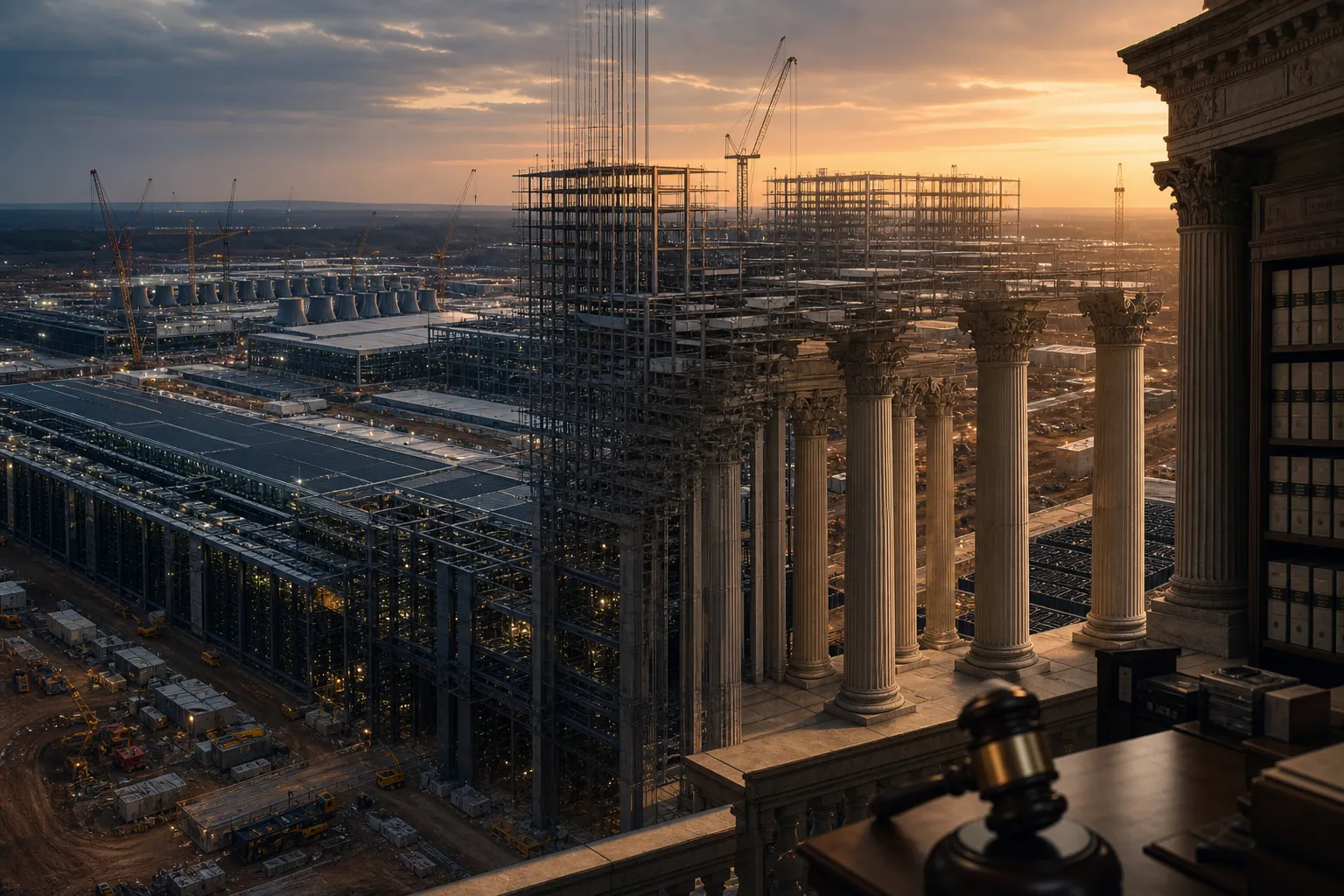
The strongest version of Huang’s case is financial, not rhetorical. NVIDIA reported fiscal 2026 data center revenue of $193.7 billion, up 68% year over year, and fourth-quarter fiscal 2026 data center revenue of $62.3 billion, up 75%. [6] Reuters later reported Q1 FY27 data center revenue of $75.2 billion and a quarterly outlook above estimates. [7] Those figures do not prove how many local workers a facility will employ after commissioning, but they do show that the AI data center buildout is backed by very large capital movement.
The employment evidence is less expansive than the public jobs language. Brookings’ May 2026 county-level study used a synthetic-control design covering about 770 facilities, 93 treated counties, roughly 3,000 controls, and 2003–2024 Bureau of Labor Statistics data. Its estimate was that a county’s first large data center was associated with a 4% to 5% increase in total private employment over five to six years, with construction employment up 11% and information-sector employment up 22%. The authors also found that naive estimates overstated job effects by a factor of three, and disclosed that Anthropic’s Claude Code was used for data analysis. [8]
That is meaningful employment evidence, but it is not the same as validating every half-million-jobs headline. The Brookings result is county-level and time-bound. It separates observed employment effects from broader claims about national industrial transformation. It also leaves intact the basic distinction that matters in project approvals: construction jobs arrive before a facility opens; permanent operations jobs are the smaller continuing base.
CBS News reported a McKinsey estimate of up to $7 trillion in data center spending by 2030, about 4,000 existing U.S. data centers, and roughly 3,000 announced or under construction. The same report cited an American Edge Project estimate of 4.7 million temporary construction jobs compared with about 697,000 permanent operating jobs. [9] The gap is the part local counsel and public lawyers cannot treat as a footnote. The legal documents that get filed after a project is announced often turn on what was promised, what was permitted, and what the community was told would last.
Where the jobs story becomes legal workload
For lawyers, the most concrete impact is not a generalized “AI creates work” claim. It is the conversion of infrastructure pressure into review disputes, permit fights, Clean Air Act allegations, utility proceedings, zoning challenges, moratorium bills, tax-incentive scrutiny, and emergency injunction practice. That is where the buildout stops being a keynote theme and becomes a case calendar.
MCEA v. Pine Island: environmental review as the first chokepoint
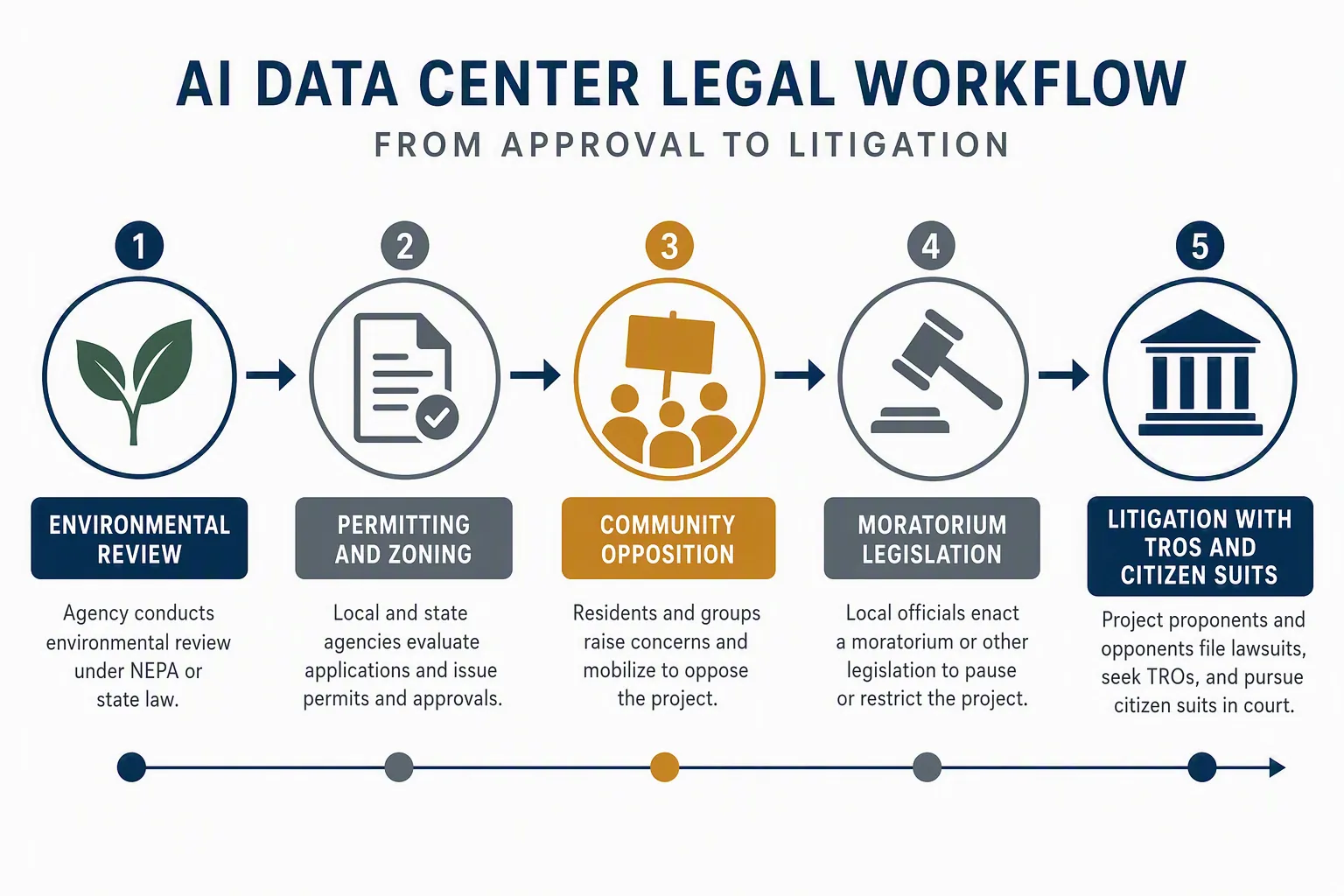
The Pine Island dispute is the cleanest warning against treating approvals as a ceremonial step. TechPolicy.Press reported that a Minnesota county court granted a temporary restraining order blocking construction of a 100-plus-acre Google data center while litigation proceeds over the adequacy of environmental review. [5] That is not an abstract concern about sustainability. It is a halt at the construction gate.
The legal work in a dispute like that is not limited to environmental specialists. It can pull in local-government counsel, project-finance lawyers, real-estate teams, construction counsel, outside litigators, records custodians, public-relations reviewers, and in-house lawyers who must reconcile public economic-development claims with the administrative record. A jobs announcement may help a project politically; it does not substitute for a defensible review file.
NAACP v. xAI: air permitting and emergency relief
The Colossus dispute shows a different legal surface. TechPolicy.Press reported allegations that xAI’s Colossus sites used 33 unpermitted gas turbines by mid-April 2026, with later reports putting the number at 46, and that plaintiffs alleged Clean Air Act violations. The report also noted that a preliminary injunction was sought on May 6, 2026, an August hearing was set, and the U.S. government filed a notice of possible intervention on May 13, 2026. [5]
That combination matters because it changes the risk posture. A developer can often manage ordinary permitting delay as a business problem. A citizen suit, a preliminary-injunction request, and a possible federal intervention notice move the dispute into a different register. The company is no longer just sequencing construction and power needs; it is defending the legality of how capacity was supplied.
The same enforcement family is being tracked in the site’s live record on SpaceXAI unpermitted turbine enforcement. For legal teams, that kind of record is more useful than an undated jobs talking point. It preserves the parties, asserted statutory theory, procedural posture, and intervention risk that determine what counsel actually has to do next.
TechPolicy.Press also identified challenges in Chile, Ireland, California, and Massachusetts. [5] The individual facts differ, but the pattern is familiar: data center expansion strains local environmental, energy, water, and land-use systems before courts and regulators have settled on a predictable review path.
State law is becoming part of the approval calendar
The state-law layer is now too active to treat as background noise. WilmerHale reported that more than 200 data-center bills were introduced across all 50 states in 2025 and more than 40 were enacted, spanning energy tariffs, water reporting, zoning moratoriums, foreign-entity restrictions, and related issues. [10] At the federal level, the White House issued a July 2025 executive order on accelerating federal permitting of data center infrastructure. [11]
That leaves counsel with two clocks to watch at once. One is the project clock: site control, interconnection, water supply, permits, tax incentives, construction, and commissioning. The other is the lawmaking clock: local moratoriums, state reporting obligations, utility-cost allocation fights, foreign-ownership restrictions, and federal energy or permitting measures that can change a project’s risk profile while it is still being sold to local officials.
The zoning piece has its own taxonomy, and it should not be flattened into a generic “community opposition” label. The site’s analysis of legal challenges to AI data center zoning is the better place for that framework. Moratorium fights raise a different set of claims, including the theories collected in six legal theories that could challenge state data center moratoriums. For New York-specific tracking, the existing two-track New York data center moratorium analysis is the safer reference point. Federal energy proposals belong in the AI data center energy bills tracker.
Law-firm demand is visible, but it is not the same as net legal employment
There is sourced evidence that firms are building capacity around the boom. Pirical reported that lateral partner hires with data-center experience rose 65% in 2025 and 168% since 2020, and identified Kirkland & Ellis as having roughly 250 data-center-experienced partners. [12] The American Lawyer reported in its lede that Latham and Kirkland were building practices with hundreds of data-center lawyers amid a “unique and unparalleled” AI boom; because the article is paywalled beyond that lede, that is as far as the source should be taken here. [13]
Those figures support a demand-side point: elite firms see enough data-center work to recruit, brand, and organize around it. They do not prove how many lawyers the buildout will employ net of automation, alternative staffing, or internal legal-operations changes. The legal profession’s exposure is therefore better described as practice concentration plus matter complexity, not simply job creation.
The practice mix is broad but not mysterious. Real-estate lawyers handle site acquisition and covenants. Energy lawyers work through interconnection, tariffs, backup generation, and power-purchase arrangements. Environmental lawyers test air, water, wetlands, noise, and review obligations. Tax and public-law teams structure incentives. Litigators inherit the record when opponents seek emergency relief. Financing and disclosure counsel then have to decide whether litigation, permitting delays, or power constraints belong in investor-facing risk language, the same kind of question raised in the site’s coverage of data center financing and bondholder risk.
A defensible claim file for legal teams
If an operator, developer, hyperscaler, municipality, or law firm is briefing the buildout, the safest approach is to keep the claim file separated by category. Huang’s reported remarks are useful as market narrative. NVIDIA’s revenue figures are evidence of capital flow. Brookings is the main empirical employment check. CBS’s temporary-versus-permanent jobs reporting helps explain why a construction boom should not be presented as a permanent operating-workforce boom. The docket records show where the legal profession is already being pulled in.
- Date every public jobs claim and identify the venue where it was made or reported.
- Separate construction employment, permanent operations roles, and legal-services demand.
- Tie local approval materials to the administrative record, not to national infrastructure rhetoric.
- Track air, water, zoning, energy, and utility-cost issues as separate legal workstreams.
- Monitor TROs, preliminary-injunction motions, citizen suits, moratorium bills, and notices of government intervention as calendar-changing events.
- Review whether financing, incentive, and securities materials need updated risk language when permit or litigation facts change.
That is also the better frame for in-house risk calendars. The AI data center boom may generate more infrastructure-adjacent legal work, but it also creates more points where a statement made for approval, investment, or community reassurance can be tested against permits, emissions controls, utility records, and court filings. The broader governance problem is close to the one raised in the site’s discussion of AI wealth and legal-team risk planning: economic upside and dispute exposure can grow at the same time.
The buildout is real. The jobs arithmetic is not yet as durable as the revenue evidence, and it is weaker still when temporary construction work is folded into permanent employment language. For the legal profession, the most defensible conclusion is narrower and more useful: AI data centers are creating infrastructure-adjacent demand for counsel while also expanding litigation exposure, one dated permit, injunction motion, moratorium bill, and citizen-suit filing at a time.
References
- Nvidia CEO Jensen Huang Says AI Will Create High-Paying Trade Jobs — Observer, Jan. 21, 2026.
- Jensen Huang says AI will reshape work like Industrial Revolution, US should absolutely lead — Fox News, June 2026.
- ‘Largest infrastructure buildout in human history’: NVIDIA’s Jensen Huang on AI job boom — ConstructConnect.
- Nvidia’s Jensen Huang says AI will create jobs — Axios, July 24, 2026.
- Environmental Lawsuits Present Roadblock for the AI Data Center Boom — TechPolicy.Press, June 3, 2026.
- NVIDIA Announces Financial Results for Fourth Quarter and Fiscal 2026 — NVIDIA Newsroom, Feb. 25, 2026.
- Nvidia forecasts quarterly revenue above estimates, announces $80 billion share buyback — Reuters, May 20, 2026.
- New evidence on data center employment effects — Brookings, May 4, 2026.
- AI data center jobs construction technician — CBS News.
- State Regulation of Data Centers: Emerging Trends and Potential Legal Complexities — WilmerHale, Feb. 23, 2026.
- Accelerating Federal Permitting of Data Center Infrastructure — The White House, July 2025.
- Which law firms are powering the data center boom? — Pirical.
- Elite Law Firms Build Scale in Data Center Practices, Riding ‘Unique and Unparalleled’ AI Boom — The American Lawyer, July 20, 2026.
Related records
Tool profile
Browse tool evaluations →Governing regulation
Browse the obligations tracker →Preventive workflow
Browse verification workflows →
Report a correction or tip
Spotted an outdated figure, a misstated fact, or a ruling this case record should reflect? Public comments are disabled for this content given the professional cost of a misreported case outcome, penalty amount, or rule text — use the structured correction channel instead.
Report a correction or tip for this record →