
Why the RFK Jr. Vaccine Fight Is an Administrative-Law Case
A docket-level record of AAP v. Kennedy (D. Mass. No. 1:25-cv-11916), the litigation over RFK Jr.'s overhaul of federal childhood vaccine policy, showing what the courts have actually enforced so far and where the stayed appeal stands. The enforceable constraints applied to date are procedural — APA notice-and-comment and FACA membership rules — not constitutional, and the administrative-record response is due September 24, 2026.
- Jurisdiction
- US federal (D. Mass.)
- Court
- U.S. District Court for the District of Massachusetts
- Judge
- Brian E. Murphy
- AI tool named
- No AI tool named
- Ruling date
- Mar 16, 2026
- Source document
- View primary court order ↗
- Last verified
- Aug 3, 2026
Lex Machina Review is an independent risk-tracking and reference resource. Nothing on this site is legal advice, and using it does not create an attorney-client relationship. Every record is reviewed against primary sources but may not reflect the most current status of a matter — always verify directly against the cited court order, rule text, or a licensed attorney before relying on it.
Companion explanation — secondary to the source document above
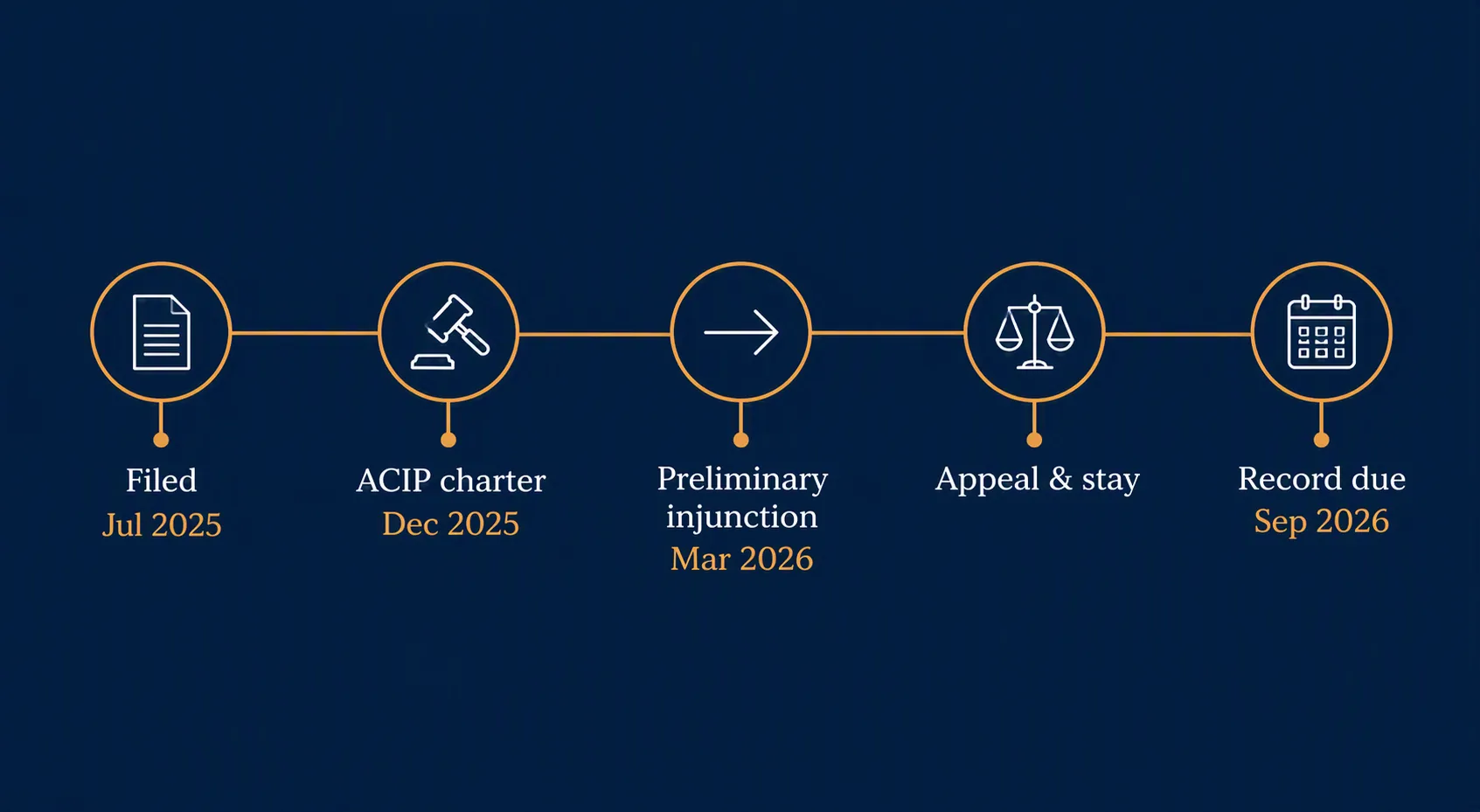
A search for “rfk jr constitutional rights measles public health legal analysis” lands close to the public controversy, but not quite on the live docket. The case to read is American Academy of Pediatrics et al. v. Robert F. Kennedy Jr. et al., D. Mass. No. 1:25-cv-11916, filed July 7, 2025, before Judge Brian E. Murphy. The controlling vocabulary is administrative law: APA notice-and-comment requirements, FACA rules governing advisory-committee membership, agency discretion, preliminary injunction, appeal, stay, and administrative record.

That distinction matters because the March 16, 2026 order did not announce that a vaccine policy was scientifically correct or incorrect. At the preliminary-injunction stage, the court treated the challenged actions as procedurally vulnerable. The case is now on appeal, the district-court case is stayed pending appeal, and the next live date in the district-court record is September 24, 2026, when defendants’ response to the motion to complete the administrative record is due. [1]
Docket posture as of August 3, 2026
| Item | Record |
|---|---|
| Case | American Academy of Pediatrics et al. v. Robert F. Kennedy Jr. et al., D. Mass. No. 1:25-cv-11916 [1] |
| Filed | July 7, 2025 [1] |
| Court and judge | U.S. District Court for the District of Massachusetts; Judge Brian E. Murphy [1] |
| Plaintiffs | Plaintiffs led by AAP, ACP, APHA, IDSA, and SMFM; lead counsel Epstein Becker & Green [1] |
| Defendants | Robert F. Kennedy Jr., HHS, FDA Commissioner Marty Makary, NIH Director Jay Bhattacharya, and CDC’s O’Neil [1] |
| Key order | Preliminary injunction entered March 16, 2026 [2][3][4] |
| Current status | Appeal filed; case stayed pending appeal [1] |
| Next district-court date | Defendants’ response to the motion to complete the administrative record due September 24, 2026 [1] |
The site’s surrounding RFK Jr. coverage already has separate records for adjacent problems: the polio-sketch legal controversy, employer MMR obligations, peptide-policy APA risks, state mandate rollbacks, the Merck conflict record, and the Gavi impoundment analysis. This record is narrower: it follows the AAP docket and the procedural rulings that currently control it.
The challenged actions were concrete, but the legal hook was procedural
The plaintiffs challenged a cluster of 2025–2026 federal vaccine-policy actions, not one isolated press statement. The challenged actions included the January 5, 2026 revised childhood immunization schedule reducing the listed vaccines from 17 to 11; the May 2025 Secretarial Directive on COVID-19 vaccine recommendations; the December 2025 ACIP hepatitis B downgrade; and the firing of 17 ACIP members followed by 13 replacements. [2][3][4]
Those facts explain why the case can sound, in public shorthand, like a fight over measles, public health, and childhood vaccination. They do not convert the docket into a general constitutional-rights case. The relief that has actually issued turns on whether HHS and related officials used the required procedures before changing a federal vaccine schedule and reconstituting the advisory body whose votes feed into that schedule.
What the March 16 preliminary injunction did
Judge Murphy’s March 16, 2026 preliminary injunction is the load-bearing event in the record. At that stage, the court found likely APA violations tied to the schedule changes and ACIP reconstitution, and likely FACA violations tied to the ACIP appointments. The order was preliminary: it assessed likelihood of success and related injunction factors, not final liability after a full merits record. [2][3][4]
The quoted line worth preserving is procedural, not epidemiological. The government, the court said, “disregarded those methods and thereby undermined the integrity of its actions.” [2][3][4]
The relief reported from the injunction reached several downstream products of the challenged process:
- Kennedy’s 13 ACIP appointments made since June 2025 were stayed. [2][3][4]
- All ACIP votes were stayed. [2][3][4]
- The January 5, 2026 revised childhood immunization schedule was stayed. [2][3][4]
- The May 2025 Secretarial Directive was overturned. [2][3][4]
- The hepatitis B downgrade was reversed. [2][3][4]
That is an important set of consequences, but it should not be described as a court deciding the scientific merits of each vaccine recommendation. The injunction is better read as a court insisting that when an agency has legally relevant procedures for schedule changes and advisory-committee composition, it cannot skip those procedures and then insulate the result from review by calling the whole field discretionary.
The hearing exchange that made reviewability the center of the case
The March 4, 2026 hearing is useful because it exposed the government’s reviewability position in unusually stark terms. Bloomberg Law reported that DOJ lawyer Isaac Belfer argued Kennedy had “broad, unreviewable authority” in this area. In the same reported exchange, Belfer confirmed that even a hypothetical recommendation for a “shot that gives you measles” would be unreviewable under the government’s theory. [5]
That quote is legally revealing, but it should be handled carefully because the hearing account is single-sourced to Bloomberg Law. It is enough to show the shape of the government’s defense: if the Secretary’s vaccine-recommendation authority is committed to agency discretion in a way courts cannot review, then plaintiffs need a procedural hook strong enough to get around that barrier.
Plaintiffs’ answer at the hearing, as reported, was not a generalized constitutional objection. Their counsel invoked INS v. Yang for the proposition that courts can review irrational departures from agency policy. That framing matters because it turns the case toward administrative consistency and self-imposed procedural constraints. [5]
The appeal: unreviewable discretion versus a charter that allegedly fetters discretion
After the injunction, HHS spokesman Andrew Nixon said the administration planned to appeal, and the Georgetown tracker now shows an appeal filed with the case stayed pending appeal. [1][3]
The appellate fight should not be summarized as “court versus RFK Jr. on vaccines.” The sharper issue is whether the Secretary’s authority is so discretionary that the court cannot police the challenged actions, or whether Kennedy’s own governing instruments and agency practice create reviewable limits.
The plaintiffs’ appellate framing is that Kennedy’s December 3, 2025 ACIP charter “fetters” his discretion. That is not a settled holding. It is the plaintiffs’ counter to the government’s unreviewability theory: once the agency has announced rules or standards for how ACIP functions, plaintiffs argue, the Secretary cannot irrationally depart from them and then tell the court there is nothing to review.
That is why the administrative record matters. If the appeal or later district-court proceedings turn on what procedures HHS actually used, what reasons were given, and whether advisory-committee rules were followed, the record is not housekeeping. It is the evidence base for whether the agency’s conduct is reviewable and, if so, whether it can survive APA and FACA scrutiny.
The measles backdrop belongs in context, not in the holding
The public-health setting is real: CDC reported 2,371 confirmed measles cases in 2026 as of July 30, 2026. [6]
But the measles number is context, not proof of the legal claim in AAP v. Kennedy. It helps explain the stakes of federal vaccine recommendations; it does not answer whether the January 5 schedule change required notice and comment, whether the ACIP appointments complied with FACA, or whether the Secretary’s discretion is reviewable.
A parallel state-led challenge also exists at the edge of this record. California announced on February 24, 2026 that it co-led a 15-state lawsuit over the January decision stripping seven childhood vaccines from recommendations. [7] That filing may matter to the broader vaccine-policy map, but it is not the AAP docket and should not be merged into this case’s procedural posture.
Where the record stands now
As of August 3, 2026, the enforceable ruling remains the March 16 preliminary injunction. The case has not produced a final merits judgment on the challenged vaccine-policy overhaul. The appeal has been filed, the district-court case is stayed pending appeal, and the administrative-record dispute remains open, with defendants’ response due September 24, 2026. [1]
For briefing purposes, the safest description is therefore narrow: AAP v. Kennedy is presently an administrative-law fight over process and reviewability. The court has enforced likely APA and FACA limits at the preliminary-injunction stage. It has not issued a constitutional-rights ruling on vaccine science.
References
- American Academy of Pediatrics et al. v. Robert F. Kennedy Jr. et al., Georgetown Health Care Litigation Tracker
- Federal judge blocks Kennedy’s changes to childhood vaccine policy, CIDRAP
- Judge blocks RFK Jr. vaccine changes, NPR, March 16, 2026
- Federal judge blocks immunization schedule changes, APHA
- RFK Jr. Can Push Measles Herd Immunity in Theory, DOJ Says, Bloomberg Law
- Measles Cases and Outbreaks, CDC, July 30, 2026
- California co-leads multi-state lawsuit against CDC’s unscientific vaccine recommendations, putting public health at risk, Office of Governor Gavin Newsom, February 24, 2026
Related records
Tool profile
How Meta's AI Spending Reshapes Law Firm ProfitabilityGoverning regulation
Browse the obligations tracker →Preventive workflow
Browse verification workflows →
Report a correction or tip
Spotted an outdated figure, a misstated fact, or a ruling this case record should reflect? Public comments are disabled for this content given the professional cost of a misreported case outcome, penalty amount, or rule text — use the structured correction channel instead.
Report a correction or tip for this record →