
Road Rage Self-Defense Claim Now on Appeal Over AI Video
An Arizona judge credited an AI-generated video of a road rage victim delivering his own impact statement, imposing the maximum 10.5-year sentence in a case now on appeal. This verified record separates confirmed events from unverified details and flags the missing advance-notice and authenticity standards as the concrete risk signal for counsel.
- Jurisdiction
- Arizona, United States
- Court
- Maricopa County Superior Court
- Judge
- Todd Lang
- AI tool named
- Unnamed AI tools
- Ruling date
- May 1, 2025
- Source document
- View primary court order ↗
- Last verified
- Aug 2, 2026
Lex Machina Review is an independent risk-tracking and reference resource. Nothing on this site is legal advice, and using it does not create an attorney-client relationship. Every record is reviewed against primary sources but may not reflect the most current status of a matter — always verify directly against the cited court order, rule text, or a licensed attorney before relying on it.
Companion explanation — secondary to the source document above
Verification status: real sentencing record, missing primary order
For anyone tracking the Horcasitas road-rage case because of the AI video, the first correction is procedural: it is reported as a Maricopa County Superior Court sentencing before Judge Todd Lang on May 1, 2025, after convictions for manslaughter and endangerment, with a 10.5-year prison sentence imposed and a defense appeal noticed in May 2025.[1][2]
Record status matters here. The sentencing events are confirmed through multiple convergent reports from named outlets, but the primary minute entry or sentencing order has not been linked in the materials available for this digest. That means the case should be treated as a documented, date-stamped risk record, not as a fully docket-verified appellate precedent.
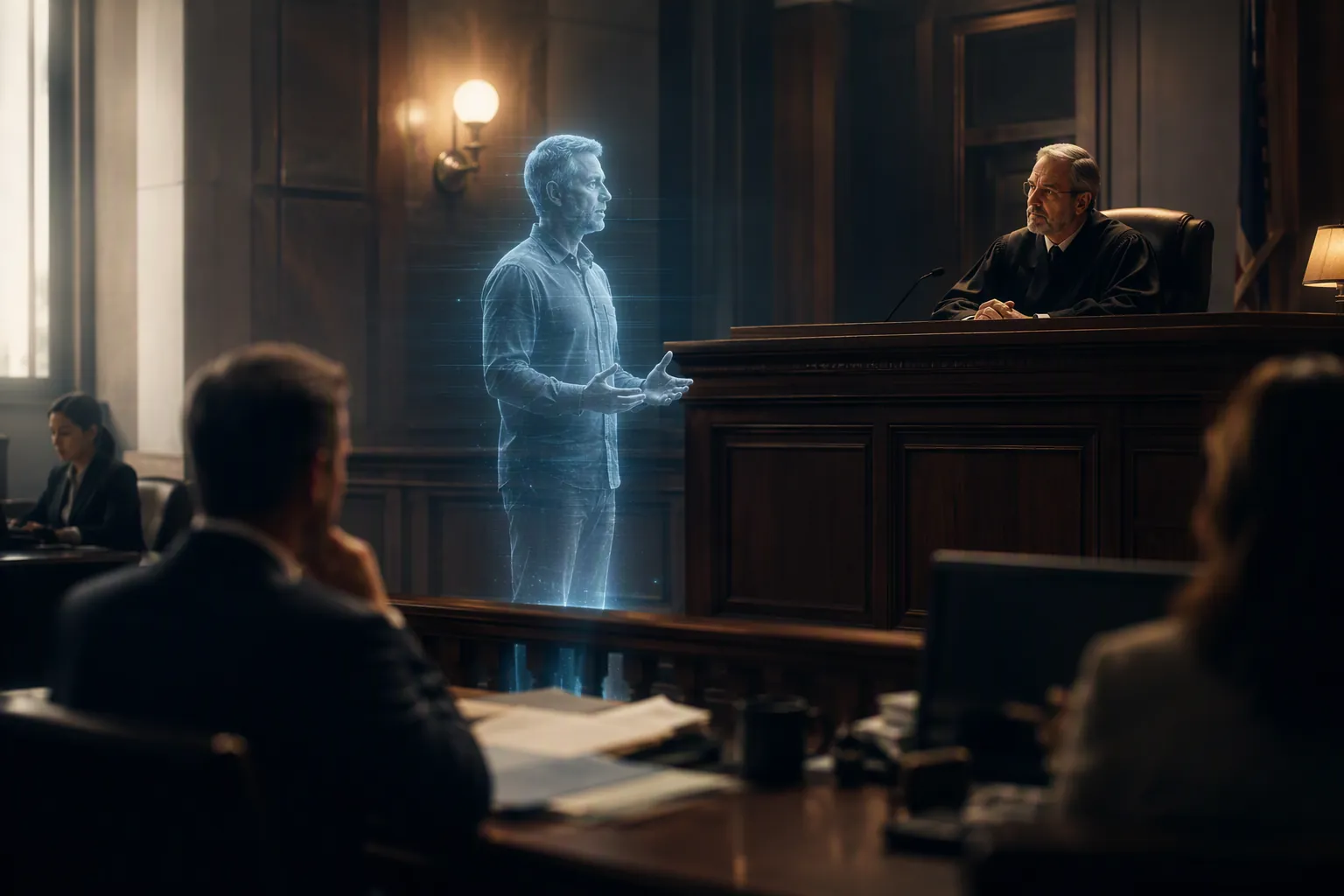
The central fact is not merely that an AI-generated version of Christopher Pelkey appeared in court. It is that the judge allowed the video as victim-impact material, said he heard genuine forgiveness in it, and then imposed the maximum term—10.5 years, the top of the reported 7-to-10.5-year range and above the prosecution’s reported 9.5-year request.[1][2]
The sentencing sequence, without the mythology
The underlying encounter occurred on Nov. 13, 2021, in Chandler, Arizona. Reports describe a road-rage confrontation in which Pelkey exited his vehicle and walked toward the shooter’s car; self-defense was the defense position at trial and sentencing.[3][4] That is the necessary context, but it should not be quietly converted into an established factual finding that Pelkey “was” the instigator. The available record supports only the narrower statement: the defense argued that theory.
At sentencing, Pelkey’s sister, Stacey Wales, presented an AI-generated video in which an avatar of Pelkey delivered a victim-impact statement. Reports say Wales wrote the script, used an approximately 4.5-minute audio component and a funeral photo, and relied on multiple AI tools that the cited reporting does not identify by name.[2][5] Any account that supplies a specific vendor name without a sourced basis is adding detail the record materials do not support.
Defense counsel Jason Lamm objected. His objection was not an abstract complaint that AI exists; it went to notice and characterization. He said he had not received advance notice, called the presentation “cringe,” and argued that the video showed a “kinder, more gentle” version of a victim whom the defense claimed had instigated the encounter.[1][2][4]
The prosecution did not need the video to become trial evidence for it to matter. It was presented in the sentencing phase as victim impact. That distinction is doing a great deal of work: sentencing courts often hear material that would be treated differently at trial, and this was a judge-sentencing proceeding rather than a jury exposure problem. But the distinction does not make the submission weightless.
Judge Lang’s own words are the reason this case cannot be dismissed as a courthouse novelty. After hearing the AI-generated statement, he reportedly said, “I heard the forgiveness,” and, “I feel that that was genuine,” before imposing the maximum sentence.[1] That is reliance language. It does not prove legal error by itself, and it does not make the video evidence. It does show that synthetic courtroom media can enter through a victim-impact channel and still affect the sentencing judgment.
Why “not evidence” is not the end of the analysis
A clean evidentiary label would be comforting. This record does not offer one. The AI statement was not submitted as evidence, and the decision-maker was a judge, not a jury. Those facts limit the case’s reach. They also define the problem: a sentencing judge may consider a broad range of victim-impact material, yet the adversary still needs a fair opportunity to contest what the court is being asked to absorb.
That is where the advance-notice objection becomes more important than the question everyone asks first—whether the family should have made the video at all. Victim-impact statements are meant to make harm visible. Pelkey’s family wanted the court to encounter a version of the person they had lost, including forgiveness. The procedural issue is different: when the medium itself manufactures presence, voice, and affect, opposing counsel needs time to inspect what was created, who wrote it, what source materials were used, and whether the presentation attributes feelings or words to the deceased that cannot be verified.
That concern is adjacent to, but not identical with, authentication doctrine. A traditional authenticity question asks whether an item is what the proponent claims it is. Here, everyone appears to have understood that the avatar was AI-generated. The harder question is fidelity: whether the generated presentation accurately reflected Pelkey, or instead created a persuasive new courtroom artifact carrying his face and voice.
For related verification frameworks, the site’s notes on AI media authenticity and proof-of-life verification and AI-processed evidence authentication are better starting points than treating Horcasitas as a generic “deepfake in court” anecdote.
The experts are not all saying the same thing
The useful expert commentary has been narrower than the loudest headlines. Gary Marchant, quoted in Judicature, called the video “completely fake,” a blunt description of the synthetic nature of the presentation.[6] That phrase captures why the submission unsettles lawyers who are used to treating victim impact as personal, embodied, and attributable.
Maddy Grossman’s point, also reported in Judicature, cuts the other way: the risk was limited because the video was not evidence and was seen by a judge rather than a jury.[6] That distinction should not be brushed aside. A sentencing judge is expected to filter emotionally charged material in ways a jury might not. The case is therefore a poor vehicle for sweeping claims that AI victim-impact videos are automatically inadmissible, unconstitutional, or trial-tainting.
Ronald Grimm’s observation is more practical: judges are likely to demand advance notice on a case-by-case basis.[6] That is not the same as a rule. It is a prediction about how trial courts may try to manage the next filing when the governing text has not caught up.
Steve Leben frames the deeper problem as fidelity—whether the AI presentation remains faithful to the person it purports to represent.[7] In this record, fidelity is not an aesthetic question. It goes to whether the court credited forgiveness from Pelkey himself, from his family’s memory of him, from a script written after death, or from some blended presentation that the law has not yet learned to label.
The standards gap
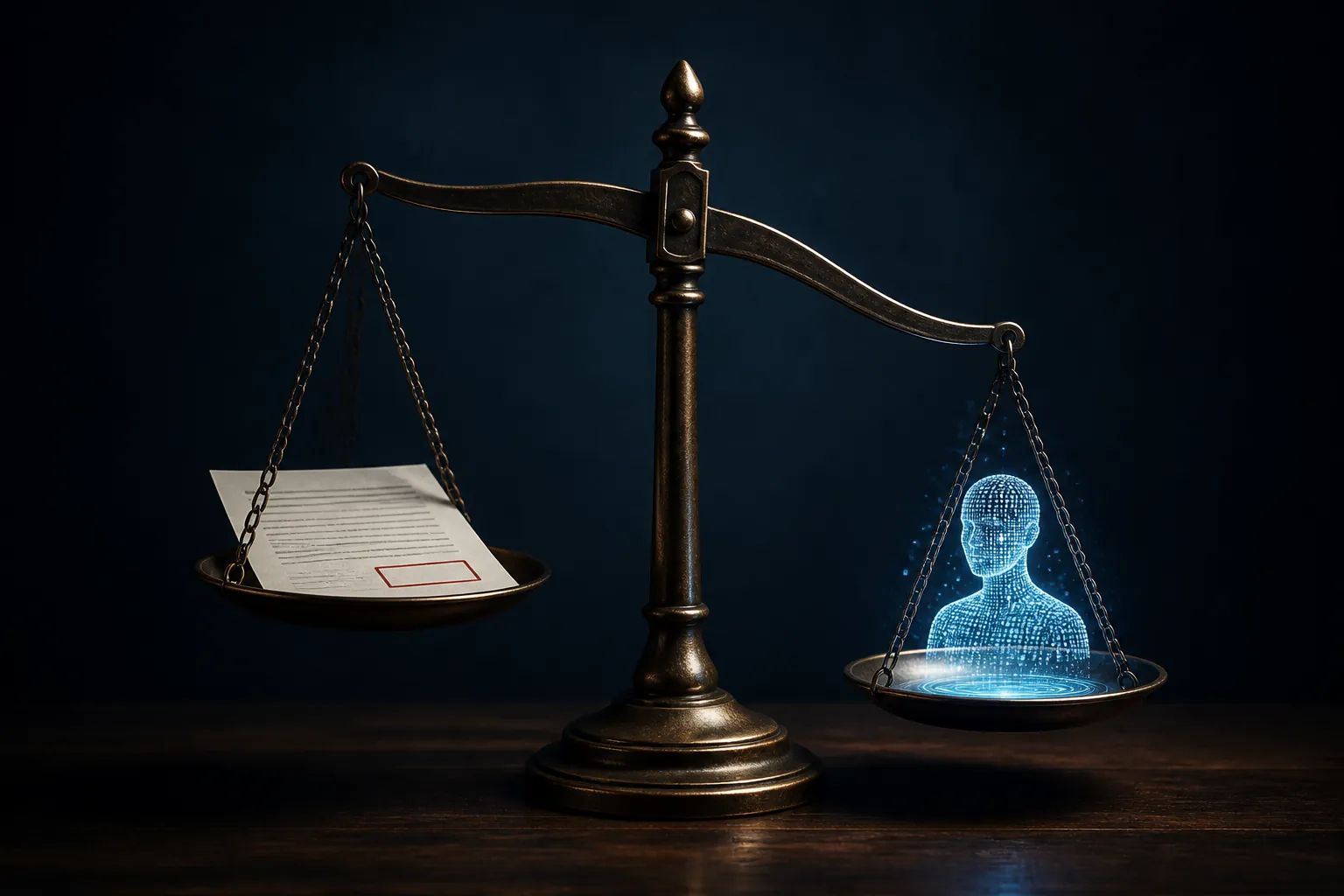
The Horcasitas record sits in an awkward space between established evidence rules and sentencing practice. There was no identified advance-notice rule tailored to AI-generated victim-impact media. There was no cited authenticity standard governing how such a submission had to be disclosed, documented, or tested before a sentencing judge viewed it. And because the item was not offered as evidence, familiar admissibility vocabulary does not fully answer the objection.
| Issue | What is confirmed | What remains open |
|---|---|---|
| Notice | Defense counsel objected that he received no advance notice. | What notice a future court must require before AI victim-impact media is played. |
| Status of the video | The video was presented as victim impact, not submitted as evidence. | Whether a court should still require source files, scripts, tool disclosures, or a foundation. |
| Decision-maker | A judge, not a jury, heard the video. | Whether the same submission would be treated differently before a jury or in a different sentencing scheme. |
| Reliance | The judge expressly credited the forgiveness conveyed before imposing the maximum sentence. | How an appellate court would characterize that reliance. |
| Appeal | A defense notice of appeal was reported in May 2025. | The appeal’s status as of Aug. 2, 2026, is not verified in the materials reviewed. |
The institutional background is moving, but it did not govern this sentencing. Arizona Chief Justice Ann Timmer has warned that AI “can also hinder or even upend justice if inappropriately used,” and Arizona’s supreme court has an AI committee.[8] At the federal level, the U.S. Judicial Conference Advisory Committee advanced proposed Federal Rule of Evidence 707 on May 2, 2025, aimed at reliability hearings for machine-generated evidence; the comment period closed Feb. 16, 2026, an Advisory Committee vote was scheduled for May 7, 2026, and Rules Enabling Act review remained ahead.[8]
Proposed FRE 707 should not be described as the rule that controlled Horcasitas. It was not final, and this sentencing involved victim-impact material rather than machine-generated evidence admitted at trial. Its relevance is contextual: rulemakers are trying to build a reliability process for machine outputs while courts are already encountering AI-generated courtroom media through procedural side doors.
The same vacuum appears in disputes over AI-generated imagery admissibility: a court may understand that an image is synthetic and still need a disciplined way to decide what foundation, limitation, and record preservation are required.
What the appeal can and cannot be made to prove
Reports state that Lamm filed a notice of appeal and identified the AI video as a likely issue.[1][2] That is the last appeal posture confirmed in the materials supplied for this article. As of Aug. 2, 2026, the appeal status has not been independently verified here beyond those May 2025 notices.
That limitation matters because this case is already being overread. It is not a final appellate holding approving AI victim-impact videos. It is not a final appellate holding barring them. It is not a Federal Rule of Evidence 707 case. It is not proof that the defense’s description of Pelkey as the instigator was correct. It is a sentencing record in which a synthetic victim-impact presentation was allowed, objected to, expressly credited, and followed by a maximum sentence.
That is enough to make it useful. A lawyer does not need a final appellate mandate to recognize a preservation problem. The party opposing an AI-generated sentencing submission must decide, in real time, whether to object to notice, foundation, authorship, source materials, emotional prejudice, attribution, and the absence of a limiting record. If the court proceeds anyway, the appellate record must show exactly what the judge saw, what the judge was told about the making of the video, what the objection was, and what the court said it relied on.
Concrete risk flags for counsel
Horcasitas belongs in an AI courtroom-risk tracker because it shows influence before doctrine. It is not a sanctions case, and it is not a hallucinated-citation case, but it sits beside the same broader problem collected in the site’s AI litigation sanctions and risk tracker: courts are being asked to react to AI outputs before lawyers have consistent disclosure habits.
- If offering AI-generated victim-impact media, disclose it early enough for the opposing party to inspect the script, source materials, editing process, and intended courtroom use.
- If opposing it, separate the objections: lack of notice, lack of foundation, disputed attribution, prejudicial presentation, and the need for a preserved copy of exactly what the court viewed.
- If the court allows it as victim impact, ask the court to state whether it is treating the submission as evidence, allocution, demonstrative material, or some other sentencing input.
- If the judge comments on the video, preserve the reliance language. In Horcasitas, the judge’s reported statement that he heard genuine forgiveness is the procedural hinge.
- Do not cite Horcasitas as settled law. Cite it, if at all, as a dated example of AI-generated courtroom media affecting sentencing before clear notice and authenticity rules were in place.
The live warning is narrow and serious. This record does not show that AI victim statements are categorically barred or categorically allowed. It shows that, in one Arizona road-rage manslaughter sentencing, an AI-generated statement was played without a clear advance-notice and authenticity framework, the judge expressly credited what it conveyed, and the defendant received the top sentence while the appellate issue remained unresolved.
References
- Road rage victim ‘speaks' via AI at his killer's sentencing, NBC News.
- Family shows AI video of slain victim as an impact statement — possibly a legal first, NPR, May 7, 2025.
- Arizona man shot dead in road rage ‘returns' to address his killer, BBC.
- Murder victim ‘speaks' beyond the grave in AI generated video at sentencing, ABC News.
- AI of dead Arizona road rage victim addresses killer in court, The Guardian.
- Victim Speaks via AI, Sparking an International Conversation, Judicature, Duke Bolch Judicial Institute.
- Why a US court allowed a dead man to deliver his own victim impact statement – via an AI avatar, UNSW.
- AI & the Courts: Recent Developments, ABA Washington Letter, April 23, 2026.
Related records
Tool profile
How Meta's AI Spending Reshapes Law Firm ProfitabilityGoverning regulation
Browse the obligations tracker →Preventive workflow
Browse verification workflows →
Report a correction or tip
Spotted an outdated figure, a misstated fact, or a ruling this case record should reflect? Public comments are disabled for this content given the professional cost of a misreported case outcome, penalty amount, or rule text — use the structured correction channel instead.
Report a correction or tip for this record →