
Can AI age progression hold up as cold case evidence?
Age-progressed images are routine in cold case work, yet peer-reviewed validation shows recognition accuracy varies sharply by subject and artist, and as of Q3 2026 no settled admissibility standard covers AI-generated versions. Litigators can use this record to pin down the accuracy benchmarks and jurisdiction-specific rules that determine whether a given image can be challenged or safely offered.
- Jurisdiction
- US-federal; US-state
- Court
- U.S. federal and state courts
- AI tool named
- AI age-progression software
- Ruling date
- May 7, 2026
- Source document
- View primary court order ↗
- Last verified
- Aug 1, 2026
Lex Machina Review is an independent risk-tracking and reference resource. Nothing on this site is legal advice, and using it does not create an attorney-client relationship. Every record is reviewed against primary sources but may not reflect the most current status of a matter — always verify directly against the cited court order, rule text, or a licensed attorney before relying on it.
Companion explanation — secondary to the source document above
Risk Digest posture, last verified August 1, 2026: in an ai age progression cold case investigation, the safer litigation position is to treat the image as a lead-generation artifact, not as identification proof. That does not make the image useless. It means the courtroom question is not whether an age-progressed face looks plausible on a poster or in a tip sheet. The question is what was generated, from what source material, by which artist or system, under what method, with what known error range, and for what specific evidentiary purpose. This is a risk analysis, not legal advice.
The validation record is not empty, but it is also not the kind of record a lawyer can safely round up into “AI found the person.” In a 2026 pilot evaluation of forensic age progression for missing-person investigations, Donato and coauthors reported results from 105 untrained attendees and found a sharp split in correct identification between two subjects: 79.1% for one and 54.3% for the other. The PubMed abstract also flags lighting, orientation, and morphology discrepancies as part of the recognition problem.[1]
That spread matters more than a single average would. A courtroom does not admit “age progression” in the abstract; it is asked to deal with this face, made from these inputs, shown to these people, in this case. A result that varies from 79.1% to 54.3% correct identification between two subjects is not a minor footnote. It is the beginning of the admissibility fight.
The second pressure point is artist discretion. Erickson and coauthors’ 2017 study, bluntly titled “When age-progressed images are unreliable,” examined age-progressed images created by eight forensic artists and found visibly different progressions of the same faces. The study also reported that similarity was highest over short age ranges and when external features were concealed.[2]
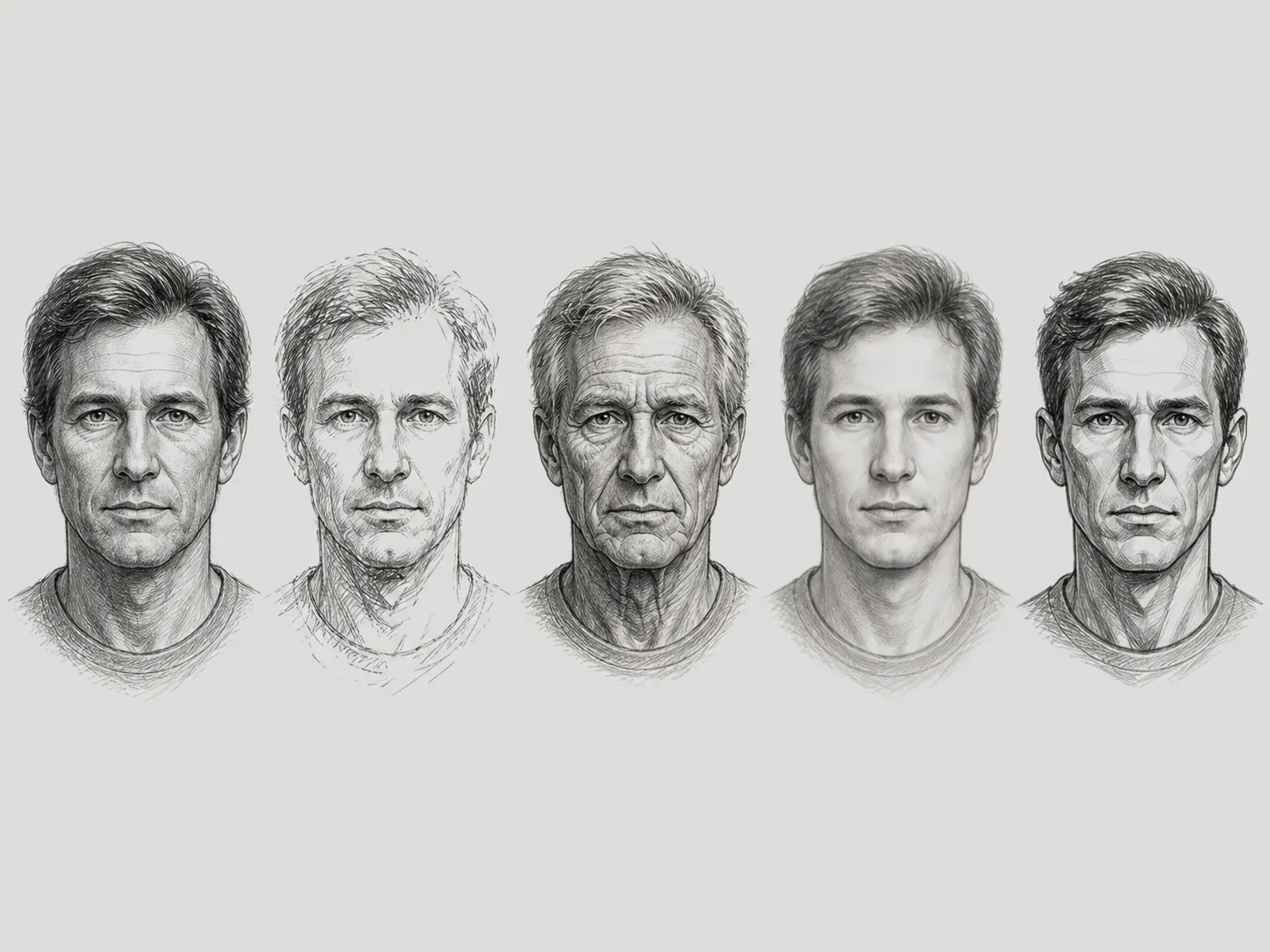
That is not a criticism of forensic artists as a profession. It is a warning about the evidentiary weight of the finished image. A polished progression can hide a long chain of choices: which childhood features were treated as stable, which family resemblance was borrowed, how weight, hair, skin texture, facial hair, and aging patterns were imagined, and whether distracting external features were included or suppressed. If eight trained artists can produce meaningfully different outputs from the same underlying problem, the single image later handed to a witness, prosecutor, or jury needs a foundation that accounts for that variance.
The validation gap is narrower than broad accuracy claims
The most defensible statement is narrow: age-progressed images may help investigators generate leads in long-term missing-person and fugitive matters, but the current peer-reviewed record does not justify treating a particular progression as a reliable identification unless the method, subject conditions, and accuracy basis are established.
An earlier Donato reliability evaluation, published in 2025, belongs in the same file because it frames forensic age progression as a task with accuracy limitations rather than a settled identification technique.[3] Put beside the 2026 pilot, the lesson is not that every progression fails. The lesson is that the reliability question is conditional. It depends on the age interval, the source image, the subject’s development, the visual information retained or obscured, and the way the resulting image is used.
Provenzano and coauthors add another important restraint. In a 2020 study, parental reference photographs did not improve recognition across longer age ranges, and age progressions did not produce a recognition benefit over outdated photographs.[4] Lampinen’s earlier work, reported by the University of Arkansas in 2009, similarly warned that age-progressed images did not necessarily help people recognize missing children better than older photos.[5]
Those findings matter in motion practice because they cut against a common assumption: that a more current-looking face is automatically better evidence than an old face. Sometimes it may be more useful for publicity, triage, or tip generation. That is different from proving that the generated face improves reliable courtroom identification.
| Use of the image | What the record can usually support | Where the risk concentrates |
|---|---|---|
| Lead generation | A visual aid to refresh public attention, solicit tips, or help investigators search for possible matches | Overstating the image’s accuracy when documenting reliance |
| Investigative comparison | One non-identifying data point among photographs, records, interviews, biometrics, and other leads | Letting the generated face drive confirmation bias before corroboration |
| Courtroom demonstrative | A limited explanatory exhibit, if the jurisdiction allows it and the foundation is controlled | Jurors may treat an impressive image as substantive proof |
| Identification evidence | Only if the proponent can defend the method, inputs, validation, and fit to the case | No settled AI-age-progression reliability standard as of Q3 2026 |
The table is deliberately conservative. It does not say an age-progressed image can never be shown in court. It says the use category has to be named honestly. A poster image used to generate a tip is not the same thing as an expert opinion that the person in the courtroom is the person in the childhood photograph. If the image crossed that line during the investigation, the file should show when, why, and with what corroboration.
Routine use is not courtroom validation
The National Center for Missing & Exploited Children gives the practice institutional scale. In a 2022 post, NCMEC reported more than 7,500 age progressions and more than 1,800 recovered children associated with its forensic imaging work.[6] In a February 2025 Photoshop-anniversary post, NCMEC reported more than 7,800 age progressions and more than 300 reconstructions.[7]
Those figures are useful context, not an admissibility study. They show that age progression is a routine investigative-image tool in missing-child work. They do not provide an independently audited success rate for age-progressed images, do not isolate which recoveries were caused by a progression rather than by other investigative work, and do not answer whether a particular AI-generated progression satisfies a jurisdiction’s reliability rule. The slight difference between the figures in the two NCMEC posts is also a reminder to cite the specific institutional claim being used, not a generalized number from memory.
The same discipline is needed with broad AI-forensic accuracy claims. Bugelli and coauthors’ 2026 systematic review of artificial intelligence in forensic personal identification reported 89 studies and a median accuracy of 91.4%, but the review also described heterogeneous methods, population-specific datasets dominated by Asian samples, scarce external validation, and it deliberately excluded age estimation.[8]
That 91.4% median is not an age-progression accuracy number. Importing it into an age-progression dispute would blur several boundaries at once: personal identification versus age estimation, laboratory performance versus field use, and dataset performance versus a cold-case image made from sparse historical material. The sharper, age-progression-specific record is less comfortable and more legally useful: recognition accuracy varies by subject, and artist outputs can diverge.
The admissibility problem has not caught up with the image problem
As of Q3 2026, no widely reported controlling Daubert or Frye ruling specifically resolving the admissibility of AI-generated age-progressed images was found in the sources cited here. That absence should not be overread. It is not a holding that such images are admissible. It is not a holding that they are inadmissible. It is a litigation gap.
The nearby AI-evidence landscape is moving, but mostly around the edges of this specific question. A proposed Federal Rule of Evidence 707 addressing AI-generated evidence was declined by the Advisory Committee on May 7, 2026, as reported by Complete Legal in July 2026.[9] That leaves federal litigants in the familiar position of arguing through existing authentication, relevance, expert, hearsay, demonstrative, and Rule 403 channels rather than through a new AI-specific federal evidence rule.
State-level developments are uneven. Louisiana Act 250, effective August 1, 2025, created a pretrial verification duty for certain AI-generated evidence while including a demonstrative-exhibit carve-out.[10] New York Part 161, effective June 1, 2026, concerns filings and expressly excludes evidence.[11] California Rule 10.430, effective September 1, 2025, addresses internal court use of generative AI rather than party evidence.[12] None of those authorities directly answers whether an AI age progression in a cold case is reliable identification evidence.
Deepfake and authentication resources are still relevant because they train courts to ask basic provenance questions. The National Center for State Courts’ AI resources, including bench-card materials developed with CivAI, focus attention on authentication, disclosure, and verification concerns around AI media.[13] Those concerns travel well to age progression even though deepfake fabrication and age-progression extrapolation are not the same problem.
A judge facing an age-progressed image may therefore receive a technically impressive exhibit without a settled reliability framework designed for it. That is a problem for both sides. The prosecutor who offers the image risks having a visually powerful but methodologically underdeveloped exhibit excluded or narrowed. The defense lawyer who challenges it needs more than a generalized objection to AI. The detective who relied on it may be asked to explain exactly how it entered the investigation and what it did, or did not, cause investigators to do.
What counsel should pin down before the image becomes an exhibit
The first task is to separate the production chain from the litigation story. “AI age progression” is too blunt a label. The file should identify whether a forensic artist, a commercial system, an internal law-enforcement tool, a generative model, or a hybrid workflow produced the image. If a human artist altered the output, that should be documented. If the system generated multiple candidates and one was selected, the selection process matters. If text instructions, masks, reference photos, intermediate drafts, model settings, or metadata exist, preserve them.
- Source material: original photographs, dates, image quality, orientation, lighting, known distortions, and whether the source image was itself enhanced.
- Method: artist notes, software name, model version if known, text instructions or settings where available, reference images, and any family-comparison materials.
- Human discretion: who selected the final image, who rejected alternatives, and what assumptions were made about weight, hair, facial hair, skin, injury, health, or lifestyle.
- Investigative reliance: when the image was circulated, to whom, what tips it generated, and what independent corroboration followed.
- Proposed courtroom use: demonstrative aid, investigative-background exhibit, expert basis material, or substantive identification evidence.
This is also where chain-of-custody habits from other AI-media disputes become useful. The preservation problem is familiar from AI-processed audio, synthetic-media authentication, and verification workflows. A cold-case file that keeps only the final poster image may be enough for a press release, but it is a poor record for a reliability hearing. For related risk framing, see the site’s discussions of AI-generated evidence entering courtrooms, proof-of-life verification for AI media, authentication gaps in AI evidence, and metadata and chain-of-custody risks.
For a proponent, the dangerous move is to let the image do more work than the foundation can support. A detective may fairly explain that a progression was circulated and that a tip followed, if the jurisdiction permits that background and the probative value is not substantially outweighed by prejudice. A much harder proposition is that the generated face itself reliably identifies the defendant or missing person. That proposition requires method-specific support, not institutional familiarity.
For an objector, the useful challenge is concrete. Ask for the source images. Ask whether alternatives were generated. Ask whether the artist or system has validation data for the relevant age interval and population. Ask whether the claimed accuracy comes from age-progression recognition studies or from broader AI-identification research. Ask whether the witness saw the generated image before making an identification. Ask whether the jurisdiction has an AI-evidence disclosure or verification rule that changes timing, burden, or authentication practice.
The case may still turn on ordinary corroboration: records, location data, DNA, fingerprints, dental comparison, admissions, family testimony, employment history, school records, travel records, or other evidence that does not depend on the generated face. If that corroboration is strong, the age progression may be unnecessary in front of the jury. If the corroboration is weak, the picture’s persuasive force becomes the problem rather than the solution.
A defensible Q3 2026 risk posture
The current record supports use of age-progressed imagery as an investigative tool, especially in files that have gone cold and need renewed public attention or searchable visual leads. It does not support casual translation of that image into identification evidence. Donato’s recognition split, Erickson’s inter-artist divergence, Provenzano’s no-benefit finding over outdated photos, and Lampinen’s earlier warning all point in the same practical direction: fit and foundation matter, and the specific image has to be defended on its own terms.
Before offering or challenging an AI age progression, identify the production chain, preserve the source materials and metadata where available, separate investigative use from evidentiary use, check the jurisdiction’s current AI-evidence and demonstrative-exhibit rules, and do not present the image as identification proof unless the reliability foundation can withstand being taken apart step by step.
References
- Forensic age progression for missing person investigations: A pilot evaluation of recognition accuracy, PubMed, 2026, https://pubmed.ncbi.nlm.nih.gov/41687395/
- When age-progressed images are unreliable, PubMed, 2017, https://pubmed.ncbi.nlm.nih.gov/28284439/
- Forensic age progression for missing person investigations: A reliability evaluation, PubMed, 2025, https://pubmed.ncbi.nlm.nih.gov/41075534/
- The effect of parental reference photos on age progression recognition, PubMed, 2020, https://pubmed.ncbi.nlm.nih.gov/33077035/
- Age Progressed Images May Not Help Find Missing Children, University of Arkansas, 2009, https://news.uark.edu/articles/13279/age-progressed-images-may-not-help-find-missing-children
- Forensic Imaging Unit Age Progression, National Center for Missing & Exploited Children, 2022, https://www.missingkids.org/blog/2022/forensic-imaging-age-progression
- NCMEC Celebrates 35 Years of Photoshop, National Center for Missing & Exploited Children, February 2025, https://www.missingkids.org/blog/2025/photoshop-anniversary-forensic-imaging
- Artificial intelligence in forensic science: Part I personal identification, International Journal of Legal Medicine / Springer, 2026, https://link.springer.com/article/10.1007/s00414-026-03564-9
- Proposed Federal Rule of Evidence 707 Declined by Advisory Committee, Complete Legal, July 27, 2026, https://completelegal.us/proposed-federal-rule-of-evidence-707-declined-by-advisory-committee/
- Louisiana Act 250, Louisiana State Legislature, 2025, https://www.legis.la.gov/legis/ViewDocument.aspx?d=1390831
- Part 161 Use of Artificial Intelligence by Attorneys, New York State Unified Court System, 2026, https://ww2.nycourts.gov/rules/chiefadmin/161.shtml
- California Rule of Court 10.430, California Courts, 2025, https://courts.ca.gov/cms/rules/index/ten/rule10_430
- Artificial Intelligence and the Courts, National Center for State Courts, https://www.ncsc.org/consulting-and-research/areas-of-expertise/technology/artificial-intelligence
Related records
Tool profile
How Meta's AI Spending Reshapes Law Firm ProfitabilityGoverning regulation
Browse the obligations tracker →Preventive workflow
Browse verification workflows →
Report a correction or tip
Spotted an outdated figure, a misstated fact, or a ruling this case record should reflect? Public comments are disabled for this content given the professional cost of a misreported case outcome, penalty amount, or rule text — use the structured correction channel instead.
Report a correction or tip for this record →