
What the Rohto Eye Drops Recall's Class II Designation Means
The July 2026 Rohto eye drops recall — roughly 12 million bottles, Class II 'lack of assurance of sterility,' no confirmed infections as of 2026-07-31 — reads as a risk signal, not an all-clear. Counsel weighing health risk and litigation exposure get a source-linked benchmark tying the event to the same failure mode's documented trajectory, from the facility's 2014 recall to the 2023 EzriCare outbreak.
- Jurisdiction
- US federal
- Court
- FDA
- AI tool named
- No AI tool named
- Ruling date
- Jul 14, 2026
- Source document
- View primary court order ↗
- Last verified
- Jul 31, 2026
Lex Machina Review is an independent risk-tracking and reference resource. Nothing on this site is legal advice, and using it does not create an attorney-client relationship. Every record is reviewed against primary sources but may not reflect the most current status of a matter — always verify directly against the cited court order, rule text, or a licensed attorney before relying on it.
Companion explanation — secondary to the source document above
Last verified: 2026-07-31. This article is legal-risk analysis, not medical advice, and it does not determine whether any individual product caused an injury.
For counsel weighing the health risks in the Rohto eye drops recall, the live question is not whether the July 2026 recall should be described as another EzriCare event. The present record does not support that. The harder question is whether a Class II recall for “lack of assurance of sterility” can be treated as a low-stakes administrative problem. That also goes too far.
The anchor record is FDA Enforcement Report Event 99440. It identifies a voluntary recall initiated on 2026-07-14 by Rohto-Mentholatum (Vietnam) Co. Ltd., with nationwide distribution by The Mentholatum Company, and classifies the recall as Class II because of “lack of assurance of sterility.” The affected products are Rohto-branded eye drops, with affected lots ending in “V” and expiration dates generally running from 2026/07 through 2029/02, with some Optic Glow lots listed through 2025/07 in the recall reporting materials.[1]
As of this verification date, the public record reviewed here does not show confirmed infections, confirmed product contamination, a Rohto-specific lawsuit, or a Rohto-specific multidistrict litigation arising from the 2026 recall. That boundary matters. So does the failure mode. Eye drops are not a product category where sterility language is decorative; the product goes into or near a vulnerable body site, and sterility-assurance failures have a documented history of moving, in some cases, from inspection and recall language into confirmed contamination and serious injury.
For lot-specific checking, the site’s Rohto FDA recall list is the better place to work through affected products. For consumer-facing disposal, refund, and symptom-response steps, use the separate Rohto eye drops recall guide. The point here is narrower: what the classification signals for health-risk and litigation-risk calibration.
The count is roughly 12 million, but the unit wording should not be cleaned up silently
The scale is large, but even the scale requires careful wording. The FDA event record is the controlling recall source, while media accounts have described the quantity with slightly different unit labels. USA Today reported 11,960,623 cartons containing 12,460,649 bottles; Prevention reported 12,460,649 bottles; EatingWell described nearly or approximately 11,960,623 eye-drop bottles.[1][3][4][5]
That discrepancy is not a reason to doubt that the recall is large. It is a reason not to flatten the record into a falsely precise sentence. A defensible shorthand is “roughly 12 million bottles, with public reports differing on whether the 11.96 million figure refers to cartons or bottles.” For a filing, client memo, or demand analysis, the FDA event entry should be rechecked directly because the enforcement report page is the administrative source for the current event.
Class II is a risk classification, not a reassurance label
FDA’s recall classes are not casual severity adjectives. FDA explains Class I recalls as situations where use of or exposure to a violative product has a reasonable probability of causing serious adverse health consequences or death. Class II applies where use of or exposure to the product may cause temporary or medically reversible adverse health consequences, or where the probability of serious adverse health consequences is remote. Class III applies where use of or exposure is not likely to cause adverse health consequences.[2]
That puts the Rohto recall below the evidentiary temperature of a Class I event. It does not make the products “safe,” and it does not resolve the biological question that sits behind the recall wording. The present FDA classification says the probability of serious harm is remote under the recall framework. It does not say that sterility failure is harmless, and it does not establish that every distributed bottle was sterile.
| Current Rohto record | What that supports | What it does not support |
|---|---|---|
| Class II recall for lack of assurance of sterility | A risk signal below Class I severity under FDA’s recall framework | A statement that the products were safe or that no exposure risk existed |
| No confirmed Rohto-linked infections identified in the reviewed public record as of 2026-07-31 | A lower present evidentiary temperature | A conclusion that future adverse-event reports, testing, or regulatory findings cannot change the analysis |
| Roughly 12 million recalled units, with public unit wording inconsistent | A large recall requiring precise source handling | A reason to invent a reconciled count that the record does not cleanly provide |
| Affected lots ending in “V” in the FDA event materials | A lot-screening fact for recall administration | A stand-alone proof of contamination or injury |
“Lack of assurance of sterility” is an administrative phrase with biological consequences
The phrase “lack of assurance of sterility” is easy to underread because it sounds procedural. In recall records, it often means the agency or firm cannot adequately rely on the manufacturing, testing, packaging, or quality-control record to assure that the product is sterile. It is not the same statement as “confirmed contamination.” It is also not the same as “no problem.”
That distinction is especially important for eye drops. The risk corridor begins with sterility assurance: whether the process gives adequate confidence that microbial contamination is not present. It may remain there, with no confirmed contaminated product and no confirmed injuries. Or it may move into a different evidentiary category: positive product or environmental testing, documented insanitary conditions, adverse-event clusters, outbreak investigation, causation proof, and litigation.
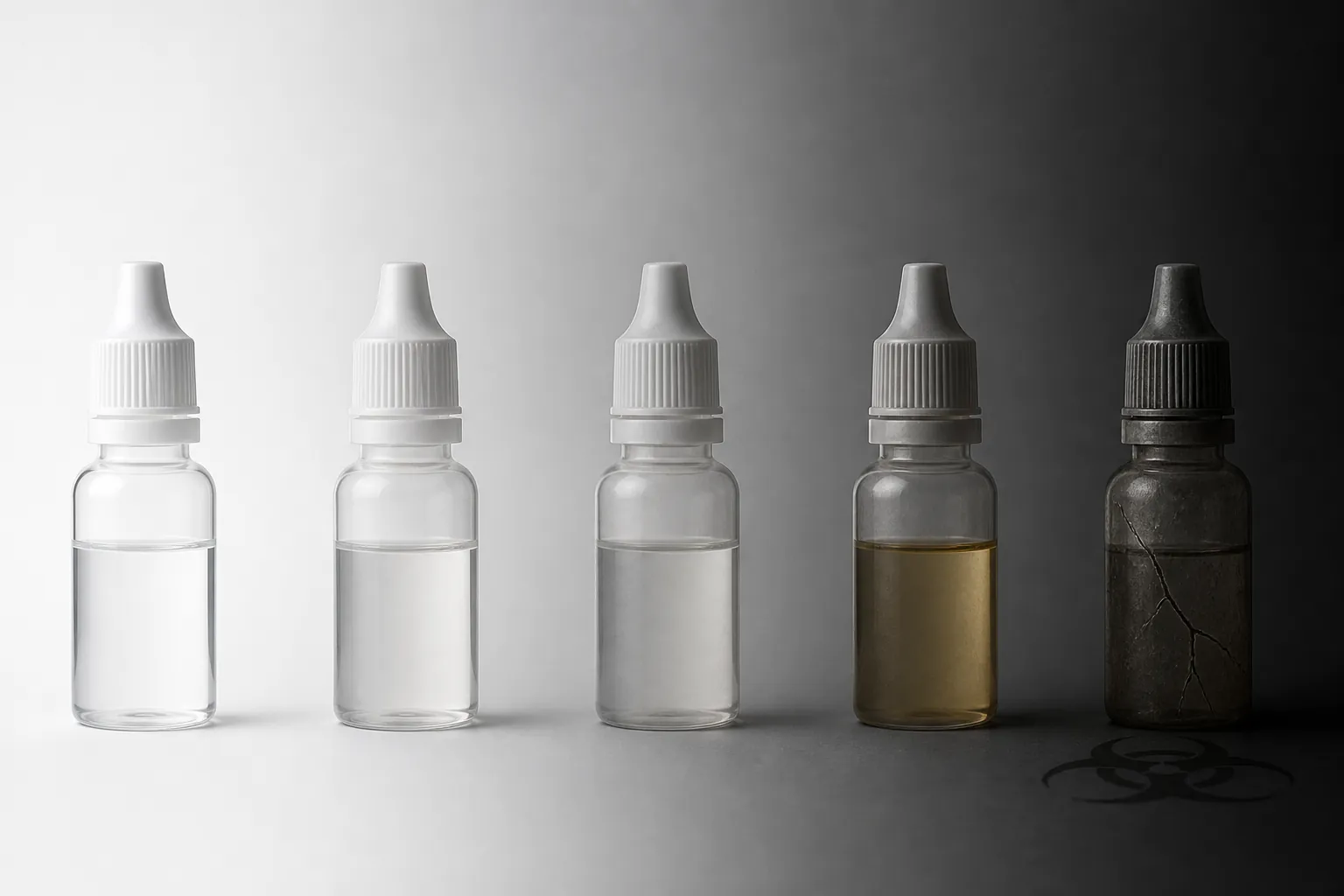
The present Rohto record is at the first stage of that corridor. It identifies an assurance failure, not confirmed contamination. But prior eye-drop recalls show why the first stage should not be dismissed when counsel is asked to brief product-liability exposure before a litigation record exists.
The prior eye-drop pattern gives the Rohto classification its weight
The closest historical echo is not the most catastrophic one; it is the same manufacturer site. In 2014, the American Academy of Ophthalmology described a nationwide recall of certain Rohto eye drops made by Mentholatum in Vietnam because sterility could not be assured. The 2014 account also noted affected lots marked with “V,” which makes it a relevant manufacturing-history comparator, though it remains a secondary account and should not be treated as a finding that the 2026 products were contaminated.[6]
The 2014 precedent matters in a limited way. It does not prove a repeat defect. It does show that “lack of assurance of sterility” at this product/manufacturing intersection is not appearing in a vacuum. For a risk memo, that is enough to keep the event out of the nuisance-only bucket, even while the no-confirmed-infection boundary remains visible.
The severity ceiling comes from a different event: the 2023 EzriCare and Delsam Artificial Tears outbreak. CNN, in a 2026 article published with The Conversation, summarized the outbreak as involving 81 Pseudomonas aeruginosa infections across 18 states, 14 cases of vision loss, four enucleations, and four deaths.[7]
That outbreak should not be imported wholesale into the Rohto file. The present Rohto event does not have confirmed infections on the public record reviewed here, and the recall class is not the same evidentiary posture as an outbreak tied to confirmed contamination and injuries. The EzriCare/Delsam record is useful for a narrower purpose: it shows what the same category of sterility failure can become when the facts move from lack of assurance to contamination, infection, and injury proof.
The 2023 Kilitch Healthcare episode adds a different kind of comparator. FDA warned consumers not to purchase or use certain eye drops from several major brands after investigators found insanitary conditions at the manufacturing facility and positive bacterial test results from environmental sampling of critical drug-production areas.[8]
Again, the comparison is about the risk pathway, not factual identity. Kilitch illustrates a middle evidentiary position between abstract assurance concerns and patient-injury litigation: regulatory findings about the manufacturing environment. Those findings can change how counsel describes defect risk even before individualized causation records are available.
The 2026 K.C. Pharmaceuticals recall shows that the pattern did not end with the 2023 outbreak. UC Davis Health described a 2026 FDA-flagged recall involving more than 3 million bottles of eye drops, while the CNN/The Conversation account linked the K.C. Pharmaceuticals recall to continuing regulatory concerns after an earlier FDA warning letter.[7][9]
None of those comparators converts the Rohto recall into a proven injury case. Together, they do something more modest and more useful: they establish that sterility-assurance language in eye-drop recalls belongs to a known risk corridor. Some events may stop at recall administration. Others have escalated into environmental findings, confirmed microbial contamination, serious patient injury, and litigation.
Absence of confirmed injury is not the same as absence of exposure risk
The cleanest defensible sentence is also the least dramatic one: as of 2026-07-31, the reviewed public record does not identify confirmed infections tied to the 2026 Rohto recall. That sentence should not be stretched into “there was no risk.” A recall for lack of assurance of sterility exists precisely because the firm and regulator cannot leave the product in ordinary commerce with the same confidence they would have had absent the quality failure.
In legal-risk terms, the distinction affects timing. Before confirmed injuries, the file is driven by the enforcement entry, manufacturing history, complaint monitoring, adverse-event signals, product testing, and follow-up regulatory actions. After confirmed injuries, the file changes shape: causation, warning adequacy, defect theory, damages, aggregation, and expert proof move forward.
That is why “no confirmed adverse events” is important but not dispositive. It lowers the present claim temperature. It does not erase the signal created by the recall category, the product route of exposure, the scale of distribution, and the eye-drop market’s recent sterility history.
Product-liability exposure remains contingent, not imaginary
A Rohto plaintiff file would need more than the recall entry. A viable injury case would ordinarily require product use, lot connection, injury evidence, medical causation, and a theory tying the alleged injury to the sterility-assurance failure. The recall can help establish notice, defect context, and regulatory background; by itself, it does not prove that a particular bottle was contaminated or that a particular patient was injured by it.
On the defense side, Class II status and the absence of confirmed Rohto-linked infections are meaningful facts. They support a narrower risk statement than a Class I outbreak record would. They may also matter for early claim valuation, reserve discussions, retailer communications, and whether alleged injuries look temporally and biologically coherent against the recall record.
On the plaintiff side, the recall’s scale, the product category, the sterility language, and the prior eye-drop outbreak history prevent the event from being dismissed as mere paperwork. The more useful comparison is not “Rohto equals EzriCare.” It is that confirmed-contamination eye-drop litigation shows how severe the exposure can become if future testing, adverse-event reports, or regulatory findings move the Rohto file into a different evidentiary posture. Public contaminated-eye-drop litigation materials as of this review window focus on EzriCare and related artificial-tears claims, not a Rohto-specific litigation track.[10]
For Rohto-specific liability theories, the separate product-liability claims analysis is the more direct place to examine defect, warning, causation, and damages scenarios. Here, the narrower point is classification: a Class II sterility-assurance recall is not presently an outbreak record, but it is still a litigation-relevant risk signal.
A defensible client answer
If a client asks whether this is nuisance exposure or something worse, the answer should be bounded rather than comforting. The verified record supports saying that the 2026 Rohto recall is a large, nationwide, voluntary Class II recall for lack of assurance of sterility, with no confirmed Rohto-linked infections identified in the reviewed public record as of 2026-07-31. FDA’s Class II definition places the event below a Class I reasonable-probability-of-serious-harm finding, but it does not make the recall an all-clear.
The event should be monitored for three kinds of movement: adverse-event reporting, product or environmental testing findings, and FDA follow-up. Those developments would matter more than broad brand commentary or isolated unsourced social-media claims. They would determine whether the file remains a recall-administration matter or begins to resemble the eye-drop cases where sterility failure became confirmed contamination and patient injury.
The current Class II designation lowers the present evidentiary temperature. It does not erase the risk signal. Counsel should read the Rohto recall against the documented sterility-failure pattern in the eye-drop market while keeping the present no-confirmed-infection boundary visible.
References
- FDA Enforcement Report Event 99440 — FDA.
- Understanding Drug Recalls: What to Know and What to Do — FDA.
- Millions of Rohto-brand eye drops recalled nationwide — USA Today.
- 12 Million Rohto Eye Drops Recalled Nationwide — Prevention.
- Nearly 12 Million Eye Drop Bottles Recalled Nationwide — EatingWell.
- Nation-wide eye drop recall — American Academy of Ophthalmology, 2014.
- Massive eye drop recall reflects ongoing issues — CNN, 2026-04-15.
- FDA warns consumers not to purchase or use certain eye drops from several major brands due to risk of eye infection — FDA, October 2023.
- Eye drop recall 2026: FDA flags over 3 million bottles; eye doctors explain what you should know — UC Davis Health, 2026.
- Contaminated Eye Drops Lawsuit — TorHoerman Law.
Related records
Tool profile
How Meta's AI Spending Reshapes Law Firm ProfitabilityGoverning regulation
Browse the obligations tracker →Preventive workflow
Browse verification workflows →
Report a correction or tip
Spotted an outdated figure, a misstated fact, or a ruling this case record should reflect? Public comments are disabled for this content given the professional cost of a misreported case outcome, penalty amount, or rule text — use the structured correction channel instead.
Report a correction or tip for this record →