
What Rohto's FDA history proves in an eye drop lawsuit
The July 2026 Rohto recall follows years of FDA compliance findings at the same Ho Chi Minh City plant. This Risk Digest entry separates what that history can support in a product-liability suit — notice and knowledge of recurring sterility-control concerns — from what it cannot prove: prior contamination or injury.
- Jurisdiction
- United States (federal)
- Court
- U.S. federal courts
- AI tool named
- No AI tool implicated
- Ruling date
- Jul 23, 2026
- Source document
- View primary court order ↗
- Last verified
- Aug 2, 2026
Lex Machina Review is an independent risk-tracking and reference resource. Nothing on this site is legal advice, and using it does not create an attorney-client relationship. Every record is reviewed against primary sources but may not reflect the most current status of a matter — always verify directly against the cited court order, rule text, or a licensed attorney before relying on it.
Companion explanation — secondary to the source document above

Last verified: Aug. 2, 2026, UTC. This Risk Digest entry is litigation-risk analysis, not legal advice. Its current posture is narrow: the July 2026 Rohto recall is confirmed by the FDA Enforcement Report, the 2014 V-lot recall is confirmed by the American Academy of Ophthalmology notice, and the broader 2012–2019 inspection/import-alert history remains useful but source-limited unless counsel pulls the underlying FDA, import-alert, and facility records before filing.
For anyone evaluating a rohto eye drop recall lawsuit after the July 2026 recall, the question is not whether the FDA history sounds bad. It does. The harder question is what that history can prove without overstating the record. On the present materials, it is strongest for notice, knowledge, and state-of-mind allegations about recurring sterility-control concerns at the Ho Chi Minh City facility. It is not, by itself, proof that any recalled Rohto bottle was contaminated or that any user was injured.
The July 2026 recall proves a sterility-assurance problem, not confirmed contamination
FDA Enforcement Report Event 99440 is the load-bearing source. It identifies a Class II recall initiated on July 14, 2026 and classified on July 23, 2026 for “lack of assurance of sterility.” The event reports 11,960,623 cartons and 12,460,649 bottles across eight Rohto product groups, with recall numbers D-0715-2026 through D-0722-2026.[1]
| Confirmed July 2026 recall anchor | What it can safely support |
|---|---|
| FDA Event 99440; recall initiated July 14, 2026; classified July 23, 2026 | Timing of the current recall and regulatory classification |
| Class II recall reason: “lack of assurance of sterility” | A sterility-control or sterility-assurance theory, not a confirmed-contamination allegation |
| Rohto ALL-IN-ONE, Max Strength, Optic Glow, Digi Eye, Dry Aid, and Cool Relief product groups; recall numbers D-0715-2026 through D-0722-2026 | Product-family scope sufficient to anchor a complaint, while SKU-by-SKU checking belongs in the recall-list record |
| Total reported quantity: 11,960,623 cartons / 12,460,649 bottles | Scale of distribution and potential exposure universe, not proof of injury |
The phrase “lack of assurance of sterility” has courtroom weight because eye drops are used in a vulnerable part of the body and consumers cannot inspect sterility at home. But the phrase also has a boundary. It does not say the FDA found a pathogen in Rohto bottles. It does not identify a confirmed infection cluster. It does not, standing alone, prove medical causation.
Consumers checking whether their product is within the recall need the SKU and lot-level companion record, not a litigation analysis. That narrower inventory work is handled in the site’s Rohto FDA recall list. For pleading purposes here, the important point is the FDA’s stated reason and the product-family scope.
The “V” lot marker is the cleanest thread back to 2014
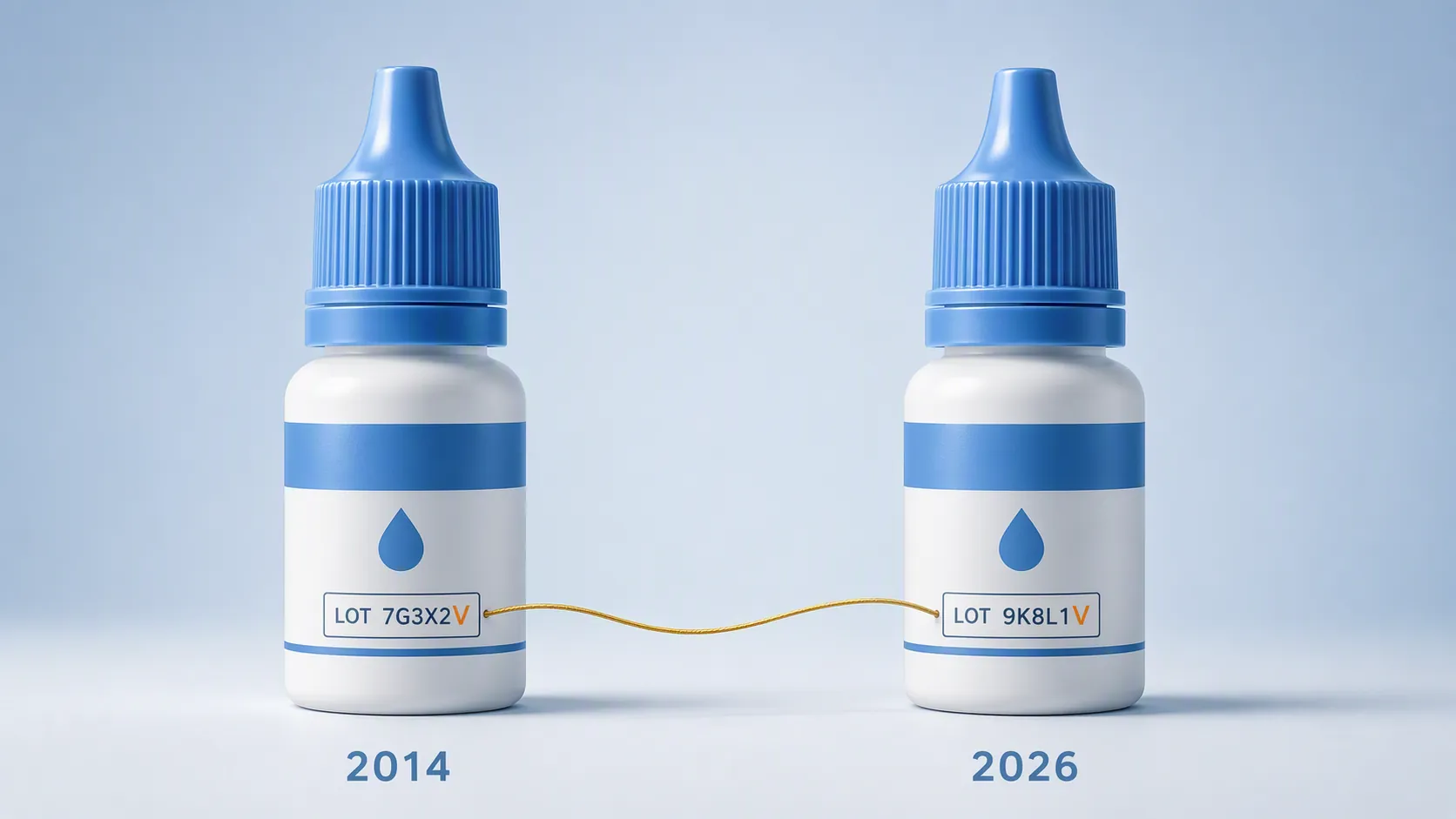
The current recall’s legal significance is sharper because it does not float in corporate generalities. The record can be tied to consumer-verifiable labels. The July 2026 recall includes V-suffix lot markers such as 3H1V and 4A2V in the affected Rohto lots.[1] The 2014 Mentholatum Vietnam recall notice explained that “a V in the lot code indicates the product was manufactured in Vietnam” and identified the recalled lot code 3E1V.[2]
That matters because “same company had FDA issues years ago” is a loose pleading theme. “Same Vietnam-made lot marker, same sterility-assurance concern, and same Ho Chi Minh City manufacturing thread” is a more disciplined allegation. It gives a defendant less room to say the complaint is merely using a distant regulatory history to inflame the reader.
The same label thread also prevents a common overclaim. A V suffix does not prove contamination. It proves a manufacturing-origin connection that may make prior notice and knowledge allegations more plausible when the prior event involved sterility assurance.
The earlier FDA history is useful, but it needs source discipline
TechTimes reported that the facility history includes a May 2012 FDA finding of an “unacceptable state of compliance,” 13 violations including a deficient aseptic processing area, an August 2013 import alert, and later voluntary-action-indicated inspection outcomes in 2015, 2018, and 2019. It also reported a Rohto marketing claim of “100% sterile, 100% free from contamination.”[3]
Those are not throwaway facts. Aseptic-processing deficiencies, import restrictions, and repeated VAI outcomes can matter to notice and knowledge if the underlying records confirm the same facility, the same product category, and a related sterility-control issue. The marketing claim can matter too, but only if counsel can tie the statement to the relevant packaging, advertising, purchase period, jurisdictional consumer-protection theory, and user reliance theory where required.
The caution is equally important. In this entry, the 2012 violation count, import-alert details, and facility-record specifics are treated as reported secondary-source material unless the primary FDA inspection, ProPublica Rx Inspector, and import-alert records are separately pulled and matched. A complaint that quotes the full violation count without that verification may win a dramatic paragraph and lose credibility.
Why the 2014 recall cuts both ways
The 2014 notice is the most important historical document because it strengthens the continuity theory and limits it at the same time. It described a nationwide recall of Rohto Arctic, Rohto Ice, Rohto Hydra, Rohto Relief, and Rohto Cool eye drops with lot number 3E1V and explained the Vietnam “V” lot marker.[2] Fierce Pharma’s contemporaneous coverage framed the event as an FDA recall questioning sterility of eye drops made in Vietnam.[4]
But the AAO notice also included the sentence that should stop any responsible pleading from sliding too far: “The recall is being conducted as a precautionary measure. There is no evidence that the product did not meet specifications.”[2] That caveat does not erase the recall. It does stop the 2014 event from becoming proof that the earlier Rohto product was actually contaminated.
Used fairly, the 2014 recall supports a corporate-notice story: Rohto had already dealt with a Vietnam-made eye drop recall involving sterility assurance and V-marked lots before the 2026 recall. Used unfairly, it becomes a disguised prior-bad-act argument: Rohto had a recall in 2014, therefore the 2026 bottles were contaminated. The first theory belongs in a serious complaint if the other elements are present. The second should draw a Rule 403 fight before it reaches a jury.
What the history can add to a complaint
A first-mover complaint does not need to pretend the FDA history proves everything. It can use the record for the things regulatory history is actually good at showing: notice of sterility-control concerns, knowledge of prior recall risk, the foreseeability of harm if sterility controls fail, and the reasonableness of expecting stronger oversight after earlier facility events.
- Notice: the 2014 V-marked recall and the reported earlier facility history give counsel a basis to allege that sterility assurance was not a brand-new issue.
- Knowledge: if primary records confirm the same facility and related control issues, the history can support allegations that the company knew or should have known sterility controls required close attention.
- State of mind: the record may matter to punitive-damages, warranty, or consumer-protection theories in jurisdictions where prior knowledge changes the analysis.
- Pleading plausibility: the same-facility and V-lot continuity can help distinguish a concrete sterility-control theory from a generic “recall happened, therefore defect” complaint.
The strongest pleading theory is procedural, not sensational. A plaintiff can allege that a manufacturer of sterile ophthalmic products should have treated prior sterility-assurance events as operational warning signs. Defense counsel, in turn, can concede the recall history exists while forcing the complaint to identify exposure, product lot, injury, and causation rather than letting the history do all the work.
For the claim-theory side of that analysis, the companion entry on Rohto product-liability claims is the better place to separate design defect, manufacturing defect, failure to warn, warranty, and consumer-protection theories. This record is narrower: what the FDA history does inside those theories.
Where the history stops helping

The present record does not identify a confirmed Rohto-specific injury, class action, MDL, or consolidated docket as of Aug. 2, 2026. That is an absence finding, not a prediction that no case will be filed. It simply means the litigation analysis cannot skip from FDA recall history to injury verdict.
The missing pieces are the ordinary hard pieces in a sterility case: did the claimant buy or use an affected lot; was the bottle within the recall; was the product contaminated; what organism or injury was identified; what alternative exposures existed; and can a qualified medical expert connect the product to the injury? Regulatory history can make those questions worth asking. It cannot answer them without product testing, medical records, exposure proof, and expert causation work.
Expiration-date ranges should be handled the same way. Some public recall coverage has not been perfectly aligned on product-table details. A pleading should use Event 99440 for Rohto dates, lots, and quantities, and should not import March 3 or March 31, 2026 dates from separate K.C. Pharmaceuticals eye-drop recall coverage into the Rohto event.[1]
Two evidence flags for counsel review
Rule 407 should be reviewed before relying on later corrective measures as proof of culpable conduct. Prior recalls and prior inspection findings may be offered for notice or knowledge rather than defect, but the admissibility question will turn on timing, purpose, jurisdiction, and how tightly the earlier event matches the current theory.
Rule 403 is the other obvious fight. A same-facility, same-sterility-assurance history has probative value. A decade-old regulatory narrative can also become unfairly prejudicial if it is used to suggest contamination without lab proof. The 2014 “no evidence” caveat is the defense exhibit that will keep that line visible.
The repeat-recall comparison is helpful only if it stays specific
Repeat-recall evidence can matter when it shows prior knowledge of the same hazard or recurring procedural failure. That is why comparators such as the Ford Explorer roof rail cover recall and the 2026 bacon recall product-liability analysis can be useful as procedural analogies. They are not shortcuts. The Rohto record still has to stand on its own facility, product, lot, and sterility facts.
The same caution appears on the other side of the line. A recall classification can create public concern while still leaving a civil-liability gap, as the Dollarama garlic powder recall lawsuit analysis illustrates in a different product context. That gap is especially important here because the current Rohto record speaks in sterility-assurance terms, not confirmed injury terms.
Present litigation-risk judgment
Rohto’s FDA history has real courtroom gravity: the 2014 V-marked recall, the July 2026 V-suffix lots, and the reported inspection history give a plaintiff a responsible basis to plead recurring sterility-control concerns at the Vietnam facility. Its strongest use is as a notice, knowledge, and state-of-mind pleading tool, especially for a first mover. It is not a substitute for product testing, exposure proof, medical causation, or a confirmed injury record.
References
- Enforcement Report Event 99440 — U.S. Food and Drug Administration
- Nation-wide eye drop recall — American Academy of Ophthalmology
- Rohto Eye Drop Recall: Nearly 12 Million Cartons Tied to Factory With History of FDA Violations — TechTimes, July 30, 2026
- FDA recall questions the sterility of eye drops made in Vietnam — Fierce Pharma, Jan. 2014
Related records
Tool profile
How Meta's AI Spending Reshapes Law Firm ProfitabilityGoverning regulation
Browse the obligations tracker →Preventive workflow
Browse verification workflows →
Report a correction or tip
Spotted an outdated figure, a misstated fact, or a ruling this case record should reflect? Public comments are disabled for this content given the professional cost of a misreported case outcome, penalty amount, or rule text — use the structured correction channel instead.
Report a correction or tip for this record →