
Twin Falls Shooting Exposes Dual AI Verification Duties
The Twin Falls active-shooter response brought two AI verification layers into the legal record: Idaho's early adoption of AI-drafted police reports and hoax content that circulated before verification. For counsel, the practical takeaway is a Brady, Giglio, and evidence-integrity checklist to run while the record is still hardening.
- Jurisdiction
- Idaho
- Court
- Idaho state courts
- AI tool named
- Code Four, Axon Draft One
- Ruling date
- Aug 1, 2026
- Source document
- View primary court order ↗
- Last verified
- Aug 2, 2026
Lex Machina Review is an independent risk-tracking and reference resource. Nothing on this site is legal advice, and using it does not create an attorney-client relationship. Every record is reviewed against primary sources but may not reflect the most current status of a matter — always verify directly against the cited court order, rule text, or a licensed attorney before relying on it.
Companion explanation — secondary to the source document above
Last verified: Aug. 2, 2026, UTC. This Risk Digest analysis is not legal advice. The Twin Falls record remains less than 24 hours old, so this piece treats official casualty reporting as subject to revision, keeps suspect-status claims in a reported-only posture, and separates primary-source facts from material that may later prove to be rumor, reposting, or automated narrative.
The reliable starting point for the Twin Falls active-shooter response is narrow. On Aug. 1, authorities responded to an active-shooter incident near the Twin Falls In-N-Out area; Twin Falls PIO Josh Palmer, as reported in early coverage, put the casualty count at three dead and two injured. Local reporting described a multi-agency response involving Twin Falls, Buhl and Jerome police, Idaho State Police, Twin Falls Fire, and Magic Valley Paramedics, with roads closed and nearby businesses locked down during the response.[1]
Just as important for the legal record is what one outlet did not publish. KMVT noted that it had obtained social media video of a suspect but was withholding it until cleared by proper authorities.[1] That is not a dramatic fact. It is a useful one. A withheld video does not become a captioned certainty, a screenshot in a motion, or a quoted line in a charging narrative before someone has tied it to source evidence.
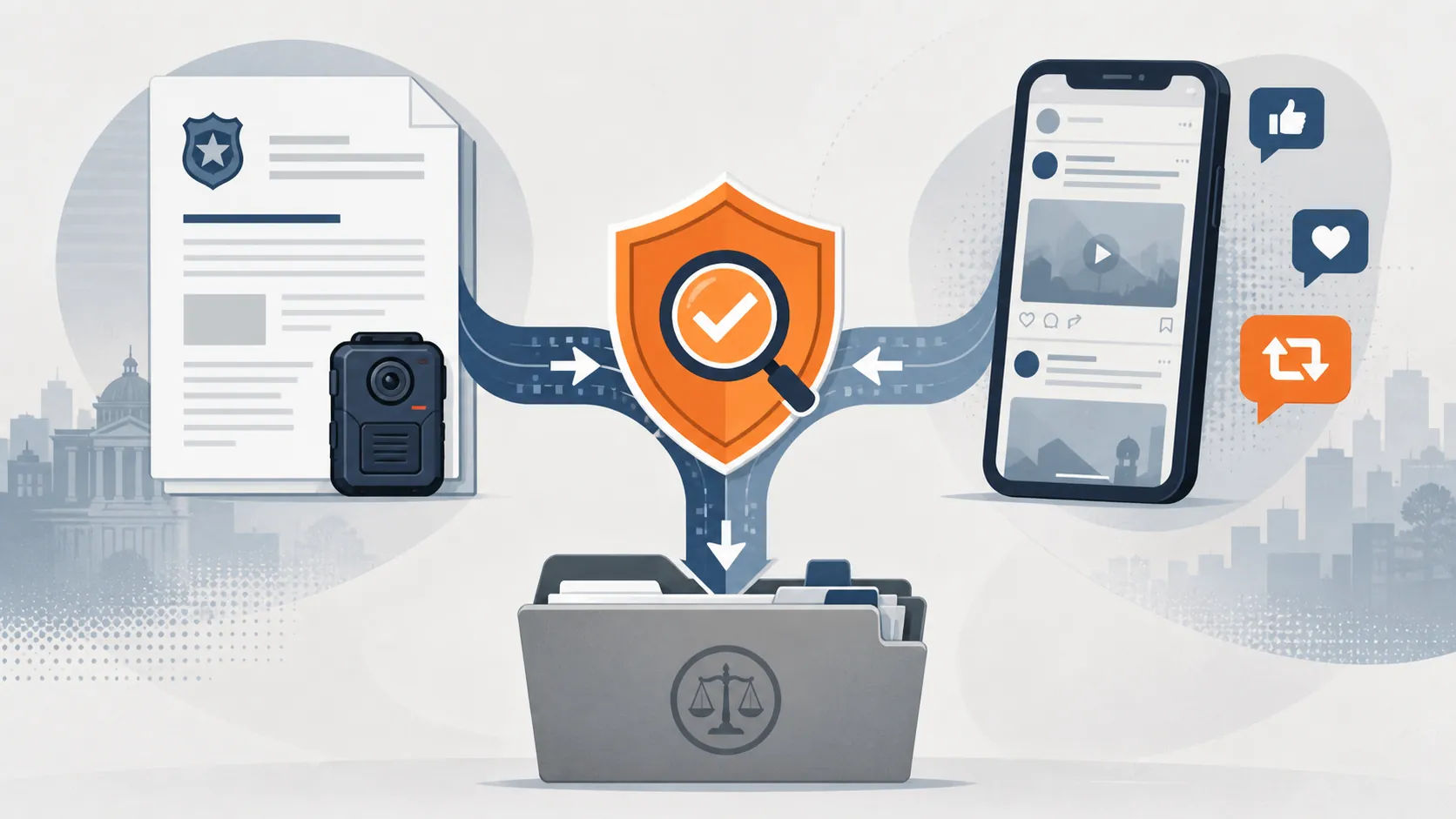
The verification problem has two lanes
The Twin Falls file now has two narrative layers that should not be allowed to merge casually. One is the public misinformation layer: social video, suspect claims, screenshots, fake news pages, and reposts circulating while police are still securing a scene. The other is the police-report layer: AI-assisted narratives that may be generated from body-worn camera footage, then edited, signed, filed, disclosed, and later treated as a clean account of what happened.
The point is not that AI caused an error in the Aug. 1 incident. The available record does not support that claim. The point is narrower and more useful: before counsel relies on any narrative about this incident, counsel needs to know where that narrative came from, what primary evidence supports it, what edits were made, and whether any unverified public claim or AI-generated draft entered the official record.
Twin Falls already has a swatting contamination history
Twin Falls is not a blank slate for live-incident misinformation. In 2023, Canyon Ridge High School was targeted by a swatting hoax that NPR described as involving fake videos, a fake news site called SNBC13.com, and malware-laced links.[2] The local history matters because hoax material rarely stays neatly outside a criminal file. It can shape witness expectations, prompt tips, influence public statements, and create a set of supposed facts that later have to be unwound.
The FBI’s 2025 swatting alert describes swatting as false reporting designed to trigger an emergency law-enforcement response and notes that threat actors may use spoofing services and other methods to conceal identity, divert emergency resources, and place victims and first responders at risk.[3] That operational risk is real. So is the record risk: once a hoax-generated assertion is repeated in a dispatch note, probable-cause narrative, press release, or social media post, it may look more official than it is.

KMVT’s restraint is therefore not just a media ethics footnote. It marks the kind of provenance decision lawyers later wish every participant had made. If a video is not cleared, the fact that it exists is different from the claim that it depicts the suspect. If a screenshot is circulating, the fact that it circulated is different from the claim that it accurately records an official statement. If a fake news page is reposted by real people, repetition does not cure source failure.
For counsel, the misinformation lane should be handled as a source-authentication problem from the beginning. Preserve the item if it may matter, but do not treat it as factual until the original uploader, timestamp, location, chain of reposting, and law-enforcement clearance status are known. Where an item has influenced a public statement, charging theory, warrant affidavit, or witness interview, that influence should be logged.
Idaho is also an early AI police-report jurisdiction
The second lane is less visible during breaking coverage, but it may matter more in litigation. Idaho agencies are already experimenting with or using generative police-report tools. GovTech and the Idaho Statesman reported that Pocatello police had used Code Four’s body-camera-report tool for about a year, that the Pocatello City Council approved a $33,600 contract in April 2026, that Caldwell now uses the tool, that the Ada County Sheriff’s Office tested Axon’s product and declined to adopt it, and that Boise police reported no use.[4]
Those adoption facts do not prove that any Twin Falls-area responding agency used AI drafting in the Aug. 1 matter. They do make the question ordinary enough to ask. In Idaho criminal litigation after Twin Falls, a report should not be assumed to be entirely human-drafted merely because it appears on agency letterhead or carries an officer signature.
The Department of Justice COPS Office has framed the minimum human-control steps plainly: an officer should review, edit, sign, and disclose AI-generated report narratives.[5] Each verb matters. Review without edit history leaves counsel guessing. Edit without preservation may erase the difference between generated text and officer recollection. Signature without disclosure can make a tool-assisted narrative look indistinguishable from a conventional report.
EFF’s critique of Axon’s Draft One identifies the preservation problem in sharper terms. EFF reported that Draft One does not retain the original AI draft by design and that Palm Beach County could isolate more than 3,000 Draft One reports because the county required disclosure language in each report.[6] That is the practical lesson: if the original draft is not retained and disclosure language is optional, lawyers may have to infer AI involvement from policy, metadata, vendor use records, or agency admissions rather than from the report itself.
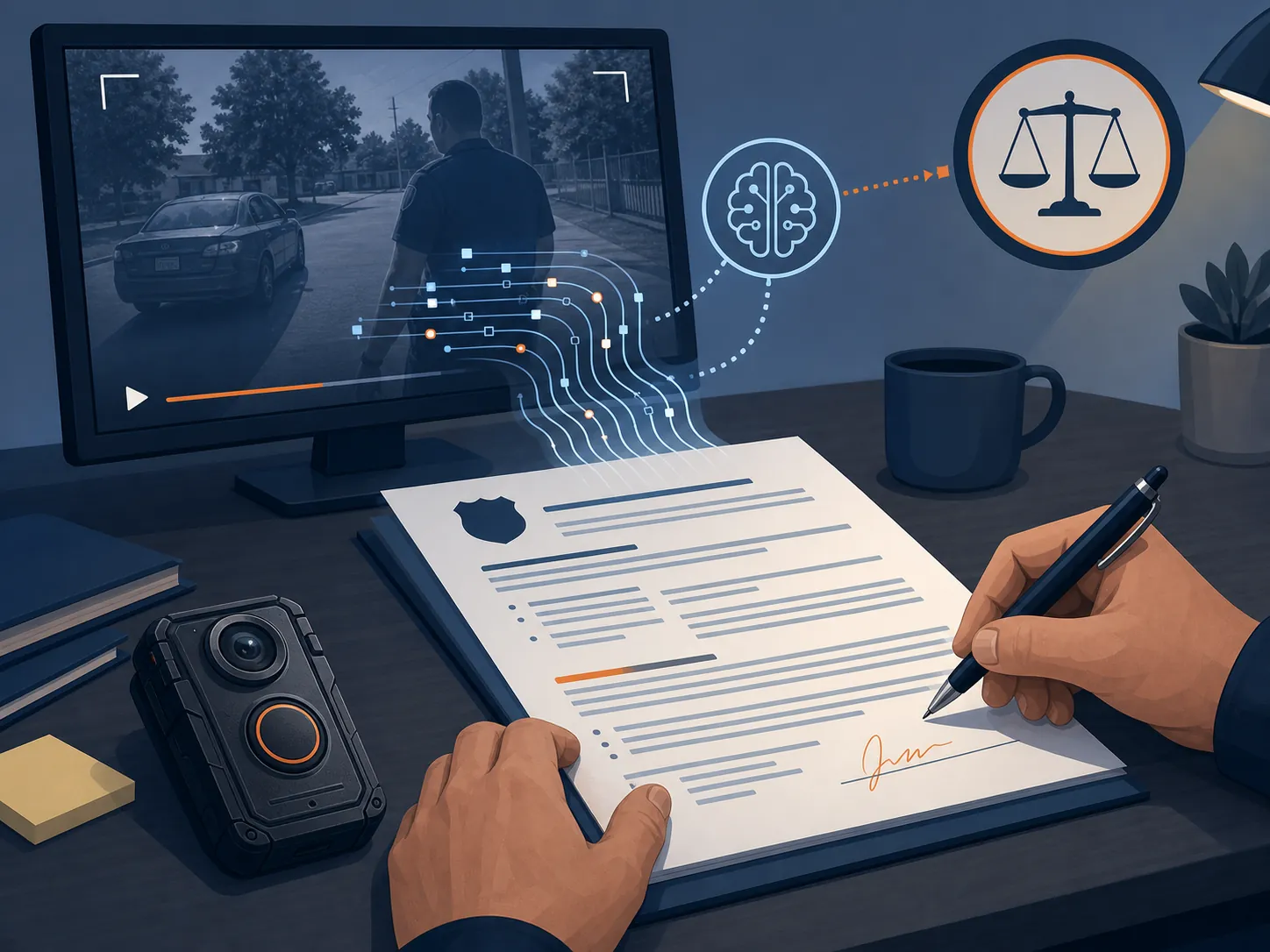
Defense attorney Scott McKay gave the litigation version of the same warning in the Idaho reporting: an inaccurate report is catastrophic because prosecutors, defense lawyers, and judges make decisions based on what is written.[4] That is not an argument against every drafting aid. It is an argument against treating the polished narrative as the first source of truth.
The Brady, Giglio, and Rule 16 check should start before the record hardens
The useful workflow is not a broad demand for everything labeled AI. It is a provenance check aimed at the points where narrative can detach from source material. Prosecutors need it to avoid disclosure failures. Defense counsel need it to test reliability and impeachment. Judges need it because evidentiary disputes are harder when every party arrives with confident summaries and weak source trails.
| Question | Why it matters |
|---|---|
| Did any responding, assisting, or reviewing agency use an AI drafting tool for an incident report, supplement, probable-cause narrative, press summary, or investigative synopsis? | The answer determines whether counsel must ask for tool policies, user logs, disclosure language, and draft-preservation information. |
| What primary material fed the narrative? | Body-worn camera footage, dispatch audio, CAD entries, witness statements, photographs, and officer notes may support different parts of the final report. |
| Does the report disclose AI assistance? | Disclosure language may be the only practical way to identify AI-assisted reports at scale, as the Palm Beach County example illustrates. |
| Was the original AI draft preserved? | If the draft was not retained, counsel should document that fact and identify what substitute records can show generation, review, and editing. |
| Who reviewed, edited, and signed the final narrative? | The signature identifies responsibility, but the edit path shows whether the officer corrected, accepted, or introduced material claims. |
| Did any viral claim influence the official narrative? | A suspect image, social video, or fake-source claim may become discoverable if it affected a lead, statement, charging theory, or witness question. |
A practical request in the Twin Falls matter, or in a later Idaho prosecution arising from the response, should therefore cover both lanes. Ask whether Code Four, Axon, or any other automated drafting or summarization tool was used by any agency contributing reports. Ask for the body-camera and dispatch source material tied to each narrative paragraph. Ask whether disclosure language was inserted or omitted. Ask whether the original generated draft exists. If it does not, ask what policy or system design caused that absence.
Then compare the generated or final narrative against the primary record. Match claimed observations to video. Match timing to dispatch and CAD. Match quotations to audio. Match witness statements to the interview record rather than to an officer’s paraphrase. Where an officer edited a generated account, identify whether the edit corrected the source record, added inference, removed uncertainty, or merely cleaned up prose.
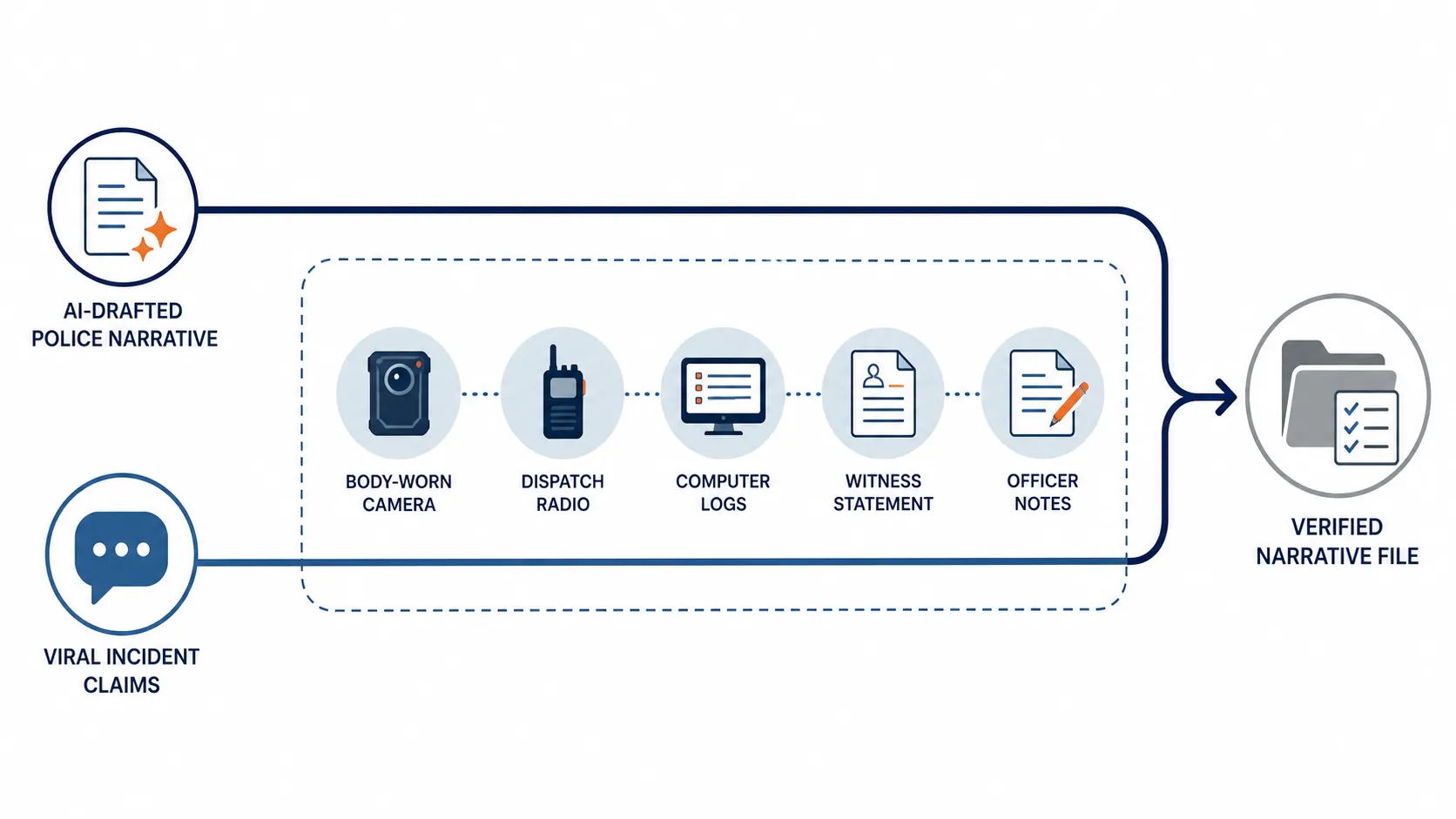
The same discipline applies to public claims. If a suspect video, screenshot, fake news page, or social-media identification appears in the investigative file, counsel should determine who first found it, how it was authenticated, whether law enforcement cleared it, and whether it was shown to witnesses. A social post does not become reliable because it was collected by an agency. It becomes useful only after the provenance work is done.
This is where existing evidence-integrity workflows should be joined rather than separated. The body-camera disclosure issues discussed in the site’s ICE body-cameras legal implications record, the Brady/Giglio exposure in the Sheriff Nanos record, and the source-verification failures in the Reflecting Pool unverified-sources record all point to the same operational need: a lawyer should be able to reconstruct how a factual assertion entered the file.
What belongs outside this record for now
Several tempting legal frames should remain in the background unless later facts justify them. FBI active-shooter materials help explain why agencies move quickly and why multi-agency coordination matters, but national active-shooter context does not answer whether a particular Twin Falls report is accurate or whether a specific social post was verified.[7]
Idaho’s Critical Incident Task Force materials are also context, not a ruling on this incident. Idaho State Police has described a model in which ISP may lead officer-involved-shooting investigations, and Twin Falls County-related CITF materials have included routing to the Ada County Prosecutor’s Office with published declination letters.[8][9] Those materials are useful analogs if force, officer conduct, or prosecutorial review later becomes relevant. They do not establish what happened on Aug. 1.
The same caution applies to municipal-liability analysis. Monell doctrine may become relevant if a plaintiff later challenges a municipal policy or custom, and Lawfare’s explainer is a useful primer on why municipal liability is not the same as respondeat superior.[10] But no court order in the Aug. 1 Twin Falls matter currently supplies a Monell record.
Livingston v. City of Twin Falls is likewise only an analog. The federal docket reflects dismissal with prejudice by stipulation on Aug. 21, 2025.[11] It should not be converted into authority about the active-shooter response, the suspect status, AI drafting, or any agency’s conduct in this incident.
Disambiguation is part of record hygiene. The Nov. 2023 Capri Drive homicide, the June 2025 Coeur d’Alene firefighter ambush, and the July 23, 2026 11th Avenue East shooting are separate matters. Unless a source ties them to the Aug. 1 response with primary evidence, they should not be imported into pleadings, public summaries, or background sections as if they explain this event.
The narrow legal takeaway
The contrast with the site’s Space Needle Shooting AI Evidence Risk record is instructive: a jurisdiction that categorically rejects AI police reports creates a different disclosure problem from one where agencies are adopting, testing, or declining tools agency by agency. Twin Falls adds the other half of the problem because the community has already seen swatting-style misinformation and because the Aug. 1 response generated unverified suspect content quickly enough for a newsroom to say no.
For a swatting-triggered liability comparison, the site’s Pima County swatting shooting claim record belongs in the research file. For AI-media authentication, the FBI proof-of-life deepfake verification record supplies a useful parallel. Neither changes the Twin Falls facts; both help keep the verification questions precise.
The Aug. 1 record does not yet support accusations of AI misuse, failed disclosure, or municipal liability. It does support a quarantine rule. In Idaho matters after Twin Falls, viral incident claims and AI-assisted police narratives should be held in the same evidentiary quarantine until checked against primary source material and logged for Brady, Giglio, and Rule 16 review.
References
- Heavy police presence near In-N-Out Burger in Twin Falls — KMVT, Aug. 1, 2026
- How a hoax school shooting call put a small Idaho city on high alert — NPR, Apr. 14, 2023
- Threat Actors Use Swatting to Target Victims Nationwide — Federal Bureau of Investigation, Apr. 29, 2025
- Should Idaho Police Use AI to Write Reports From Body Cam Footage? — GovTech
- AI-Generated Police Reports — U.S. Department of Justice COPS Office Dispatch, Jan. 2025
- Axon’s Draft One Is Designed to Defy Transparency — Electronic Frontier Foundation, July 2025
- Addressing the Problem of the Active Shooter — FBI Law Enforcement Bulletin
- Update: Officer-Involved Shooting Incident in Twin Falls County — Idaho State Police
- Twin Falls Declination Letter Optimist Park ACS24-9187 — Ada County
- Municipal Liability in Police Misconduct Lawsuits — Lawfare
- Livingston et al v. City of Twin Falls et al — PACER Monitor
Related records
Tool profile
Browse tool evaluations →Governing regulation
Browse the obligations tracker →Preventive workflow
Browse verification workflows →
Report a correction or tip
Spotted an outdated figure, a misstated fact, or a ruling this case record should reflect? Public comments are disabled for this content given the professional cost of a misreported case outcome, penalty amount, or rule text — use the structured correction channel instead.
Report a correction or tip for this record →