
Who polices misconduct by an AI posing as a psychiatrist?
Pennsylvania's pending enforcement suit against Character.AI — announced as the first US action against a chatbot posing as a licensed psychiatrist — shows a state can invoke its general unauthorized-practice statute without any AI-specific law. The compliance question is which regime binds first, and this tracker maps the state-by-state statute patchwork, effective dates, and the possible FDA device theory to answer it.
- Jurisdiction
- Pennsylvania, US
- Court
- Commonwealth Court of Pennsylvania
- AI tool named
- Character.AI
- Ruling date
- May 1, 2026
- Source document
- View primary court order ↗
- Last verified
- Aug 3, 2026
Lex Machina Review is an independent risk-tracking and reference resource. Nothing on this site is legal advice, and using it does not create an attorney-client relationship. Every record is reviewed against primary sources but may not reflect the most current status of a matter — always verify directly against the cited court order, rule text, or a licensed attorney before relying on it.
Companion explanation — secondary to the source document above
The enforcement trigger is narrow enough to place on a docket before it is interesting as an AI story: Pennsylvania State Board of Medicine v. Character Technologies, Inc., Pa. Commw. Ct., No. 220 MD 2026, petition filed May 1, 2026, announced May 5, 2026. The Commonwealth’s requested relief is a preliminary injunction and cease-and-desist order, not monetary damages, and the record available for this tracker remains complaint-stage: no ruling, no identified judge, no penalty, and contested allegations. The docket details belong in the site’s Pennsylvania Character.AI Risk Digest record; this article uses the case as the compliance trigger for the next question. [1][2][3]
For anyone arriving through a “psychiatrist patient relationship misconduct case” search, the distinction matters. This is not an adjudicated discipline matter against a human psychiatrist, and it is not a finding that a chatbot created a traditional psychiatrist-patient relationship. It is a pending unauthorized-practice complaint over an AI character allegedly presenting the trappings of professional status: a clinical title, claimed training, a license number, and psychiatric authority.
The first regulator may be the licensing board
Pennsylvania did not wait for a chatbot-specific health statute. The complaint invokes the state Medical Practice Act, including 63 P.S. §§ 422.10 and 422.38, against alleged unlicensed practice and the alleged presentation of a nonhuman character as a licensed psychiatrist. That is why this record travels beyond Pennsylvania: many state medical-practice laws were written broadly enough to reach a person or entity holding itself out as practicing medicine, even if the latest delivery mechanism is a consumer chatbot. [1]
That does not make the answer uniform. A chatbot may be reached first by a licensing board because it claims a regulated title. It may be reached first by a direct chatbot statute because the state has enacted one with an operative effective date. It may invite federal scrutiny if the product’s intended use looks diagnostic or treatment-oriented. Those are not cleanly stacked regimes; they are overlapping doors, and the one that opens first depends on where the user is, what the bot says it does, and what date the relevant statute became enforceable.
State obligation tracker, last verified August 3, 2026
The table separates general unauthorized-practice authority from the newer direct chatbot layer. Pennsylvania anchors the first category because the pending complaint shows how an existing medical-practice statute can be used without an AI-specific enactment. The remaining rows identify direct chatbot, healthcare-title, nursing-title, therapy, or conversational-AI measures reflected in the available tracker materials; where the materials do not supply final enactment or effective-date details, the row is deliberately flagged instead of treated as operative law. [4][5][6]
| State | Regime type | Status and effective-date posture | Trigger most relevant to an AI clinician claim | Compliance reading |
|---|---|---|---|---|
| Pennsylvania | General medical-practice / unauthorized-practice authority | Complaint filed May 1, 2026; announced May 5, 2026; pending in Commonwealth Court; no adjudicated penalty in the available record. [1][2] | AI character allegedly presented as a licensed psychiatrist and practiced medicine without Pennsylvania licensure. | A medical board can move first even without an AI-specific statute. |
| Utah | Direct AI statute plus regulator partnership path | Utah AI Policy Act materials identify administrative fines up to $2,500 per violation; the November 2024 ElizaChat regulatory-mitigation agreement shows the partnership alternative. [4][5] | AI system conduct covered by Utah’s AI-specific framework, especially where representations affect regulated services. | Do not treat disclosure alone as the whole control; check whether the state regulator has a mitigation agreement route or an enforcement route. |
| New York | Advanced direct chatbot bill | S7263A passed the Senate on May 26, 2026; enactment is not verified in the available materials. The bill is reported with civil penalties up to $15,000 per day and a provision barring liability disclaimers based merely on notifying users that a chatbot is nonhuman. [4] | Companion or chatbot conduct where the operator attempts to rely on nonhuman-status notice as a liability shield. | Track as advanced, not operative, unless enactment and effective date are independently confirmed. |
| Delaware | Direct healthcare-title and practice restriction | HB 191 (2026) is described as expressly prohibiting a nonhuman entity, including one powered by AI, from using professional healthcare titles or practicing medicine. [6] | Use of doctor, clinician, psychiatrist, or similar professional healthcare status by a nonhuman AI entity. | This is the direct-statute version of the Pennsylvania fact pattern: the title claim itself is the compliance event. |
| California | Tracked direct clinician-chatbot measure | AB 489 appears in the available tracker materials as part of the direct chatbot / healthcare-professional statute layer; final chapter and effective-date treatment are not supplied in the materials. [4] | AI systems presented in a healthcare-professional or therapeutic role. | Verify bill status and effective date before coding it as an operative control. |
| Oregon | Direct nursing-title restriction | HB 2748 is identified as banning nonhuman entities from nursing titles; effective-date detail is not supplied in the available materials. [4] | AI tool using nursing credentials, nursing titles, or nurse-like professional presentation. | A bot does not need to say “psychiatrist” to create a licensure issue; nursing titles have their own board and title-protection chain. |
| Nebraska | Conversational AI Safety Act | Effective July 1, 2027. [4] | Covered conversational AI conduct once the statute is in force. | Before July 1, 2027, do not rely on this future-effective statute as the first binding rule; older licensing and consumer-protection authorities may still apply. |
| Idaho | Conversational AI Safety Act | Effective July 1, 2027. [4] | Covered conversational AI conduct once the statute is in force. | The operative-date issue is the same as Nebraska: build the future control, but assess current exposure under existing law. |
| Illinois | Direct AI therapy restriction | HB1806 / Public Act 104-0054 is identified as prohibiting AI therapy; the available materials do not supply all implementation details. [4] | AI system offered as therapy or therapist-like service. | Therapy-function review belongs next to title review; a bot may create risk by what it does, not only by what it calls itself. |
| Nevada | Tracked direct chatbot / AI measure | AB406 appears in the available tracker materials; final operative treatment is not supplied here. [4] | Covered AI chatbot conduct depending on final statutory text and effective date. | Keep the row open until local bill-page verification supplies enactment, date, penalties, and exemptions. |
| Tennessee | Tracked direct chatbot / AI measure | SB1580 appears in the available tracker materials; final operative treatment is not supplied here. [4] | Covered AI chatbot conduct depending on final statutory text and effective date. | Same compliance posture as Nevada: do not convert a tracked bill citation into enforceable law without status verification. |
What direct chatbot laws add
The newer statutes matter because they reduce the amount of interpretive work a board or attorney general has to do. If Delaware bars a nonhuman entity from using professional healthcare titles or practicing medicine, the inquiry can begin with the title and representation rather than with a longer argument about whether a chatbot’s dialogue amounts to the practice of medicine. If Oregon protects nursing titles against nonhuman use, a credentialing reviewer has a different search list: nurse, RN, NP, nursing advice, and related formulations, not just physician or psychiatrist.
The direct statutes also create their own penalty and timing problems. New York S7263A is useful to watch because the reported version would impose civil penalties up to $15,000 per day and would not let a chatbot operator avoid liability merely by saying the chatbot is nonhuman. But as of this tracker’s verification point, the available materials support only “passed the Senate,” not “enacted and enforceable.” That difference is the kind of status flag that should survive into product requirements, procurement review, and board reporting. [4]
Future-effective laws create a separate trap. Nebraska and Idaho’s Conversational AI Safety Acts are identified with July 1, 2027 effective dates. A platform can build toward those requirements now, but a compliance memo dated in Q3 2026 should not list those future-effective acts as the first binding rule for a live release. The first binding rule may still be a medical-practice act, a nursing title law, a consumer-protection authority, or a regulator’s order in a particular state. [4]
The sequencing problem in a real review queue
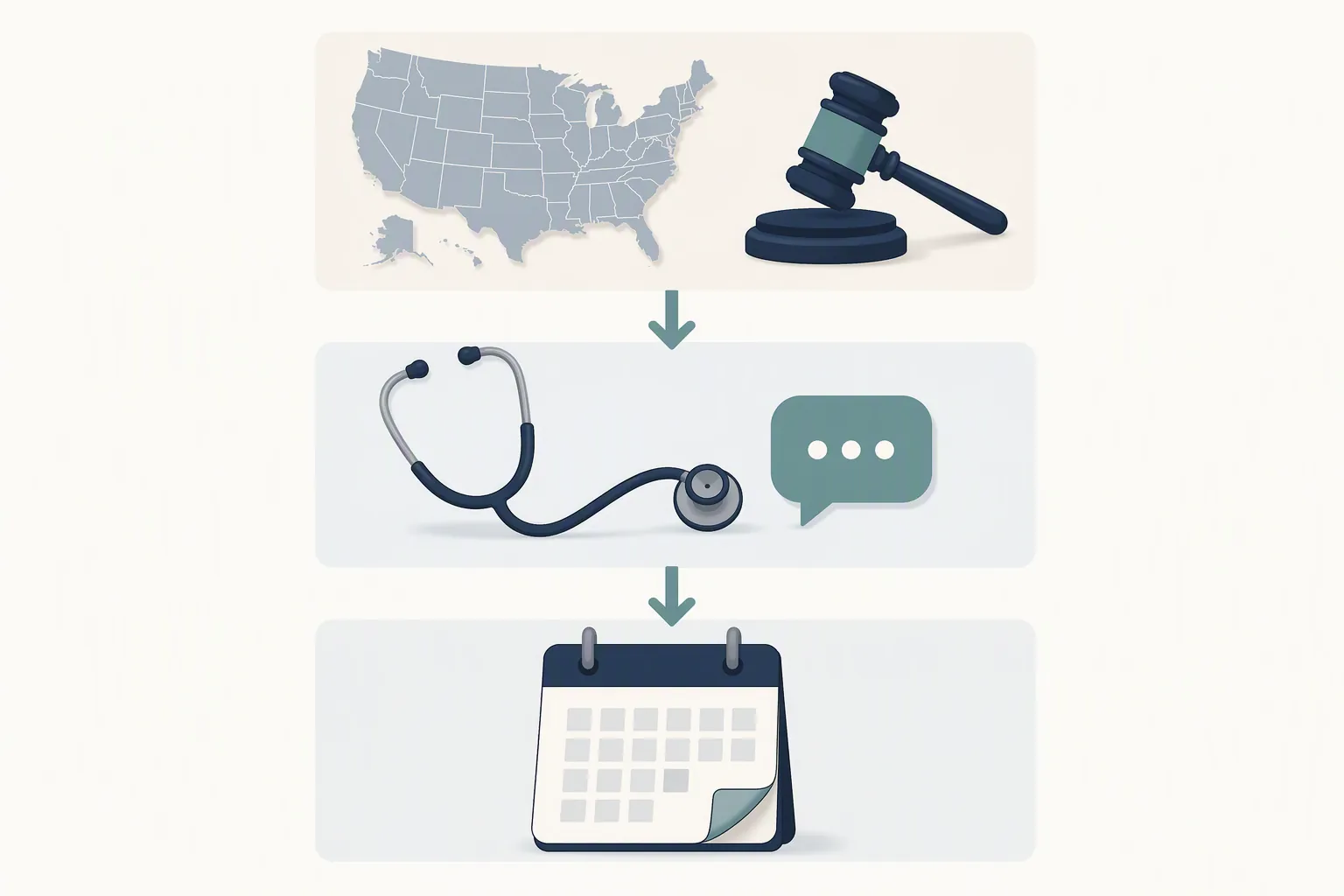
A compliance team does not experience this as a theory map. It receives a character profile, instruction set, marketing page, user complaint, or app-store screenshot. Someone then has to decide who owns the first escalation: legal, clinical governance, trust and safety, regulatory, or a credentialing unit.
Start with the claimed jurisdictional hook. If the bot says it is a Pennsylvania psychiatrist, gives a Pennsylvania-style license number, or invites users to rely on psychiatric credentials in Pennsylvania, the licensing-board question comes before the general AI-policy question. The verification process looks much like the human-side chain used when a real clinician’s license is checked, suspended, or revoked; the site’s licensed-claims verification companion and the Amy Mazza MacIntyre license record are useful comparisons because both real and fabricated credentials fail at the same board lookup step.
Then test the function. A general-purpose companion bot that claims to be a psychiatrist may trigger a licensing-board theory even if it avoids formal diagnostic language. A bot that recommends a diagnosis, treatment pathway, medication decision, or care plan raises a different federal question. Cooley’s analysis points to the FDA software-as-medical-device framework and the intended-use rule at 21 C.F.R. § 801.4, under which a chatbot performing diagnostic or treatment functions could be treated as a device; that is an attributed source analysis, not a court holding in the Pennsylvania case. [4]
Disclaimers sit in the same unsettled space. Legal analyses of the Pennsylvania complaint and the FDA theory warn that saying “this is not a human” or “this is not medical advice” may not control if the product’s presentation and intended use point the other way. That should not be overstated into a national rule that disclaimers always fail. The narrower, better-supported conclusion is that a disclaimer is not a substitute for title control, function control, and jurisdictional review. [4][5]
A practical order of review
- Identify the state connection first: user location, marketing target, claimed license jurisdiction, and where the operator is responding to complaints.
- Search for regulated titles and credential claims: psychiatrist, physician, doctor, therapist, nurse, licensed, board-certified, degree history, license number, and years of practice.
- Separate identity from function: a false professional identity is one issue; diagnosis, treatment, or therapy delivery is another.
- Map current law before future law: enacted and effective controls first, then enacted-but-future-effective controls, then advanced bills.
- Assign the escalation path: licensing-board risk, direct chatbot-statute risk, FDA intended-use review, consumer-protection review, or product-liability preservation.
The Federation of State Medical Boards’ May 2026 workgroup belongs in that queue as a signal, not as binding law. Its stated purpose is to develop recommendations and model guidelines for state medical boards on AI in medicine. That may make board expectations more consistent over time, but it does not suspend existing unauthorized-practice statutes while boards wait for model language. [4]
What the Pennsylvania allegations add to the tracker
The Pennsylvania complaint is most useful for the professional-posture facts, not for the novelty of a chatbot conversation. The Commonwealth alleges that a Character.AI bot called “Emilie” presented as a psychiatrist, claimed an Imperial College London credential, claimed seven years of practice, and used a license number reported in legal analyses as PS306189. The same legal-tracker materials report roughly 45,500 user interactions by mid-April 2026, with Dechert describing the count as over 45,000. Those remain allegations and reported complaint facts, not adjudicated findings. [5][7]
Those details explain why a board clerk, hospital credentialing office, or platform compliance analyst would not treat the case as only a content-moderation incident. A claimed license number is not a mood. A claimed medical degree is not a personality trait. They are verification objects. Once a product supplies them, someone can check the issuing board, compare the name and number, and decide whether the representation is real, expired, mismatched, nonexistent, or outside the product’s permission to use.
The related AI-health-advice and chatbot-liability records on this site sit beside that issue, not inside it. Product-liability and health-advice theories are tracked separately in the ChatGPT medical advice lawsuits, Winters v. OpenAI liability lawsuit, and ChatGPT health liability suits records. The Pennsylvania board case is narrower: it asks whether existing medical-licensure machinery can be used when an AI system allegedly holds itself out as a licensed clinician.
The compliance answer
Pennsylvania shows that AI-specific law is not required for a state medical board to act against an AI tool allegedly posing as a licensed psychiatrist. Direct chatbot statutes are arriving, but unevenly: some target healthcare titles, some therapy, some nursing titles, some conversational-AI safety, and some are not yet effective. The FDA path remains open where diagnostic or treatment functions are part of the intended use, but the available materials support that as a source analysis rather than a settled holding.
So the operational answer to “who polices it?” is not a single agency name. It is jurisdiction first, function second, date third. A tracker row that loses that order will make the law look cleaner than it is.
References
- Pennsylvania State Board of Medicine v. Character Technologies, Inc. Petition for Review in the Nature of a Complaint Addressed to the Court’s Original Jurisdiction, Pennsylvania State Board of Medicine, May 1, 2026
- Shapiro Administration Sues Character.AI Over Fake Medical Claim, Commonwealth of Pennsylvania, May 5, 2026
- Pennsylvania sues Character.AI over chatbot medical advice, NPR, May 5, 2026
- AI Chatbots’ Medical Claims Draw Regulatory Scrutiny, Cooley, June 25, 2026
- Pennsylvania Targets AI Chatbot for the Unauthorized Practice of Medicine, Troutman Pepper Locke
- “Emilie” Is Not a Psychiatrist: Pennsylvania Board of Medicine Alleges Unlawful Practice of Medicine by an AI Chatbot, Epstein Becker Green
- AI in Litigation Series: Pennsylvania Sues Character.AI Alleging Unlicensed Practice of Medicine, Norton Rose Fulbright
Related records
Tool profile
How Meta's AI Spending Reshapes Law Firm ProfitabilityGoverning regulation
Browse the obligations tracker →Preventive workflow
Browse verification workflows →
Report a correction or tip
Spotted an outdated figure, a misstated fact, or a ruling this case record should reflect? Public comments are disabled for this content given the professional cost of a misreported case outcome, penalty amount, or rule text — use the structured correction channel instead.
Report a correction or tip for this record →