
Four Ethical Duties for Lawyers Using Artificial Intelligence
This article provides a jurisdiction-specific compliance roadmap for law firms to translate ABA Formal Opinion 512 and emerging state bar guidance into enforceable policies on AI use, including verification protocols, disclosure templates, and training requirements to mitigate professional liability risk.
- Hallucination rate
- Not measured / undisclosed
The practical question for a lawyer using artificial intelligence in 2026 is no longer whether legal AI tools are interesting enough to test. It is whether the firm can show, after a filing, client email, invoice, or privilege dispute, that a lawyer used the tool under rules the firm actually enforced.
ABA Formal Opinion 512, issued on July 29, 2024, gives that question a professional-responsibility frame: lawyers using generative AI must still satisfy duties of competence, confidentiality, communication, and reasonable fees under the Model Rules.[1] That sounds familiar until it is translated into workflow. “Verify outputs” is not a control. A control says who verifies, what source is checked, when review occurs, what may not be delegated, how client information is protected, whether disclosure is required, and where the record is kept.
The gap between approval and control is still wide. The 8am Legal Industry Report data says 54% of firms provide no AI training, 43% have no written AI policy, and only 9% have an enforced written policy.[2] Those figures are troubling because the risk is not confined to lawyers who use public chatbots recklessly. The risk sits in ordinary work: a litigation associate summarizing cases, a paralegal drafting a chronology, a partner sending a client a cost estimate based on AI-assisted review, or legal operations approving a new intake tool without a confidentiality review.

Start With the Four Duties, Not the Tool
Formal Opinion 512 does not create a special AI ethics code. It applies existing duties to a new category of tools. That matters because a firm policy built around brand names will be obsolete quickly, while a policy built around legal duties can survive vendor changes, model updates, and new court orders.
| Duty | Operational Question | Firm Control |
|---|---|---|
| Competence | Can the lawyer understand the AI tool’s benefits and risks well enough to use it responsibly? | Task-risk tiers, source-checking rules, prohibited uses, and verification records |
| Confidentiality | Will client information be exposed to systems, vendors, or training uses that violate Rule 1.6 obligations? | Approved-tool list, vendor review, data-entry restrictions, and incident escalation |
| Communication | Does the client need notice or consent before AI is used in the representation? | Disclosure triggers, consent language, jurisdiction checks, and court-order review |
| Reasonable fees | Is the client being charged fairly for AI-assisted work? | Billing rules, time-entry guidance, client-matter coding, and partner review |
The table is intentionally plain. Firms do not need a manifesto before they need a working control environment. The written policy should make it possible for a supervising lawyer, risk officer, or claims counsel to reconstruct how AI was used on a matter without relying on memory.
Competence Means a Verification Protocol
Under Formal Opinion 512, competence includes understanding the benefits and risks of relevant AI technology.[1] In practice, the competence duty should become a verification protocol. Lawyers do not have to become machine-learning engineers, but they must know enough to recognize when an output requires independent legal judgment, source checking, or rejection.
A useful protocol separates low-risk productivity assistance from legal analysis that may affect a client, court, transaction, or invoice. A spelling suggestion, meeting agenda, or generic formatting edit may not need the same review as a brief section, contract clause, research memo, privilege log, damages summary, or client recommendation. The policy should say that distinction explicitly instead of leaving every user to improvise.
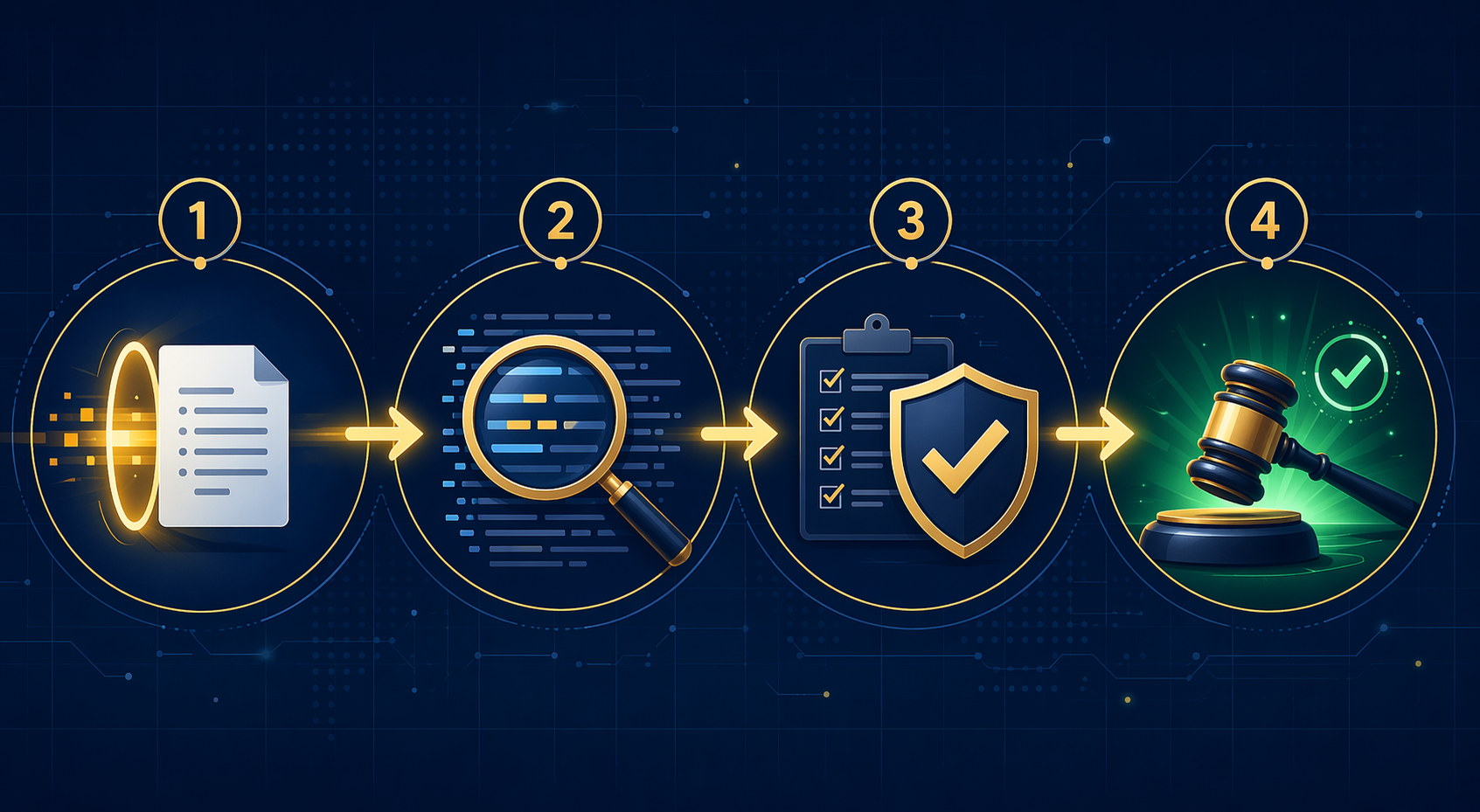
For legal research and drafting, the protocol should require the lawyer to check every cited authority against an authoritative source before the work is filed, sent to a client, or relied on in advice. That means checking the existence of the authority, the quoted language, the proposition for which it is cited, current validity, jurisdiction, and procedural posture. If the AI tool generated a case name, quotation, statute, regulation, rule, or factual assertion, the lawyer should treat it as unverified until the source is reviewed outside the AI output.
The record does not need to be theatrical. A matter note, checklist, research log, or document-management entry can be enough if it identifies the AI-assisted work product, the lawyer responsible for review, the sources checked, the date of review, and any correction made before use. The point is not to create busywork. The point is to avoid a later file where everyone agrees verification was required but no one can show who performed it.
- Forbid filing or sending AI-generated legal citations unless each citation has been checked in an authoritative legal database or official source.
- Require partner or designated senior-lawyer review before AI-assisted analysis is used for dispositive motions, expert work, opinion letters, settlement recommendations, or client advice on material legal risk.
- Require users to document AI involvement when the output affects legal analysis, factual chronology, privilege calls, contract drafting, or billing.
- Treat generated quotations, case summaries, statutory language, and factual assertions as unverified until confirmed outside the AI system.
- Ban AI delegation for decisions that require a lawyer’s personal professional judgment, including final legal advice, strategic recommendations, and settlement authority.
The last point is where state guidance becomes useful. Florida’s 2024 ethics opinion analogized AI work product to work delegated to a paralegal: it must be reviewed, and the lawyer may not delegate tasks that require the lawyer’s personal judgment.[3] That analogy is not perfect, because AI systems do not have professional training, loyalty, or accountability. But as a supervision rule, it is practical: no AI output moves into client advice or court submission without lawyer review.
Sanction cases show what failed verification looks like from the bench. In Mata v. Avianca, lawyers were sanctioned $5,000 after submitting fabricated ChatGPT-generated cases in the Southern District of New York in June 2023.[4] In Gauthier v. Goodyear, the reported sanction was $2,000 plus mandatory continuing legal education in 2024.[5] These cases should not be treated as colorful folklore about careless lawyers. They are evidence that courts punish the absence of a reliable checking process.
For readers tracking the growing sanction record, a separate AI citation hallucination court-sanctions registry is the better place for case-by-case detail. The operational lesson for policy purposes is narrower and more durable: a lawyer must verify generated legal authority before relying on it.
Artificial Lawyer’s 2026 predictions article cites Clearbrief CEO Jacqueline Schafer for a reported acceleration from 120 total hallucination-related cases between April 2023 and May 2025 to 660 by December 2025, with 4–5 new cases per day.[6] Those figures should be verified against Clearbrief’s original methodology before a firm treats them as a settled dataset. Even with that caveat, the direction of concern is clear enough for governance: verification is no longer an optional best practice.
Confidentiality Requires a Data-Use Rule
Formal Opinion 512 ties generative AI use to Rule 1.6 confidentiality duties.[1] The risk is not merely that a lawyer might paste a client name into a public chatbot. The harder problem is that many lawyers do not know whether a tool stores prompts, trains on inputs, permits vendor review, shares information across tenants, or allows firm administrators to retrieve matter-level activity.
A firm policy should therefore start with a simple prohibition: users may not enter confidential, privileged, personal, or client-identifying information into any AI system unless the system has been approved for that category of data. Approval should come after legal, security, privacy, and procurement review, not after a practice group decides the tool is useful.
- Classify AI tools by permitted data: public-only, internal non-client, client-confidential, privileged, personal data, or prohibited.
- Require vendor review for retention, training, access, audit logs, security controls, confidentiality terms, subcontractors, and data-location issues.
- Block use of open or unapproved AI systems for client facts, documents, transcripts, discovery material, settlement positions, nonpublic deal terms, or privileged communications.
- Require matter-team approval before uploading client documents even to approved AI tools when the matter has special confidentiality terms, protective orders, or regulatory restrictions.
- Create an escalation path for accidental disclosure, including notice to risk management, information security, and the responsible lawyer.
The approved-tool list should not be a marketing page. It should tell users what they may put into each system. A tool approved for public legal research may not be approved for uploading merger documents. A tool approved for internal knowledge management may not be approved for protected health information or material subject to a protective order. Those distinctions are the difference between a usable policy and a general encouragement to be careful.
Firms should also decide whether prompts and outputs become part of the client file, the work-product record, a technology log, or no retained record at all. There is no single answer for every matter type, but the policy should not leave retention to each user’s browser history. If the firm later needs to defend a filing, investigate a data event, or respond to a client question, it will need more than a memory that someone used an approved platform.
Communication Turns on Disclosure Triggers
Formal Opinion 512 connects AI use to the lawyer’s duty to communicate with the client.[1] The safest firm policy will not say “disclose AI use when appropriate” and stop there. It will define events that require the matter lawyer to consider notice, consent, engagement-letter language, or court-specific disclosure.
A disclosure trigger is not the same thing as a universal confession that a lawyer used technology. Many ordinary uses of AI may not be material to the representation. But several categories deserve mandatory review: uploading client confidential information to an AI vendor, using AI to perform a substantive task the client would reasonably expect a lawyer to perform, relying on AI in a way that materially affects strategy or advice, using AI under a client’s outside-counsel guidelines, or appearing in a court with an AI disclosure standing order.
State guidance is no longer isolated. Bloomberg Law’s 50-state survey reports that 16 states have addressed AI ethics and that all nine issued opinions discussed supervisory duties.[7] That does not mean every jurisdiction imposes the same client-disclosure rule. It means the firm’s policy must have a jurisdiction check built into the workflow, especially for multistate litigation, national clients, and matters governed by outside-counsel guidelines.
Court standing orders need their own check. Courts in New York’s Commercial Division and other jurisdictions are developing AI disclosure requirements, and that landscape remains in flux. A firm cannot assume that compliance with a state bar opinion satisfies the judge’s order in a specific case. The docketing or litigation-support workflow should include an AI-order review when a new matter is opened, when a case is assigned to a judge, and before a filing is submitted.
For client-facing language, firms should keep a short clause available rather than asking every partner to draft from scratch. A useful template identifies the category of AI tool, the purpose of use, whether client confidential information will be processed, the review that a lawyer will perform, and whether the client may object or impose conditions. That language should be adjusted for the jurisdiction, matter type, client guidelines, and the tool’s actual data-use terms.
Sample disclosure concept for adaptation:

Our firm may use approved technology tools, including artificial intelligence tools, to assist with tasks such as document organization, research support, drafting support, or review workflows. We do not rely on AI-generated legal analysis without lawyer review. We will not submit client confidential information to an AI system unless the system has been approved under firm confidentiality and security procedures and the use is consistent with applicable professional obligations, court orders, and client instructions.
That sample is not a substitute for jurisdiction-specific advice. It is a drafting starting point that forces the right questions: what tool, what task, what data, what lawyer review, what client expectation, and what court requirement.
Reasonable Fees Need Their Own Billing Rule
The fee issue is easy to understate because it sounds less dramatic than hallucinated cases or confidentiality failures. Formal Opinion 512 nevertheless connects AI use to Rule 1.5 and reasonable fees.[1] If an AI tool substantially reduces the time needed for a task, the firm needs a billing rule before lawyers begin making inconsistent time-entry decisions across matters.
The central billing problem is not whether a lawyer may charge for judgment. Of course a lawyer may charge for legal judgment, supervision, strategy, and review. The problem is charging clients as if a lawyer manually performed hours of work that an AI-assisted workflow compressed, or separately passing through AI tool costs without explaining what the client is paying for. A fee policy should distinguish lawyer time, technology charges, vendor costs, flat-fee assumptions, and value-based arrangements.
- Require time entries to describe the lawyer task performed, not merely the AI output generated.
- Prohibit billing for saved time as though it were actually spent.
- Define when AI platform costs are overhead, when they may be passed through, and what client approval is required.
- Require partner review for AI-assisted work billed under alternative-fee, contingency, or capped-fee arrangements where assumptions may change.
- Train lawyers to record review, verification, analysis, and revision time separately from automated generation.
A deeper treatment belongs in a dedicated generative AI billing policy guide. For ethics-policy purposes, the immediate need is to prevent the firm from treating efficiency gains as invisible. If AI changes how work is performed, the billing policy should say how that change is reflected in timekeeping, client communication, and invoice review.
What the Written Policy Should Actually Contain
The written AI policy should be short enough for lawyers to use and specific enough for the firm to enforce. A 40-page policy that no one reads is not meaningfully better than no policy. The core document can be concise if it is supported by an approved-tool list, task-risk chart, verification checklist, disclosure template, billing guidance, and training record.
A companion one-page AI ethics policy template can help with drafting. The firm-level version should still be customized to practice areas, jurisdictions, client guidelines, and the tools actually approved for use.
| Policy Component | Minimum Content |
|---|---|
| Scope | Who is covered, which tools are covered, and whether personal accounts are prohibited for firm work |
| Approved tools | Permitted tools, permitted data types, prohibited tools, and approval owner |
| Task-risk tiers | Low-risk uses, review-required uses, partner-approval uses, and prohibited uses |
| Verification | Source-checking requirements, reviewer identity, documentation method, and filing/client-communication checkpoints |
| Confidentiality | Data-entry restrictions, vendor-review standards, privileged-material rules, and incident escalation |
| Client communication | Disclosure triggers, consent templates, outside-counsel guideline review, and court-order checks |
| Fees | Billing rules, pass-through cost treatment, time-entry standards, and invoice review |
| Training | Required training, refresher schedule, practice-specific modules, and access consequences for noncompletion |
| Monitoring | Audit method, usage logs, exception process, policy owner, and update schedule |
The policy should also say what happens when someone violates it. If a lawyer uses an unapproved AI tool with client material, misses required training, or files AI-assisted research without source verification, the response cannot be invented after the fact. At minimum, the policy should require escalation to the responsible partner, risk management, and, where appropriate, information security or general counsel.
Training Is an Access Control, Not a Webinar
Training should be tied to tool access. If the firm allows users into approved AI systems before they understand confidentiality limits, verification duties, and billing rules, the training program is decorative. Access should depend on completing a baseline module, and higher-risk use should require practice-specific training.
The baseline module should cover the firm policy, approved-tool list, prohibited uses, prompt confidentiality, hallucination risk, source-checking steps, disclosure triggers, billing rules, and incident reporting. Litigation teams need additional training on citation verification, court orders, expert materials, discovery, and privilege. Transactional teams need training on contract drafting, due diligence, deal confidentiality, and client consent. Legal operations and staff need training because they often handle the workflows where AI first becomes routine.
For practical task mapping, a task-risk guide for legal AI use can help separate administrative assistance from work requiring independent lawyer judgment. The firm’s training should turn that distinction into examples from its own matters, not abstract warnings about AI in general.
- New users complete baseline AI ethics training before receiving access to approved systems.
- Practice groups complete tailored modules for litigation, transactions, regulatory, investigations, employment, tax, or other high-use areas.
- Annual refreshers include new state-bar guidance, court orders, vendor changes, and sanction examples.
- Supervising lawyers receive separate training on reviewing AI-assisted work by associates, paralegals, and staff.
- Training completion is tracked, and failure to complete required training suspends access to approved AI tools.
Maintenance: Who Owns the System After Launch
The first version of an AI policy is not the hard part. The hard part is maintaining it when state opinions, court orders, client guidelines, vendors, and internal workflows change. Ownership should be assigned before launch. A governance committee can approve policy changes, but one named role should be responsible for keeping the control system current.
A workable ownership model assigns ethics or risk counsel to professional-responsibility updates, information security to vendor and data controls, legal operations to usage and workflow records, practice-group leaders to task-specific rules, and finance to billing controls. No single department can carry the whole program. But every control should have a named owner.
| Maintenance Task | Responsible Owner |
|---|---|
| Track ABA, state-bar, and jurisdiction-specific ethics guidance | Ethics counsel or risk partner |
| Review court standing orders and judge-specific AI rules | Litigation support, docketing, and supervising litigation partner |
| Approve AI tools and permitted data categories | Information security, privacy, procurement, and legal |
| Audit verification records and policy compliance | Risk management or internal audit |
| Maintain training completion and access controls | Learning and development with IT administration |
| Review AI-related billing practices | Finance, billing partner, and general counsel or risk counsel |
Jurisdiction updates deserve particular discipline. Bloomberg Law’s survey is useful for spotting that state guidance is expanding, but a firm should not rely on a secondary survey as its final authority for a specific jurisdiction.[7] The safer process is to maintain a jurisdiction tracker that links to direct bar opinions, court rules, and standing orders. A jurisdiction-specific tracker, such as the Texas State Bar AI ethics opinion entry, can serve as a model for how that record should be organized.
Audits should test behavior, not just policy existence. Pull a sample of AI-assisted matters. Check whether the tool was approved, whether the data entered was permitted, whether legal authorities were verified, whether disclosure was considered, whether billing reflected the actual work performed, and whether the users had completed required training. If the answer is “we think so,” the control did not leave enough evidence.
A more developed law firm AI governance policy can add procurement, security, privacy, records, and audit architecture. The ethics roadmap should remain anchored in the professional duties that create the lawyer’s exposure.
The Defensible Posture
A law firm does not eliminate AI risk by banning vague conduct or trusting each lawyer to exercise discretion without a system around that discretion. It reduces professional-liability exposure by writing rules that can be followed, training people before they use the tools, documenting verification before reliance, and checking the jurisdiction-specific bar and court requirements that apply to the matter.
This is a compliance posture, not legal advice. Before treating any roadmap as complete, firms should consult the governing rules, bar opinions, court orders, client guidelines, and internal risk counsel for the jurisdictions and matters they actually handle.
References
- ABA issues first ethics guidance on a lawyer’s use of AI tools, American Bar Association, July 29, 2024.
- 8am Legal Industry Report, 8am.
- Florida Bar Ethics Opinion 24-1, The Florida Bar, 2024.
- Mata v. Avianca, Inc. Sanctions Order, U.S. District Court for the Southern District of New York, June 2023.
- Gauthier v. Goodyear sanctions materials, CourtListener, 2024.
- Artificial Lawyer Predictions 2026, Artificial Lawyer, January 8, 2026.
- AI in Legal Practice Explained, Bloomberg Law.
Chronological incident history
No sanction cases have named this tool in the tracked record set to date. This does not imply the tool is safe — see Risk Digest for ongoing monitoring.
← Compare peer toolsReport a correction or tip
Spotted an outdated figure, a misstated fact, or a ruling this tool profile should reflect? Public comments are disabled for this content given the professional cost of a misreported case outcome, penalty amount, or rule text — use the structured correction channel instead.
Report a correction or tip for this record →