
Which Legal Tasks Can ChatGPT Handle Safely
This guide breaks down common legal tasks into three risk tiers — green, yellow, and red — so you can identify which ones are safe for ChatGPT, which require purpose-built legal AI tools, and which should never be delegated to a general-purpose LLM. It is grounded in ABA Formal Opinion 512, documented sanctions, and practitioner evidence.
For a legal team, the useful question is not whether ChatGPT can write like a lawyer. It plainly can produce polished legal-looking prose. The question is which tasks can pass through a general-purpose chatbot without exposing client confidences, misstating current law, or creating a filing that someone else has to repair after the deadline has moved from “soon” to “now.”
A workable policy for ChatGPT for lawyers starts with three gates: Does the prompt include confidential or privileged information? Does the answer require current, jurisdiction-specific legal authority? Will the output leave the office as legal advice, professional work product, or a court filing? If the answer to all three is no, ChatGPT may be useful. If one answer is yes, the task needs stricter controls, a legal-specific tool, or no delegation at all.
This article is an operational guide, not legal advice. Local rules, client requirements, court orders, and firm policies can impose stricter limits than the general framework here.
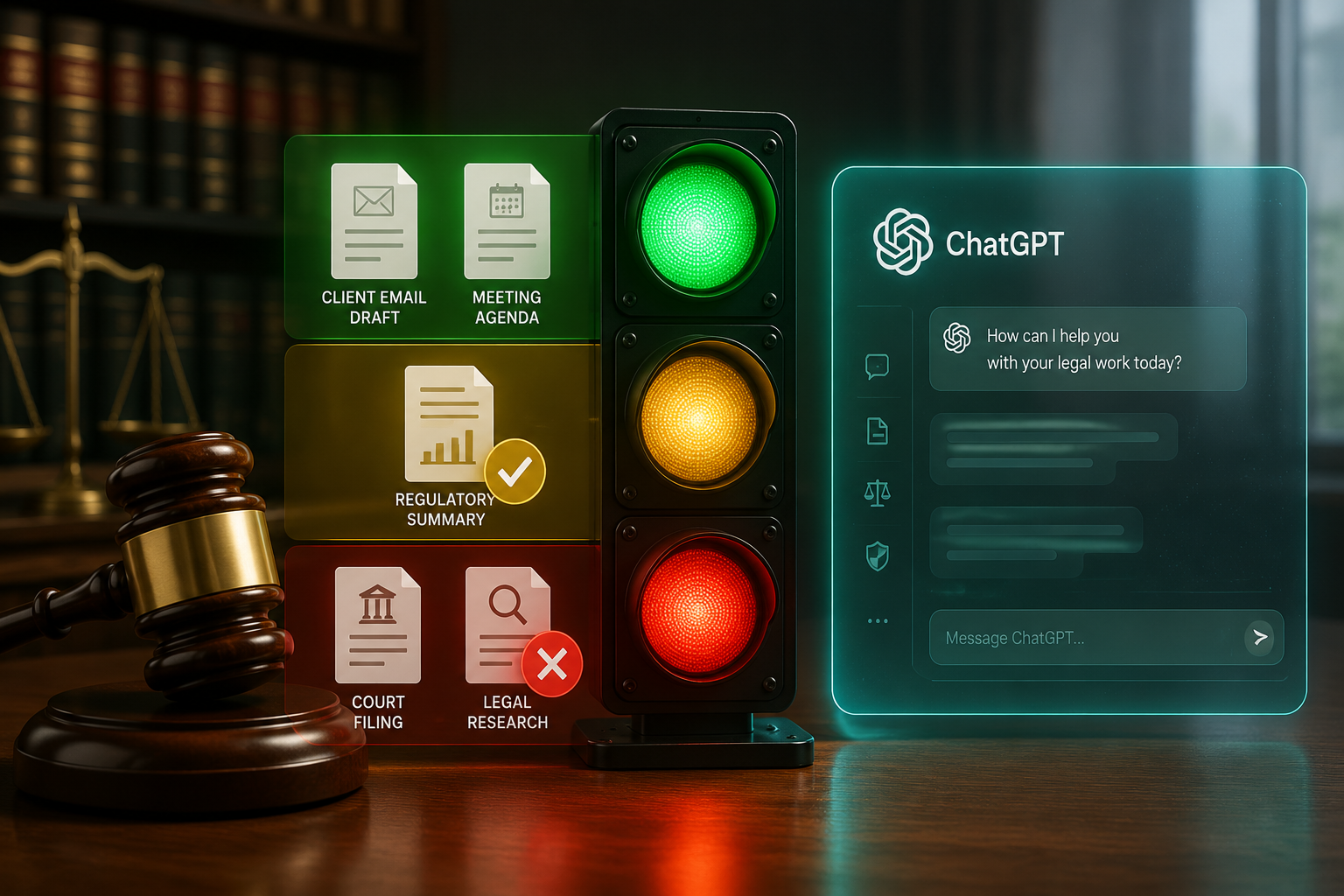
The Green, Yellow, And Red Task Matrix
| Tier | Typical Tasks | Conditions | Usual Tool Choice |
|---|---|---|---|
| Green | Non-confidential client explainers, meeting agendas, tone edits, first-cut outlines, plain-language summaries of public materials | No client secrets, no legal conclusion, no current citation dependency, human review before use | General-purpose ChatGPT may be acceptable |
| Yellow | Internal memo structure, public regulatory guidance summaries, deposition note organization, contract-clause issue spotting with sanitized text | Requires lawyer review, source checking, confidentiality screening, and sometimes enterprise or legal-specific controls | ChatGPT only with guardrails; purpose-built legal AI often better |
| Red | Court filings, legal research, citation-dependent briefs, confidential matter work, jurisdiction-specific legal advice, client document analysis in public ChatGPT | High risk to confidentiality, competence, candor, privilege, or docket compliance | Do not delegate to general-purpose ChatGPT |
The tiers are not a rating of whether ChatGPT sounds competent. They are a rating of the cleanup burden if it is wrong, the confidentiality risk if the prompt is retained or used outside the firm’s control, and the professional consequence if the output becomes advice or a filing.
Green Tasks: Language Work With No Client Secrets And No Legal Authority
Green tasks are the narrow but genuinely useful category. They ask ChatGPT to improve communication, structure, or readability without asking it to decide the law. The ABA’s 2026 practical-use examples put first-cut engagement letters, client explainer emails, meeting agendas, deposition note outlines, regulatory guidance summaries, and tone-adjusted messaging in the zone of possible use, while also warning against confidential matters without enterprise controls, jurisdiction-specific legal analysis without independent verification, and court-mandated AI disclosure situations.[1]
A safe prompt in this tier strips out names, dates, deal terms, medical facts, litigation strategy, settlement posture, witness details, and anything else that could identify a client or matter. “Rewrite this generic explanation of the discovery process for a non-lawyer client” is a different task from “tell this client whether these facts support sanctions in this judge’s court.” The first is communications drafting. The second is legal judgment.
- Acceptable: turn a lawyer’s rough, non-confidential bullet points into a plain-English explainer.
- Acceptable: create a meeting agenda from non-sensitive topics already cleared for internal circulation.
- Acceptable: make a dense public agency notice easier to read, as long as a person checks the original source.
- Not green: draft advice applying law to a client’s facts.
- Not green: summarize a confidential transcript, contract, pleading, or investigation file in public ChatGPT.
Vendor prompt libraries from Clio, Spellbook, Juro, and Sirion show why lawyers are tempted to use ChatGPT for these jobs: prompts for client communications, document outlines, contract summaries, and internal drafting can reduce the blank-page problem.[2][3][4][5] Those examples are useful as drafting patterns, not as permission slips. The prompt is only as safe as the facts placed inside it and the review process after it.
Yellow Tasks: Useful, But Only With Review And Tool Controls
Yellow tasks are where many legal teams get sloppy. They look administrative at first, but one extra sentence can turn them into legal analysis. Summarizing public regulatory guidance may be reasonable if the lawyer compares the summary against the published guidance. Asking ChatGPT to explain how that guidance applies to a client’s operations in a particular state is no longer a simple summary task.
The practical dividing line is whether the model is being asked to organize material the lawyer already controls, or to supply legal authority the lawyer has not independently verified. A public-source summary with citations checked against the source can be a time saver. A memo that relies on ChatGPT to identify controlling cases, rank authorities, or determine whether precedent is still good law belongs in a more controlled workflow.
This is also where purpose-built legal AI often becomes the more responsible choice. Legal research and citation-dependent drafting require source grounding, jurisdiction filters, citator signals, audit trails, and a review record. If the team is still deciding how to govern those workflows, the next document to read is Closing the Governance Gap for AI Legal Research.
| Yellow Task | Why It Is Not Automatically Green | Minimum Control |
|---|---|---|
| Internal memo outline | The outline can quietly embed legal assumptions | Lawyer supplies the legal standard and reviews every issue category |
| Regulatory guidance summary | The source may be current, superseded, or incomplete | Compare against the official public source before relying on it |
| Deposition note organization | Notes may contain privileged strategy or confidential witness facts | Sanitize or use approved enterprise controls |
| Contract clause issue spotting | Client documents and negotiation positions may be confidential | Use a legal-specific or enterprise-controlled system for real documents |
A yellow task should have an owner. “Reviewed by counsel” is not a meaningful control unless someone knows what they are checking: source accuracy, omitted exceptions, jurisdiction, privilege, tone, client-specific assumptions, and whether the output should be saved to the matter file.
Red Tasks: Do Not Hand These To General-Purpose ChatGPT
Red tasks are not “use with caution” tasks. They are tasks where public, general-purpose ChatGPT lacks the controls a legal professional needs before the work can be trusted or ethically handled. The list starts with confidential client information, legal research, jurisdiction-specific analysis, and anything that may become a court filing.
Confidential Matter Work
ABA Formal Opinion 512 matters because it does not treat generative AI as a professional-responsibility holiday. The opinion confirms that duties of competence, confidentiality, communication, reasonable fees, supervision, and nonlawyer assistance continue to apply when lawyers use generative AI tools.[6] For a working team, that means the same confidentiality analysis that applies to vendors, databases, contract attorneys, and document platforms has to happen before anyone pastes matter facts into a chatbot.
The confidentiality problem is sharper with non-API public tools. The NBI analysis of OpenAI terms points to Section 3(c) concerns that non-API content may be used to improve services, which creates a Model Rule 1.6 issue if lawyers input confidential client information.[7] Because terms can change, a firm should verify the current OpenAI terms directly before adopting any policy. But the operational default is straightforward: do not put confidential client information into public ChatGPT unless the firm has confirmed the tool’s contractual, technical, and ethical controls.
Legal Research And Citation-Dependent Drafting
General-purpose ChatGPT is not a citator. It does not KeyCite or Shepardize. It cannot reliably confirm whether a case remains good law, whether a statute has been amended, or whether a court in the relevant jurisdiction treats a rule differently. Spellbook and Sirion both warn that ChatGPT can produce plausible-looking citations that do not exist.[3][5]
That limitation is not academic. In Mata v. Avianca, lawyers were sanctioned after filing briefs that included fabricated cases generated through ChatGPT; the court imposed $5,000 sanctions on each attorney involved.[3] The lesson is not merely “check the cases.” It is that a workflow that allows fabricated authority to travel from chatbot to draft to filing without primary-source verification is already broken.
The enforcement pattern has continued. Our AI hallucination sanctions tracker reports at least $145,000 in monetary sanctions in Q1 2026 alone and 1,696 global hallucination cases tracked as of July 2026. Those numbers are not a prediction of what will happen in every court. They are enough to make citation-dependent filing work a red-line category for general-purpose ChatGPT.
Court Filings And Judge-Specific AI Orders
Court filings deserve their own red label because the harm does not stay inside the firm. A false citation, misstated record reference, or undisclosed AI use can affect the court, opposing counsel, the client, and the lawyer’s credibility. Some judges have issued standing orders addressing AI use, and secondary summaries identify orders associated with judges including Brantley Starr, Michael Baylson, Gabriel Fuentes, and Nina Wang.[3] Before relying on any specific order’s wording, a lawyer should verify the primary order on the court’s own site or docket.
State guidance also varies. ABA Formal Opinion 512 is influential, but it is not binding law in every jurisdiction. Available materials discuss approaches in states including California, Florida, Michigan, New York, Texas, and New Jersey, with New Jersey’s 2024 AI guidance described as preliminary in the cited secondary source.[3][8] That is not a substitute for a 50-state survey. It is a reminder that a firm policy should route jurisdiction-specific AI questions to current local authority, not to a generalized national assumption.
Where Adoption Data Helps, And Where It Does Not
Adoption numbers explain why this issue is now operational rather than theoretical. Juro’s 2023 Tech GC Report found that 55% of surveyed legal professionals already used or intended to use generative AI.[4] A 2023 Goldman Sachs estimate, discussed in broader legal-industry analysis, suggested that about 44% of legal tasks could be automated.[9] Both figures are dated by mid-2026, and neither tells a firm whether public ChatGPT is safe for a particular matter.
The adoption point should not be overread. “Lawyers are using generative AI” is not the same claim as “general-purpose ChatGPT is effective for legal research,” and “some tasks may be automatable” is not the same claim as “a lawyer can delegate legal judgment.” Market enthusiasm is context. The risk tier is the decision tool.
When To Upgrade From ChatGPT To A Legal AI Tool
A task should move out of public ChatGPT when the team needs confidentiality controls, source grounding, legal databases, citator integration, matter-level auditability, or jurisdiction-specific reasoning. This is not about buying a more impressive chatbot. It is about matching the tool to the professional duty.
- Legal research: use systems that connect answers to legal sources and support independent verification.
- Confidential client workflows: use tools with approved contractual, security, retention, and access controls.
- Contract review involving client documents: use platforms designed for document handling, confidentiality, and review trails.
- Citation-dependent drafting: use tools that preserve source links and require primary-source review before filing.
- Repeatable firm workflows: use systems that administrators can govern, monitor, and document.
For teams still comparing categories, Which Free AI Legal Assistants Can You Safely Use? is a useful intermediate step, while How to Choose AI Tools for Your Law Firm in 2026 is the better next read once the firm is comparing enterprise controls, legal research capabilities, and implementation requirements.
A Practical Intake Rule For Every Prompt
The easiest policy to enforce is the one a lawyer, paralegal, or junior associate can apply before the prompt is pasted. It should not require a committee meeting. It should stop the dangerous uses early and leave room for low-risk drafting work.
| Question | If Yes | Result |
|---|---|---|
| Does the prompt contain confidential, privileged, or identifying client information? | Do not use public ChatGPT | Use approved enterprise or legal-specific controls, or do the work manually |
| Does the answer require current law, case status, citations, or jurisdiction-specific analysis? | Do not rely on ChatGPT as the source | Use legal research tools and primary-source verification |
| Will the output become advice, work product, a client deliverable, or a court filing? | Require lawyer ownership and documented review | Escalate to yellow or red depending on confidentiality and citation needs |
| Is the task only language cleanup, structure, or tone using non-confidential material? | Proceed with review | Green, if no legal conclusion is added |
The firm’s policy should also say who is responsible for verification. If a partner asks for “a quick AI draft,” someone still has to check citations, local rules, client facts, privilege issues, and filing requirements. Formal Opinion 512’s supervision duties make that allocation hard to avoid.[6] A fuller implementation model belongs in an ABA Formal Opinion 512 compliance playbook, not in an unwritten habit passed around by screenshots.
For a broader tool overview, What Lawyers Must Know Before Using ChatGPT covers the baseline capabilities and limits. For firmwide rollout, Implement AI in Your Law Firm with a Workflow-Guided Framework is the better place to turn the tiering rule into intake forms, approvals, training, and audit records.
ChatGPT is acceptable for bounded, non-confidential language work where a legal professional reviews the result and no legal authority is being supplied by the model. Purpose-built legal AI is needed where confidentiality, source grounding, jurisdiction, and auditability matter. General-purpose ChatGPT should not be delegated work that can expose client confidences, misstate the law, or enter the court record without lawyer-controlled verification.
References
- Practical Uses of ChatGPT in Your Legal Practice — ABA, 2026.
- 10 ChatGPT Prompts for Lawyers: Tips & Use-Cases — Clio.
- Is It Legal for Lawyers to Use ChatGPT? Rules, Risks, and Safe Use (2026) — Spellbook.
- ChatGPT for lawyers: best use cases for legal teams — Juro.
- ChatGPT for Lawyers: Use Cases, Prompts & Key Limitations — Sirion.
- ABA issues first ethics guidance on a lawyer's use of AI tools (Formal Opinion 512) — American Bar Association, July 2024.
- How to Prevent Lawyer Ethics Violations When Using ChatGPT — NBI.
- ABA ethics rules related to Generative AI — Thomson Reuters.
- The Implications of ChatGPT for Legal Services and Society — Harvard Law School Center on the Legal Profession.
Grounded in
This procedure is grounded in the cited rule or opinion, independent of any single documented case. See the Regulation tracker for the governing text.
Cases this step would have prevented
No cases have been explicitly linked to this checklist yet. See Risk Digest for documented incidents generally.
← Back to WorkflowsReport a correction or tip
Spotted an outdated figure, a misstated fact, or a ruling this workflow checklist should reflect? Public comments are disabled for this content given the professional cost of a misreported case outcome, penalty amount, or rule text — use the structured correction channel instead.
Report a correction or tip for this record →