

Full profile

The Pricing Opacity Problem: Why Harvey Won't Tell You What It Costs
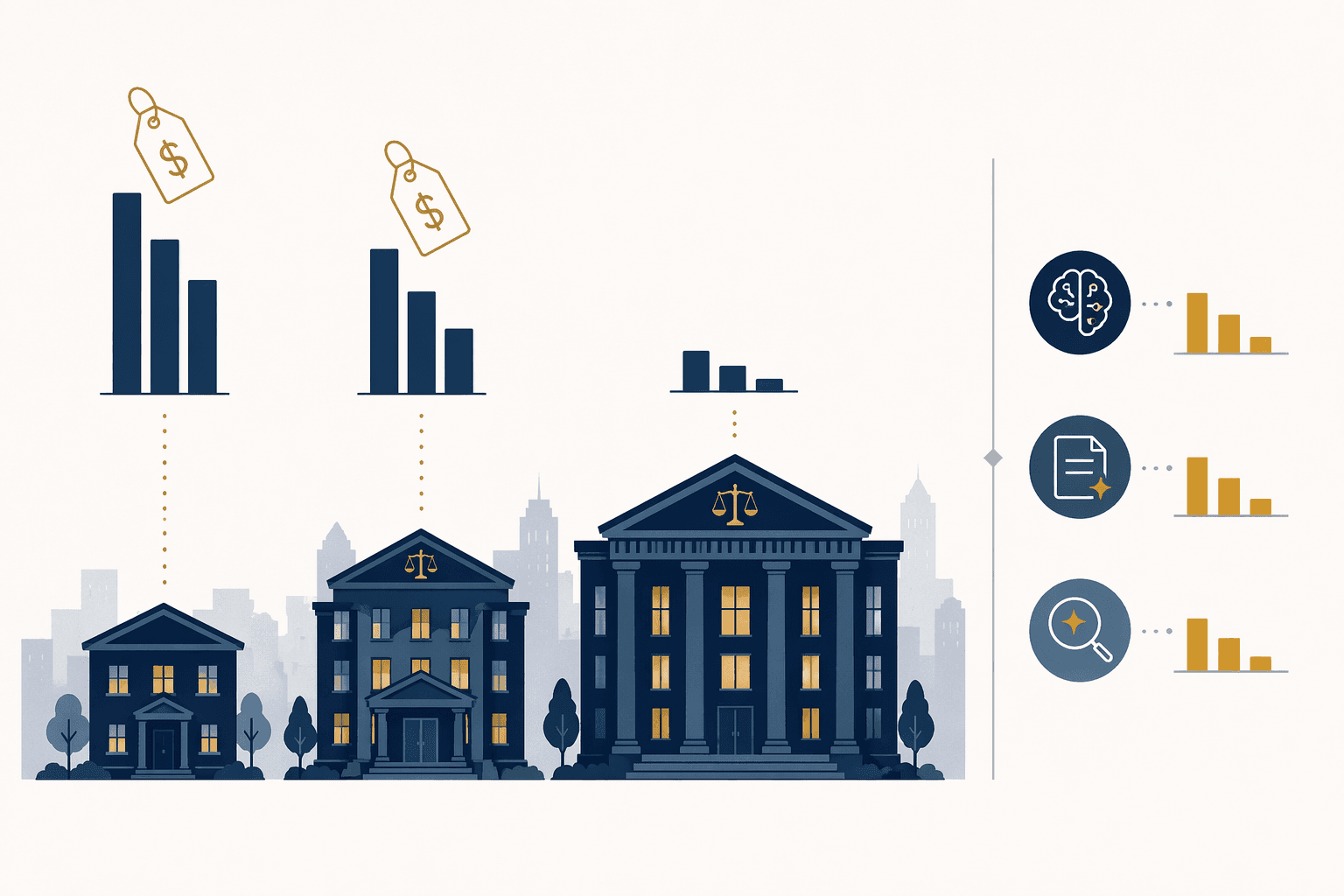
Harvey AI does not publish pricing. There is no rate card, no self-serve tier, and no public calculator. Every prospective buyer must enter a sales process to receive a custom quote, and those quotes vary by a factor of roughly 20x depending on who is asking. According to estimates triangulated by Bind Legal, per-seat costs range from $100–$200 per user per month for Am Law 100 firms with 200 or more seats to $1,200–$2,000 per user per month for mid-market firms with 50–200 attorneys. That is a 6–20x price disparity for the same software.
This structural inequity is not an accident. Harvey's enterprise sales model is designed to extract maximum willingness to pay from each buyer segment. Large firms bring brand value, reference-ability, and multi-year commitments. Mid-market firms bring neither, so they pay a premium. The result is that a 75-attorney firm evaluating Harvey faces a per-seat cost that is an order of magnitude higher than what a 500-attorney competitor pays, despite receiving identical software.
The The Legal Prompts independently estimates Harvey's pricing at roughly $1,000–$1,200 per lawyer per month with a 20-seat minimum and a 12-month commitment, putting the minimum annual spend at approximately $288,000 before any add-ons. For a mid-market firm, that is not a pilot — it is a material budget line item.
Actual Pricing Bands by Firm Size: What the Market Is Paying
The table below consolidates the available third-party estimates into a single view organized by firm size. The data reveals a clear pattern: the smaller the firm, the higher the per-seat cost.
| Firm Size (Attorneys) | Estimated Per-Seat/Month | Estimated Annual Contract Range | Minimum Seat Commitment |
|---|---|---|---|
| Am Law 100 (200+ seats) | $100 – $200 | $250,000 – $1,000,000+ | 25–50 seats |
| Mid-Market (50–200) | $1,200 – $2,000 | $100,000 – $250,000 | 25–50 seats |
| Small Firm (25–50) | $1,000 – $1,200 | $50,000 – $100,000 | 20–25 seats |
The disparity is stark. An Am Law 100 firm with 500 seats might pay $150 per seat per month — roughly $900,000 annually. A 75-attorney mid-market firm at $1,500 per seat per month would pay $1.35 million annually for fewer seats. The larger firm gets better pricing by a factor of 10x per user.
Minimum seat commitments compound the problem. Bind Legal reports a 25–50 seat minimum, while The Legal Prompts reports 20 seats. Even at the lower end, a 25-attorney firm must commit to a minimum annual spend of roughly $288,000–$360,000 before any usage. For firms that want to pilot Harvey with a small group before scaling, the minimum commitment creates a high barrier to entry.
The Hidden Costs That Drive TCO 30–50% Above Headline License Fees
The per-seat license fee is only the beginning. Based on Bind Legal's analysis, the Year 1 total cost of ownership for a 100-attorney firm runs between $1.97 million and $2.25 million — roughly 30–50% above the headline license cost of $1.56 million. The gap comes from five categories that are easy to overlook during contract negotiation.
- Implementation and onboarding ($30,000–$60,000): Integrating Harvey with existing document management systems (iManage, NetDocuments, SharePoint), configuring access controls, and setting up the Vault and Knowledge modules requires dedicated project management and technical resources.
- Premium support ($280,000/year): Standard support is included, but premium tiers with dedicated account management, faster response SLAs, and priority feature requests come at a substantial premium. For firms that treat Harvey as mission-critical, this is not optional.
- Training and change management ($50,000–$200,000): Harvey's platform is powerful but not intuitive for all users. Firms report spending heavily on structured training programs, prompt engineering workshops, and ongoing user support to drive adoption. Low readiness can significantly increase per-learner training costs and reduce ROI.
- Custom model fine-tuning ($50,000–$150,000): Firms that want Harvey tuned on their own precedents, playbooks, or jurisdictional law must pay for custom model fine-tuning. This is a one-time cost but can recur if the firm wants periodic model refreshes.
- Renewal escalations (5–10% annually, 10–25% without caps): Reported renewal increases range from 5–10% per year when contractual caps are in place to 10–25% when they are not. Over a three-year term, an uncapped renewal can add $300,000–$750,000 to total cost.
Total Cost of Ownership Modeling for Three Firm Archetypes
To make the TCO discussion concrete, the table below models Year 1 costs for three firm archetypes using the Bind Legal framework. These are estimates based on triangulated pricing ranges and typical implementation assumptions. Actual costs will vary by firm and negotiation outcome.
| Cost Category | 50-Attorney Firm | 100-Attorney Firm | 500-Attorney Firm |
|---|---|---|---|
| License (per-seat x seats x 12 months) | $600,000 – $720,000 | $1,560,000 | $900,000 – $1,200,000 |
| Implementation | $30,000 – $60,000 | $30,000 – $60,000 | $60,000 – $120,000 |
| Premium Support (annual) | $140,000 – $200,000 | $280,000 | $500,000 – $800,000 |
| Training & Change Management | $50,000 – $100,000 | $50,000 – $200,000 | $200,000 – $500,000 |
| Custom Fine-Tuning (optional) | $50,000 – $150,000 | $50,000 – $150,000 | $100,000 – $300,000 |
| Year 1 TCO (Low Estimate) | $870,000 | $1,970,000 | $1,760,000 |
| Year 1 TCO (High Estimate) | $1,230,000 | $2,250,000 | $2,920,000 |
The 500-attorney firm benefits from dramatically lower per-seat license costs ($100–$200 vs. $1,200–$2,000), but its absolute TCO is still high due to scale. The 50-attorney firm faces the worst per-seat economics, with TCO per attorney reaching $17,400–$24,600 in Year 1.
Three-year projections amplify the disparity. Assuming 7% annual renewal escalation (mid-range with a cap) and no additional fine-tuning costs, the 100-attorney firm's three-year TCO ranges from approximately $5.6 million to $6.5 million. Without a renewal cap, the 10–25% annual increases could push that figure above $7.5 million.

Negotiation Tactics: How to Reduce Harvey's Pricing Inequity
Mid-market firms are not powerless in Harvey negotiations, but they must come prepared. The following tactics are drawn from reported buyer experiences and industry analysis.
- Multi-year commitments (10–20% discount): Harvey's sales team values predictable revenue. A two- or three-year commitment can unlock 10–20% per-seat discounts. The trade-off is reduced flexibility, so ensure the platform meets your needs before locking in.
- Contractual renewal caps (5–10% per year): Without a cap, renewal increases of 10–25% have been reported. Insist on a contractual cap of 5–10% per year. This single clause can save hundreds of thousands of dollars over a three-year term.
- Competing quotes from alternatives: Harvey's sales team knows the competitive landscape. Having a signed quote or active evaluation from Spellbook (~$179/seat/month), CoCounsel Core (~$225/seat/month), or Bind (~$90/seat/month) provides concrete leverage. Even if Harvey is your first choice, the existence of a credible alternative changes the negotiation dynamic.
- Minimum seat reduction: If the 25–50 seat minimum is too high for a pilot, negotiate a phased ramp. Propose a 10–15 seat pilot at a reduced per-seat rate with a contractual commitment to scale if adoption targets are met. Some firms have reported success with this approach.
- Bundle with LexisNexis content: Harvey's partnership with LexisNexis is expected to push all-in costs roughly one-third higher for bundled content. If you already have a LexisNexis contract, explore whether a combined deal can reduce overall spend. If you do not, consider whether the bundled content is worth the premium.
Alternatives at Every Budget Level: What You Get for Less
Harvey is not the only option, and for many mid-market firms, it may not be the best one. The table below compares Harvey against three focused alternatives at significantly lower price points.
| Tool | Estimated Per-Seat/Month | Primary Use Cases | Best For |
|---|---|---|---|
| Harvey AI | $1,000 – $2,000 (mid-market) | Legal drafting, contract review, due diligence, discovery, legal research | Large firms with diverse needs and dedicated AI teams |
| Spellbook | ~$179 | Contract drafting and review, clause generation, redlining | Mid-market firms focused on contract work |
| CoCounsel Core | ~$225 | Legal research, document review, deposition preparation | Firms already using Westlaw Precision |
| Bind | ~$90 | Contract review, clause extraction, compliance checks | Budget-conscious firms and legal ops teams |
According to The Legal Prompts, focused alternatives cover 70–80% of typical contract AI use cases at a fraction of Harvey's mid-market pricing. For a firm whose primary need is contract review and drafting, Spellbook at ~$179/seat/month delivers strong capability without the $1,000+ per-seat premium. For firms already invested in the Westlaw ecosystem, CoCounsel Core at ~$225/seat/month integrates directly with existing workflows.
The trade-off is breadth. Harvey leads in seven of 11 use-case categories tracked by the SKILLS Legal AI Survey, including legal drafting, contract review and analytics, due diligence, contract negotiation, playbook generation, discovery automation, and timelines and chronologies. A firm that needs all of those capabilities may find Harvey's breadth justifies the premium. A firm that needs two or three may be overpaying.
Decision Framework: When Does Harvey's Premium Make Financial Sense?
The decision to invest in Harvey — or any premium legal AI platform — should be driven by a structured assessment of firm size, budget, use-case breadth, and organizational readiness. The following framework is designed to help legal ops leaders and managing partners evaluate whether Harvey's premium is justified for their specific context.
| Factor | Favorable for Harvey | Favorable for Alternatives |
|---|---|---|
| Firm size | 200+ attorneys (Am Law 100 scale) | 25–200 attorneys (mid-market) |
| Annual AI budget | $2M+ (can absorb TCO without material impact) | Under $1M (budget-constrained) |
| Use-case breadth needed | 5+ categories (drafting, review, diligence, discovery, research) | 1–3 categories (primarily contract work or research) |
| Organizational readiness | Dedicated AI team, strong change management capability | Limited AI experience, no dedicated team |
| Existing tech stack | LexisNexis, iManage, NetDocuments (Harvey integrates natively) | Clio, standalone tools, or no DMS integration |
| Risk tolerance | Low (willing to pay premium for lower hallucination rate) | Moderate (acceptable trade-off for lower cost) |
For mid-market firms that align with the right column, the recommendation is clear: model TCO carefully, negotiate aggressively on renewal caps and minimum seat commitments, and compare Harvey against focused alternatives before committing. The 6–20x pricing disparity between large and mid-market firms is not a reflection of value — it is a reflection of market power.
For firms that do choose Harvey, the key is to enter the negotiation with data. The estimates in this article provide a baseline. Actual quotes will vary, but knowing the ranges, the hidden costs, and the negotiation levers gives mid-market buyers a fighting chance against a pricing model designed to extract maximum willingness to pay.
Comments
Join the discussion with an anonymous comment.