
How to check if your plate is in Flock camera logs legally
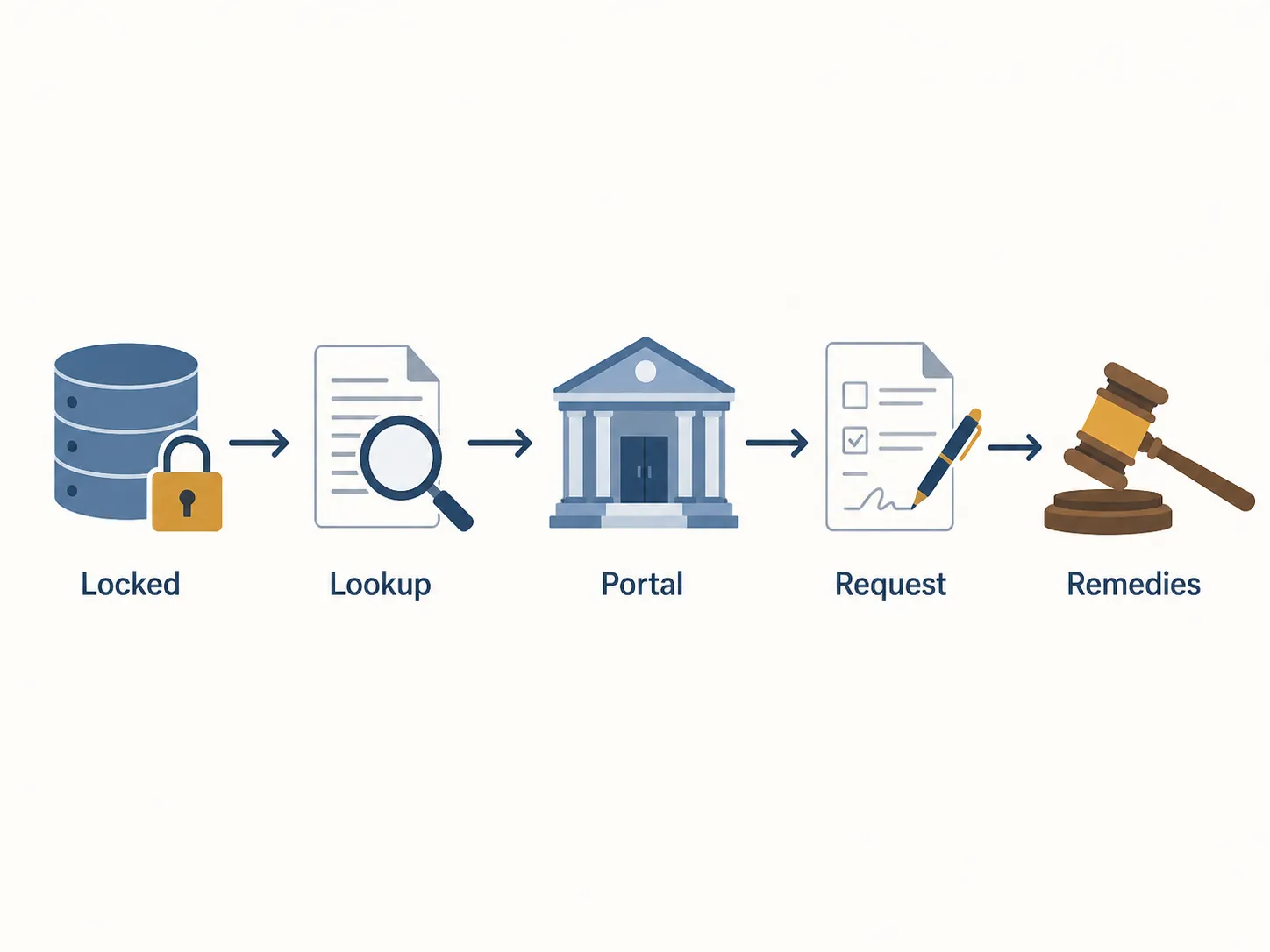
A lawful plate check runs through a defined sequence: the free HaveIBeenFlocked audit-log search, the local agency's Flock Transparency Portal, targeted FOIA/PRA requests, state-specific own-data rights, and denial remedies — because no public database or Flock-operated lookup exists for individual plate records. Timing is critical, since Flock's retention windows are short and data deleted before a request cannot be restored.
- Applicable role
- pro se litigant
- Workflow stage
- pre-filing
- Primary source
- Flock Evidence Policy (Aug. 12, 2026); state FOIA/PRA statutes

If the question is how to check if your plate is in Flock camera logs legally, the answer starts with a limit: there is no lawful public search box, and there is no Flock-operated self-serve database where an individual can type a plate number and retrieve its history. This is a lawful-access guide, not legal advice, and it was last checked in Q3 2026. Flock’s company-authored Evidence Policy says non-customers must direct requests to the customer agency, and its Trust Center says there is “no public browsing. No open access.”[1][2]
The route is still not hopeless. It is just narrower than people expect. A lawful check usually means looking for external traces first, identifying the agency that owns or controls the relevant records, and then asking that agency for the right artifacts before the retention clock runs out. Flock’s materials are inconsistent about the default retention period: company materials dated June 30, 2026, and a deletion blog describe a rolling 7-day hard-delete default, while the Evidence Policy and Trust Center still refer to 30 days.[3][4][1][2] Flock also says deleted data cannot be restored, so the first procedural mistake may be the one that ends the search.[4]
| Stage | What you are checking | What the result can and cannot prove |
|---|---|---|
| 1. Do not use a private workaround | Whether there is a public or Flock-run lookup | There is no lawful public browsing route described in Flock’s own materials. |
| 2. Search HaveIBeenFlocked | Whether your plate appears in FOIA-derived audit-log records of searches | A hit may show an operator-entered search. A no-result proves nothing about camera captures. |
| 3. Find the deploying agency | The local Flock Transparency Portal, agency policy page, or public contract trail | A portal helps identify who to ask. It is not a substitute for an underlying records request. |
| 4. Send a targeted FOIA/PRA request | Organization audit logs, network audit logs, contracts, retention settings, and policy documents | The agency may disclose, redact, deny under a cited exemption, or say no responsive record exists. |
| 5. Use state-specific rights and remedies | Own-data rights, administrative appeals, writ practice, or counsel review | Escalation can test a denial, but it does not guarantee plate-data disclosure. |
What not to search for
Do not spend the critical first days looking for a hidden Flock public database. Flock’s position, as stated in its own legal and privacy materials, is that the data belongs to the customer agency and that non-customer requests go to that agency, not to Flock as a general consumer-access desk.[1][2]
That distinction matters because a misdirected request can fail cleanly while the underlying record expires quietly. A person who sends a broad message to the wrong inbox may later be told, accurately, that the vendor does not process that category of request or that the agency no longer has responsive records. The legal issue may be interesting, but the practical consequence is simpler: the plate data may be gone.
For background on misuse consequences and litigation, the better place to branch out is after the access request is preserved. The site’s related records on police Flock misuse consequences, the Flock Safety police misuse legal docket, and lawsuits over Flock license plate cameras are useful context, but they do not replace the records-routing work described here.
Use HaveIBeenFlocked, but read the result narrowly
The quickest first check is HaveIBeenFlocked. As of its August 2026 crawl, the site reported 243,028,273 audit-log entries covering 4,686,527 plates.[5][6][7] That scale makes it useful. It also makes overreading easy.
The important word is audit. HaveIBeenFlocked is not a complete mirror of Flock camera captures. It searches FOIA-derived records of operator-entered searches and related audit-log material, not every time a camera may have observed a vehicle. The site itself warns that a no-result proves nothing, and reporting on the tool has repeated that limitation.[5][6][7]
A hit should be treated as a lead: someone’s system records may show a query involving that plate. It does not, by itself, establish why the query occurred, whether a camera captured the plate at a particular place, whether a stop followed, or whether the search was lawful. A no-result is even thinner. It may mean the plate was not in the dataset; it may also mean the relevant agency did not produce records, the records have not been loaded, the data was redacted, the search happened outside the available set, or the underlying plate capture was never represented in those audit logs.
The privacy upside is that the site says it discards entered plate numbers.[5] That helps with the first-pass check, but it does not turn the site into a legal access channel. If the result matters — for a ticket, stop, employment concern, civil claim, or reporting project — preserve a screenshot for your own notes and move quickly to the agency-record step.
There is also a reason audit logs have become a point of pressure. CBS reported, attributing the figures to The Washington Post, that 46 officers had been charged or accused of plate-reader misuse; Mashable described the count as at least 50.[6][7] Separately, 404 Media reported on January 13, 2026, that Flock threatened the creator of HaveIBeenFlocked after a redaction error exposed audit-log information.[8] Those facts do not prove misuse in any individual result. They explain why the record name matters: audit logs are often the only place to see who searched, when, and under what stated purpose.
Find the agency before you draft the request
The next stop is usually the local Flock Transparency Portal, if the agency has one. Use it to identify the deploying agency, the listed policy, the general sharing posture, and sometimes the contact point. Do not treat the existence of a portal as fulfillment of a request for the underlying logs.
This is where many otherwise reasonable requests go soft. “Any records about my plate” may be understandable to a driver, but it gives a clerk too much interpretive work under too little time. Inside Investigator’s public-records guidance emphasizes asking for both organization audit logs and network audit logs by name, and not accepting a transparency page as a substitute for the records themselves.[9]
Before sending, collect the facts that let the agency search without guessing:
- Your plate number and state of registration.
- The date range. Keep it as narrow as possible, especially if you are trying to beat a short retention window.
- The place, route, incident, citation, stop, tow, or other reason you believe the plate may have been queried.
- The agency or agencies that operate cameras in the relevant area.
- Any HaveIBeenFlocked result, if one appeared, including the date you searched and any visible agency or query context.
If the agency page points to a police department but the contract was signed by a city, county, university, sheriff, or HOA-related public entity, consider whether more than one custodian needs a request. The point is not to multiply paperwork for its own sake. It is to avoid the familiar answer that the recipient does not maintain the record you meant.
Ask for artifacts, not conclusions
A defensible request does not ask the agency to tell you whether you were “surveilled.” It asks for identifiable records the agency either has or does not have. The strongest version usually separates plate-hit records, audit logs, and configuration documents, because each may be governed by different exemptions and retention rules.
- Records showing any Flock ALPR camera capture, hit, alert, hotlist match, search result, or investigative use involving plate [PLATE] between [START DATE] and [END DATE].
- Organization audit logs showing searches, views, exports, comments, case associations, or access events involving plate [PLATE] during the same period.
- Network audit logs showing searches or access involving plate [PLATE] by users outside the agency, if the agency’s Flock network-sharing configuration permits such access.
- The agency’s Flock contract, data-retention settings, retention schedule, data-sharing settings, policy documents, and any local configuration records controlling deletion.
- If any record is withheld or redacted, the specific statutory exemption relied on for each withheld category.
That last sentence is not decoration. A denial that cites a specific exemption is a different object from a vague statement that records are confidential. It gives you something to appeal, narrow, or test in the correct forum. It also helps separate three outcomes that often get blurred together: no responsive record, responsive record deleted before the request, and responsive record withheld under law.
Do not ask only for “my Flock data” unless a state law gives you a personal access right with that wording. Public-records systems usually operate by record category and custodian, not by the consumer-data model people know from privacy portals. The agency may still verify identity or ownership where state law requires it, but the request should be built so a records officer can locate the relevant system logs.

Retention is not a footnote
Flock’s public materials do not speak with one clean voice on retention. The company’s LPR Policy dated June 30, 2026, and a company deletion blog describe a rolling 7-day hard-delete default.[3][4] The Evidence Policy dated August 12, 2026, and the Trust Center still reference 30 days.[1][2] The safest operational conclusion is not to average those numbers or assume the longer one applies. Verify the agency’s contract, local configuration, policy, and state law.
Flock’s deletion blog says deleted data cannot be restored.[4] If your request arrives after the configured retention period, a later appeal may still test whether the agency mishandled the request or had a duty to preserve, but it may not resurrect the plate record itself. That is why the request should go out before the debate is polished.
A short preservation note can be included with the request. It should not sound like a threat if you are not prepared to litigate. It can simply say that you are requesting preservation of responsive ALPR records, audit logs, configuration records, and deletion metadata while the public-records request is pending. Whether that has legal force depends on the jurisdiction and circumstances, but it at least makes the timing issue visible.
State rules can change the answer
The lawful route depends heavily on state law. The following examples are not a national survey. They are narrow points supported by the available materials and should be checked against current statutory text before filing.
| Jurisdiction | What the available materials support | Practical consequence |
|---|---|---|
| Connecticut | Inside Investigator reported a 2026 own-vehicle access right for vehicles registered in the requester’s own name, with caveats for multi-owner and lessor situations.[10] CT Mirror had earlier reported broad support for a bill constraining license plate data use.[11] | If you are relying on an own-data right, verify the enacted text, the covered records, proof-of-ownership requirements, and any retention period before filing. |
| Washington | MRSC reported that SB 6002 was signed on March 30, 2026; it exempts ALPR data from the Public Records Act while leaving audit-trail data disclosable with partial redaction.[12] | A request for raw ALPR data may fail where the exemption applies, but a carefully framed audit-trail request may still have a route. |
| California | The First Amendment Coalition describes a posture in which bulk ALPR data has been treated as exempt under the CPRA catch-all, anonymized data remains an open question, and the remedy route is a writ of mandate with potential fee-shifting.[13] | Expect exemption fights over bulk data. If the denial matters, the escalation path may be judicial rather than another informal email. |
For broader state-by-state context, see the separate tracker on state restrictions on Flock Safety camera data. Do not import a rule from one state into another request. A California CPRA denial, a Washington PRA exemption, and a Connecticut own-vehicle access right are different tools.
What a response means
A lawful plate check can end in several defensible but unsatisfying ways. “No responsive records” may mean the plate was never captured or searched by that agency during the requested period. It may also mean the request was too narrow, the wrong custodian was asked, or the responsive record lived in a system the agency did not search. The answer should state enough about the search to let you decide whether to clarify.
“Records deleted” is different. Ask when the relevant category was deleted, what retention rule controlled, whether deletion was automatic, and whether any audit entry, deletion log, case note, export record, hotlist record, email, report, or incident file still exists. The plate image or hit may be gone while proof of access, export, or deletion remains.
“Denied” should come with law attached. If the agency withholds ALPR data, audit logs, or contracts, ask for the specific exemption for each withheld category and whether segregable portions can be released. Audit logs may contain user names, law-enforcement-sensitive details, or third-party information; that can justify redaction in some jurisdictions without necessarily justifying a total denial.
A transparency portal response deserves special care. If the agency sends only a public Flock portal link, reply that you are not asking whether the agency participates in Flock or publishes a general policy page; you are asking for the underlying records identified in the request. Keep the reply short and tied to the record names.
Escalation without pretending disclosure is guaranteed
Start with the least dramatic correction: clarify the date range, add the exact log names, identify the agency portal or contract page you relied on, and ask the records officer to confirm which systems were searched. If the response says the records are exempt, ask for the exemption and whether partial release is possible. If it says the records were deleted, ask for the retention setting and deletion basis.
Some disputes move next to an administrative appeal, ombuds process, public-records commission, or court. California’s CPRA remedy route, as described by the First Amendment Coalition, is a writ of mandate with potential fee-shifting.[13] Other states use different paths and deadlines. If the records relate to a stop, prosecution, immigration matter, employment action, civil claim, or threatened litigation, this is the point where counsel review is usually more useful than another broad request.
For adjacent escalation patterns, including how stale or automated records can affect real-world enforcement, see the site’s stale warrant checklist and the analysis of whether police can stop a car on a Flock camera theft alert alone. Those are enforcement questions, not access shortcuts, but they show why the underlying log trail can matter.
The final answer may still be “no responsive record,” “deleted before request,” or “withheld under a cited exemption.” That is not the same as having no lawful route. It means the route runs through partial audit-log datasets, agency-controlled records, state-specific rights, and timely preservation — not through a private lookup or an assumed Flock search box.
References
- Flock Evidence Policy — Flock Safety, August 12, 2026
- Data Privacy — Flock Safety Trust Center
- LPR Policy — Flock Safety, June 30, 2026
- How Does Flock Handle License Plate Data Deletion? — Flock Safety
- HaveIBeenFlocked — HaveIBeenFlocked
- Flock license plate tracking search check — CBS News
- Have I Been Flocked license plate search — Mashable
- Police Unmask Millions of Surveillance Targets Because of Flock Redaction Error — 404 Media, January 13, 2026
- Transparency Update: Tips for Obtaining ALPR Records — Inside Investigator
- Inside Investigator — Inside Investigator
- Bill constraining use of license plate data gets broad support — CT Mirror, March 10, 2026
- License Plate Reader Data — MRSC, April 2026
- Sheriff Denied My Request for Data From Automated License Plate Readers — First Amendment Coalition
Grounded in
This procedure is grounded in Flock Evidence Policy (Aug. 12, 2026); state FOIA/PRA statutes, independent of any single documented case. See the Regulation tracker for the governing text.
Cases this step would have prevented
No cases have been explicitly linked to this checklist yet. See Risk Digest for documented incidents generally.
← Back to WorkflowsReport a correction or tip
Spotted an outdated figure, a misstated fact, or a ruling this workflow checklist should reflect? Public comments are disabled for this content given the professional cost of a misreported case outcome, penalty amount, or rule text — use the structured correction channel instead.
Report a correction or tip for this record →