
Understanding the AI Contract Review Pipeline
Understand the five-stage pipeline behind AI contract review—ingestion, clause identification, risk assessment, data extraction, and human review—and why playbook quality determines whether the output is reliable or inconsistent.
After a contract is uploaded to an artificial intelligence contract review tool, the useful question is not whether the AI “reads” it. The useful question is what the system turns the document into, what it compares that output against, and where a lawyer or reviewer is expected to intervene.
A representative AI contract review pipeline has five stages: document ingestion, clause identification, risk assessment against a playbook, data extraction, and human review. Vendor implementations differ, and some products combine stages or rely on other systems for parts of the workflow, but this sequence shows the machinery that typically sits between upload and final reviewed output.[1][2][3]
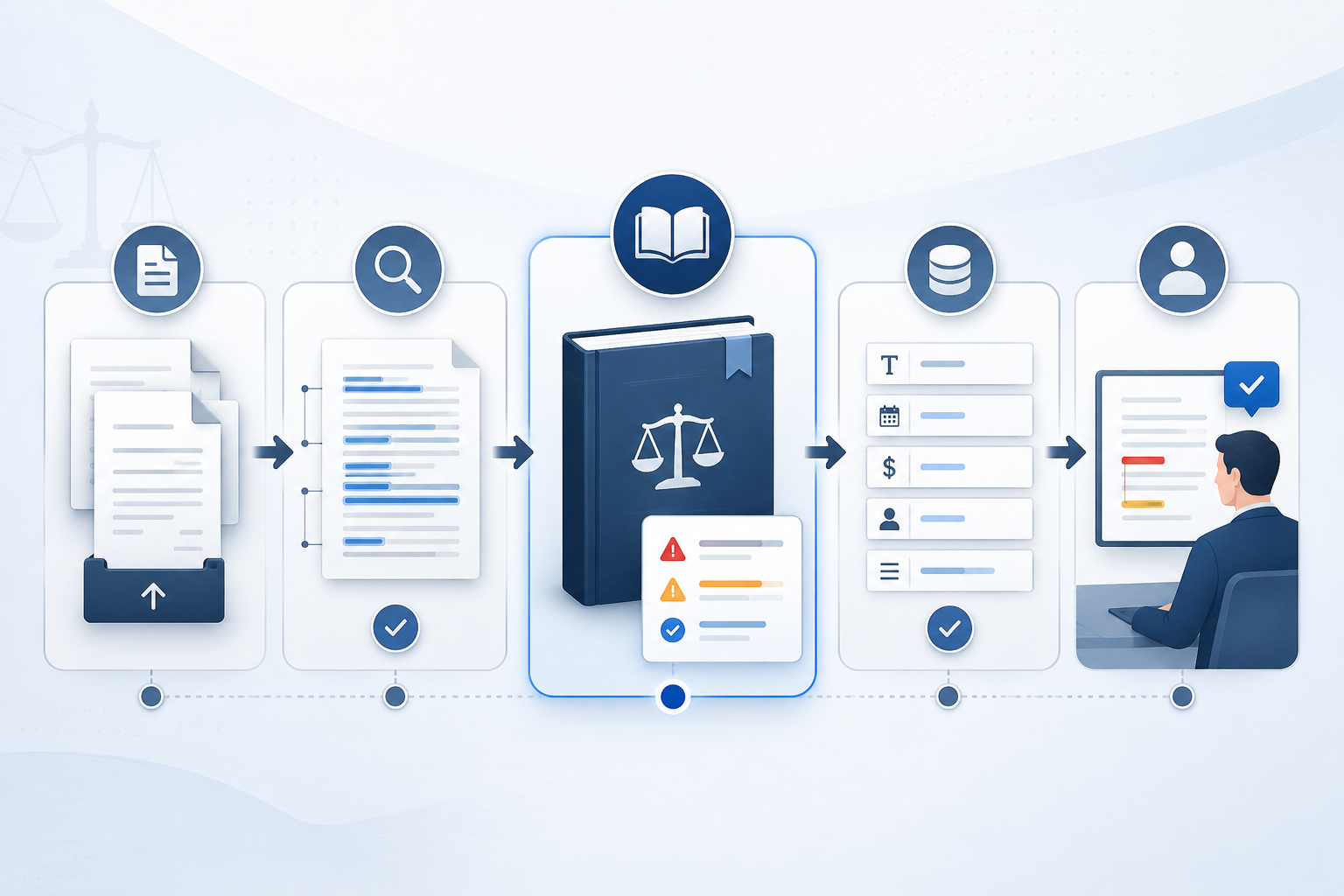
| Pipeline stage | What happens | What can go wrong |
|---|---|---|
| 1. Ingestion | The system receives the file, converts it into machine-readable text, preserves document structure where possible, and applies security controls. | Bad scans, broken formatting, missing exhibits, or weak data controls can compromise every later stage. |
| 2. Clause identification | The system detects and classifies clauses such as indemnity, termination, assignment, confidentiality, governing law, or limitation of liability. | The model may identify a clause label without understanding whether the language is acceptable for this deal. |
| 3. Risk assessment against a playbook | The system compares detected language against the organization’s fallback positions, required language, prohibited terms, and escalation rules. | If the playbook is missing, stale, or vague, risk flags become inconsistent even when clause detection works. |
| 4. Data extraction | The system converts selected contract information into structured fields, such as counterparty name, renewal date, governing law, fee terms, or notice period. | Extracted fields may be technically correct but unusable if the review team has not defined which fields matter. |
| 5. Human review | A lawyer, contract manager, or trained reviewer checks exceptions, resolves ambiguities, approves positions, and records the final decision. | If review queues and accountability are unclear, AI output becomes another unverified document summary. |
Stage 1: Ingestion decides what the system can read
Ingestion sounds administrative, which is why it is easy to underweight. It is the point where a contract moves from a file sitting in email, a CLM platform, a data room, or a shared drive into a review environment. The system has to accept the file, read the text, retain enough structure to distinguish sections and exhibits, and associate the document with the right matter, counterparty, template, or review queue.
This stage is where practical failures start. A scanned PDF with weak OCR can turn defined terms into noise. A Word document with comments and tracked changes may contain language that is proposed, rejected, or superseded. An uploaded zip file may include the main agreement but omit a schedule that changes the economics. If the system cannot reliably tell what text is operative, later clause labels and risk flags inherit that uncertainty.
Ingestion is also where data governance stops being a procurement checkbox. The contract may include personal information, pricing, trade secrets, customer lists, security obligations, or acquisition plans. Before judging the quality of the model, a legal team should know where documents are processed, whether files are retained for training, how access is logged, how deletion works, and which subcontractors touch the data. Those questions sit at the front of the pipeline, not after a pilot has already absorbed sensitive agreements. For a fuller diligence path, see the site’s AI contract review security and data governance guide.
Stage 2: Clause identification turns text into labels
Once the document is readable, the system begins classifying contract language. It may mark a paragraph as indemnity, limitation of liability, confidentiality, assignment, audit rights, non-solicitation, renewal, termination for convenience, governing law, dispute resolution, or another clause type. This is often the first visible “AI” output because it looks like the tool has understood the agreement.
Clause identification is valuable, but it is not the same thing as legal judgment. A model can find a limitation of liability clause without deciding whether the cap is commercially acceptable, whether the carveouts match company policy, or whether the clause conflicts with a separate indemnity obligation. It has found the object of review, not completed the review.
Purpose-built legal AI can perform well on standard contract types and well-defined clause categories. LegalOn reports 85–95% clause identification accuracy for standard contract types, and also reports a benchmark in which its AI was 17 times faster than Claude Opus 4.6 at clause identification under its test configuration.[4] Those figures are useful, but they should be read as context-bound. Accuracy on NDAs, MSAs, or familiar commercial provisions does not automatically transfer to bespoke financing terms, hybrid services-and-software deals, or multi-jurisdictional regulatory commitments.
This is also where a legal team should separate a general-purpose language model from a contract review system. General models can summarize and classify text, but contract review requires stable clause taxonomies, jurisdiction-aware training or configuration, version control, audit trails, and a way to connect labels to the organization’s own risk rules. The site’s AI contract analysis accuracy benchmarks go deeper on why benchmark design matters before an accuracy claim should influence buying decisions.
Stage 3: The playbook is where detection becomes review
The most important step in the pipeline is not the most theatrical one. It is the moment when a detected clause is compared with a legal team’s playbook: preferred language, fallback positions, prohibited terms, escalation thresholds, jurisdictional variations, and business-specific exceptions.
Without that layer, the system can say, “This is an indemnity clause.” With that layer, it can say, “This indemnity is uncapped, extends to indirect losses, lacks a negligence standard, and should be escalated unless the deal is below the approved value threshold.” The difference is not cosmetic. The first output helps someone find the issue. The second output helps route work, apply policy, and explain why the contract was flagged.
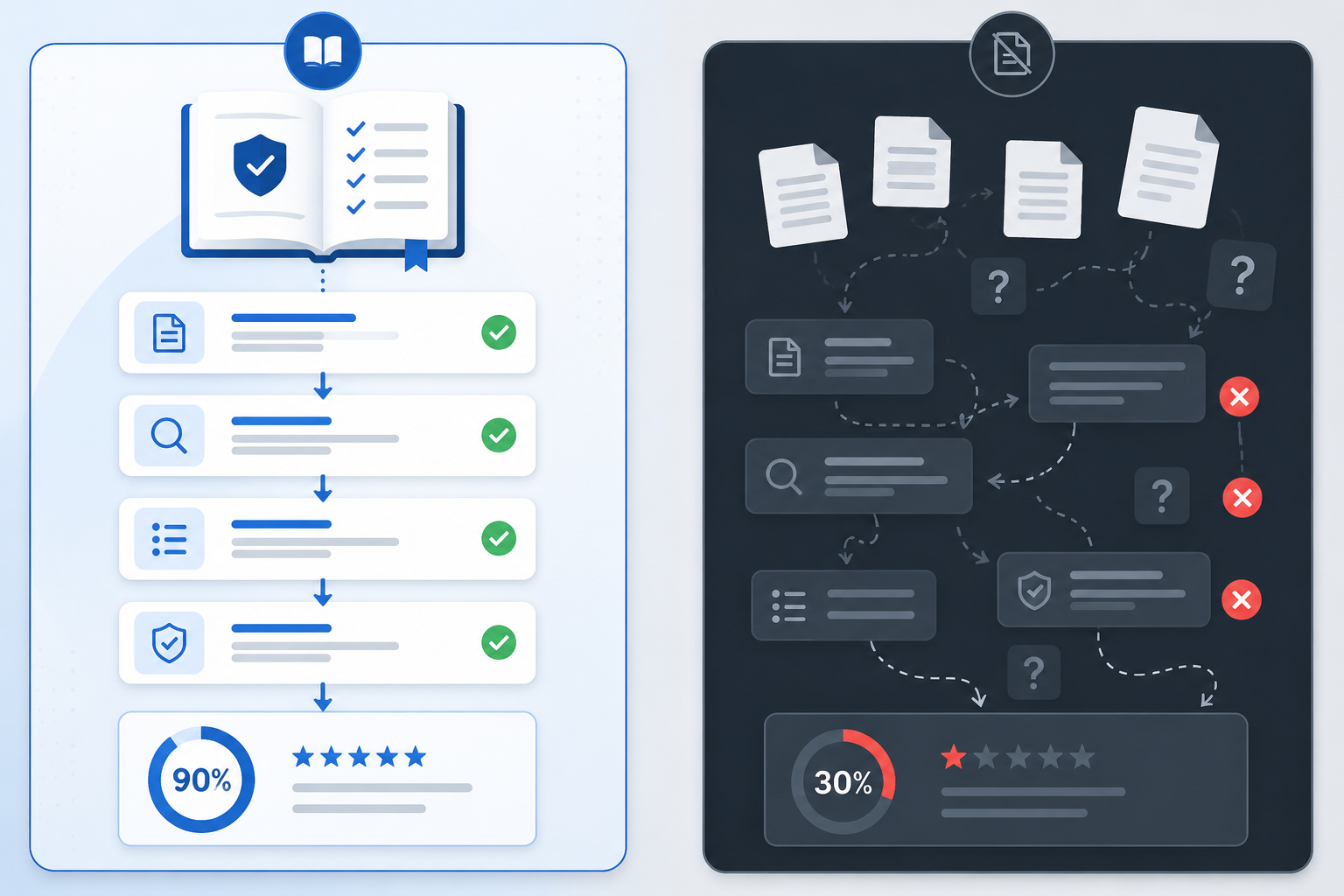
This is where many implementations are weaker than the software demo. LegalOn’s 2026 survey reported that 95% of legal teams have playbook gaps, and 34% have no playbooks at all.[4] That means many teams are asking AI to standardize a process that the organization has not actually standardized for humans.
The performance gap is large enough to change how the whole category should be evaluated. LegalOn’s 2026 survey findings cite a Deloitte 2026 legal operations report finding that organizations using pre-built, regularly updated playbooks achieved 90% clause flagging accuracy in AI contract review, compared with 30% without playbooks.[4] That is not a small implementation detail. It is the difference between a review system that can apply a policy and a classifier that leaves reviewers to invent the policy contract by contract.
A useful playbook is not just a list of risky clauses. It tells the system what “risky” means for this organization. For a limitation of liability clause, it may specify the preferred cap, acceptable alternatives, required carveouts, unacceptable carveouts, monetary thresholds for escalation, and business units that use different positions. For governing law, it may distinguish routine vendor agreements from regulated customer contracts. For assignment, it may care less about ordinary corporate reorganizations than about assignment to a competitor.
Playbooks also need ownership. Someone has to decide when a fallback becomes outdated, when a regulatory change requires a new flag, when a business unit’s exception has become routine, and when a negotiated position should remain an exception rather than become policy. AI does not remove that work. It makes the absence of that work visible.
There is a real limitation here. A playbook can make review more consistent, but it can also harden old assumptions. Novel deal structures, unusual bargaining leverage, new product lines, or fast-moving regulatory areas may require judgment outside the stored rules. The goal is not to turn the playbook into a constitution. The goal is to make routine decisions reproducible while forcing genuinely unusual issues into the human review queue.
Teams building this layer usually need more than a vendor configuration session. They need to translate institutional judgment into review rules. The site’s repeatable AI adoption playbook is a useful next step for that operational work.
Stage 4: Data extraction makes the review reusable
After clauses are identified and risks are flagged, the system can extract contract data into structured fields. That may include party names, effective date, expiration date, renewal term, notice period, governing law, payment obligations, termination rights, assignment restrictions, security obligations, insurance requirements, or other fields the legal team tracks.
This stage matters because legal review should not disappear into a marked-up PDF. Extracted data can populate a contract repository, feed renewal workflows, support obligation management, or help the legal department report on recurring negotiation issues. If every reviewed agreement still requires someone to retype dates and obligations into another system, the pipeline has only moved labor from one screen to another.
Extraction also creates another verification problem. A date can be copied correctly but assigned to the wrong field. A renewal provision can be extracted without the notice period that controls it. A governing law clause can be captured while a venue clause in the next paragraph is missed. The test is not whether the system can produce a spreadsheet. The test is whether the structured fields match the decisions the business will later rely on.
For teams comparing extraction performance, the site’s AI contract clause extraction benchmarks provide a more focused view of how tools perform on this part of the workflow.
Stage 5: Human review closes the loop
Human-in-the-loop review is often described too vaguely. It should not mean that a lawyer glances at a colorful dashboard after the system has effectively made the decision. It should mean that the workflow identifies which outputs require verification, who owns that verification, what evidence they review, and how the final decision is recorded.
Some outputs may only need sampling once the system has been validated on a stable contract type. Others should always be reviewed: high-value agreements, non-standard paper, unusual jurisdictions, customer-drafted terms, clauses marked as low-confidence, conflicts between extracted fields, or deviations from a playbook that require business approval. The queue design matters because it determines whether AI reduces review burden or simply hides it.
A good review interface should show more than the conclusion. Reviewers need to see the source language, the clause label, the playbook rule applied, the reason for the flag, the confidence or uncertainty signal if available, and the available actions: accept, reject, edit, escalate, or mark as an exception. If a tool cannot show why a clause was flagged, the legal team cannot reliably train reviewers, defend decisions, or improve the playbook.
Professional responsibility issues sit here as well, especially when lawyers rely on AI-assisted outputs in client work or high-stakes commercial review. The point is not to turn every contract workflow into an ethics seminar. It is to make sure supervision is designed into the process rather than bolted on after a missed clause. The site’s professional responsibility framework for AI contract review covers that layer in more detail.
Where the time and cost claims fit
The business case for AI contract review is not imaginary. LegalOn reports that legal teams spend an average of 3 hours reviewing a single contract; at 500 contracts per year, that becomes 1,500 hours, or 188 working days, on first-pass review.[4] That is the operational baseline the pipeline is trying to compress.
Vendor-published sources report meaningful reductions under favorable conditions. Icertis reports per-contract cost dropping from $150–400 for manual review to $5–15 for AI-assisted review, while organizations report 50–75% reductions in first-pass review time across vendor case data.[1] Harvey reports typical users saving 15–25 hours per month, power users saving more than 30–50 hours per month, and a Bridgewater case in which vendor contract reviews fell from 2 days to 2 hours.[5]
Those numbers are worth attention, but they should not be treated as portable guarantees. They come from vendor-published materials and favorable deployments. They are most believable where the contract type is repeatable, the playbook is maintained, ingestion is reliable, and review queues are well defined. A team with no playbooks and a steady stream of bespoke agreements should expect a different implementation curve than a team reviewing high-volume NDAs against a mature standard.
For readers building the investment case rather than the workflow design, the site’s AI contract review ROI guide addresses those assumptions directly.
Questions to ask before trusting the output
Once the pipeline is visible, vendor evaluation becomes less dependent on demo language. The better questions follow the work product from upload to approval.
- For ingestion: Which file types are supported, how is OCR handled, what happens to comments and redlines, and where is contract data processed and retained?
- For clause identification: Which contract types and clause categories were tested, under what conditions, and how does performance change on non-standard paper?
- For risk assessment: What playbooks are available, who maintains them, how are company-specific positions configured, and how are updates versioned?
- For data extraction: Which fields are extracted, how are conflicts handled, and where does the structured data go after review?
- For human review: Which outputs require approval, who receives escalations, what audit trail is preserved, and how are reviewer corrections fed back into the workflow?
These questions also help separate product category claims. A lightweight drafting assistant, a clause extraction tool, a CLM-native review module, and a dedicated AI contract review platform may all use similar language in sales materials while implementing very different parts of the pipeline. The site’s 2026 AI contract review software comparison is more useful after those workflow boundaries are clear.
AI contract review is a chain of transformations: file to text, text to clause labels, clause labels to playbook-based risk flags, risk flags to structured data, and structured output to supervised legal action. The strongest model in that chain still needs something to apply. In practice, the maintained playbook is often the difference between impressive extraction and reliable review.
References
- How Does AI Contract Review Work? Process, Benefits & Use Cases, Icertis
- AI Contract Review Workflow for Legal Teams, Legislate
- AI Contract Review, Explained, Docusign
- AI Contract Review Software: Complete 2026 Buyer's Guide, LegalOn
- Measuring What Matters: A Practical Framework for Legal AI ROI, Harvey
Grounded in
This procedure is grounded in the cited rule or opinion, independent of any single documented case. See the Regulation tracker for the governing text.
Cases this step would have prevented
No cases have been explicitly linked to this checklist yet. See Risk Digest for documented incidents generally.
← Back to WorkflowsReport a correction or tip
Spotted an outdated figure, a misstated fact, or a ruling this workflow checklist should reflect? Public comments are disabled for this content given the professional cost of a misreported case outcome, penalty amount, or rule text — use the structured correction channel instead.
Report a correction or tip for this record →