
Which AI Tool Works Best for Pro Se Litigants?
This comparison guide evaluates dedicated pro se AI platforms (Prosei, Cetient, AI Lawyer, Courtroom5) against general chatbots (ChatGPT, Claude, Gemini) on hallucination risk, citation accuracy, case management, privacy, and cost. It helps legal professionals understand the strengths and limitations of each option for advising or facing pro se litigants.
- Hallucination rate
- Not measured / undisclosed
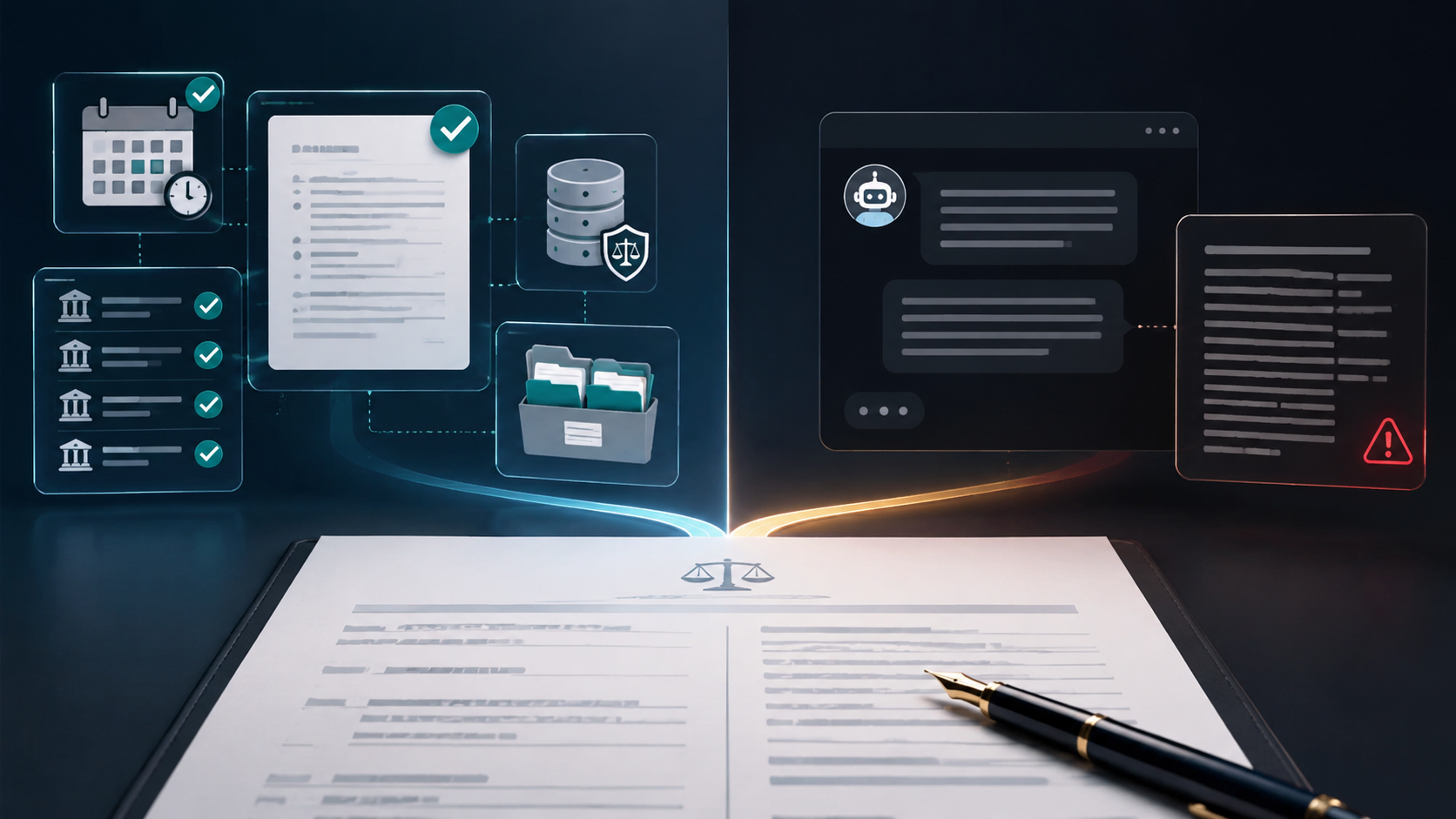
The best legal AI for pro se litigation is usually not the chatbot that writes the smoothest paragraph. For litigation tasks, dedicated pro se platforms are generally safer than general chatbots because they add legal-source connections, citation checks, deadline tracking, and case organization. That does not make any output file-ready. Every citation, rule, deadline, and legal proposition still has to be checked against primary authority and the court’s local requirements before it reaches a docket.
For lawyers, legal aid staff, and court-facing teams, the useful question is no longer whether self-represented litigants are using AI. Many are. The question is what kind of AI sits behind the draft: a general model generating plausible legal language, or a litigation workflow that points the user back to real sources, deadlines, and case files.
| Tool | Best fit | Hallucination risk | Citation verification | Case management | Deadline tracking | Privacy posture | Cost snapshot |
|---|---|---|---|---|---|---|---|
| Prosei AI | Pro se case workflow where deadlines, filings, and citations need to stay organized | Lower than a general chatbot when the user follows source links; not eliminated | Connects to CourtListener and advertises citation verification [1][2] | Yes: AI case management [2] | Yes: deadline tracking [2] | More litigation-oriented than public chat, but users still need to review terms and data handling [2] | Free to $89.99/month, last checked July 9, 2026 [1][2] |
| Cetient | Legal research support for self-represented litigants who need source-connected answers | Lower than a general chatbot when answers are grounded in real case databases; still requires checking | Connects to real case databases according to its pro se materials [1][3] | Research-centered rather than full case-management-centered | Not the main advertised differentiator in the research materials | Review vendor terms before entering sensitive facts [3] | Free to $79/month, last checked July 9, 2026 [1][3] |
| AI Lawyer | Plain-language research, document drafting, and basic case tracking | Lower only to the extent the user verifies; do not treat as filing authority | Research functions are advertised, but citations still need independent verification [1] | Basic case tracking [1] | Basic support only in the materials reviewed | Review product terms; avoid assuming attorney-client privilege | Free to $30/month, last checked July 9, 2026 [1] |
| Courtroom5 | Case organization and document preparation for self-represented litigants | Workflow may reduce procedural drift; citation accuracy still depends on verification | Legal research resources are part of its public guidance, but filings still require authority checks [4] | Yes: case management and document preparation [4] | Case workflow support, but users should still calendar court deadlines independently | Review vendor terms and filing workflow before uploading sensitive material | $75/month, last checked July 9, 2026 [4] |
| ChatGPT / Claude / Gemini | Plain-language explanation, brainstorming, and non-final drafting | High if used as standalone legal research or citation generation | No built-in legal database or reliable citation verification in ordinary chatbot use [1] | No litigation case file unless the user builds one manually | No court deadline system unless the user supplies and maintains it | Public chatbot use should not be treated as a confidential attorney-client setting | Common paid tiers around $20/month, last checked July 9, 2026 [1] |
Best for what?
“Best” changes once the task is named. A pro se litigant asking, “What does summary judgment mean?” needs a different safeguard than someone preparing an opposition, checking a statute of limitations, or deciding whether a cited case still exists. General chatbots can help translate unfamiliar language into ordinary English. They can also help turn a rough account of events into a first draft. The danger begins when fluency is mistaken for legal verification.
A useful sorting rule is simple: the closer the task is to filing, the less tolerable a general chatbot becomes. For background explanation, a chatbot may be enough if the user understands that it is not legal advice. For research, deadline management, citation checking, and document assembly, the safer tool is the one that forces contact with legal sources and case structure. That is why a broader AI legal research tools comparison looks different from a writing-app comparison.
| Task | Safer tool category | What to verify before use |
|---|---|---|
| Understanding a legal concept | General chatbot or dedicated platform | Whether the explanation matches the jurisdiction, claim type, and current rule |
| First draft of a letter or narrative declaration | General chatbot can help, but not as final authority | Facts, tone, admissions, protected information, and court-specific formatting |
| Legal research | Dedicated legal or pro se platform with source connections | Every case, statute, rule, quotation, parenthetical, and treatment signal |
| Deadline management | Dedicated case-management platform plus independent calendaring | Triggering event, local rule, holiday rule, service method, and court order |
| Preparing a filing | Dedicated pro se workflow, court forms, self-help center, or lawyer review | Caption, jurisdiction, requested relief, exhibits, certificate, citations, signature, and AI disclosure requirements |
Why dedicated platforms change the risk profile
The main advantage of a dedicated pro se platform is not that it sounds more legal. It is that the product is built around the parts of litigation where unrepresented people often lose ground: identifying authority, keeping filings in order, tracking deadlines, and turning scattered facts into a usable case file.
Prosei is the clearest example in the current comparison set because its advertised design combines AI case management, deadline tracking, citation verification, and a CourtListener connection [1][2]. Those are not cosmetic features. A tool that points a user to CourtListener at least creates a path back to a real docket or opinion. A tool that tracks deadlines at least makes the date visible. Neither feature guarantees a careful litigant, but both reduce the chance that the entire case depends on memory and a paragraph generator.
Cetient’s pro se materials emphasize legal research and connections to real case databases [3]. That makes it more relevant for users trying to understand authority than for users who need a full litigation command center. The practical question for a legal professional reviewing Cetient-assisted work is whether the cited materials can be opened, read, and matched to the proposition in the filing. Source-connected output is better than unsourced output, but it still has to survive the same check a paralegal would perform on a brief.
AI Lawyer appears more drafting-oriented in the materials reviewed, with research, document drafting, and basic case tracking at a lower monthly price point [1]. That may be enough for a user who needs help turning facts into a letter, organizing a chronology, or understanding procedural vocabulary. It is less reassuring when the task is legal authority. The product may generate useful starting points, but the filing risk still sits with the person who signs the paper.
Courtroom5 deserves careful attribution because its public materials include unusually concrete vendor metrics: it self-reports a 73% user win-or-settle rate and more than 170,000 documents prepared [4]. Those numbers are not the same as an independent court-tested effectiveness study. They do, however, show a product oriented around recurring litigation workflow rather than one-off chat. The safer reading is not “Courtroom5 wins cases.” It is “Courtroom5 has substantial self-reported user activity in document preparation and case support.”
Where general chatbots still help, and where they become dangerous
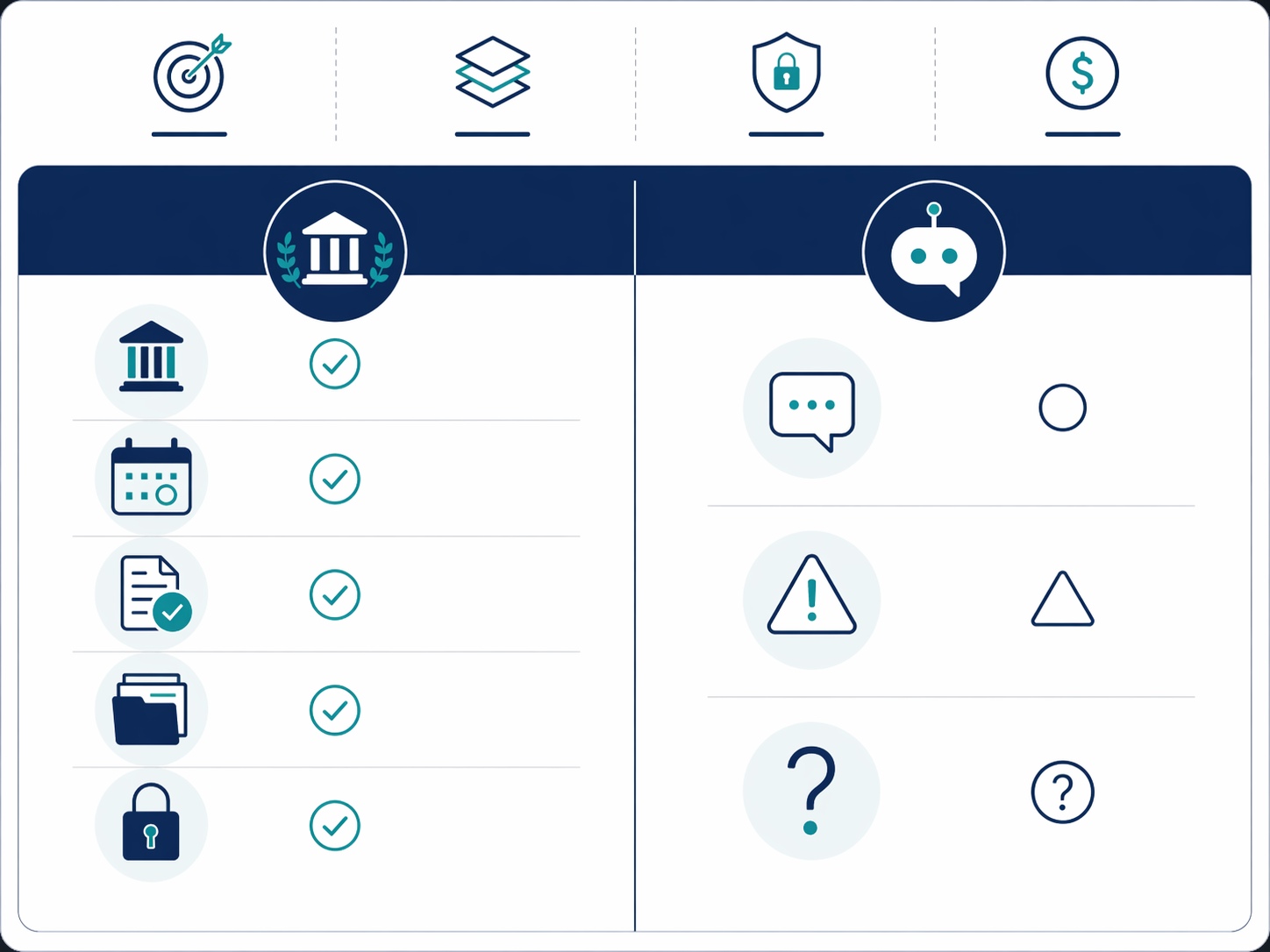
ChatGPT, Claude, and Gemini can be useful when the job is language support. They can explain what a complaint is, summarize a court order the user provides, suggest a cleaner chronology, or help draft a non-final cover letter. Those uses still require judgment, but they do not depend on the model inventing legal authority. For a more detailed treatment of safe and unsafe chatbot uses, see which legal tasks ChatGPT can handle safely.
The same tools become poor litigation engines when asked to supply cases, quote holdings, calculate deadlines, or predict what a judge will accept. A chatbot can produce a plausible citation with the same confidence it uses for a real one. It can also miss the procedural fact that matters most: the service date, the local rule, the standing order, the amended complaint deadline, or the judge’s certification requirement.
The hallucination data in the available materials supports that distinction, although one caveat matters. The AI Lawyer guide cites Stanford-measured hallucination rates of 17% to 33% for paid legal-grade AI research tools and 58% to 82% for general chatbots on legal queries without a legal database [1]. Because those percentages were not independently traced to the original Stanford study here, they should be checked against the original source before publication or formal reliance. Even with that caveat, the directional point is consistent with what clerks and opposing counsel are already seeing: legal-source grounding matters.
Privacy is another reason not to steer a distressed self-represented litigant into a public chatbot box with a full fact pattern. A public chatbot session is not a lawyer intake. It does not create an attorney-client relationship, and users should not assume that sensitive facts, settlement posture, medical history, immigration facts, employment records, or admissions are protected merely because the interface feels conversational. Lawyers using or advising on these tools should pair any recommendation with a clear warning about confidentiality and data handling. For lawyers’ own use, the same concern is part of a broader ChatGPT-for-lawyers risk analysis.
The court problem is not bad writing. It is unverified filing.
A polished AI draft creates work for someone. If the self-represented litigant verifies it, the draft may become a useful starting point. If not, the work shifts to the clerk, the judge, opposing counsel, or a legal aid lawyer trying to repair the damage after the deadline has passed.
Bloomberg Law reported that at least 24 U.S. pro se litigants had been sanctioned with monetary fines since the second half of 2023 for AI-related hallucination problems, with the largest sanction exceeding $66,000 in attorneys’ fees [5]. The same reporting cites Fisher Phillips partner Kristin White for the estimate that defending AI-assisted pro se cases costs 10% to 15% more than typical claims [5]. Those figures do not prove that most AI-assisted pro se cases are abusive. They do show why opposing counsel cannot treat fabricated authority as a harmless curiosity.
Damien Charlotin’s AI hallucination case database listed 1,696 hallucination cases globally as of July 3, 2026, including 991 involving pro se litigants [6]. The database is a third-party research project, not an official court registry, so its inclusion criteria and methodology matter. Still, its direction is hard to ignore. Bloomberg’s discussion of the database reported that court-recorded AI hallucination decisions rose from 2 in February 2025 to 52 in February 2026 [5][6].
The enforcement response is becoming procedural as well as punitive. Standing orders in the Northern District of New York, the Northern District of Texas, and the Eastern District of Texas address AI use by pro se litigants, and compliance guides report a growing number of federal judges requiring signed AI-use certifications for some filings [7][8][9]. A legal professional reviewing a pro se AI-assisted filing should therefore ask two separate questions: are the citations real, and did the filer comply with the court’s AI disclosure or certification rules?
The sanction pattern is important enough to deserve its own tracking. For a deeper look at enforcement data, see AI hallucination sanctions in 2026. For lawyer-side verification systems, an ABA Formal Opinion 512 compliance playbook is the more relevant frame than any prompt trick.
Why this is showing up on more dockets
The pressure is not theoretical. Federal employment litigation is one visible channel. Lex Machina’s 2026 Employment Litigation Report, discussed by Baker Donelson, found that pro se employment filings doubled from 2,052 in 2021 to 4,388 in 2025, rising from 9.7% to 16.5% of all federal employment cases [7]. ArentFox Schiff, citing New York Times reporting, noted that non-prisoner pro se cases rose from 11% to 16.8% of all federal civil cases over five years [8].
Those numbers should not be flattened into a story about bad-faith plaintiffs or miracle access to justice. Many self-represented litigants are using AI because the system is expensive, technical, and unforgiving. At the same time, a court does not become less technical because a chatbot helped draft the motion. The caption, service rules, jurisdictional allegations, exhibit handling, and deadline calculations still have to be right.
Free tools are useful, but they are not a free AI lawyer
Search intent around this topic often includes some version of “free AI lawyer.” That phrase needs correction at the door. No tool in this comparison is a licensed attorney, and no free chatbot becomes one because it can draft in legal style. Free resources are still valuable, but their value is usually narrower and more concrete.
- Court self-help centers can provide local forms, filing instructions, clinic referrals, and court-specific procedural guidance.
- LawHelp.org can help users find legal aid and self-help resources by location and problem type.
- Justia can provide accessible legal information and case-law search, but users still need to verify current law.
- Google Scholar can locate opinions, though it does not manage a case or tell a litigant whether an opinion is still good law.
- CourtListener can connect users to opinions and docket-related materials and is especially useful when a platform points back to it.
A careful pro se workflow may combine a free court form, a self-help center instruction sheet, CourtListener research, and a limited AI drafting tool. The risk rises when the AI tool replaces those sources instead of helping the user navigate them. For a separate comparison focused on no-cost options, see free AI legal assistants.
A practical framework for lawyers, legal aid, and opposing counsel
When a client, clinic visitor, or opposing party appears to be using AI, the first move should not be a lecture about never using it. That advice is unlikely to survive contact with filing fees, rent, and a deadline. The more useful move is to separate drafting help from legal verification.
- Prefer tools that connect to real legal sources, show the source, and make the user open it before relying on it.
- Treat every AI-generated citation as unverified until the case, statute, rule, quotation, holding, and jurisdiction have been checked independently.
- Use deadline features as prompts, not authority; calculate deadlines from the applicable rule, order, service method, and local calendar.
- Check the judge’s standing orders, local rules, and any AI certification requirement before filing or responding.
- Warn users not to place sensitive facts into public chatbots unless they understand the confidentiality and data-handling consequences.
- Attribute vendor metrics carefully, especially when a platform reports user outcomes or document volumes without independent validation.
The New York State Bar Association’s 2025 AI task force discussion also flags unauthorized-practice-of-law concerns when AI tools are used by underserved populations [10]. That concern does not mean every AI-assisted self-help interaction is improper. It does mean lawyers and courts should be precise about what is being offered: information, drafting support, research assistance, workflow management, or legal advice.
On the current materials, Prosei is the strongest fit when the priority is a full pro se litigation workflow with deadlines, case management, citation verification, and CourtListener connection. Cetient is more naturally evaluated as a research-centered option. Courtroom5 is best understood as a self-represented litigation workflow and document-preparation platform with self-reported user metrics that should be attributed, not overstated. AI Lawyer is the lower-cost drafting and basic tracking option. ChatGPT, Claude, and Gemini remain useful language tools, but they are unsafe as standalone legal research or filing systems.
This comparison is not legal advice and does not recommend that any self-represented person file AI-generated work without review. The safer professional recommendation is narrower: if AI will be used, choose source-grounded and case-structured tools over general chat, verify every authority independently, and check the court’s AI rules before the document is signed.
References
- Best AI for Pro Se Litigants in 2026: A Non-Lawyer's Guide — AI Lawyer
- Prosei AI — Prosei AI
- Cetient Pro Se page — Cetient
- 5 Best Legal Research Tools for Self-Represented Litigants — Courtroom5
- Big Law Grapples With AI-Fueled Pro Se Surge, Rising Legal Costs — Bloomberg Law
- AI Hallucination Cases Database — Damien Charlotin
- The Rise of AI Assisted Pro Se Employment Litigation: What Employers Need to Know — Baker Donelson
- AI-Powered Pro Se Litigation Is Flooding Federal Courts: What Businesses Need to Know — ArentFox Schiff
- When Must Lawyers Disclose AI Use? Court Requirements for Legal Work — Spellbook
- Pro Se Advocacy in the AI Era: Benefits, Challenges, and Ethical Implications — NYSBA, April 2025
Chronological incident history
No sanction cases have named this tool in the tracked record set to date. This does not imply the tool is safe — see Risk Digest for ongoing monitoring.
← Compare peer toolsReport a correction or tip
Spotted an outdated figure, a misstated fact, or a ruling this tool profile should reflect? Public comments are disabled for this content given the professional cost of a misreported case outcome, penalty amount, or rule text — use the structured correction channel instead.
Report a correction or tip for this record →