
What Lawyers Must Know Before Using ChatGPT
Practicing attorneys need to know whether ChatGPT can be used without ethics violations, privilege loss, or sanctions. This source-cited tool profile covers capabilities, ethical boundaries under ABA Formal Opinion 512 and United States v. Heppner, and safe workflow frameworks for 2026.
- Hallucination rate
- Not measured / undisclosed
Yes, a lawyer can use ChatGPT in legal work. No, a lawyer should not treat it as a legal research platform, a confidential client file room, or a junior associate whose work can go straight into a filing. That is the practical answer in 2026.
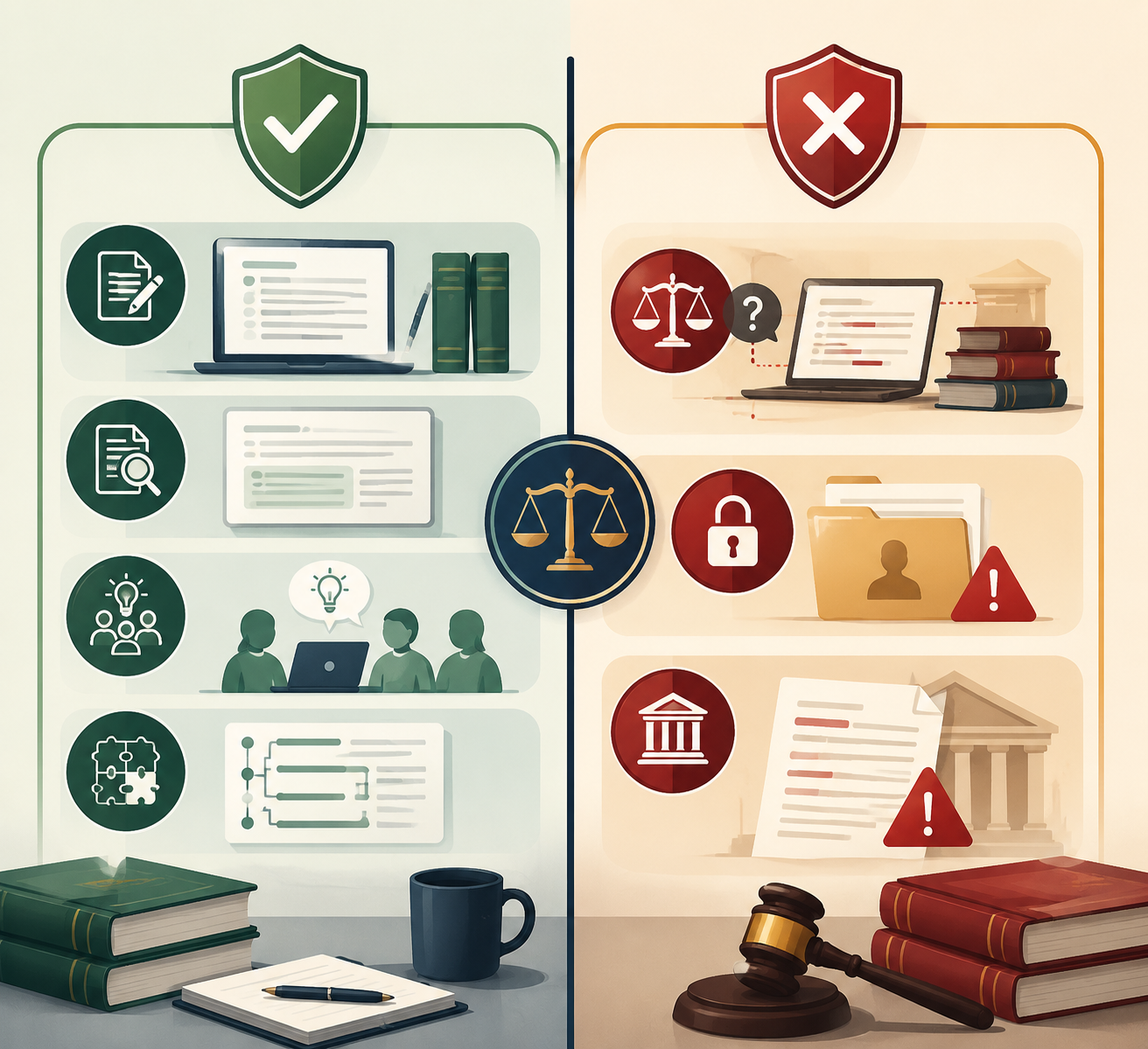
The safer profile is narrower than the marketing language around generative AI suggests. ChatGPT can be useful for first-pass drafting, summarizing non-confidential background materials, turning a messy outline into a cleaner memo structure, preparing issue lists, simplifying dense language, and brainstorming arguments when no privileged facts are supplied. It becomes dangerous when the task depends on legal authority, client confidences, privilege preservation, or court-facing accuracy.
| Use of ChatGPT | Risk judgment for legal practice |
|---|---|
| Rewrite a non-confidential paragraph for clarity | Generally low risk if a lawyer reviews the result |
| Summarize non-confidential background materials | Useful, but the summary must be checked against the source material |
| Brainstorm issues or questions before research begins | Acceptable when no client secrets are included and no output is treated as authority |
| Find cases, quote statutes, or state current law | Unsafe unless every proposition is independently verified in primary legal sources |
| Upload privileged client facts into a consumer-tier account | High privilege and confidentiality risk |
| Place AI-generated citations or legal analysis into a filing without independent review | Sanctions risk |
The reason this matters now is not that lawyers suddenly discovered automation. It is that private use has moved faster than institutional control. Clio’s 2025 Legal Trends Report says 79% of legal professionals use AI and 52% use ChatGPT, while ABA 2025 materials put firm-wide generative AI deployment at 21%. That gap is where the ethics problem usually starts: a lawyer or staff member quietly uses a convenient tool, the firm has no rule for what may be entered, no review protocol for what comes out, and no clear owner for the risk.
The Ethical Spine: Competence, Confidentiality, And Supervision
ABA Formal Opinion 512, issued in July 2024, is the most useful starting point because it does not treat generative AI as magic or as contraband. It translates the tool into familiar professional duties: competence, confidentiality, communication, fees, and supervision. The opinion warns that lawyers must understand the benefits and risks of the technology they use, protect client information, and supervise both lawyers and nonlawyers who rely on AI tools.[1]
The important word is not “AI.” It is “lawyer.” A lawyer cannot avoid responsibility by saying the software produced the error. If ChatGPT invents a case, misses a limitation, misstates a standard, or changes a quotation, the professional failure occurs when a lawyer adopts that output without doing the work a lawyer is required to do.
That is why competence under Opinion 512 is more than knowing how to type a better prompt. The lawyer must know the tool’s limits: it generates probable language, not verified legal truth; it can sound confident while being wrong; it may omit controlling authority; and it may fabricate citations or quotations. A good prompt may improve the usefulness of a draft, but it does not convert ChatGPT into a citator, a docket search system, or a subscription legal database.
Supervision matters in the same practical way. A partner who prohibits AI in writing while associates use it anyway has not solved the problem. A firm that permits AI but gives no rule for source checking, client data, or court filings has not solved it either. The question is whether the lawyer responsible for the matter can explain what the tool was used for, what information was entered, what came out, and how the final work was verified.
For a deeper implementation framework, see How to Build an ABA Formal Opinion 512 Compliance Playbook. The short version is that a defensible ChatGPT policy starts with legal duties, not feature lists.
Privilege Risk Is No Longer A General Warning
United States v. Heppner sharpened the confidentiality analysis. As discussed in the Harvard Law Review Blog’s 2026 analysis, the decision treated AI exchanges as privileged only when the use of the tool was counsel-directed, contractually confidential, and tied to legal advice. Consumer-tier ChatGPT and similar consumer AI tools failed that framework because the communications were not sufficiently directed by counsel, protected by contractual confidentiality, or connected to legal advice.[2]
That is a more concrete test than “be careful with secrets.” It requires asking who controlled the interaction, what contract governed the tool, and why the communication existed. A client who pastes facts into a public chatbot before calling counsel is in a very different position from a law firm using an enterprise arrangement under lawyer supervision for a defined legal task. The words “AI” and “ChatGPT” do not answer the privilege question by themselves.
| Question after Heppner | Consumer ChatGPT risk | Business or enterprise posture |
|---|---|---|
| Was the exchange directed by counsel? | Often no, especially if the client or employee uses the tool independently | Can be structured so use is lawyer-directed |
| Was the exchange contractually confidential? | Consumer-tier terms may not satisfy the needed confidentiality posture | Depends on the negotiated or applicable business terms |
| Was the exchange tied to legal advice? | Often unclear if used for convenience, drafting, or general explanation | Can be documented as part of a legal-service workflow |
The pricing-tier distinction belongs in the privilege analysis because the same brand name can sit on materially different arrangements. A free or consumer subscription should not be treated as a secure extension of the case file. Business or enterprise tools may offer stronger contractual terms, administrative controls, data-handling commitments, and auditability, but even then the privilege analysis does not disappear. The lawyer still needs to connect use of the tool to legal advice and keep human direction in the workflow.
For client facts, the default rule should be simple enough that no one needs to interpret it at midnight: do not put privileged or confidential client information into consumer-tier ChatGPT. If a firm wants to use generative AI with matter-specific facts, that use belongs inside an approved environment, under a written policy, with terms reviewed for confidentiality, data retention, training use, access control, and audit rights.
The Sanctions Pattern Is A Broken Workflow
The sanctions cases are often described as AI horror stories. They are better understood as verification failures. The basic pattern is repetitive: a lawyer uses ChatGPT or another AI tool to generate legal authorities, the tool fabricates or distorts them, and the lawyer files the result without checking the citations in a reliable legal database.
Mata v. Avianca became the early warning after lawyers submitted nonexistent cases and were sanctioned $5,000. Later sanctions episodes, including ByoPlanet, Mostafavi, Landberg, and a Sixth Circuit sanctions order, reflected the same professional breakdown at higher dollar amounts and with more severe collateral consequences. For a running sanctions chronology, see AI Hallucination Sanctions in 2026: The Enforcement Wave by the Numbers.
The California Mostafavi matter shows how quickly this can leave the realm of embarrassment and become professional discipline territory. CalMatters reported that a Los Angeles lawyer was fined $10,000 after filing a brief containing AI-generated fake cases, in a proceeding that drew attention as California considered AI regulation.[3]
The lesson is not that lawyers must never use AI to think through a problem. The lesson is that generated legal authority is not authority. A citation exists only after the lawyer has found it in a primary or trusted legal database, read it, confirmed that it says what the filing says it says, and checked whether it remains good law.
Why ChatGPT Fails At Citation-Dependent Research
ChatGPT is designed to produce fluent, context-sensitive text. That is why it can be useful for drafting. It is also why it is unsafe as a stand-alone legal research tool. A sentence can look like a judicial holding, follow the rhythm of a real case summary, and still be fabricated or materially wrong.
The Stanford RegLab and HAI study published in 2024 found that state-of-the-art large language models hallucinated on 69% to 88% of specific legal queries, and that on precedential relationship tasks they performed no better than random guessing. The same study found that legal-specific retrieval-augmented generation tools reduced hallucinations but still hallucinated in at least one in six benchmark queries.[4]
That distinction matters. Legal-specific tools connected to legal databases may reduce risk, but they do not eliminate the lawyer’s duty to verify. General-purpose ChatGPT sits further from the source material. It may be fine for asking, “What issues should I research?” It is not fine for asking, “Give me the controlling cases,” and then trusting the answer.
The Charlotin AI Hallucination Cases Database illustrates the scale of the documented problem. As of July 3, 2026, the database listed 1,696 judicial decisions involving AI hallucinations across more than 40 jurisdictions, including 1,187 in U.S. courts and 663 involving lawyers. The database also reported acceleration from roughly two cases per week in early 2025 to two to three per day in late 2025.[5]
That database tracks court-addressed hallucination incidents, not every hallucination that occurred in private practice. It therefore should not be read as an incidence rate. It is still enough to refute the comforting assumption that fake AI citations are rare edge cases affecting only careless lawyers.
A Defensible ChatGPT Workflow For Lawyers
A workable policy does not need to ban every useful interaction. It needs to separate tasks that benefit from language assistance from tasks that require legal authority, confidentiality protection, or professional judgment. The separation should be visible in the workflow, not buried in a training slide.
- Use ChatGPT for drafting only after deciding what facts may be shared and what legal authorities will be supplied from verified sources.
- Keep privileged and confidential client information out of consumer-tier tools.
- Treat every case, statute, quotation, rule statement, and procedural assertion generated by AI as unverified until checked elsewhere.
- Verify legal authority in primary sources or trusted legal databases, not by asking the same AI tool whether it is correct.
- Assign a human lawyer final responsibility for the work product before it goes to a client, opposing counsel, regulator, or court.
The most important operational rule is to separate drafting from research. ChatGPT may help turn a verified research outline into a first draft. It should not be the system that finds the law, validates the law, and writes the filing. Those functions need different controls.
Before Using The Tool
The lawyer should classify the information before it enters the tool. Public procedural background, generic legal concepts, and invented hypotheticals are different from client communications, litigation strategy, settlement posture, nonpublic deal terms, medical records, internal investigations, and witness facts. If the information would make a client nervous to see in a vendor training set, a casual chatbot window is the wrong place for it.
Instructions to the tool should also make its role explicit. A safe request asks for structure, clarity, possible issues, plain-language explanation, or alternative wording. A risky request asks the model to provide controlling law, quotations, or a finished argument without supplying verified sources.
During Drafting
ChatGPT is most useful when the lawyer controls the ingredients. For example, a lawyer can provide a non-confidential outline and ask for a clearer introduction, a client-friendly summary, a list of questions for a witness interview, or a neutral comparison of arguments already identified by counsel. The tool can reduce blank-page time and expose gaps in organization.
It should not be allowed to smuggle in authorities. If the model adds case names, quotations, statutory references, dates, or factual assertions that the lawyer did not provide, those additions should be treated as suspect. The safer drafting instruction is often: do not add citations or legal authorities; use only the authorities provided.
Before Filing Or Sending
The final review should not be a quick read for tone. It should include source verification, factual verification, privilege review, and professional judgment. Every cited case must be opened. Every quotation must be compared. Every parenthetical must be checked. Every legal standard must be tied to authority the lawyer has actually read.
Do not delegate that verification back to ChatGPT. Asking the same model whether its earlier answer was accurate is not independent review. It is a second conversation with the same risk source.
Where ChatGPT Fits In A Legal Tool Stack
ChatGPT is a general-purpose AI tool. That is both its appeal and its limit. It can help across many writing and comprehension tasks, but it is not built around the legal profession’s core controls: authoritative source retrieval, citator treatment, matter-level confidentiality, court-rule compliance, and audit trails.
Legal-specific tools may be a better fit for research-heavy work, especially where they connect outputs to source databases. Even then, the Stanford findings make the duty to verify unavoidable. Vendor benchmark claims should be treated as vendor claims unless independently tested under conditions that resemble the firm’s actual work.
Readers comparing options can start with How to Choose AI Tools for Your Law Firm in 2026 or, for accuracy-focused legal AI comparisons, CoCounsel vs Lexis+ AI: Accuracy, Hallucination Rates, and the Duty to Verify. Small firms weighing cost and control tradeoffs may also want How to Choose a Legal AI Tool for Your Small Law Firm in 2026.
The Firm Policy Should Match The Actual Use
A written policy that no one follows is worse than a candid policy with limits. Firms should assume that lawyers and staff are already using AI somewhere: to clean up emails, summarize articles, start memos, prepare deposition topic lists, or translate legalese into client language. The policy should bring that behavior into view.
The minimum policy should state which tools are approved, which data may be entered, which tasks are prohibited, what verification is required, who may approve matter-specific AI use, and what must be documented. Litigation teams should add a court-order check, because some judges and courts require AI disclosures or certifications. For the institutional layer, see Closing the Governance Gap for AI Legal Research.
Training should be practical rather than abstract. Lawyers do not need another hour of awe or panic. They need examples of acceptable prompts, prohibited inputs, fake citation failures, privilege-risk scenarios, and final-review checklists. Staff need the same rules, because a confidentiality breach does not become harmless because it began with a paralegal, assistant, or summer associate.
The Working Boundary
ChatGPT can belong in legal work as a drafting and comprehension assistant. It should not be allowed to become an unverified research engine, a repository for privileged client facts, or an invisible co-author of court filings. The defensible boundary is operational: separate drafting from research, keep privileged material out of consumer tools, verify every citation in primary legal databases, and assign a human lawyer final responsibility.
That boundary will not make AI use perfectly safe. It will make the lawyer’s choices explainable to a court, a client, a managing partner, an insurer, or a disciplinary authority. In legal practice, that is the standard that matters.
References
- ABA issues first ethics guidance on a lawyer’s use of AI tools, American Bar Association, July 2024, link
- United States v. Heppner, Harvard Law Review Blog, March 2026, link
- ChatGPT lawyer fine AI regulation, CalMatters, September 2025, link
- Hallucinating Law: Legal Mistakes with Large Language Models are Pervasive, Stanford HAI, link
- AI Hallucination Cases Database, Damien Charlotin, July 3, 2026, link
Chronological incident history
No sanction cases have named this tool in the tracked record set to date. This does not imply the tool is safe — see Risk Digest for ongoing monitoring.
← Compare peer toolsReport a correction or tip
Spotted an outdated figure, a misstated fact, or a ruling this tool profile should reflect? Public comments are disabled for this content given the professional cost of a misreported case outcome, penalty amount, or rule text — use the structured correction channel instead.
Report a correction or tip for this record →