
The Capital Imbalance: 71% of Legal AI Funding Has Gone to Plaintiff-Side Startups
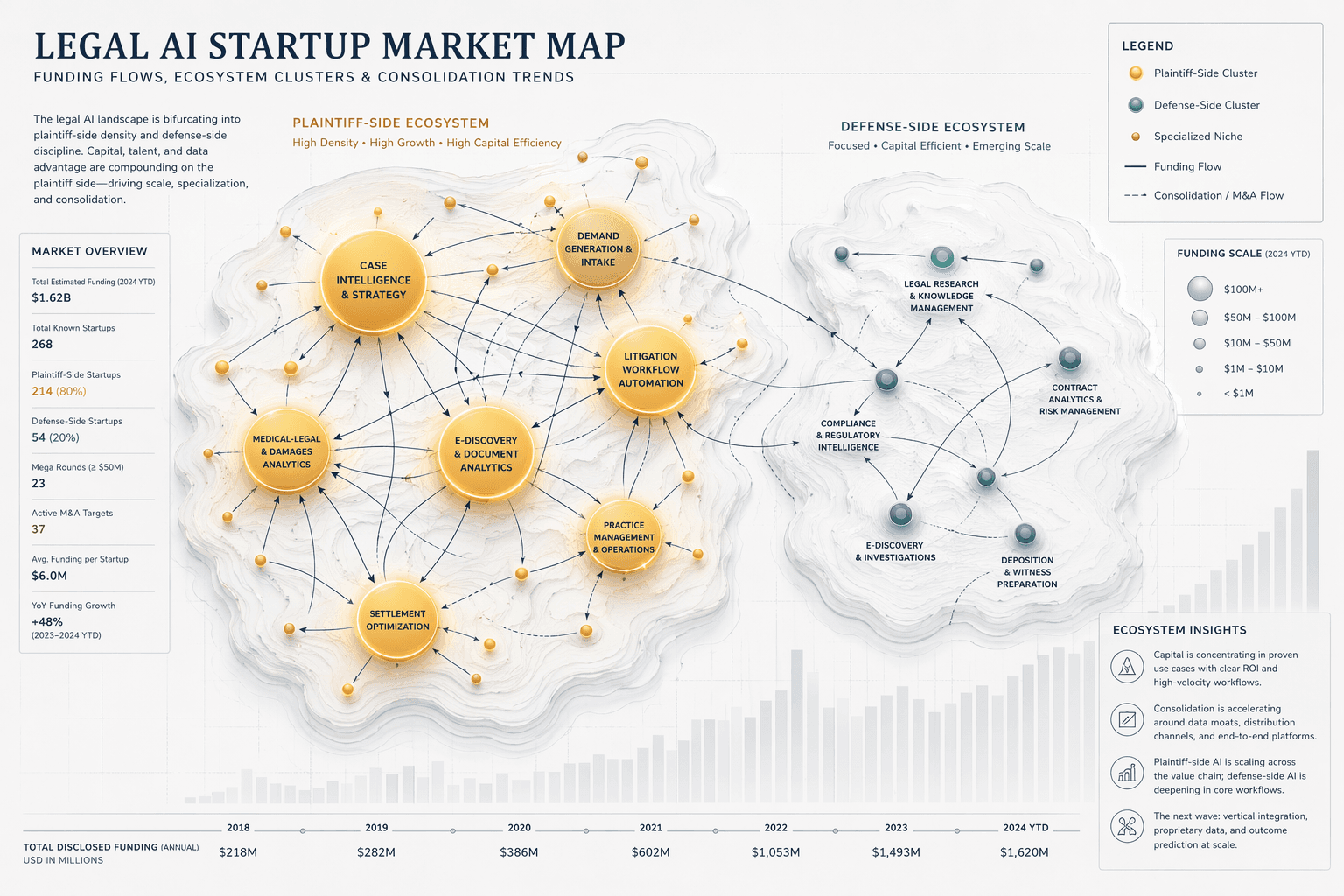
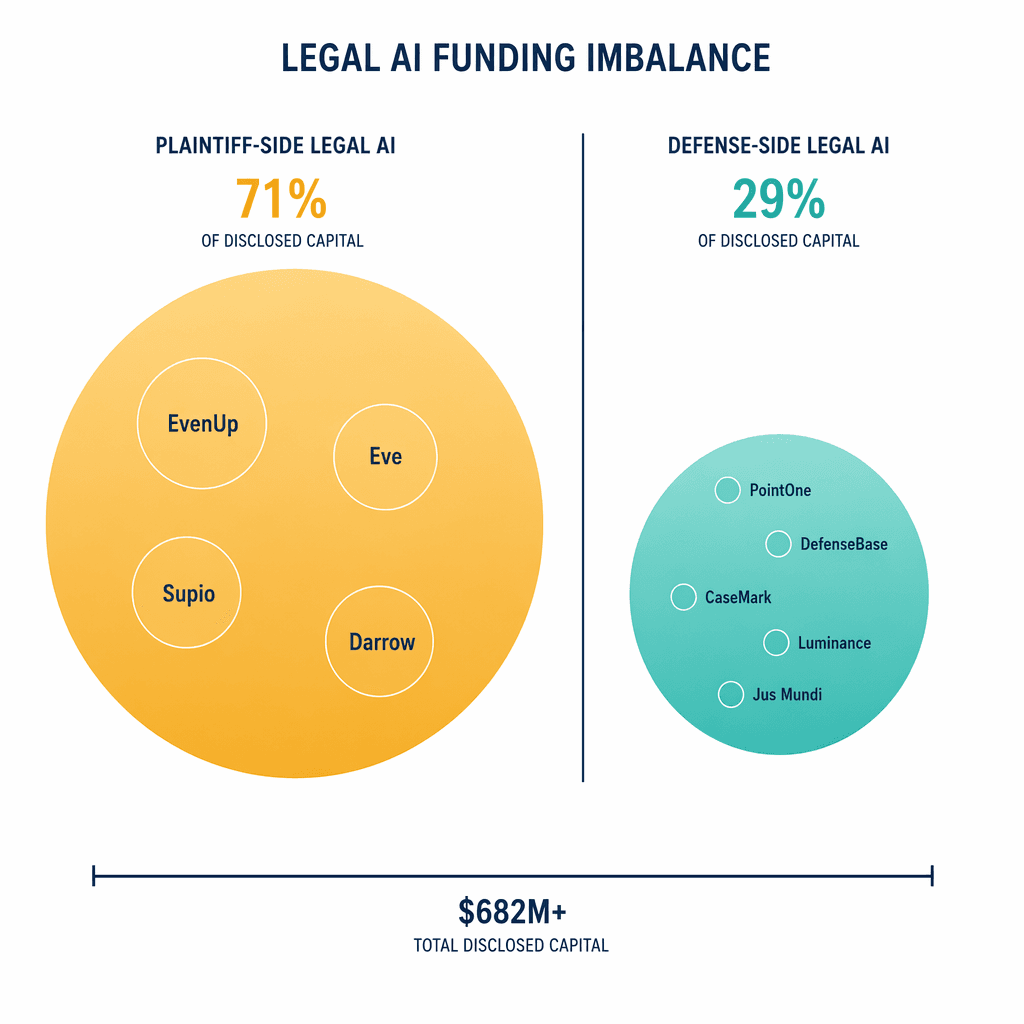
The legal AI market is not a single, uniform landscape. It is a market with a pronounced structural asymmetry, and the data on where venture capital has flowed makes that asymmetry impossible to ignore. According to a Crunchbase News analysis, plaintiff-focused legal AI companies account for approximately 71% of all disclosed capital invested in the sector. The combined total for four plaintiff-side startups alone — EvenUp ($370 million), Eve ($164 million), Supio ($85 million), and Darrow ($63 million) — comes to roughly $682 million.
This concentration is not accidental. It reflects a market where investors have found a part of the sector where adoption, workflow clarity, and venture-scale narratives already align. The defense side, by contrast, has not yet produced a breakout company of comparable scale. The Crunchbase analysis describes defense-side litigation AI as "an underbuilt segment of a broader legal software market." For legal operations leaders and investors, that description is less a diagnosis than it is a signal.
Why Plaintiff AI Scaled First: Standardized Workflows and Clearer ROI
The capital imbalance is not arbitrary. Plaintiff-side legal AI scaled first because the underlying workflows are structurally more amenable to automation and venture-scale business models. Several factors converged to make plaintiff-side startups attractive to investors.
- Standardized intake processes. Personal injury and mass tort practices follow repeatable intake patterns: client screening, medical record collection, demand letter generation, and settlement negotiation. These workflows are consistent enough across firms to be productized.
- Clearer ROI metrics. Plaintiff-side ROI is measurable in settlement value, cycle time reduction, and case volume. A tool that increases per-attorney case throughput by 3x or reduces intake-to-demand time by 40% produces a direct, quantifiable return that makes procurement decisions easier.
- Simpler sales cycles. Plaintiff firms are typically smaller, more entrepreneurial, and more willing to adopt new technology when the ROI case is clear. The decision-maker is often a managing partner who can approve a purchase in weeks, not months.
- Repeatable venture narratives. Investors understand the "software eating the personal injury market" story. It maps to familiar SaaS metrics: ARR per law firm, case volume growth, and expansion revenue from existing clients.
These structural advantages made plaintiff-side AI a natural first wave. The question for investors and legal ops leaders is whether the second wave — defense-side litigation intelligence — will produce even larger outcomes.
The Defense-Side Pain Point: Fragmented Systems, Spreadsheets, and No Portfolio Visibility
The operational reality for corporate legal departments and law firms managing high-volume defense work is strikingly different from the plaintiff-side environment. Where plaintiff firms have standardized intake pipelines, defense-side operations are often a patchwork of fragmented systems, manual processes, and institutional inertia.
The Crunchbase analysis describes the current state bluntly: corporate legal departments and the law firms managing high-volume defense work still rely heavily on fragmented systems, spreadsheets, and email-based coordination. For a legal operations leader at a large retailer, insurer, or healthcare system managing hundreds of active litigation matters, the lack of portfolio-level visibility is a persistent operational pain point.
- No centralized view of litigation risk. GCs and legal ops directors cannot easily see across all active matters to identify patterns in opposing counsel behavior, judge rulings, or settlement ranges.
- Manual data aggregation. Key data points — case status, budget burn, defense counsel performance — are often scattered across email threads, individual spreadsheets, and separate matter management systems.
- Inconsistent workflows across practice areas. Unlike plaintiff-side personal injury, defense work spans employment, product liability, commercial disputes, regulatory enforcement, and dozens of other practice areas, each with its own workflow patterns.
- Limited outcome data. Defense-side organizations rarely have systematic access to historical verdict data, settlement benchmarks, or judge-specific analytics that could inform case strategy and budgeting.
This fragmentation creates an opening. The defense-side market is not small — a Goldman Sachs report cited in the Crunchbase analysis estimates that 44% of legal work could eventually be automated. But the path to product-market fit is longer and more complex than the plaintiff-side route.
Emerging Solutions: Theo AI, Bench IQ, Pre/Dicta and the New Defense-Side Stack
A small but growing cohort of startups is attempting to build the defense-side litigation intelligence stack. These companies are early-stage compared to their plaintiff-side counterparts, but they share a common thesis: that proprietary outcome data, combined with AI-powered analytics, can transform how corporate legal departments manage litigation portfolios.
| Startup | Focus Area | Key Approach | Stage / Funding Context |
|---|---|---|---|
| Theo AI | Defense-side litigation intelligence | AI-powered portfolio analytics for corporate legal departments managing high-volume defense work | Early-stage; CEO authored the Crunchbase analysis framing the defense-side opportunity |
| Bench IQ | Litigation outcome prediction | Machine learning models trained on historical case data to predict judge behavior, settlement ranges, and case duration | Early-stage; part of the emerging defense-side analytics category |
| Pre/Dicta | Judge and venue analytics | Data platform providing attorney- and judge-specific analytics for litigation strategy | Established in the litigation analytics space; now incorporating AI-powered prediction features |
These companies are not yet household names in legal tech. Their combined disclosed funding is a fraction of what EvenUp or Eve have raised. But their emergence signals that the market is beginning to recognize the defense-side gap. For legal operations leaders evaluating their technology stack, these tools represent a new category of solution that did not exist three years ago.
Structural Barriers: Why Defense-Side Startups Face Longer Sales Cycles
The defense-side opportunity is real, but it is not easy to capture. Startups entering this market face structural barriers that plaintiff-side companies largely avoided. Understanding these barriers is essential for investors evaluating the thesis and for legal ops leaders considering adoption.
- GC-as-buyer dynamics. The buyer for defense-side litigation intelligence is often the General Counsel or a senior legal operations leader at a large enterprise. These buyers are risk-averse, require extensive security and compliance reviews, and have procurement processes that can stretch six to twelve months.
- Non-standardized workflows. Unlike plaintiff-side personal injury, defense work varies dramatically by practice area, jurisdiction, and client. A product that works for employment litigation at a retailer may not translate to product liability defense at a manufacturer.
- Enterprise sales complexity. Selling to Fortune 500 legal departments requires navigating multiple stakeholders: the GC, legal ops, IT security, data privacy, and sometimes outside counsel coordination. Each stakeholder has different priorities and approval requirements.
- The governance gap. Many enterprises lack formal AI governance frameworks, which creates friction in procurement. Legal departments are still developing policies for when and how AI tools can be used in litigation workflows.
These barriers are not insurmountable, but they mean that defense-side startups need more capital, longer runways, and more patient investors than their plaintiff-side counterparts. The companies that succeed will likely be those that can demonstrate clear ROI in a single, well-defined use case before expanding to adjacent workflows.
The Data Moat Thesis: Why Proprietary Outcome Data Becomes More Valuable With Scale
The most compelling argument for defense-side legal AI as a venture-scale opportunity is the data moat thesis. Unlike general-purpose AI tools that rely on publicly available training data, defense-side litigation intelligence platforms can accumulate proprietary datasets that become more valuable as they grow.
Consider the types of data that a defense-side platform could aggregate over time: verdict outcomes by jurisdiction, settlement ranges by case type, judge-specific ruling patterns, opposing counsel win rates, expert witness performance metrics, and duration benchmarks for different litigation phases. Each new data point improves the accuracy of predictive models and increases the switching costs for customers.
This creates a winner-take-most dynamic. The startup that achieves critical mass in a specific practice area or jurisdiction builds a defensible advantage that is difficult for competitors to replicate without their own proprietary data. Plaintiff-side companies like EvenUp have already demonstrated this dynamic in personal injury. The question is whether a defense-side company can replicate it in a more fragmented market.
Market Timing Signals: Valuations, Consolidation, and the $40B Addressable Market
Several market signals suggest that the conditions are ripening for a defense-side breakout. The broader legal AI market is maturing rapidly, creating tailwinds that could accelerate adoption in underserved segments.
| Signal | Detail | Source |
|---|---|---|
| Record legal AI funding in 2025 | $3.2 billion invested across 102+ deals from Q1 2024 to Q2 2026 | New Market Pitch dataset |
| Harvey AI valuation | $11 billion after $200M round in March 2026 | Broadband Breakfast / Stanford CodeX coverage |
| Legora valuation surge | Tripled to $5.55 billion after $550M round in March 2026 | Broadband Breakfast / Stanford CodeX coverage |
| Consolidation activity | Legora acquired Walter (March 2026); Harvey acquired Hexus (January 2026); Thomson Reuters acquired Noetica (February 2026) | Prime Legal Staffing Q2 2026 M&A analysis |
| Projected market size | $5.21 billion in 2026, growing to $40.94 billion by 2034 (29.4% CAGR) | Fortune Business Insights |
| Law firm AI adoption | 65% of U.S. law firms have adopted some form of AI for document review and legal research | Fortune Business Insights (citing U.S. Department of Justice) |
The consolidation activity is particularly noteworthy. When large platforms like Thomson Reuters acquire AI-native companies like Noetica, it signals that the incumbents view AI-driven transactional analysis as strategically important. Similarly, Harvey's acquisition of Hexus — an enterprise adoption startup — suggests that even the highest-valued legal AI companies recognize that enterprise deployment is a bottleneck that needs to be solved.
For defense-side startups, these signals cut both ways. The market is clearly large enough to support multiple winners — Fortune Business Insights projects a $40.94 billion market by 2034. But the consolidation trend also means that the window for independent startups to achieve escape velocity may be narrowing. The companies that control legal technology platforms will increasingly shape how legal services are delivered and priced, as noted in the Prime Legal Staffing Q2 2026 M&A analysis.
What Investors and Legal Ops Leaders Should Watch For
The defense-side legal AI opportunity is real, but it is not a sure thing. For investors evaluating the thesis and legal operations leaders considering their technology roadmaps, several indicators will signal whether the market is maturing as expected.
- Defense-side funding rounds. The most direct signal will be a significant Series A or B round for a defense-side litigation intelligence startup. A $30M+ round from a top-tier venture firm would validate the thesis and likely trigger a wave of competitive activity.
- Enterprise pilot announcements. Watch for public announcements from Fortune 500 legal departments piloting defense-side analytics tools. Early enterprise adoption, even at small scale, would signal that the product-market fit is emerging.
- Data partnership deals. The data moat thesis depends on proprietary data. Partnerships with court data providers, insurance companies, or large law firms that agree to share anonymized outcome data would be a strong signal that the data aggregation model is working.
- Platform acquisitions. If Thomson Reuters, LexisNexis, or another incumbent acquires a defense-side analytics startup, it would confirm that the market sees strategic value in this segment.
- New roles and hiring patterns. The emergence of dedicated "litigation intelligence analyst" or "legal AI operations" roles at corporate legal departments would indicate that organizations are investing in the infrastructure needed to use these tools effectively.
For legal operations leaders, the strategic implication is clear: the tools that will define defense-side litigation management over the next decade are being built now. Early adopters who engage with emerging platforms, provide feedback, and shape product development will have a competitive advantage in building the workflows and data assets that will become standard practice.
The next $1 billion legal AI startup may not look like the last one. It will likely be a company that solves the defense-side data fragmentation problem, navigates the enterprise sales cycle, and builds a proprietary data moat in a market that most investors have overlooked. The question is not whether that company will emerge — it is which team will execute well enough to capture the opportunity.
Comments
Join the discussion with an anonymous comment.