
Who's Actually Sued in the Sofia Vergara AI Deepfake Case
Tranchin v. EBY, Inc. — the case behind the "Sofia Vergara AI deepfake lawsuit" headlines — puts Vergara's co-founded underwear brand, not Vergara, in the defendant seat over an allegedly AI-altered creator video, making it the first high-profile commercial test of California Civil Code § 1708.86 against a celebrity-backed brand. The record separates confirmed docket events from unproven allegations and tracks the motion-to-dismiss deadlines as of Aug 26, 2026.
- Jurisdiction
- U.S. federal (N.D. Cal.)
- Court
- U.S. District Court for the Northern District of California, San Francisco
- Judge
- Magistrate Judge Peter H. Kang
- AI tool named
- Unspecified generative AI video tool
- Ruling date
- Nov 4, 2026
- Source document
- View primary court order ↗
- Last verified
- Aug 26, 2026
Lex Machina Review is an independent risk-tracking and reference resource. Nothing on this site is legal advice, and using it does not create an attorney-client relationship. Every record is reviewed against primary sources but may not reflect the most current status of a matter — always verify directly against the cited court order, rule text, or a licensed attorney before relying on it.
Companion explanation — secondary to the source document above
Case header: what the “Sofia Vergara AI deepfake lawsuit” actually is
The search phrase is legally imprecise. The case is Tranchin v. EBY, Inc., a Northern District of California lawsuit by Dallas creator Molly Tranchin, known online as FashionVeggie, against EBY, Inc., the underwear brand co-founded by Sofia Vergara. Vergara is not a party. The celebrity connection explains the headline shorthand; it does not identify the defendant.
| Item | Risk Digest record |
|---|---|
| Case | Tranchin v. EBY, Inc., No. 3:26-cv-05559, N.D. Cal. [1] |
| Plaintiff | Molly Tranchin, a Dallas influencer also known as FashionVeggie; complaint filed June 9, 2026. [1] |
| Defendant | EBY, Inc.; Sofia Vergara is not listed as a party on the docket. [1] |
| Court / judge | U.S. District Court for the Northern District of California, San Francisco; Magistrate Judge Peter H. Kang. [1] |
| Jurisdiction / suit code | PACER Monitor lists cause as 28:1332 diversity and nature of suit 890. [1] |
| Statute to watch | California Civil Code § 1708.86, pleaded alongside contract, copyright, publicity, privacy, defamation, tort, and emotional-distress theories. [2][3] |
| Live status verified Aug. 26, 2026 | EBY filed a motion to dismiss on Aug. 17, 2026; opposition due Aug. 31, 2026; reply due Sept. 8, 2026; hearing reset to Nov. 4, 2026 at 2:00 p.m. [1][4] |
Confirmed docket facts, reported allegations, and what remains untested
The confirmed record is narrow but important. The complaint was filed on June 9, 2026. EBY’s motion to dismiss was filed on Aug. 17, 2026. The docket schedule, as reported and reflected in the public docket, leaves the opposition due Aug. 31, the reply due Sept. 8, and the hearing set for Nov. 4, 2026. As of Aug. 26, 2026, no opposition brief was yet due, and EBY had not answered on the merits. [1][4]
The conduct allegations come from the complaint and reporting on that pleading. Tranchin alleges that EBY used an unspecified generative-AI video tool to alter creator content she had made for the brand, making a video appear to expose her breasts through a sheer bra, then published the edited video on EBY’s Instagram and, through a whitelisting arrangement, through her own account without review or approval. [5][6]
That distinction matters because EBY’s motion is now the live litigation event. Law360 reported the company’s position at the motion-to-dismiss stage as including the argument that the video is “not pornography as commonly understood.” That is the retrievable public description of the defense posture; the ruling should not be predicted from it, and no merits answer should be assumed from it. [4]
| Record category | What can be said now |
|---|---|
| Confirmed | Case number, court, judge, filing date, pending motion-to-dismiss schedule, and the existence of an AI-use notice attachment on EBY’s Aug. 17 motion filing. [1][4] |
| Alleged | The AI alteration, the sexualized nature of the altered video, publication, whitelisting through Tranchin’s account, and lack of review or approval. [5][6] |
| Reported from complaint / legal press | The claims list and the agreement-versus-editing theory described below. [2][3][5][6] |
| Unknown from the cited public record | The specific AI tool allegedly used, the court’s view of § 1708.86 at the pleading stage, and whether the facts will survive discovery. |
The agreement is the center of the case
The strongest way to read the complaint is not as a free-floating platform deepfake dispute. It is a brand-deal control case. Tranchin allegedly agreed on Sept. 23, 2025 to create content for EBY under terms that allowed one round of “reasonable edits” with her feedback, while she retained copyright and derivative-work rights. The complaint’s theory is that the alleged AI alteration crossed that contractual line. [3][6]
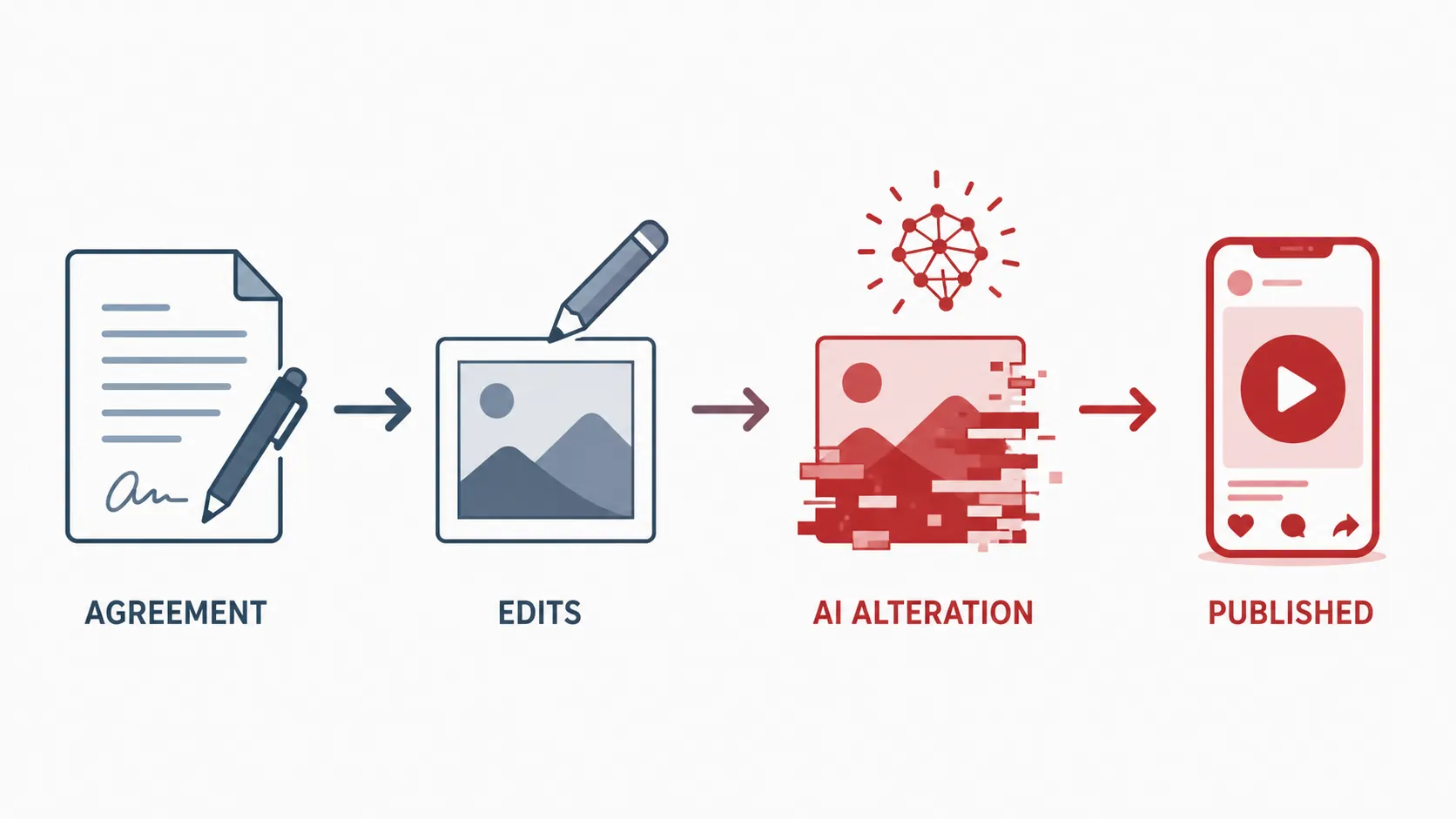
That workflow is the risk fact pattern: a creator consents to make brand content; the brand receives limited editing latitude; the agreement preserves the creator’s copyright and derivative-work rights; the brand allegedly uses AI to create a materially different sexualized version; the brand allegedly publishes that version on its own social channel and through whitelisting on the creator’s account. The alleged injury is not only that a video appeared online. It is that the publication allegedly used the creator’s own commercial channel after the edit became something she says she did not approve.
Whitelisting is what makes the dispute feel less like a remote content-moderation problem and more like an internal approval failure. If an advertiser can push content through a creator’s account, the approval boundary is not cosmetic. The account carries the creator’s identity, audience trust, and implied authorship. In this case, whether those permissions were respected is an allegation for the pleadings and, if the case proceeds, the proof record. But the complaint shows why influencer counsel will now look harder at edit clauses that used to be treated as routine.
The complaint also pleads the case more broadly than the § 1708.86 count. Reported claim lists include aiding and abetting disclosure of a nonconsensual deepfake, right of publicity, invasion of privacy, defamation, breach of contract, tortious interference, copyright infringement, intentional infliction of emotional distress, and negligence. [2][3]
Why § 1708.86 is the statute to watch
California Civil Code § 1708.86 is not the same thing as California’s election-deepfake laws. Readers arriving with a general memory that some California deepfake rules were blocked should keep the categories separate. The constitutional fights over AB 2839 and AB 2655 concerned election and platform-related synthetic media rules; § 1708.86 addresses nonconsensual digitally altered sexually explicit material and has not been invalidated on that basis in this record. For that election-law boundary, see our California election deepfake-law tracker.
Section 1708.86 originated with AB 602 in 2019, which targeted the distribution of nonconsensual sexually explicit deepfakes. [7] The statute later changed through AB 621, effective Jan. 1, 2026. Secondary statutory trackers and code publishers report a post-amendment damages structure that includes up to $250,000 for malicious violations, but exact damages language should be checked against official California legislative text before it is quoted in a filing or board memo. [8][9]
For commercial AI-video review, the date matters. The alleged brand agreement was in 2025; the complaint was filed in 2026; the amended damages framework was effective Jan. 1, 2026. That does not resolve liability or damages. It does explain why this case is being watched beyond fashion and influencer circles: it places a celebrity-backed consumer brand in a pleading fight over whether an allegedly AI-altered, sexualized edit of consented UGC can fit within California’s nonconsensual deepfake statute.
The useful caution is narrower than the headline. This is not, on the available record, a case about an AI impersonation ad using a celebrity face without permission. It is not a political deepfake case. It is not a claim by Vergara over a fake video of herself. It is a commercial creator-content dispute in which the pleaded statutory count depends on the alleged movement from consented content to nonconsensual digitally altered sexually explicit material.
For comparison layers, our federal deepfake law status map tracks federal legislative status; the advertiser-side liability matrix covers adjacent campaign-risk theories; and the NO FAKES Act analysis addresses the federal likeness-rights layer. Those are adjacent frameworks, not substitutes for the § 1708.86 question now teed up in Tranchin.
The AI notice is not a sideshow
EBY’s Aug. 17 motion filing included a “Notice Regarding Use of Artificial Intelligence” attachment. [1][4] That filing detail belongs in the risk record because Judge Kang’s standing order context makes AI-use disclosure part of counsel’s litigation hygiene, not merely a technology footnote. Drug & Device Law has noted Judge Kang’s Rule VII(C) GenAI-disclosure requirement in the Northern District of California as part of a wider court trend toward AI disclosure, certification, and consequences. [10]
The notice does not prove or disprove the alleged AI alteration at issue in the complaint. It signals something different: in a case about alleged AI-altered content, the court’s own AI-disclosure practices can become part of the procedural risk environment. Litigation teams should expect the record to distinguish between AI allegedly used in the underlying commercial act and AI, if any, used in drafting or preparing court filings.
What counsel should take from the docket now
The immediate calendar is simple: opposition due Aug. 31, 2026; reply due Sept. 8, 2026; hearing reset to Nov. 4, 2026. [1][4] Until those papers and any ruling exist, the practical record is a pleading-stage test, not an outcome.
- For brand counsel: edit rights in creator agreements should say whether AI alteration, body modification, garment transparency changes, sexualized edits, derivative versions, and whitelisted publication require fresh approval.
- For influencer counsel: retained copyright and derivative-work language should be matched with operational approval controls, especially where the brand can publish through the creator’s account.
- For AI-video procurement teams: a vendor tool review is incomplete if it only asks whether a synthetic output can be generated. The review also needs to ask whether the brand has rights to create that output, who approves it, and whether the edit changes the sexual or reputational character of the original content.
- For litigation teams: do not describe the case as a suit against Sofia Vergara, do not identify the AI tool unless the record does, and do not treat the motion to dismiss as a merits answer.
A verification workflow for viral or synthetic clips should start with source provenance, publication path, account-control history, and consent boundaries; our deepfake clip verification workflow is a useful operational companion to that review. In Tranchin, the disputed path is not merely “AI video appeared online.” It is alleged agreement, edit, AI alteration, publication, and whitelisting.
That is why the docket, not the celebrity headline, is the risk signal. The live question is whether a court will allow Tranchin’s theory to proceed past dismissal: that a consented creator deliverable allegedly became nonconsensual AI-altered sexualized content after the brand exceeded the editing and approval boundaries of the deal.
References
- Tranchin v EBY, Inc, PACER Monitor
- Testing the Influencer Sponsorship Relationship: Influencer Sues Apparel Company Over Alleged AI-Generated Deepfake Video, RPJ Law
- Influencer’s AI Deepfake Suit Against EBY Tests Creator Right, AI Fashion Law, July 24, 2026
- Sofia Vergara's Underwear Co. Moves To Nix AI Deepfake Suit, Law360, Aug. 18, 2026
- Dallas Influencer Sues Over Apparel Company’s Deepfake, Partially Nude Instagram Post, The Texas Lawbook
- What Happens When a Brand Uses AI to Alter an Influencer Content?, The Fashion Law
- California Enacts New Laws Targeting Deepfakes, Davis Wright Tremaine, Oct. 2019
- Amendment to Section 1708.86 of the California Civil Code Establishing Civil Liability for Non-Consensual Digitised Sexually Explicit Material — Assembly Bill 621 on Deepfake Pornography, Digital Policy Alert
- California Code, Civil Code - CIV § 1708.86, FindLaw
- Courts Get Proactive on AI Disclosure, Certification and Consequences, Drug & Device Law, Apr. 2026
Related records
Tool profile
How Meta's AI Spending Reshapes Law Firm ProfitabilityGoverning regulation
Browse the obligations tracker →Preventive workflow
Browse verification workflows →
Report a correction or tip
Spotted an outdated figure, a misstated fact, or a ruling this case record should reflect? Public comments are disabled for this content given the professional cost of a misreported case outcome, penalty amount, or rule text — use the structured correction channel instead.
Report a correction or tip for this record →