
Trump's mail-voting appeal turns on Supreme Court timing
With the Supreme Court still weighing the emergency application in Trump v. California, No. 26A124, the decisive risk is timing, not the lawfulness of the mail-voting order. Litigators get the docket-level picture: what the administration's ripeness argument actually says, the 23-state injunction record the appeal sits on, and the Purcell-timing scenarios that determine whether EO 14399 can be reviewed before the 2026 midterms.
- Jurisdiction
- US Federal
- Court
- U.S. Supreme Court
- Judge
- Ketanji Brown Jackson
- AI tool named
- No AI tool implicated
- Source document
- View primary court order ↗
- Last verified
- Aug 4, 2026
Lex Machina Review is an independent risk-tracking and reference resource. Nothing on this site is legal advice, and using it does not create an attorney-client relationship. Every record is reviewed against primary sources but may not reflect the most current status of a matter — always verify directly against the cited court order, rule text, or a licensed attorney before relying on it.
Companion explanation — secondary to the source document above
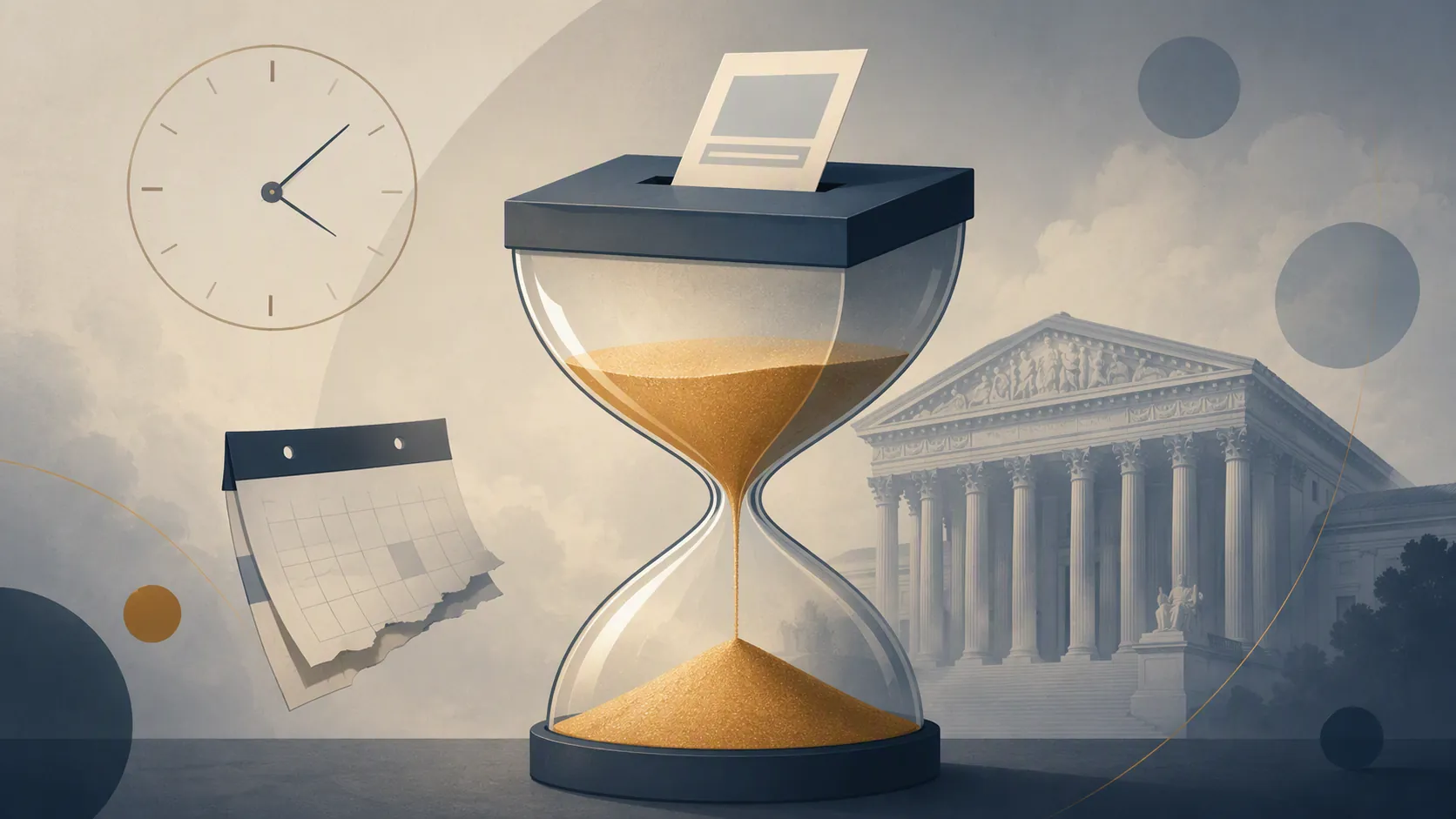
Record status, last verified Aug. 4, 2026: Trump v. California, No. 26A124, is pending on the Supreme Court’s emergency docket. Justice Ketanji Brown Jackson is the Circuit Justice. The states’ responses were due at 4 p.m. EDT on Aug. 3. The Court has not issued a ruling on the application as of this record check. [1]
If you arrived looking for a “Supreme Court Trump mail voting ruling,” this is the pending EO 14399 emergency application, not the already decided Watson v. RNC grace-period record, and not the older Trump-era mail-ballot disputes over matters such as undated ballots. The distinction matters because there is no Supreme Court ruling yet to measure for impact. There is an application, an injunction record, a ripeness argument, and a calendar that is starting to do legal work of its own.
What the administration actually asked the Court to do
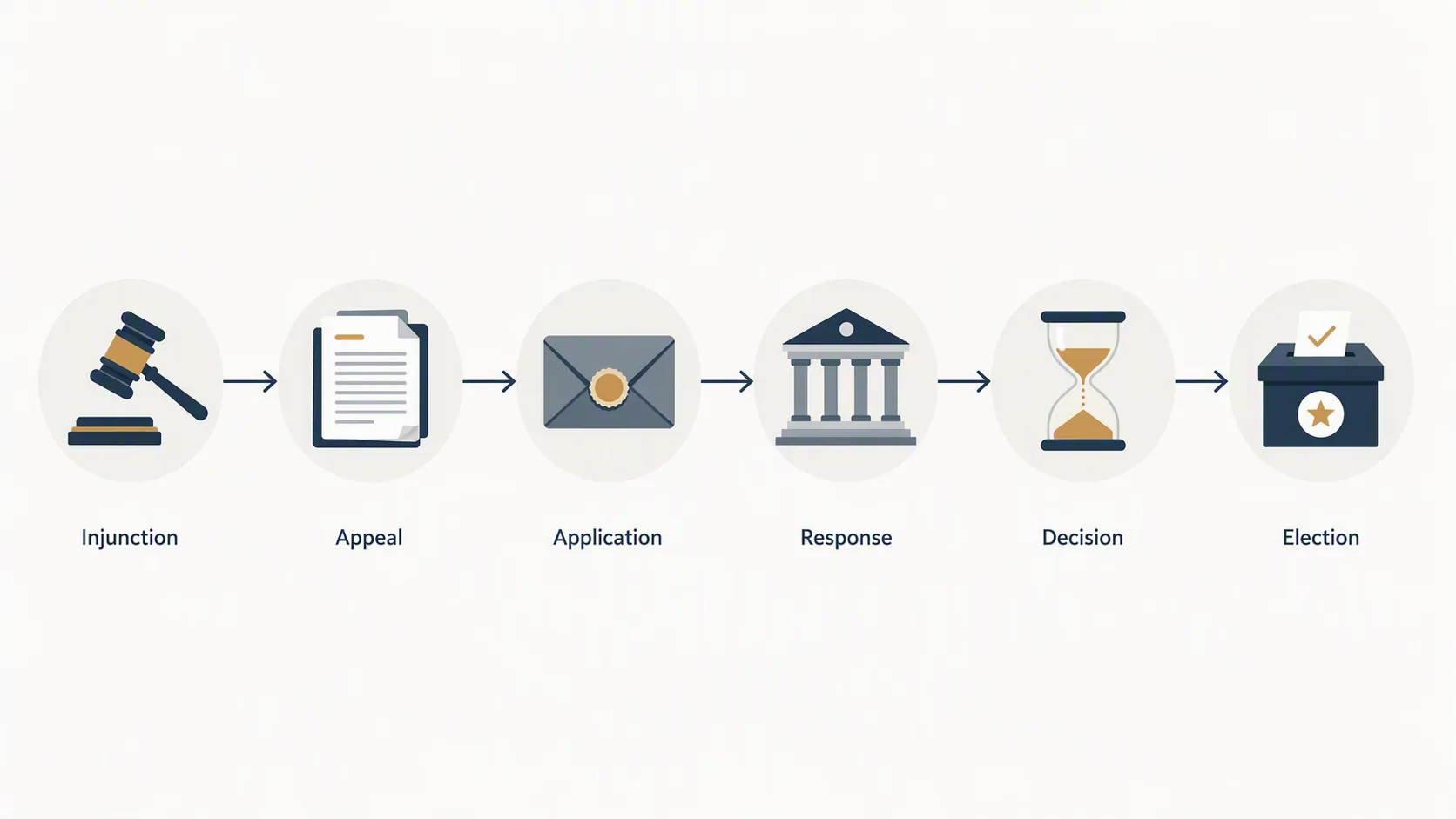
The emergency application was filed on July 27, 2026. The administration asked the Court to clear the way for new mail-voting restrictions connected to Executive Order 14399 while the case continues below, with a ruling possible later in August. [2]
The important move in the application is procedural. Solicitor General D. John Sauer does not ask the justices, at this stage, to settle the full Elections Clause fight over the executive order. He argues that the challengers’ suit is unripe because federal agencies are still deliberating over how, or whether, to implement the order’s mail-voting provisions. In that framing, judicial review now is “especially indefensible” because the alleged implementation injuries have not yet fully materialized. [2]
That is why the practical impact of a Supreme Court move cannot be read as simply “Trump wins” or “states win.” A stay could remove the current injunction barrier without deciding that EO 14399 is lawful. A denial could leave the lower-court block in place without resolving the merits. A remand or narrowing order could send everyone back into a lower-court calendar that is already crowded by election administration deadlines.
For the constitutional merits record, see the site’s EO 14399 Elections Clause analysis. This article stays with the emergency posture because that is the pending event.
The lower-court record the application sits on
The application did not arrive at the Court from a clean page. On June 25, 2026, U.S. District Judge Talwani blocked major parts of the executive order in a case brought by 23 states and the District of Columbia, including provisions affecting mail voting, citizenship documentation, and agency roles in election administration. [3]
That injunction is the immediate practical obstacle the administration wants lifted. It is also why the case is now attractive to emergency-docket litigants: the order is not merely being debated in an abstract pre-enforcement posture. A federal district court has already entered statewide relief across a broad multistate plaintiff group, and federal defendants are asking the justices to intervene before the 2026 midterms.
The 1st Circuit then affirmed the injunction in a divided ruling reported on July 25-26, 2026. [4] The split matters less as a vote count than as a signal that the emergency application is asking the Supreme Court to step into a live appellate disagreement over timing, authority, and administrability. For a fuller breakdown of the 1st Circuit reasoning, see the site’s 1st Circuit mail-voting constitutional analysis.
There is a second appellate strand pulling in the other direction. In separate litigation brought by the DSCC, the D.C. Circuit on July 28 found that the challenge was likely unripe, while also flagging “serious questions concerning the lawfulness of proposed actions if implemented on the threshold of the upcoming federal election.” [5]
That combination is the pressure point. A court can think a federal election policy raises serious legal questions and still conclude that the current case has arrived too early. But if the same court waits until the agency action is final, and the election calendar then makes relief disruptive, the case can become too late in practical terms. Ripeness doctrine is supposed to avoid advisory review. In an election case, it can also move the dispute into the zone where every remedy looks destabilizing.
Reported single-source details should be kept separate from the independently verified record. Reports have described a partial dissent by Judge Dunlap in the lower-court record, but that item should be treated as reported unless independently checked against the underlying order. The same caution applies to reported USPS rule-date details and to reported references to NAACP v. USPS in the surrounding litigation record.
Why the calendar is now the legal issue
EO 14399 gave agencies 120 days to take certain implementation steps, placing the final-rule deadline on July 29, 2026. [6] That date passed while the emergency application was pending and while the administration was still arguing that agency deliberations made the dispute unripe.
The Postal Service has told courts that it is running out of time, and Notre Dame law professor Derek Muller has assessed that 2026 implementation is “not going to happen.” [7] That is not the same as a judicial holding that EO 14399 cannot be implemented this cycle. It is a warning about the operating calendar: ballots, envelopes, election-management systems, voter instructions, vendor deadlines, postal handling, and state certification procedures do not wait politely for appellate sequencing.
This is where the Supreme Court’s late-August window becomes consequential. A decision in that window may still leave formal time before the Nov. 3 midterms, but not necessarily usable time for administrators. If the Court stays the injunction, states and federal agencies may have to decide whether a newly unblocked federal policy can be operationalized without confusing voters or forcing emergency changes. If the Court denies relief, the current injunction remains the working baseline, at least for now. If the Court sends the case back under a ripeness theory, the merits fight may reappear only after further agency action, and by then the same calendar pressure may be used against intervention.
| Supreme Court move | Immediate legal effect | Timing consequence for 2026 |
|---|---|---|
| Stay the injunction | Lower-court block is lifted in whole or part while litigation continues | Implementation pressure shifts to agencies, USPS, states, vendors, and local administrators before Nov. 3 |
| Deny emergency relief | The injunction remains in place at this stage | EO 14399 remains blocked in the covered jurisdictions while the merits track continues |
| Remand or narrow on ripeness | Lower courts are told to reconsider whether the dispute is ready for review | The case may return only after more agency action, when election-administration disruption arguments are stronger |
| Hold the application into late August or beyond | No Supreme Court merits signal is given during the wait | The practical window for any orderly implementation or unwinding keeps shrinking |
The Purcell problem is not a slogan here
The D.C. Circuit reportedly said the plaintiffs had the Purcell principle “backwards,” while citing no Supreme Court precedent applying Purcell in this setting. [5] The line is getting attention because it flips a familiar election-litigation instinct. Plaintiffs often invoke Purcell to resist late changes. Here, the argument becomes whether blocking or reviewing a federal policy close to an election is itself the destabilizing act.
That should not be treated as a settled extension of Purcell. CNN and Votebeat reported warnings from Derek Muller and ACLU lawyer Sophia Lin Lakin that the Supreme Court has never weighed Purcell in a case involving a federal election policy. [5][8] The usual Purcell cases involve courts changing state election rules near an election. EO 14399 presents a different posture: a federal executive policy interacting with state election administration, postal operations, and preexisting state mail-ballot rules.
That distinction does not automatically favor the challengers. It does mean that “Purcell” cannot do all the work by itself. A court still has to identify whose change counts as disruptive: the executive order, the injunction, a stay of the injunction, a later merits ruling, or agency implementation after months of uncertainty. The answer may differ depending on whether the Court is looking at federal defendants, state election officials, postal operations, voters, or local administrators.
The most serious timing scenario is not the dramatic one. It is the ordinary procedural sequence in which each court asks a plausible question at a plausible time: Are the agencies finished? Is the injury concrete? Is it now too close to the election? Has the requested relief become more disruptive than the status quo? None of those questions is frivolous. Together, they can leave the merits practically unreachable before the election.
What remains separate: merits, compliance risk, and the administration’s wider litigation posture
The challengers’ merits theory remains the constitutional argument that EO 14399 exceeds executive authority over federal elections and intrudes into rules Congress and the states control. That issue is not disappearing; it is simply not the main thing the emergency application asks the justices to decide today. The administration’s emergency posture is ripeness and timing first, not a full merits defense first.
For state and institutional risk teams, the operative question is narrower than whether the executive order is ultimately lawful. It is whether existing state systems must prepare for implementation, partial implementation, or continued injunction coverage before the midterms. The site’s 23-state compliance-risk map tracks the jurisdictions directly affected by the district-court injunction.
EO 14399 also sits inside a broader federal election-litigation posture, including Justice Department voter-roll litigation. That parallel track is relevant to institutional planning, but it should not blur the issue pending in No. 26A124. For that separate front, see the DOJ voter-roll litigation tracker.
The impact if the Court waits
A quick stay or denial would at least give administrators a working answer. The harder impact comes from delay paired with a ripeness frame. If agencies are still deliberating, courts may hesitate to review. If agencies finish late, courts may hesitate to order changes. The dispute then moves from “not ready” to “too late” without any court ever needing to say that EO 14399 is constitutional.
That is the docket-level risk in Trump v. California. The danger is not that the Supreme Court has already blessed the Trump mail-voting order; it has not. The danger is that an emergency posture built around ripeness and Purcell could let the implementation clock run past the point at which any court can provide meaningful pre-election review.
References
- Trump v. California, SCOTUSblog.
- Trump administration asks Supreme Court to clear the way for new mail-in voting restrictions, SCOTUSblog, July 2026.
- Trump election overhaul mail voting executive order blocked Talwani USPS DHS, Votebeat, June 25, 2026.
- Appeals court backs Trump bid to block some mail ballots for now as Supreme Court mulls issue, Democracy Docket.
- Trump mail voting Supreme Court appeal, CNN, Aug. 3, 2026.
- Ensuring Citizenship Verification and Integrity in Federal Elections, The White House, March 2026.
- How can states address federal hostility to mail voting, Wisconsin State Democracy Research Initiative.
- Trump Supreme Court mail ballot restrictions executive order USPS, Votebeat, Aug. 3, 2026.
Related records
Tool profile
How Meta's AI Spending Reshapes Law Firm ProfitabilityGoverning regulation
Browse the obligations tracker →Preventive workflow
Browse verification workflows →
Report a correction or tip
Spotted an outdated figure, a misstated fact, or a ruling this case record should reflect? Public comments are disabled for this content given the professional cost of a misreported case outcome, penalty amount, or rule text — use the structured correction channel instead.
Report a correction or tip for this record →