
What the sheriff confirmed about the Guthrie ransom notes
What the Pima County sheriff and FBI Phoenix actually confirmed about the Guthrie ransom notes—and why the 'AI-generated' claim is a reported expert hypothesis, never an official or court finding. A confirmed-vs-reported reference for counsel weighing AI-suspected communications.
- Jurisdiction
- US-AZ
- Court
- U.S. District Court for the District of Arizona
- AI tool named
- Unspecified AI
- Ruling date
- Jul 31, 2026
- Source document
- View primary court order ↗
- Last verified
- Aug 3, 2026
Lex Machina Review is an independent risk-tracking and reference resource. Nothing on this site is legal advice, and using it does not create an attorney-client relationship. Every record is reviewed against primary sources but may not reflect the most current status of a matter — always verify directly against the cited court order, rule text, or a licensed attorney before relying on it.
Companion explanation — secondary to the source document above
For counsel asking what can safely be said about the Nancy Guthrie ransom notes, the answer is narrow. Pima County released the notes and asked for help identifying a writer with a “distinctive linguistic style.” FBI Phoenix publicly distinguished between notes deemed illegitimate and others still being investigated as potentially legitimate. Reuters, one day earlier, reported through an anonymous FBI source that all three notes were fake. The “AI-generated” theory remains attributed expert opinion, not an official or judicial finding.
| Status | What can safely be said | Why it matters |
|---|---|---|
| Confirmed by sheriff release | Pima County released the ransom notes in full on July 31, 2026, and asked the public to help identify the writer’s “distinctive linguistic style.” [1] | The sheriff’s release put the text into public view, but did not state that the notes were authentic, fake, AI-generated, translated, or machine-assisted. |
| Confirmed by FBI Phoenix public statement | FBI Phoenix said some notes were “extortion attempts without legitimacy,” while others “may potentially be legitimate and are still being investigated as such.” [2] | That phrasing prevents counsel from writing that the FBI publicly found all notes fake. |
| Reported by anonymous source | Reuters reported that an anonymous FBI official said all three messages were fakes, and that a cryptocurrency-deposit test had been left untouched. [3] | That is a report worth tracking, but it is not equivalent to a public agency finding. |
| Reported expert opinion | Former FBI agent Jennifer Coffindaffer was reported as giving five stylistic reasons the notes might be AI-generated. [4] | The AI claim is a risk flag. It has not been adopted in the sheriff’s release, the FBI statement, or the court record described in the available materials. |
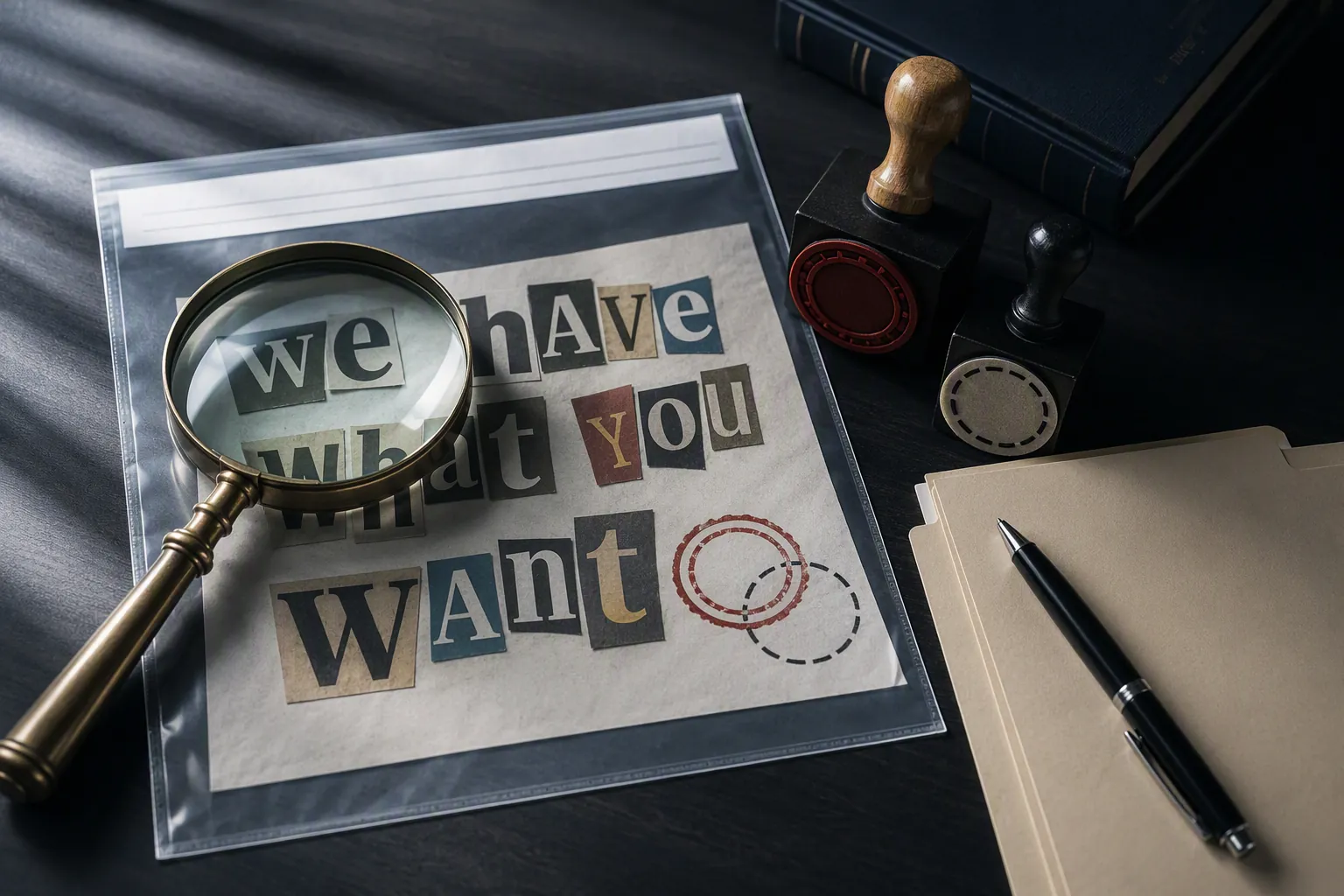
The sheriff’s release put the language in issue, not the authorship question to rest
The Pima County materials matter because they are the public entry point for the actual note text. Guthrie disappeared on Feb. 1, 2026; ransom notes followed on Feb. 2 and Feb. 6; and the sheriff released the notes in full on July 31, six months after she vanished. The release asked for public help identifying the writer’s “distinctive linguistic style.” [1]
That request is narrower than many later summaries. A request for help identifying style is not a finding that the style is human, AI-generated, translated, staged, or attributable to a particular suspect. It is also not a finding that every note falls into the same authenticity category.
The note text explains why style became the public hook. Reported excerpts and images show formal phrasing, unusual syntax, and currency phrasing such as “USD.” Those features may be relevant to investigative triage. They do not, by themselves, prove whether a communication was drafted by a kidnapper, a fraudster, a translator, an AI system, or a person imitating any of those things.
There is also a mundane but important transcription problem. Public discussion has included variants of note language; the research record flags, for example, a quoted variant attributed in coverage to Coffindaffer that differs from the published note text. That is the kind of small discrepancy that should stop a legal memorandum from treating a screenshot, a media transcription, and a sheriff-released image as interchangeable.
The FBI Phoenix statement is the hinge
The sharpest conflict is not between “AI” and “not AI.” It is between Reuters’ anonymous-source report on June 30 and FBI Phoenix’s public statement on July 1.
Reuters reported that an anonymous FBI official said the FBI had determined that all three ransom messages were fake. Reuters also reported an authenticity test involving cryptocurrency: investigators allegedly placed funds in an account, and the funds were “left untouched in the account and never taken.” [3]
CNN then reported the FBI Phoenix statement in more limited terms. FBI Phoenix said that “some of the ransom notes have been deemed to be extortion attempts without legitimacy,” while “others may potentially be legitimate and are still being investigated as such.” [2]
For court-grade use, those are not two versions of the same fact. The Reuters account is a sourced news report relying on an unnamed official. The FBI Phoenix statement is a public agency statement, but it is also deliberately segmented: some notes in one category, others not yet resolved. The later public language is too precise to collapse into “the FBI said all notes were fake.”
If this record is being carried into advice, a pleading, or an internal risk digest, the formulation should preserve that split: Reuters reported an all-fake determination from an anonymous FBI source; FBI Phoenix publicly stated that some notes lacked legitimacy and others remained under investigation as potentially legitimate.
The AI-authorship claim sits below the official record
The AI claim traces, in the available materials, to reported expert commentary rather than to a sheriff, FBI, forensic, or judicial determination. Hindustan Times reported former FBI agent Jennifer Coffindaffer’s five reasons the ransom notes might be AI-generated: formal phrasing, odd grammar, no spelling errors, pattern-driven writing, and the use of “USD” rather than a dollar sign. [4]
That is useful as an investigative risk flag. It is not proof. Formality can come from a non-native speaker, a template, translation software, legalistic affectation, deliberate staging, panic, or simply an unusual writer. Odd grammar can point in several directions. The use of “USD” may be a clue, but it is not an authorship result.
The contrary caution is on the same public record. KOLD reported forensic linguist William Eggington saying, “I don’t sense an AI influence with this,” while also explaining that linguistic analysis can help narrow the suspect pool rather than prove authorship outright. [5]
That caution is consistent with the broader authentication problem. AI detectors and stylistic indicators can produce false positives and false negatives; the University of San Diego Legal Research Center’s guide treats both as known problems in evaluating AI-detection tools. [6] A communication can look machine-like and still be human. It can look human and still be machine-assisted. It can also be edited, translated, copied, or intentionally stylized after generation.
The Guthrie notes therefore belong in the same evidence-authentication lane as other AI-contamination records, not in a settled-AI bucket. The useful comparison is not “can an expert notice patterns?” but “what has been authenticated, by whom, and through what procedure?” That is also the distinction running through the Nolan Wells AI evidence contamination record, the Fukuoka deepfake evidence protocol, and the bodycam footage verification workflow.
The Callella prosecution marks a boundary, not an AI finding
There is a federal prosecution connected to fabricated ransom communications, but it does not fill the AI gap. Court House News reported that in USA v. Callella, in the U.S. District Court for the District of Arizona in Tucson, the defendant pleaded guilty to two counts of harassment using a telecommunications device over fake ransom-note conduct, with sentencing set for Sept. 10, 2026. [7]
The DOJ release and complaint materials described a California man charged with transmitting a ransom demand, including fabricated bitcoin-related messages. They do not, in the materials identified here, describe the communications as AI-generated. [8]
That boundary matters. A fabricated text message is not automatically an AI-generated text message. A fake ransom demand can be drafted by a person with no machine assistance. Unless a charging paper, plea document, order, forensic report, or admissibility ruling adopts an AI theory, the Callella matter should be carried as a fabricated-communication case, not an AI-evidence case. PACER remains the definitive docket source for any later filings.
The genuine AI nexus is proof-of-life risk, not proven authorship
There is still a legitimate AI angle around kidnapping and ransom communications. The FBI issued a Dec. 5, 2025 public service announcement warning that criminals were using altered proof-of-life media in virtual kidnapping for ransom scams. [9] That warning supports heightened skepticism toward ransom-related images, audio, video, and messages. It does not determine what happened in the Guthrie notes.
For counsel, that distinction is the whole point. AI risk changes the authentication protocol; it does not relieve anyone of proving the thing. A ransom note suspected of AI involvement should trigger preservation requests, source-file demands, metadata review, account-access review, device and platform records, chain-of-custody questions, and expert screening where appropriate. It should not be described as AI-generated merely because the prose looks stiff.
The same caution applies to provenance signals more generally. A watermark, platform label, detector score, or stylistic assessment may help decide what to investigate next. It is not the same as an admissibility ruling or a forensic attribution. That is the same operational limit discussed in the State Department AI-map watermark analysis and the Idaho murders documentary AI-forensics record.
How to carry the Guthrie notes in an evidence-authentication file
A useful record separates four layers instead of flattening them into one conclusion.
- Sheriff release: the notes were released publicly, and the sheriff asked for help identifying a distinctive linguistic style.
- FBI public statement: some notes were deemed illegitimate extortion attempts; others may still be legitimate and remained under investigation.
- Anonymous-source reporting: Reuters reported that an unnamed FBI official said all three were fake and described a cryptocurrency test.
- AI theory: Coffindaffer’s AI-generated view is reported expert opinion, countered by Eggington’s caution, and unsupported by any identified official or court finding.
That separation avoids the most common evidentiary slide: “notes released” becomes “notes fake,” then “AI-generated,” then “officially AI-generated.” On the present record, only the first proposition is plainly confirmed by the sheriff release. The second is partly confirmed only in the segmented FBI Phoenix formulation. The third remains disputed expert commentary. The fourth is not supported.
Six months in, authenticity remains a documented conflict rather than a settled fact. Unless a later forensic report, agency statement, filing, or judicial determination adopts the AI theory, the correct litigation-risk treatment is to carry it as reported expert opinion and treat the notes as authentication-risk material, not self-proving AI evidence.
References
- Nancy Guthrie update: Read ransom notes released by Pima County sheriff 6 months after she vanished, NewsNation, July 31, 2026
- Some Nancy Guthrie ransom notes were illegitimate extortion attempts..., CNN, July 1, 2026
- EXCLUSIVE: FBI determines Nancy Guthrie kidnapping notes to be fakes, source says, Reuters, June 30, 2026
- Nancy Guthrie update: Ex-FBI gives 5 reasons why ransom notes might be AI-generated, Hindustan Times, Aug. 1, 2026
- Linguistic expert explains how investigators may analyze ransom notes in Nancy Guthrie case, KOLD, Aug. 1, 2026
- The Problems with AI Detectors: False Positives and False Negatives, University of San Diego Legal Research Center
- Guilty plea over fake ransom note in Nancy Guthrie disappearance, Court House News, July 2, 2026
- California Man Charged with Transmitting Demand for Ransom, U.S. Department of Justice
- Criminals Using Altered Proof-of-Life Media to Extort Victims in Virtual Kidnapping for Ransom Scams, FBI, Dec. 5, 2025
Related records
Tool profile
How Meta's AI Spending Reshapes Law Firm ProfitabilityGoverning regulation
Browse the obligations tracker →Preventive workflow
Browse verification workflows →
Report a correction or tip
Spotted an outdated figure, a misstated fact, or a ruling this case record should reflect? Public comments are disabled for this content given the professional cost of a misreported case outcome, penalty amount, or rule text — use the structured correction channel instead.
Report a correction or tip for this record →