
Full profile
A small firm can now spend almost nothing, about the cost of a practice-management add-on, or several thousand dollars a year on AI contract review tools for small firms. The uncomfortable part is that all three purchases can sound reasonable in a demo. The wrong one becomes obvious later, when the tool either sits outside the lawyer’s real drafting workflow or cannot reliably catch the provisions that make the review worth doing.
That is why the first question is not which tool has the longest feature list. It is whether the firm reviews enough contracts, in a repeatable enough way, to keep the time saved. Clio’s 2026 solo and small-firm analysis reports that 71% of solos and 75% of small firms use AI, but only about 32% have seen revenue gains from it.[1] Adoption is already here. Payoff is still conditional.

The 2026 Small-Firm Decision Frame
For most solo and small-firm buyers, the market sorts into three practical tiers: free or entry-level tools, mid-range tools, and professional contract review platforms. Published prices are uneven. Clio notes that legal AI pricing remains hard to compare and that many vendors do not publish prices clearly; the same pricing discussion places some enterprise-style tools at $500 or more per user per month.[2] TheLawGPT lists entry pricing beginning at $19.99 per month, while goHeather’s published pricing starts at $99 per month.[3][4]
| Tier | Typical 2026 price signal | Best-fit small-firm profile | Main risk |
|---|---|---|---|
| Free / entry | $0–$50 per month | Budget-constrained starter, occasional first-pass review, solo generalist testing demand | Too shallow for precision-critical review or repeated redlining workflows |
| Mid-range | $99–$350 per month | Word-heavy transactional practice, solo or small team reviewing routine commercial contracts | Paying for convenience without changing intake, review, or billing habits |
| Professional | $3,000–$8,000 per year | Higher-volume commercial reviewer with repeat document types and attorney review standards | Buying enterprise vocabulary without enterprise volume or implementation capacity |
The tiers are not status levels. A solo lawyer who reviews three vendor agreements a month may be better served by a cheaper web tool and a careful checklist than by a professional platform. A three-lawyer transactional boutique that lives inside Microsoft Word may regret saving money if the cheaper tool forces every review through upload, summary, download, and reformatting. The billable work still happens in the document.
If the firm is still deciding how contract review fits into broader legal AI adoption, the broader small-firm legal AI tool selection guide is the better first stop. This comparison assumes the firm has already decided that contract review is the problem worth solving.
Why a General Chatbot Is Not the Same Purchase
A general-purpose AI model can summarize a contract, explain a clause, and help draft comments. That can be useful. It is not the same as a contract review system designed to test provisions against a playbook, preserve issue lists, or handle redlines inside the lawyer’s normal review surface.
LegalOn’s 2026 Contract Review Benchmark compared 3,282 head-to-head reviews and reported that legal-specific AI outperformed general-purpose models by 1.8x to 3.8x on precision-critical provisions.[5] The more useful part of that benchmark is not the headline multiplier, especially because LegalOn is itself a vendor. It is the taxonomy of failure: clause identification precision, quantitative thresholds, cross-reference validation, multi-part conditions, and absence checks.[5]
Those are exactly the places where a small firm cannot afford theatrical confidence. A tool that summarizes an indemnity provision beautifully but misses that a liability cap excludes confidentiality breaches has not saved time; it has moved the review risk to a quieter place. The lawyer still has to know what the system checked, what it did not check, and where its answer came from.
For a deeper look at this distinction, see the comparison of purpose-built contract review tools versus general-purpose AI. The short version for buying purposes is simple: use general AI for explanation and drafting support; be much more careful before relying on it for issue spotting in provisions where a missed exception changes the deal.
Entry-Level Tools: Useful When the Firm Is Still Proving the Workflow
The entry tier is where TheLawGPT and Sai belong in this buying conversation. TheLawGPT is positioned around low-cost legal AI access, with contract review appearing alongside broader legal Q&A and drafting capabilities.[3] Sai is commonly described in comparison materials as a broader web-based legal AI tool rather than a Word-native contract redlining environment.[6]
That makes the entry tier a fit for a budget-constrained solo, a lawyer who only occasionally reviews commercial contracts, or a small firm that wants to learn what clients will actually send before committing to a more expensive system. It is also a reasonable place to test whether the firm’s lawyers will use AI review at all. If every attorney still prints the agreement and writes notes in the margin, the pricing tier is not the first problem.
- Use this tier for first-pass summaries, issue lists, clause explanations, and quick drafting support.
- Do not treat this tier as a substitute for attorney review of unusual indemnity, limitation-of-liability, data protection, exclusivity, renewal, or termination language.
- Check whether the tool gives usable output in the format the lawyer actually sends to the client.
- Track whether the tool reduces review time on real matters, not just whether it produces a pleasant summary in testing.
The entry tier becomes a bad purchase when the firm quietly expects it to behave like a professional review platform. A low monthly price does not create playbooks, enforce attorney standards, or solve the problem of revising a counterparty’s draft in Word. Readers trying to stay as close to free as possible should compare this section with the budget analysis of free AI tools for solo and small-firm lawyers before turning a trial account into a recurring subscription.
Mid-Range Tools: Where Most Small Firms Should Look First
The mid-range tier is the most important part of the market for many small firms because it is expensive enough to require a real workflow change but not so expensive that partners will necessarily treat it as an implementation project. That is a dangerous middle. A $99 to $350 monthly tool can feel harmless until nobody is responsible for updating the clause checklist, reviewing outputs, or deciding whether the firm bills the saved time differently.
goHeather and Spellbook deserve special attention here because they sit close to the actual work surface for lawyers who negotiate contracts in Microsoft Word. Vendor and comparison materials identify both as strong options for Word-centered review and redlining workflows.[4][6] Legly belongs in the same broad mid-range discussion for firms comparing contract review support below professional-platform pricing, though the available materials here do not support treating it as the same kind of Word-native redlining purchase.
If the Lawyer Lives in Word
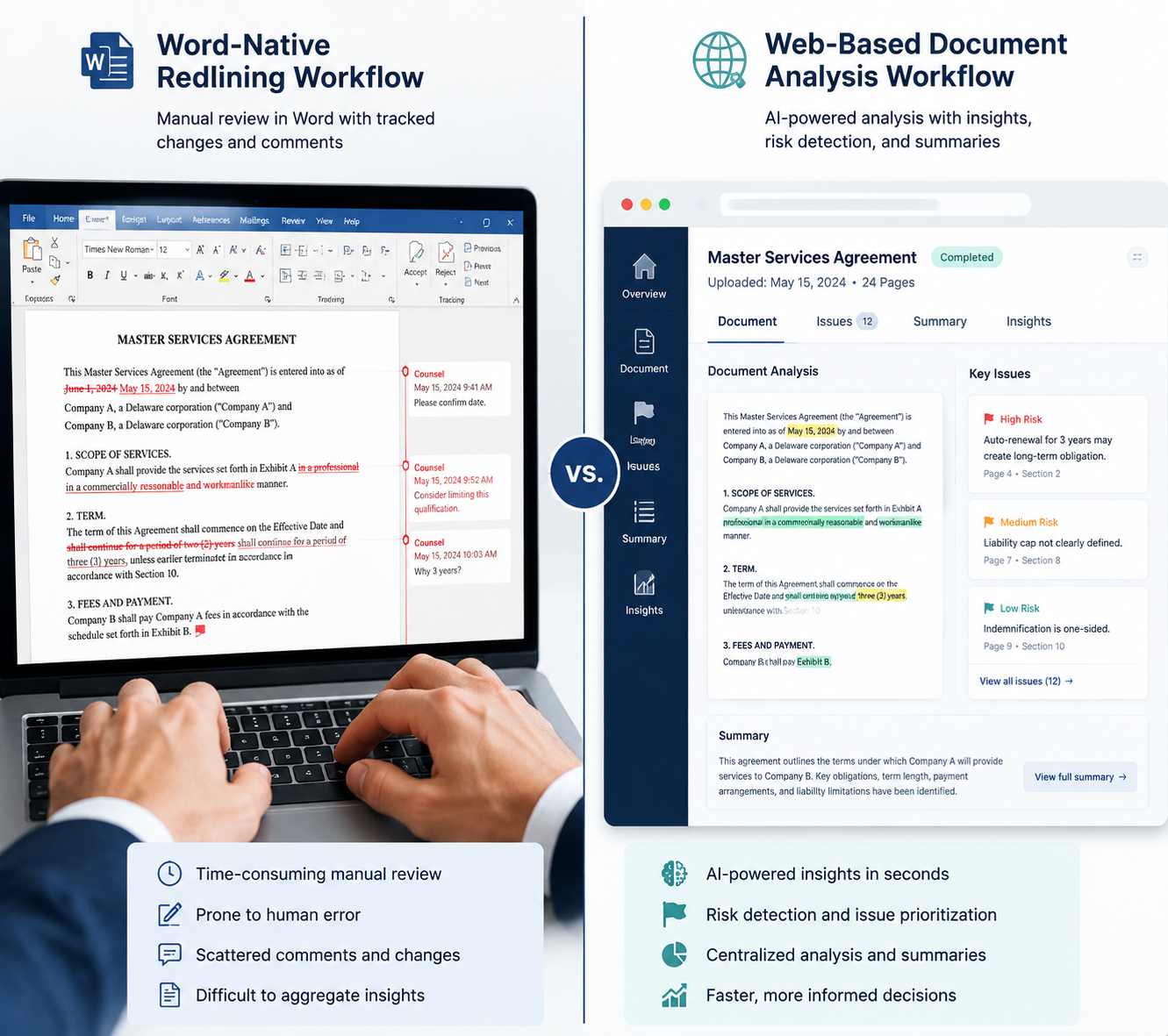
For a transactional lawyer, Word integration is not a cosmetic feature. It decides whether the tool enters before or after the actual legal work. In a Word-native workflow, the lawyer can review the draft, mark the risk, adjust the clause, and preserve the redline in the same environment the client and counterparty expect. That matters more than another dashboard if the end product is a marked-up agreement.
Spellbook and goHeather fit this conversation because they reduce the number of handoffs. A small firm reviewing vendor agreements, NDAs, service agreements, and sales contracts does not usually need an enterprise repository before it needs faster clause review and better redlines. The practical test is whether the tool can help the lawyer produce the next document the client is waiting for, not merely a separate analysis that must be translated back into the draft.
The trial should use three or four real, already-closed matters with client-identifying information removed where appropriate. Run the same contracts through the tool, then ask: Did it identify the provisions the lawyer actually changed? Did it miss a threshold, carveout, cross-reference, or missing clause? Did the output shorten the path to a client-ready redline? A demo agreement written to flatter the software will not answer those questions.
If the Firm Wants Web-Based Analysis First
A web-based workflow can be the better fit when the firm needs quick document understanding more than live redlining. TheLawGPT and Sai are easier to place here because their appeal is broader legal AI access: upload or paste material, ask questions, generate explanations, and produce drafting support. That can be enough for a solo generalist who reviews contracts as one part of a mixed practice.
The tradeoff is the extra step between analysis and delivery. Someone still has to open Word, make the change, write the client note, and keep the file organized. For occasional review, that friction is acceptable. For a lawyer touching contracts every day, it becomes the cost hidden inside the cheaper subscription.
| Workflow question | Lean Word-native | Lean web-based |
|---|---|---|
| Where does the lawyer spend most review time? | Inside Word redlines and comments | Reading, summarizing, and triaging uploaded documents |
| What is the client deliverable? | Marked-up contract plus risk explanation | Summary, issue list, or first-pass analysis |
| What creates the most friction? | Switching out of Word | Reformatting analysis into a client-ready document |
| Which tools belong in the first trial? | Spellbook, goHeather | TheLawGPT, Sai |
This is also where small firms should resist the urge to buy for the matter they hope to have next year. If the current work is five contract reviews a month, mostly for small-business clients, a polished platform that assumes playbooks, volume, and multiple reviewers may be solving a problem the firm has not earned yet.
Professional Platforms: LegalOn and the Point Where Volume Starts to Matter
LegalOn sits in a different buying category from the lowest-cost tools. LegalOn’s own 2026 comparison materials place it among automated contract review tools aimed at more structured contract analysis, and the professional tier in this market commonly reaches annual commitments of several thousand dollars.[5][7] That does not make it excessive. It does mean the firm needs a reason beyond curiosity.
The professional tier starts to make sense when the firm has repeat contract types, enough volume to standardize review, and a clear attorney review process. A lawyer who regularly reviews similar SaaS agreements, MSAs, DPAs, vendor contracts, or customer paper can benefit from more structured issue spotting. The value is less about making one review feel magical and more about making the fiftieth review less dependent on memory and fatigue.
LegalOn’s benchmark is relevant here because its failure categories map to real review work: checking whether a clause is present, whether a number meets a threshold, whether a cross-reference points to the right place, whether a condition has multiple parts, and whether an expected provision is missing.[5] Those are not glamorous features. They are the details that determine whether a contract review tool is doing legal work or merely narrating the contract back to the lawyer.
The caveat is important. A vendor-commissioned benchmark should not be treated as neutral proof that one product is best for every small firm. It is most useful as a checklist for testing any product: give the tool provisions with numbers, exceptions, cross-references, missing clauses, and multi-part conditions, then see what it catches. If a professional platform cannot outperform the firm’s current process on those tasks, the annual price is hard to defend.
Where Enterprise Tools Fit in This Comparison
Kira, Luminance, Ironclad, Harvey, and Icertis matter in a small-firm guide mostly as boundary markers. They show how quickly contract AI pricing can move from small-firm subscription to enterprise procurement. Public pricing is limited, and Clio’s pricing discussion describes enterprise legal AI as often requiring custom or high monthly commitments rather than transparent small-firm pricing.[2]
That does not make these platforms bad products. It makes them the wrong default comparison point for a five-lawyer firm without legal operations staff. Enterprise contract systems often assume larger document sets, more stakeholders, implementation support, security review, training time, and administrative ownership. A partner who says “it is only a few hundred dollars a month” still has to account for the hours spent configuring, learning, supervising, and rescuing the workflow if lawyers do not adopt it.
Small in-house teams comparing broader platform categories can use the AI contract review software platform-category comparison as a wider market map. For most small law firms, enterprise names should trigger one question before a demo: who inside the firm will own implementation after the salesperson leaves?
Match the Tool to the Firm, Not the Other Way Around
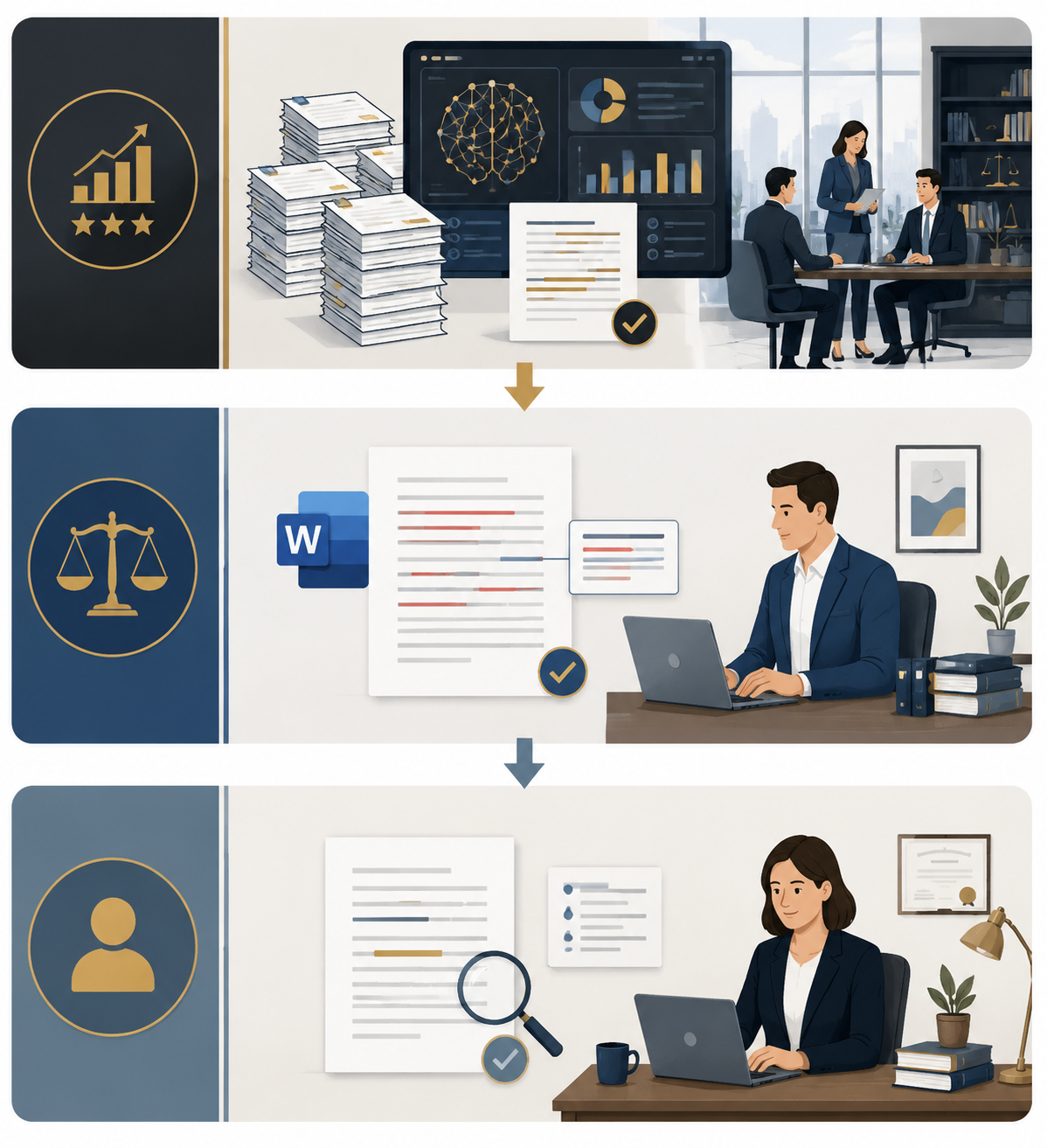
The fastest way to narrow the choice is to name the firm honestly. A budget-constrained starter should not pretend to be a legal department. A Word-heavy transactional practice should not buy a browser tool because the monthly price is tidy. A higher-volume commercial reviewer should not keep asking a general chatbot to do provision-level work that a purpose-built system is designed to test.
| Firm profile | Likely starting tier | Tools to trial first | What would justify moving up |
|---|---|---|---|
| Budget-constrained starter | Free / entry | TheLawGPT, Sai | Recurring contract work, repeated missed issues, or enough flat-fee matters to preserve saved time |
| Solo generalist | Free / entry or lower mid-range | TheLawGPT, Sai, goHeather | More client-ready contract deliverables and fewer one-off explanatory tasks |
| Word-heavy transactional practice | Mid-range | Spellbook, goHeather | Need for structured playbooks, higher review volume, or more rigorous issue tracking |
| Higher-volume commercial reviewer | Professional | LegalOn plus selected mid-range comparison trials | Repeatable contract types, attorney review standards, and enough volume to measure savings |
One firm can move between these profiles over time. The mistake is buying for the most sophisticated version of the practice before the work exists. Six months later, the regret usually sounds familiar: the lawyers liked the demo, the tool was more powerful than the workflow, and the firm never changed how it priced the work.
The Billing Model Decides Whether Efficiency Becomes Margin
Contract review AI can reduce lawyer time on a matter and still fail to improve revenue. That is the lesson hiding in the adoption-revenue mismatch. If a firm bills strictly by the hour and uses AI to cut a two-hour first pass to forty minutes, the client may benefit before the firm does. That can be the right client-service decision, but it is not the same as margin.
Flat-fee or value-based contract review packages change the calculation. A firm that charges a fixed amount for reviewing a standard vendor agreement can keep more of the efficiency gain if the tool reliably shortens the review without lowering quality. The software then supports a pricing model instead of merely shrinking the invoice.
This does not require turning every matter into a product. It does require deciding where saved time goes. It can go to lower client cost, higher firm margin, faster turnaround, more capacity, or better review depth. If the partners never choose, the subscription will make the firm busier in a vague way and only maybe more profitable.
A Practical Trial Before the Firm Commits
The trial should be small, real, and slightly unforgiving. Use closed matters or properly sanitized documents. Include at least one agreement with a liability cap, one with renewal or termination mechanics, one with cross-references, and one where an expected clause is absent. The point is not to embarrass the tool, but to learn whether its misses are acceptable for the firm’s work.
- Run the same documents through each finalist and compare outputs against the lawyer’s original markup.
- Record where the tool caught an issue, missed an issue, invented concern, or produced output too vague to use.
- Measure the time from document intake to client-ready deliverable, not just the AI response time.
- Decide who reviews AI output before it reaches the client.
- Test the tool inside the billing model the firm actually plans to use.
Attorney oversight is not an implementation detail to clean up later. It is part of the purchase. A tool that requires careful legal supervision may still be worthwhile, but the firm should price and staff the supervision honestly. For more on that layer, see the professional responsibility guide to AI contract analysis.
Technical buyers who want to understand retrieval, citations, and architecture can use the contract review software architecture explainer. For many small firms, though, the decisive test is more direct: can the tool help produce the contract markup, issue explanation, and client advice that the lawyer is already responsible for delivering?
The Purchase a Small Firm Is Least Likely to Regret
A budget-constrained solo should start low and prove demand. A solo generalist should favor broad, inexpensive web-based help unless contract review is becoming a recurring line of work. A Word-heavy transactional lawyer should trial Spellbook and goHeather before being distracted by platforms built for larger teams. A higher-volume commercial reviewer should consider LegalOn-level pricing only when repeat contract types, review standards, and measurable volume justify the annual commitment.
Choose the cheapest tool that covers the firm’s actual review workflow and risk level. Do not expect the subscription to create revenue on its own. The margin appears only when the firm can keep the saved time through better pricing, faster delivery, or more review capacity without letting quality slip.
References
- Small & Solo Law Firm Profitability, Clio, 2026
- What's Driving Legal AI Pricing in 2026, Clio, 2026
- Best AI Tools for Contract Review in 2026, TheLawGPT, 2026
- The 10 Best AI Contract Review Tools for 2026, goHeather, 2026
- LegalOn 2026 Contract Review Benchmark, LegalOn, 2026
- 10 Best AI Contract Review Tools in 2026, Simular.ai, 2026
- Best Automated Contract Review Software Tools of 2026, LegalOn, 2026
Comments
Join the discussion with an anonymous comment.