
Does Israel's Phased Withdrawal End Gaza's Occupation?
Record status, scope, and non-advice notice
This article is legal background analysis, not legal advice. It is written for issue-spotting and source-linked research discipline in a live compliance file; it does not assess any client’s facts, sanctions exposure, procurement decision, or humanitarian-operation authorization.
- Current record date: August 1, 2026, UTC.
- Legal-background review basis: ICJ advisory-opinion materials last checked for this record on August 1, 2026. The July 19, 2024 advisory opinion is non-binding and included an 11-4 vote on the unlawfulness and withdrawal conclusions; the October 22, 2025 advisory opinion is also non-binding and was adopted 10-1, with Judge Sebutinde dissenting. [1][2]
- Yellow Line factual baseline: last checked for this record on August 1, 2026. The operative range used here is roughly 53-58% of Gaza under IDF control behind the Yellow Line, with later plan stages described as reducing that area to roughly 40% and then 15%, followed by a security perimeter. [3][4][5]
- Scope: this is a Gaza occupation-law analysis under the effective-control test. It does not treat the ICJ’s broader 2024 unlawfulness findings for the West Bank and East Jerusalem as automatically dispositive for Gaza, and it separates occupation law from conduct-of-hostilities law even where both may apply at the same time. [1][2]
The live question is narrower than whether a withdrawal looks complete from a map or a broadcast feed. The legal question is whether Israel’s authority in Gaza can still be exercised, and, if it can, which duties follow from the particular powers retained. A phased withdrawal across a Yellow Line can reduce the area and intensity of control. It does not, by that fact alone, answer whether occupation-law obligations have ended.

The test is exercisable authority, not visible troop presence
Hague Regulations Article 42 frames occupation around authority that “has been established and can be exercised.” The ICJ used that formulation in its July 2024 advisory opinion and treated the inquiry as functional: the question is not only where forces are stationed, but whether the occupying power retains effective control over matters such as borders, movement, taxes, and buffer-zone arrangements. [1]
That point is what makes Gaza difficult after any withdrawal announcement. In 2024, the Court concluded that Israel’s 2005 withdrawal from Gaza did not “entirely release” it from obligations under the law of occupation. The obligations remained “commensurate with the degree” of Israel’s effective control, and the Court identified retained control over borders, movement arrangements, taxes, and the buffer zone as relevant to that assessment. [1]
The October 2025 advisory opinion did not relax that test. It stated that Israel’s effective control had “increased significantly” since October 7, 2023, that occupation-law obligations remain scaled to the degree of control, and that occupation law can apply alongside conduct-of-hostilities rules during active hostilities. That last point matters in compliance work: an active battlefield does not turn the occupation-law file into a null set. [2]
The non-binding character of the opinions should be recorded, but it should not be used as an excuse to ignore the test they articulate. Advisory opinions are not judgments between parties with binding operative orders. They are, however, primary ICJ statements of international law. For counsel, that makes them the starting point, not an optional commentary layer.
The Yellow Line changes the control map; it does not answer the legal question by itself
The October 2025 ceasefire framework, as publicly reported, contemplated a phased Israeli withdrawal in Gaza rather than an immediate removal of all Israeli authority. The White House plan, as described by the Council on Foreign Relations and the UK Home Office bulletin, provided for later reductions to roughly 40% and 15% of Gaza, with a final security perimeter remaining until Gaza is considered secure from any resurgent terror threat. [3][4]
For the present record, the critical working fact is that roughly 53-58% of Gaza remained under IDF control behind the Yellow Line in the December 2025 Secretary-General reporting. That is not a minor cartographic footnote. If a state retains authority over more than half the territory, while further withdrawals are staged and conditional, the legal analysis has to ask what authority remains exercisable in that area and through the perimeter system. [5]
| Recorded fact or issue | Why it matters legally | Record status |
|---|---|---|
| Roughly 53-58% of Gaza under IDF control behind the Yellow Line | Supports a retained-authority inquiry under Hague Regulations Article 42 rather than a clean end-of-occupation conclusion | Last checked August 1, 2026; based on December 2025 Secretary-General reporting [5] |
| Plan stages described as reducing Israeli-controlled territory to roughly 40% and then 15% | Shows that later withdrawal phases may reduce the degree of control without necessarily eliminating all authority | Last checked August 1, 2026; reported by CFR and UK Home Office bulletin [3][4] |
| Final security perimeter contemplated until Gaza is secure from resurgent terror threat | A continuing perimeter can be legally relevant if it governs movement, access, security zones, or crossings | Last checked August 1, 2026; reported by CFR and UK Home Office bulletin [3][4] |
| BBC Verify reported Yellow Line marker blocks moved deeper into Gaza; the IDF disputed that finding | The line should be treated as a monitored factual variable, not as a settled legal boundary | Last checked August 1, 2026; disputed field fact [6] |
| OHCHR described the deployment line as shifting and poorly marked, and warned that civilians not directly participating in hostilities may not be targeted because of proximity to deployment lines | Conduct-of-hostilities obligations remain separate from, and may coexist with, occupation-law obligations | Last checked August 1, 2026 [7] |
The reported movement of Yellow Line marker blocks is not used here to prove a battlefield fact beyond dispute. BBC Verify’s January 2026 satellite analysis reported that 16 marker blocks had moved deeper into Gaza by an average of about 295 meters; the IDF disputed the finding. The responsible legal treatment is to keep both entries in the file and to treat the Yellow Line as a factual condition requiring update discipline. [6]
OHCHR’s April 2026 warning points in the same operational direction without resolving the occupation question. It described the line as a “shifting and poorly marked deployment line” and stated that targeting civilians who are not directly participating in hostilities is a war crime regardless of their proximity to deployment lines. That statement belongs primarily in the conduct-of-hostilities file, but it also reinforces why a changing line cannot be treated as a stable legal endpoint. [7]

Why the 2005 disengagement is the wrong shortcut and the right precedent
The 2005 disengagement materials asserted that, after completion of the plan, there would be “no basis to the claim that the Strip is occupied land.” That is the clean proposition often attractive in a withdrawal memo: troops out, occupation over. [8]
The ICJ did not accept that proposition as a complete answer. Its 2024 analysis treated 2005 as a shift in the degree and form of Israeli control, not as a legal switch that necessarily turned all occupation obligations off. The Court’s language is careful: Israel was not “entirely released” from its obligations under the law of occupation, and those obligations remained “commensurate with the degree” of effective control retained. [1]
That makes 2005 important, but not for the reason sometimes assigned to it. It is not a clean precedent for ending occupation whenever forces withdraw from populated areas. It is the controlling precedent for scaled obligations where effective control remains through borders, movement restrictions, taxation mechanisms, buffer zones, or other retained powers. [1]
The same reasoning applies to the Yellow Line regime. If later phases reduce the area of IDF control, the legal consequence may be a reduced set of occupation-law obligations in some places and a more concentrated set in others. The consequence is not automatic termination unless authority can no longer be exercised. A partial withdrawal is therefore evidence in the analysis, not the conclusion.
The Gaza analysis must be kept separate from the West Bank unlawfulness holding
There is a second discipline point. The 2024 advisory opinion’s unlawfulness analysis rested heavily on settlement, annexation, and related facts in the West Bank and East Jerusalem. Judge Cleveland, while joining important parts of the opinion, cautioned that the jus ad bellum unlawfulness findings did not reach Gaza. Judges Iwasawa and the joint declaration of Judges Nolte and Cleveland also recorded caveats about how withdrawal duties may be implemented, including that implementation may differ territory by territory. [9][10]
That caveat does not weaken the Gaza effective-control inquiry. It prevents a different error: using the West Bank and East Jerusalem unlawfulness holding as a shortcut for Gaza. For Gaza, the core question remains the Article 42 question as applied by the ICJ in 2024 and reaffirmed in 2025: what authority is established, and can it be exercised? [1][2]
Retained powers to monitor after a phased withdrawal
A useful file should not stop at “occupation continues” or “occupation ended.” Those labels are too blunt for the decisions counsel actually has to support. The more durable analysis identifies each retained power, ties it to a duty, and records what evidence would show that the power has expanded, contracted, or ended.
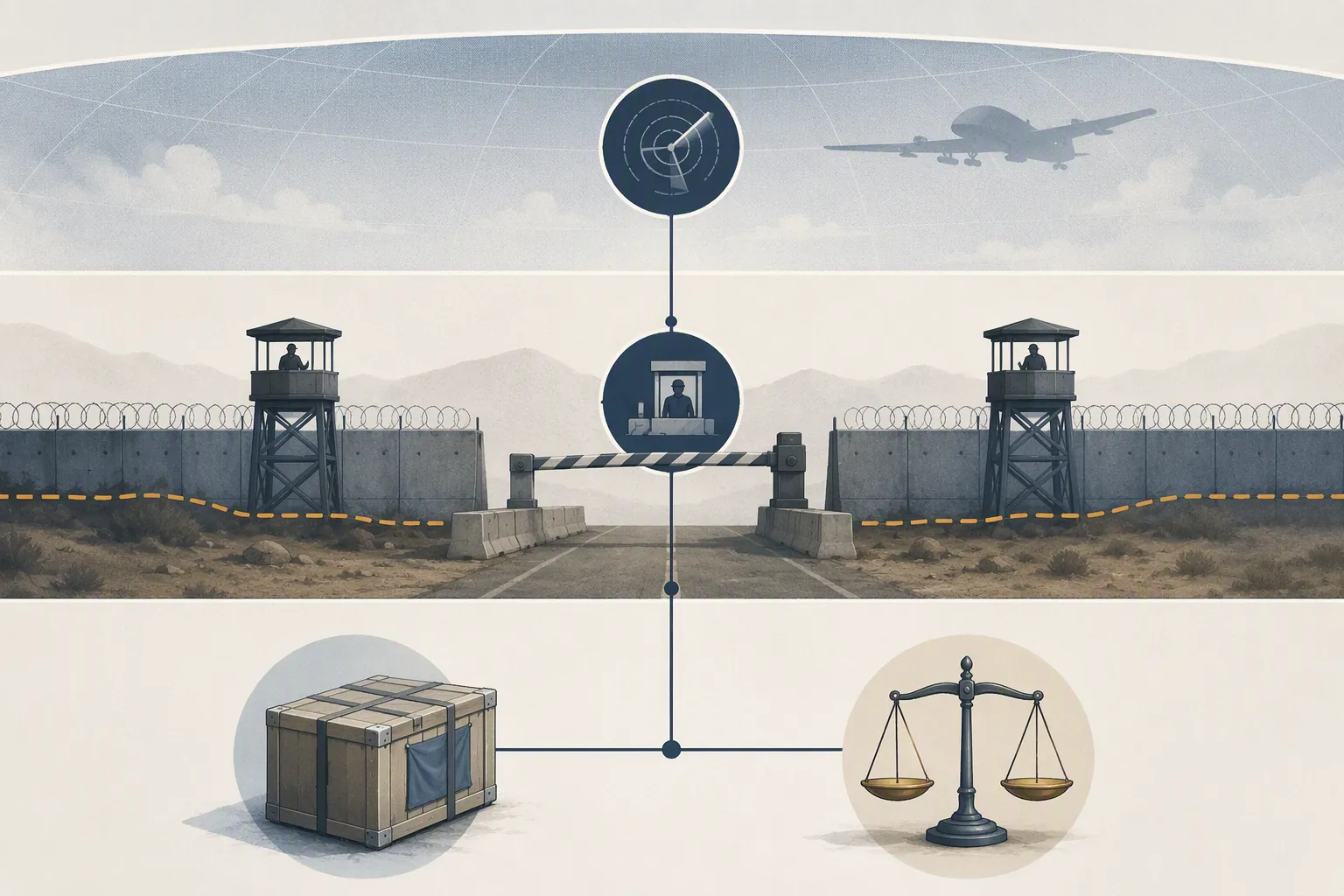
| Retained power | Monitoring question | Why counsel should care |
|---|---|---|
| Territory behind the Yellow Line and any security perimeter | Who can enter, remain in, patrol, exclude others from, or use force within the area? | Territorial authority is the most direct indicator of effective control. A perimeter that regulates access or exclusion can keep occupation-law obligations live in proportion to that authority. [1][2][3][4] |
| Buffer or security zones | Is the zone fixed, marked, publicly communicated, and limited, or is it shifting in practice? | The ICJ identified buffer-zone control as relevant after 2005. A shifting or poorly marked deployment line also raises separate conduct-of-hostilities concerns. [1][6][7] |
| Airspace and aerial access | Who authorizes, denies, or operationally controls aerial movement, surveillance, evacuation routes, or aid-related flights? | Airspace control can be part of the effective-control picture even without a permanent ground presence in every neighborhood. Human Rights Watch’s IHL explainer treats airspace control as one of the continuing Gaza control factors. [11] |
| Crossings and movement of people | Who controls exit, entry, screening, permits, evacuation corridors, return, and commercial movement? | Movement control affects civilian life and humanitarian operations directly. The ICJ’s 2024 opinion expressly treated control over borders and movement as relevant to Gaza obligations after 2005. [1] |
| Aid access and relief operations | Who decides whether consignments, agencies, routes, warehouses, fuel, medical supplies, and security guarantees can move? | Where authority over access remains exercisable, obligations concerning relief, public order, and civilian welfare cannot be analyzed as if control has disappeared. The 2025 opinion also states that occupation law may apply alongside hostilities law. [2] |
| Taxation, customs, or fiscal controls | Are tax revenues, customs clearance, import approvals, or financial channels still controlled or conditioned by Israel? | The ICJ identified taxation as one of the post-2005 control factors relevant to the continuing application of occupation-law obligations. [1] |
| Civil-registry, documentation, and population-movement systems | Who can recognize identity documents, approve family movement, or condition return and exit? | These systems may not look like troop deployments, but they can determine whether civilians can move, reunite, work, receive aid, or leave. They belong in the retained-authority file when supported by current facts. [11] |
The list is not a substitute for field verification. It is a way to prevent the legal conclusion from floating above the facts. If a crossing changes hands, the file changes. If a security perimeter becomes smaller but more restrictive, the file changes. If a nominal withdrawal leaves approval authority over aid, movement, or tax mechanisms in the same place, the legal file should not treat the word “withdrawal” as dispositive.
Aid access is not a side issue
Aid access deserves a separate note because it is often described as logistics rather than authority. In occupation-law analysis, that framing is too narrow. If a state can decide whether relief reaches civilians, which agencies may operate, which routes may be used, or whether essential supplies are delayed or denied, those facts may indicate exercisable authority. The 2025 ICJ opinion’s coexistence point matters here: rules governing hostilities do not displace occupation-law duties merely because fighting continues. [2]
For humanitarian-law counsel, the practical record should therefore capture decisions, not only outcomes. The file should show who requested access, who approved it, who denied it, who imposed conditions, who controlled the route, and whether the denial was tied to security, capacity, political conditions, or no stated reason. Those are the facts that can be mapped to retained authority.
Crossings and movement are usually where the binary theory fails first
A state can remove forces from some populated areas and still control whether people and goods move. The ICJ’s 2024 opinion put borders and movement in the center of its Gaza analysis for that reason. If the Yellow Line regime leaves Israel able to approve or prevent movement across crossings, direct convoys away from certain routes, restrict return to areas, or maintain exclusion zones, the occupation-law inquiry remains live for those functions. [1]
Taxation and fiscal controls can be quieter than checkpoints
Taxation appeared in the ICJ’s list of retained-control factors after the 2005 disengagement. That is a useful warning against over-weighting visible military facts. Control over customs, revenues, import classifications, or fiscal transfers can shape civilian administration even when it is exercised from outside the territory. Where those controls continue, the obligation analysis should not be closed merely because a ground unit has moved behind a line. [1]
Third-state duties should track the same retained powers
Third-state analysis has to be handled with the same separation. The 2024 advisory opinion addressed obligations of all states, including non-recognition, non-assistance, and duties connected to ensuring respect for the Geneva Conventions. But counsel should not lift those conclusions into Gaza without preserving the basis for each duty and the caveats around the opinion’s territorial reasoning. [1][9][10]
For Gaza, the cleaner compliance path is to tie third-state review to the continuing application of occupation law and international humanitarian law where effective control remains. That means the same retained powers that keep the occupation-law file open—crossings, aid access, airspace, security zones, movement controls, taxation, and perimeter authority—also identify the places where procurement, financing, export, assistance, and recognition questions may require review.
- For sanctions and export counsel: identify whether the transaction supports a retained-control function, a security perimeter, a crossing, surveillance, movement control, or denial-and-approval architecture.
- For humanitarian organizations and donors: record who controls access, what conditions are imposed, and whether denial of access is tied to a party with exercisable authority over the route or crossing.
- For in-house reviewers: separate support for civilian relief from support that may help administer, entrench, or operationalize a retained-control system.
- For knowledge-management staff: keep the 2024 West Bank and East Jerusalem unlawfulness holdings in a separate section from the Gaza effective-control file, with cross-references only where the opinion itself makes the link.
The point is not that every third-state duty has the same threshold or the same consequence. It is that a declaration of phased withdrawal is not enough to close the review. If authority remains exercisable through the Yellow Line system or through functional controls outside it, third-state compliance questions remain live.
What should not be made load-bearing
Casualty figures and alleged ceasefire-violation counts may be relevant to other legal and factual assessments, but they are not necessary to the occupation-law conclusion reached here. Where such numbers are party-reported or media-compiled, they should be attributed as such and should not substitute for the effective-control analysis.
The same caution applies to Phase 2 developments, the Board of Peace, and any international stabilization force arrangements as of Q3 2026. Those arrangements may change who exercises authority and where. Until the facts show that Israel can no longer exercise authority over the relevant functions, they change the monitoring file rather than closing it.
Usable legal conclusion as of August 1, 2026
A partial withdrawal can end occupation only when the former occupying power’s authority is no longer established and can no longer be exercised. Under the ICJ’s 2024 and 2025 effective-control analysis, Israel’s obligations in Gaza do not turn on troop visibility alone; they remain commensurate with retained control. [1][2]
On the currently verified record, the Yellow Line regime changes the degree and geography of Israeli control rather than ending it. Roughly 53-58% of Gaza remained under IDF control behind the line in the December 2025 reporting, later withdrawal phases were conditional and staged, and a security perimeter was contemplated. Those facts keep the occupation-law file open for the powers retained: airspace, security zones, aid access, crossings, movement controls, taxation, and any other authority that remains exercisable. [3][4][5]
The operational answer is therefore not “occupation yes” in the abstract or “occupation no” because a withdrawal phase occurred. It is that occupation-law obligations and related third-state review duties remain live to the extent of Israel’s retained effective control, and the Yellow Line must be monitored as a changing fact rather than treated as a legal endpoint.
References
- Summary of the Advisory Opinion of 19 July 2024, International Court of Justice, July 19, 2024.
- Advisory Opinion of 22 October 2025, UNISPAL, October 22, 2025.
- A Guide to Trump’s Twenty-Point Gaza Peace Deal, Council on Foreign Relations.
- Country bulletin: security situation in Gaza, Palestine, June 2026 (accessible), UK Home Office, June 2026.
- Secretary-General report on Gaza ceasefire implementation, United Nations Security Council, December 11, 2025.
- BBC Verify satellite analysis of Yellow Line marker blocks, BBC, January 2026.
- OHCHR warning on Gaza deployment line, Office of the United Nations High Commissioner for Human Rights, April 10, 2026.
- Israel’s Disengagement Plan, PLO Negotiations Affairs Department via UNISPAL.
- A Synopsis of the ICJ Finding that Israel’s Occupation of Palestinian Territory Is in Violation of International Law, Just Security.
- Authoritatively Stating International Law? The ICJ’s Advisory Opinion on Israeli Withdrawal from the OPT, Lieber Institute.
- How Does International Humanitarian Law Apply in Israel and Gaza?, Human Rights Watch, October 27, 2023.
Operationalizing workflow
No workflow has been explicitly linked to this obligation yet. See Workflows generally.
Illustrative cases
- Anwar Raslan's Life Sentence Stands After German Appeal
- Donna Adelson's Appeal Is Pending. What Is She Arguing?
- What's verified in the Max Miller House Ethics probe
- What's the Status of the Miller-Grisham Social Media Order?
- Clayton Echard–Laura Owens Lawsuit Is Not an AI-Risk Case
- What Laura Owens Actually Alleged Against Clayton Echard
- Where do the Lindsay Clancy jury deliberations stand now?
- The SC 26th Amendment Absentee Voting Case Is Watson v. RNC
- Why the SC mail-in voting age ruling is unsettled law
- Which Southwest PDX Discrimination Suit Facts Are Verified?
- Is the $750,000 California Lottery Prize Denial Verified?
- Are ECT Malpractice Lawsuits Against Psychiatrists Rare?
- Gülistan Doku Investigation Is Not an AI Sanction Case
- Milo Yiannopoulos's Deportation Case Remains Unverified
- What's Confirmed in the Sauce Gardner Contractor Lawsuit?
- Studio City Dog Boarding Death Lawsuit Is Unconfirmed
- Supreme Court’s Mail-In Voting Stay in Trump v. California
- Which Carroll Verdict Did the Supreme Court Reject?
- The Bricen Rivers and Lauren Johansen case timeline
- What is the DC grand jury investigation of public schools?
- What verdict options does Lindsay Clancy's jury have?
- Marius Borg Høiby received a four-year prison sentence
- What's verified in Milo Yiannopoulos's ICE status?
- No AI Found in Mobile Alabama Murder Grand Jury
- Is There a Robin Williams AI Impersonation Lawsuit?
- Trump's hush money conviction appeal is still pending
- What's verified in the Yosemite land transfer controversy
- No court order revoked the Cheluget 5,800-acre Narok title
- Columbia bookkeeper sentenced in $250K wire fraud case
- DOJ appeal keeps Epstein unredaction ruling in force
- Why Eric Hafner Can Stay on Alaska's U.S. House Ballot
- What's Verified in the Evelyn Cheluget RSF Passport Scandal
- What Meta's $17.1B teen social media settlement pays
- The Nevada Colorado River Water Cuts Lawsuit, by the Docket
- Who Was Charged in the Roberts Signature Forgery Case?
- Is Subhash Chandra's NCLT settlement actually final?
- Warr Receives 37 Months for South Carolina Wire Fraud
- Campbell Hall Settles Byron Scott Suit; Trial Still On
- Why Don Lemon Was Indicted Over a St. Paul Church Protest
- Wife's objection in Cher's Elijah Blue Allman conservatorship
- How to file your Google Assistant $68M claim today
- Ketanji Brown Jackson's shadow docket dissents, counted
- Final Witness at Lindsay Clancy Trial Challenges Voice Claim
- Meta's $16.7 billion settlement is not final yet
- Francisco Paulino's pandemic fraud charges, explained
- SEC subpoenas banks over AI hedge fund collapse, reports say
- Where do State Farm's Oklahoma roof claim lawsuits stand?
- How Courts Are Ruling on Fake AI-Generated Evidence
- After Chatrie, Are Flock License Plate Queries a Search?
- When Google Docs Exposes Passwords, What's the Legal Risk?
- Is AI really eliminating legal jobs?
- GEMA v. OpenAI lawsuit update: Munich ruling is on appeal
- Google AI Overviews' legal risk to publishers, case by case
- 15 State AGs Demand OpenAI Evidence in Hugging Face Hack
- Where does the NYT v. OpenAI lawsuit stand now?
- Apa yang Sebenarnya Dikembalikan Ramalan Bazi Gratis?
- Paano naging 'manghuhula online' ang AI sa Sandiganbayan?
- What do Nvidia's earnings mean for legal tech buyers?
- Who answers for NYT's AI-generated search summaries?
- Who are the Billings shooting victims? Alan Smith isn't one
- Judge Denies Lindsay Clancy Mistrial Request
- What's Confirmed in the Billings Family Murder-Suicide
- Sean Grayson–Sonya Massey Case Updates After Custody Death
- What is the psychosis defense in the Lindsay Clancy trial?
- Jed York's no-contest plea ends his disorderly conduct case
- Kai Spears wins $9.25M Alabama defamation verdict
- Who's Actually Sued in the Sofia Vergara AI Deepfake Case
- Can Anyone Predict the Lindsay Clancy Verdict?
- Why Is the Nolan Wells Case Evidence Sealed?
- How the insanity defense works in Lindsay Clancy's trial
- Superpotent Thyroid Tablets Recalled? Symptoms and Rights
- Is the FCC Actually Revoking ABC's Licenses?
- USPS mail carrier check theft penalties beyond five years
- Why Ghislaine Maxwell's grand jury records were unsealed
- How DMCA § 512(h) subpoenas unmask GTA 6 leakers
- AI-fabricated citation confirmed in Bianco ballot case
- Landon Doty's 54-year sentence, verified against the docket
- What Are the Legal Consequences of Police Flock Misuse?
- Why courtroom backlash outran Lindsay Clancy's trial record
- USPS mail carriers face $24M check theft indictment
- Inside the Clancy trial's concession strategy
- USPS Mail Carrier Charged With Mail Theft? What Happens Next
- What the GEMA v. Suno Ruling Holds for AI Music Training
- Jamie Komoroski settlement and sentence outcome by phase
- Every Keffe D bail hearing and why he remains jailed
- Sean Grayson's death investigation has three tracks
- The Grant–McMahon case is now in confidential arbitration
- What Emma Coronel's Docket Says About Life After Prison
- Where the Sara Duterte Impeachment Trial Stands on Day 18
- Did Mike Lindell Withhold His Minnesota Recount Payment?
- Who Can Be Sued After the Vitruvias Thyroid Recall
- Sean Grayson dies serving sentence for Sonya Massey killing
- The legal fallout of the GTA 6 leak site takedown
- When must law firms notify clients after Google Docs hacks?
- Who is Rockstar's parent subpoenaing over the GTA 6 leaks?
- Why the Knox-Kercher Case Is a Legal-AI Hallucination Probe
- Who decides if Kalshi's clinical trial bets are legal?
- Water utility OT cyberattack compliance deadlines for 2026
- Fired FBI agents' class action against Kash Patel, mapped
- Which Hong Kong tokenisation regulation applies to you?
- Summer Dress Code Rules Employers Need to Know
- Verifying Connecticut car accident lawsuit timeline claims
- How to verify a Pima County sheriff wrongful arrest lawsuit
- How the End Government Shutdowns Act changes current law
- Restaurant Dress Codes Under Gender Discrimination Law
- Michigan's AI SNAP Eligibility Screen Under the 2025 Changes
- What Amazon Prime Air complaints can cities act on?
- Who Is Liable in an Alabama Bad-Weather Truck Accident?
- How Liability Shapes Brooklyn Sidewalk Accident Deadlines
- How to Claim the Equifax $600 Settlement Payment
- Where Buc-ee's Trademark Policing Crosses Into Overreach
- The legal plan behind Ken Paxton's Texas AI promise
- Utah ruling keeps Kalshi's sports betting under state law
- What the Social Security 2100 Act's COLA Change Does in Law
- EPA Green Bank En Banc Ruling Leaves Forum Question Open
- New York attorney general's Kalshi lawsuit, explained
- Wisconsin absentee ballot replacement rules just changed
- Why the Jan. 6 Pence Tweet Was an Official Act
- DOL Cites San Antonio Bakery for Child Labor and Wages
- The legal issues with police surveillance AI, explained
- Prosecuting the Minnesota water cyberattack if tied to Iran
- What the en banc court held in the EPA green bank clawback suit
- What legal exposure remains in the Fukuoka assembly scandal?
- What the Blanche DOJ fight means for federal AI enforcement
- Can police stop a car on a Flock camera theft alert alone?
- The PSA Antitrust Lawsuit, Explained
- FBI agents sue Patel for firing in political retaliation
- Which SEC rules require AI capex disclosure?
- The Equifax Class Action Claim Deadline Is Sept. 1, 2026
- Missouri Amendment 4's Actual Legal Impact on Campaigns
- Three arrests in Santa Cruz police shooting, no charges yet
- Google Lens now feeds AI training. Privacy law is split.
- Who faces legal risk when AI fakes satellite images?
- What the Social Security 2100 Act Would Change
- UBS fined a record $125 million for money laundering
- Why Trump's IRS audit immunity was never lawful
- What courts actually decided on Medicaid work requirements
- The DOJ Rule Change Behind the NYT North Korea Subpoena
- Is mail theft of a winning lottery ticket a federal crime?
- What the FDA Compassionate Use Program Legally Requires
- Judge defers dismissal in Trump's $15B NYT defamation case
- The Verified Record of the Joe Felz Fullerton DUI Case
- How to Verify AI Answers on HOA Foreclosure Laws
- States Sue Over Tariffs Again After the Supreme Court Ruling
- Which EU Rules Apply to BlackRock's Tokenized MMFs?
- What's confirmed in Aaron Farinacci's Old Trails Fire case
- Cert denial closes Trump Section 301 tariff challenge
- Three Court Tracks Now Decide Texas THC Ban's Fate
- How to read Aaron Farinacci's manslaughter conviction
- The pied-a-terre tax is splitting Manhattan luxury in two
- How lottery winner anonymity laws vary by state
- What South Korea's property tax increase legally changes
- How to verify viral clips in the Udhayanidhi Stalin arrest
- What's next in the Capital One debanking fallout?
- Why Was Prince Harry's Privacy Lawsuit Dismissed?
- Which states are suing Trump over tariffs?
- Which AI deepfake laws has Congress passed so far?
- Belfast AI art copyright controversy is a legal misreading
- UBS Fined $125M for Money Laundering Violations
- What Will the 2027 Social Security COLA Be?
- Why Talarico's 'murdered' remark likely isn't actionable
- Four legal gates remain for Gwangju's semiconductor cluster
- Which Ksi Lisims LNG legal gates remain open
- Verify Kansas City Wrongful Death Lawyer's Trial Experience
- How to Verify the Maple Leaf Bacon Recall List in OR/WA
- Was F1 made by AI? The legal obligations behind the claim
- What Legal Obligations Valley Forge Owes Transfer Students?
- What must happen before Grant Thornton-CBIZ can close?
- How Japanese drug law treats Hiroshima Carp home searches
- Why Does Diddy's Release Date Keep Changing?
- What the '1933 double' Reveals About ChatGPT Benchmarks
- Which laws apply to the Fukuoka cash-for-post scandal?
- Brij Bhushan Sharan Singh's acquittal leaves the case open
- Legal issues behind Yerington's Monarch Data Center protest
- What Microsoft's AI spending means for legal tech buyers
- Can governments stop Microsoft's AI data center buildout?
- FBI agent Patrick Yaroch charged with stealing Bitcoin
- Investor legal considerations for the CBIZ acquisition
- What charges does the FBI agent face for crypto theft?
- FBI agent cryptocurrency theft case, explained
- Is your college on the $23 billion settlement list?
- Verify Max Miller abuse allegations against docket records
- Why the Grisham TRO Against Miller Can't Be Confirmed Yet
- How to Verify the Moreno–Miller Abuse Allegations
- Is 7-OH Kratom Legal After the DEA Schedule I Order?
- Federal judge upholds EPA air standard — deadlines now bind
- Is the Sweet v. McMahon Class Action Settlement Final?
- Federal judge lets ICE agents mask up, keeps NY 287(g) ban
- Who Qualifies for the Sweet v. McMahon Settlement
- Federal judge denies Illinois voter data request
- Where the Trump DOJ interference cases stand now
- What the Clancy Duxbury jury tour reveals about view law
- A witness-by-witness recap of Lindsay Clancy trial week 2
- Is Alibaba's Qwen 3.8 Max Safe for Legal Work?
- Why Jeanine Pirro's Reflecting Pool Case Collapsed
- How AI facial reconstruction fails in 1982-era cold cases
- What Jeanine Pirro's Reflecting Pool decision left open
Report a correction or tip
Spotted an outdated figure, a misstated fact, or a ruling this regulation entry should reflect? Public comments are disabled for this content given the professional cost of a misreported case outcome, penalty amount, or rule text — use the structured correction channel instead.
Report a correction or tip for this record →